
Guides
Green AI and Computational Efficiency
Green AI and Computational Efficiency
Green AI focuses on reducing the environmental impact of AI systems by prioritizing 'Energy-to-Solution' metrics over pure accuracy. Sub-guides cover 'How to implement Green AI practices,' 'Measuring the carbon footprint of your AI models,' and 'Optimizing AI for energy-to-solution metrics' to address the 'energy sobriety' trend.
How to Implement Energy-to-Solution Metrics in AI Projects
This guide explains how to shift from accuracy-only metrics to **Energy-to-Solution (E2S)**, a holistic measure of the computational energy required to achieve a business outcome. You'll learn to define E2S KPIs, integrate tools like **CodeCarbon** and **MLflow** for tracking, and make architectural decisions that optimize for efficiency. The guide provides a framework for balancing performance with environmental impact, a critical skill for sustainable AI development.
How to Set Up a Framework for Measuring AI Carbon Footprint
Learn how to establish a comprehensive carbon accounting system for your AI workloads. This guide covers selecting calculation methodologies (like the **Green Algorithms** framework), instrumenting training and inference pipelines with monitoring tools, and allocating emissions to specific projects. You'll implement a reporting dashboard that tracks Scope 2 emissions from cloud compute and provides actionable data for reducing your AI's environmental impact.
How to Architect AI Systems for Computational Efficiency
This architectural guide provides first principles for designing AI systems that minimize energy use from the ground up. It covers selecting efficient model architectures (like **MobileNet** or **DistilBERT**), designing data pipelines to reduce I/O overhead, and implementing caching strategies. You'll learn to apply **Amdahl's Law** to parallelization and make trade-offs between latency, throughput, and power consumption for sustainable scaling.
How to Establish Green AI Governance and KPIs
This guide is for engineering leads and CTOs needing to institutionalize Green AI practices. It details how to create a governance board, define policy (e.g., carbon budgets per model), and set KPIs like **Carbon per Inference** or **Model Efficiency Ratios**. You'll learn to integrate these metrics into existing **MLOps** and project management workflows, ensuring efficiency is a non-negotiable requirement from research to production.
How to Integrate Sustainability into the AI Development Lifecycle
Move beyond ad-hoc optimizations by embedding sustainability checks at every stage of the AI lifecycle. This guide provides a phase-by-phase playbook, from sustainable data collection and **frugal AI** experiment design to energy-aware model deployment and **responsible model retirement**. It includes checklists and integration points with tools like **Weights & Biases** and **Hugging Face** to operationalize green practices.
How to Select AI Models Based on Energy Efficiency
Learn a systematic process for evaluating and selecting models based on their operational energy profile, not just benchmark scores. This guide covers how to interpret model cards with efficiency metadata, use benchmarking tools like **MLPerf**, and run controlled power-draw tests using **NVIDIA DCGM** or **Intel PCM**. You'll build a decision matrix that factors in inference cost, latency, and carbon emissions for your specific hardware.
How to Architect for Edge Inference to Reduce Energy Use
Reducing reliance on cloud data centers is a key Green AI strategy. This guide explains how to design systems that leverage **edge inference** on devices or local servers. It covers model optimization for edge hardware (like **Jetson** or **Coral**), managing distributed **AI grids**, and implementing hybrid cloud-edge architectures that drastically cut data transfer energy and latency. Learn to balance model capability with the constraints of edge compute.
How to Implement Model Pruning and Distillation Strategies
This technical guide provides actionable steps for applying **model pruning** and **knowledge distillation** to reduce model size and inference energy. You'll learn practical techniques using frameworks like **PyTorch** and **TensorFlow Model Optimization Toolkit**, including iterative magnitude pruning and distilling large models (e.g., **GPT-4**) into efficient **Small Language Models (SLMs)**. The guide includes code for evaluating the trade-off between compression and accuracy loss.
How to Set Up a Continuous Efficiency Monitoring Dashboard
Operationalizing Green AI requires real-time visibility. This guide walks you through building a dashboard that tracks key efficiency metrics across your AI fleet. You'll integrate power monitoring APIs from cloud providers (**AWS CloudWatch**, **GCP Carbon Footprint**), instrument inference endpoints with **Prometheus**, and visualize trends in **Grafana**. The dashboard will alert on efficiency regressions, enabling proactive optimization of your AI workloads.
How to Implement Dynamic Compute Scaling for AI Workloads
Over-provisioning compute is a major source of energy waste. This guide teaches you to implement **dynamic scaling** policies for training and inference clusters. You'll learn to use **Kubernetes Horizontal Pod Autoscaler** with custom metrics, schedule batch jobs for off-peak renewable energy hours, and implement predictive scaling using tools like **Keda**. The result is a system that rightsizes resources in real-time, slashing costs and carbon footprint.
How to Design and Deploy Task-Specific Small Language Models (SLMs)
This guide details the end-to-end process of creating high-performance, energy-efficient SLMs for specialized tasks. It covers dataset curation for a narrow domain, fine-tuning compact models like **Microsoft Phi-3** or **Meta Llama 3**, and rigorous benchmarking against larger models. You'll learn deployment strategies for **vLLM** or **Ollama** that maximize throughput-per-watt, making SLMs a sustainable alternative to monolithic LLMs for many use cases.
How to Implement Quantization for Efficient Model Deployment
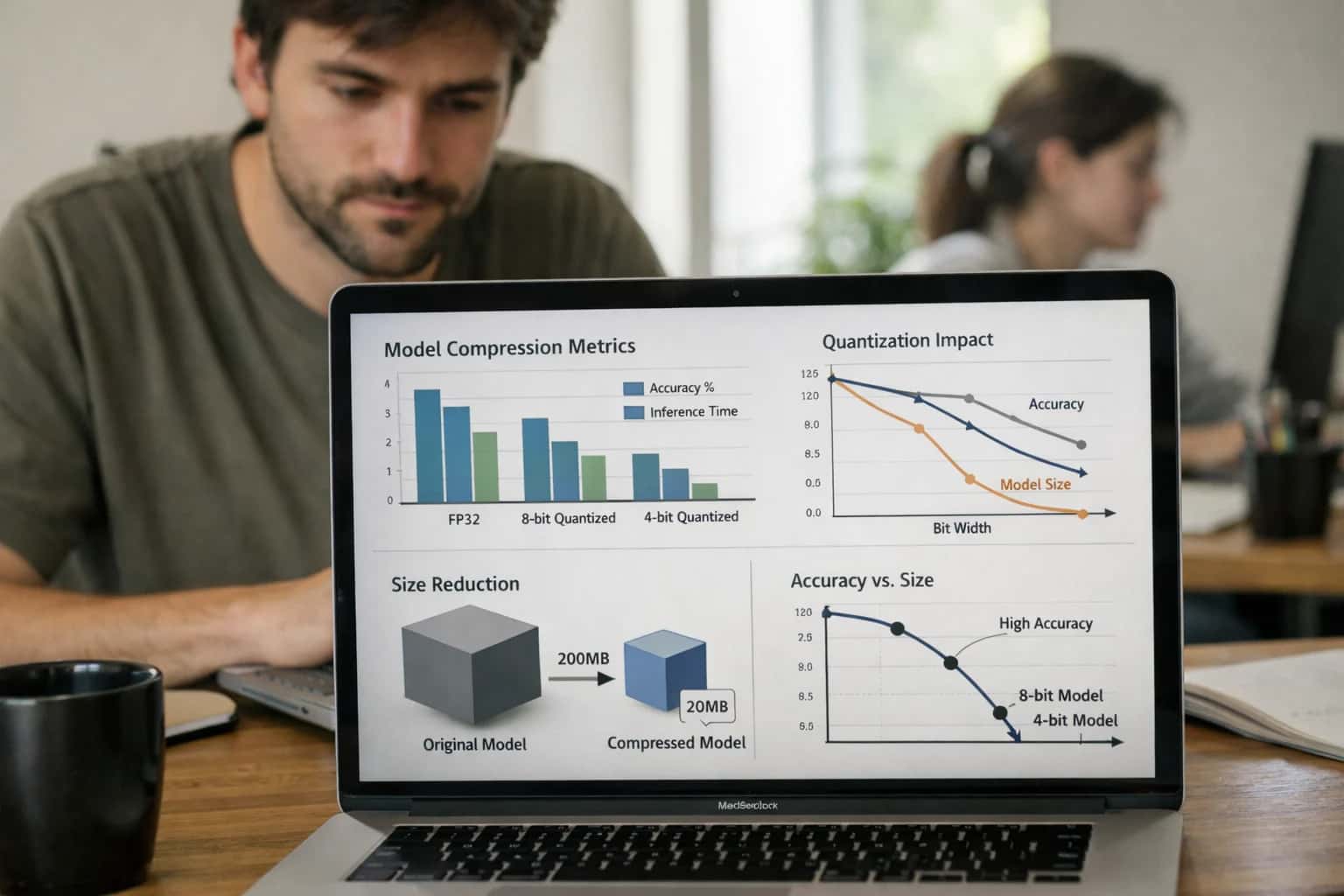
Quantization is a critical technique for deploying models on efficient hardware. This hands-on guide explains the theory behind **INT8** and **FP16** quantization and provides step-by-step instructions using **TensorRT**, **ONNX Runtime**, and **PyTorch Quantization**. You'll learn post-training and quantization-aware training methods, how to validate accuracy after quantization, and deploy quantized models to **CPU** and **edge AI accelerators** for maximum performance-per-watt.
How to Implement Frugal AI and Low-Data Training Practices
Challenge the 'big data' paradigm by learning **Frugal AI** techniques that achieve strong results with minimal resources. This guide covers methods like **active learning**, **synthetic data generation**, **transfer learning** from foundation models, and **data augmentation**. You'll learn to design experiments that prioritize data quality over quantity, significantly reducing the computational and environmental cost of the model development cycle.
How to Implement Lifecycle Assessment for AI Models
Extend your analysis beyond operational carbon to a full **Lifecycle Assessment (LCA)**. This guide teaches you to account for embodied carbon in hardware manufacturing, data center construction, and end-of-life e-waste. You'll learn to use LCA frameworks and databases to create a holistic environmental impact report for a model, a practice increasingly required for regulatory compliance and credible **ESG** disclosure.
How to Design for Hardware Longevity and Reduce E-Waste
Address the growing problem of AI hardware turnover and e-waste. This guide provides strategies for extending the usable life of **GPUs** and **AI accelerators**. It covers procurement policies favoring upgradeable and repairable hardware, implementing **circular economy** practices like refurbishment and resale, and designing software that maintains performance on older hardware through optimization. Learn to treat hardware as a long-term asset, not a disposable commodity.
Partnered with leading AI, data, and software stack.





How We Work
Custom AI workflows for your Business
One-fit-all AI don't work for modern businesses. At Inferensys, we aim to understand your business & custom requirements; which we use to define most efficient agentic workflows, the data, and the tools for your business.
01
Review the use case
We understand the task, the users, and where AI can actually help.
Read more02
Pick the right approach
We define what needs search, automation, or product integration.
Read more03
Build the first useful version
We implement the part that proves the value first.
Read more04
Improve from there
We add the checks and visibility needed to keep it useful.
Read moreThe first call is a practical review of your use case and the right next step.
Talk to Us