Task-Specific Small Language Models (SLMs) are compact, fine-tuned models designed to excel at a narrow function—like code generation, medical note summarization, or legal clause review—while consuming a fraction of the energy of general-purpose LLMs. The core design principle is computational efficiency: achieving a target business outcome with minimal energy expenditure, a key tenet of Green AI. This begins with curating a high-quality, domain-specific dataset and selecting an efficient base architecture, such as Microsoft Phi-3 or Meta Llama 3, which are pre-optimized for performance-per-watt.

Guide
How to Design and Deploy Task-Specific Small Language Models (SLMs)
This guide details the end-to-end process of creating high-performance, energy-efficient SLMs for specialized tasks. It covers dataset curation for a narrow domain, fine-tuning compact models like Microsoft Phi-3 or Meta Llama 3, and rigorous benchmarking against larger models. You'll learn deployment strategies for vLLM or Ollama that maximize throughput-per-watt, making SLMs a sustainable alternative to monolithic LLMs for many use cases.
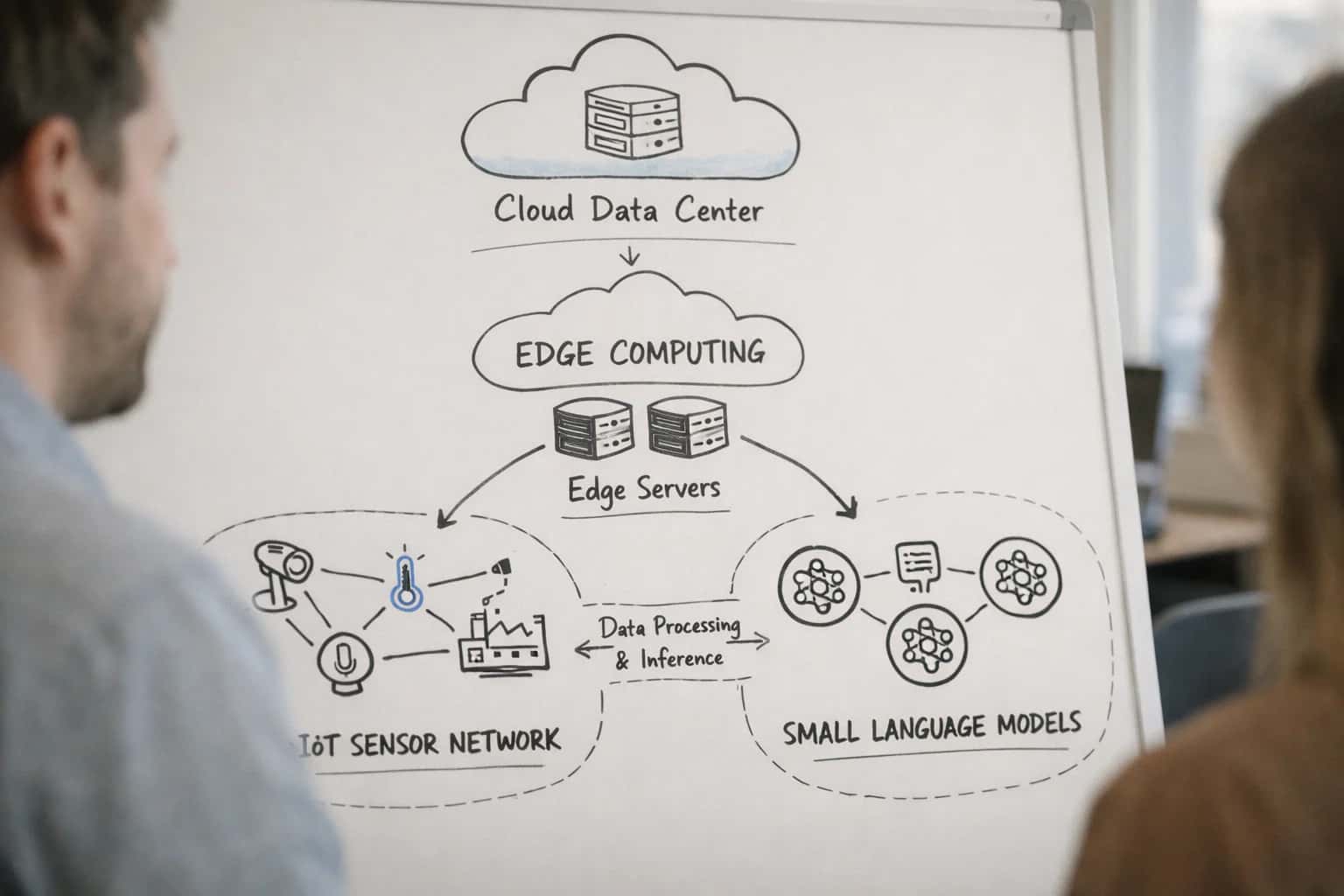
This guide details the end-to-end process of creating high-performance, energy-efficient SLMs for specialized tasks, making them a sustainable alternative to monolithic LLMs.
Deployment is where efficiency gains are realized. Use high-throughput inference servers like vLLM or Ollama that implement continuous batching and optimized attention mechanisms to maximize throughput-per-watt. Rigorously benchmark your SLM against larger models on your specific task using metrics like accuracy, latency, and carbon per inference. For a complete sustainability framework, integrate this process with our guide on How to Implement Energy-to-Solution Metrics in AI Projects to ensure environmental impact is a first-class design constraint from start to finish.
FOUNDATIONAL KNOWLEDGE
Key Concepts: SLMs and Green AI
Building task-specific Small Language Models (SLMs) is a core Green AI practice. These concepts explain the why and how behind creating efficient, high-performance models that reduce environmental impact.
01
What is a Small Language Model (SLM)?
A Small Language Model (SLM) is a compact, efficient AI model, typically under 10 billion parameters, designed for specific tasks rather than general knowledge. Unlike massive LLMs, SLMs achieve high accuracy in narrow domains (e.g., legal document review, medical coding) while using a fraction of the energy. Key characteristics include:
- Task-Specific Focus: Trained on curated, high-quality data for a single domain.
- Computational Efficiency: Requires less memory and power for training and inference.
- Deployability: Can run on local hardware or edge devices, reducing cloud dependency. Examples include Microsoft Phi-3 and distilled versions of Meta Llama.
02
The Energy-to-Solution (E2S) Metric
Energy-to-Solution (E2S) is the primary Green AI metric, measuring the total computational energy required to achieve a business outcome. It shifts focus from pure accuracy to holistic efficiency. Calculate E2S by tracking:
- Training Energy: kWh used during model fine-tuning.
- Inference Energy: Power draw per prediction over the model's lifetime.
- Infrastructure Overhead: Energy for data storage, transfer, and cooling. Tools like CodeCarbon and cloud provider dashboards (e.g., GCP Carbon Footprint) help instrument this. Optimizing for E2S often means selecting a smaller, specialized SLM over a larger, general-purpose LLM.
03
Knowledge Distillation for SLMs
Knowledge Distillation is a technique to train a small student model (the SLM) to mimic the behavior of a large, powerful teacher model (like GPT-4). The process transfers the teacher's generalized knowledge into a compact form, preserving performance for the target task. Steps involve:
- Use the teacher to generate soft labels (probability distributions) on your domain dataset.
- Train the student model on these soft labels and the original hard labels.
- The student learns the teacher's reasoning patterns, not just its outputs. This results in an SLM that performs nearly as well as the teacher but is vastly more efficient for deployment.
04
Model Pruning and Quantization
Pruning and Quantization are post-training optimization techniques that reduce model size and accelerate inference.
- Pruning: Removes redundant weights or neurons from a trained model. Iterative Magnitude Pruning progressively removes the smallest-magnitude weights, often reducing parameters by 50-90% with minimal accuracy loss.
- Quantization: Converts model weights from high-precision (e.g., 32-bit floating point) to lower precision (e.g., 8-bit integers). This drastically reduces memory footprint and increases inference speed on supported hardware. Use frameworks like the TensorFlow Model Optimization Toolkit or PyTorch Quantization to apply these techniques, making your SLM suitable for edge deployment with tools like Ollama.
05
Benchmarking SLMs: Beyond Accuracy
Evaluating an SLM requires a multi-faceted benchmark beyond task accuracy. A complete assessment includes:
- Throughput-per-Watt: Predictions per second divided by power consumption (Watts). This is the key operational efficiency metric.
- Latency: Time to first token, critical for real-time applications.
- Memory Footprint: Peak RAM/VRAM usage during inference.
- Carbon per Inference: Estimated CO2e emissions per 1,000 predictions. Compare your SLM against a baseline LLM (e.g., via MLPerf benchmarks) to demonstrate its Green AI advantage. The goal is to prove the SLM delivers a comparable business outcome with significantly lower resource cost.
06
Deployment: vLLM and Ollama
Choosing the right serving engine maximizes your SLM's efficiency in production.
- vLLM: A high-throughput, memory-efficient inference server. Its PagedAttention algorithm dramatically increases serving capacity, ideal for scaling SLM APIs on GPU servers. It excels at batch processing many concurrent requests.
- Ollama: A tool for running models locally on a developer machine or edge server. It simplifies pulling, running, and managing SLMs (like Llama 3.1) with a simple CLI. Perfect for prototyping, offline applications, or data-sovereign deployments where cloud inference is undesirable. The choice depends on your scale and architecture: use vLLM for cloud-scale serving and Ollama for local/edge deployment.
FOUNDATION
Define Your Task and Success Metrics
The first and most critical step in building a task-specific Small Language Model (SLM) is to precisely define the problem it must solve and how you will measure its success. A narrow, well-scoped task is the cornerstone of an efficient and high-performing SLM.
Start by articulating the narrow domain task your SLM will perform, such as classifying support ticket intent, summarizing legal clauses, or generating SQL from natural language. Avoid broad objectives like "general customer service." Simultaneously, define your success metrics. For Green AI, this must include Energy-to-Solution (E2S) metrics like queries-per-kilowatt-hour alongside traditional accuracy, latency, and throughput. This dual focus ensures your model is both effective and sustainable from the outset.
Next, translate these metrics into a benchmarking dataset and evaluation protocol. Create a small, high-quality validation set representing real-world inputs. Establish baseline performance using a larger, less efficient model (e.g., GPT-4) to set a quality target. This process, detailed in our guide on How to Select AI Models Based on Energy Efficiency, creates the concrete goals against which you will measure your SLM's efficiency gains during fine-tuning and deployment.
ARCHITECTURAL COMPARISON
SLM vs. General-Purpose LLM: Performance and Efficiency
A direct comparison of key operational and performance characteristics between specialized Small Language Models (SLMs) and monolithic general-purpose LLMs.
| Feature / Metric | Task-Specific SLM (e.g., Phi-3, Llama 3 8B) | General-Purpose LLM (e.g., GPT-4, Claude 3) |
|---|---|---|
Model Size (Parameters) | 1B - 15B | 100B - 1T+ |
Typical Inference Latency | < 100 ms | 500 ms - 2 sec |
Inference Energy per Query | 0.1 - 0.5 Wh | 5 - 50 Wh |
Hardware Requirements | Single GPU / CPU (Edge-capable) | Multi-GPU Cluster (Cloud-only) |
Fine-Tuning / Adaptation Cost | $10 - $500 | $10,000 - $1M+ |
Primary Optimization Goal | Throughput-per-Watt | Benchmark Accuracy |
Narrow-Domain Task Accuracy | 95%+ (with proper tuning) | 90-95% (zero/few-shot) |
Context Window Handling | Efficient for task-relevant data | High overhead for full context |
Deployment Flexibility | ✅ (vLLM, Ollama, On-Device) | ❌ (Primarily Cloud API) |
Continuous Learning / Updates | ✅ (Low-cost iterative tuning) | ❌ (Cost-prohibitive frequent retraining) |
Explainability / Traceability | ✅ (Easier due to smaller scale) | ❌ (Extremely complex) |
Carbon per 1M Inferences | ~1-5 kg CO₂e | ~50-500 kg CO₂e |
GREEN AI AND COMPUTATIONAL EFFICIENCY
Step 5: Evaluate and Benchmark Rigorously
Benchmarking is where you prove your Small Language Model (SLM) is not just smaller, but smarter and more sustainable for its specific task. This step moves beyond accuracy to measure real-world efficiency.
Define a multi-dimensional benchmark suite that reflects your production reality. Measure task-specific accuracy, but also critical Energy-to-Solution metrics like latency, throughput-per-watt, and memory footprint. Use tools like MLPerf Inference and CodeCarbon for standardized measurements. Crucially, benchmark against a relevant baseline—often a larger, general-purpose LLM like GPT-4—to demonstrate your SLM's superior efficiency for the narrow domain. This data justifies the architectural choice.
Deploy your benchmark in a staging environment that mirrors production hardware, such as an inference server using vLLM or Ollama. Run A/B tests comparing your SLM to the baseline under identical load. Analyze the results: does the SLM achieve comparable or better accuracy with significantly lower resource consumption? This rigorous validation is essential for stakeholder buy-in and is a core practice of Green AI, ensuring you deploy the most computationally efficient solution. For a deeper dive on efficiency metrics, see our guide on How to Implement Energy-to-Solution Metrics in AI Projects.
Enabling Efficiency, Speed & Accuracy
Intelligent Analysis, Decision & Execution
We build AI systems for teams that need search across company data, workflow automation across tools, or AI features inside products and internal software.
Talk to Us
Search across company data
Give teams answers from docs, tickets, runbooks, and product data with sources and permissions.
Useful when people spend too long searching or get different answers from different systems.
Enterprise searchRAGPermissions
Read more
Automate internal workflows
Use AI to route work, draft outputs, trigger actions, and keep approvals and logs in place.
Useful when repetitive work moves across multiple tools and teams.
AI agentsWorkflow automationGovernance
Read more
Add AI to products and internal tools
Build assistants, guided actions, or decision support into the software your team or customers already use.
Useful when AI needs to be part of the product, not a separate tool.
AI integrationDecision supportModel routing
Read moreSLM DEPLOYMENT
Common Mistakes
Designing and deploying task-specific Small Language Models (SLMs) is a cornerstone of **Green AI and Computational Efficiency**. Avoiding these common pitfalls ensures your model is high-performance, energy-efficient, and delivers real business value.
This is almost always a data mismatch problem. Your fine-tuning dataset must mirror the exact distribution, vocabulary, and edge cases of your production environment.
Common Fixes:
- Synthetic Data Augmentation: Generate realistic, task-specific examples using a larger model to cover rare cases.
- Domain-Adaptive Tokenization: Retrain the tokenizer on your corpus to improve subword efficiency for specialized terms.
- Iterative Validation: Continuously test on a held-out set that simulates live traffic, not just a random academic split.
Without this alignment, your model learns the wrong priors and fails in deployment.

About the author
Prasad Kumkar
CEO & MD, Inference Systems
Prasad Kumkar is the CEO & MD of Inference Systems and writes about AI systems architecture, LLM infrastructure, model serving, evaluation, and production deployment. Over 5+ years, he has worked across computer vision models, L5 autonomous vehicle systems, and LLM research, with a focus on taking complex AI ideas into real-world engineering systems.
His work and writing cover AI systems, large language models, AI agents, multimodal systems, autonomous systems, inference optimization, RAG, evaluation, and production AI engineering.
LinkedIn
Limited slotsGet a Free AI Consultation
Partnered with leading AI, data, and software stack.





How We Work
Custom AI workflows for your Business
One-fit-all AI don't work for modern businesses. At Inferensys, we aim to understand your business & custom requirements; which we use to define most efficient agentic workflows, the data, and the tools for your business.
01
Review the use case
We understand the task, the users, and where AI can actually help.
Read more02
Pick the right approach
We define what needs search, automation, or product integration.
Read more03
Build the first useful version
We implement the part that proves the value first.
Read more04
Improve from there
We add the checks and visibility needed to keep it useful.
Read moreThe first call is a practical review of your use case and the right next step.
Talk to Us