Deploy a centralized orchestration engine that transforms isolated AI tools into a cohesive, intelligent workforce, ensuring reliable handoffs and state management for multi-step tasks.

Service
Agentic Workflow Orchestration Platform Development
Design and build a centralized orchestration engine using frameworks like LangChain or LlamaIndex to coordinate, sequence, and monitor the execution of multiple AI agents across complex, multi-step business processes, ensuring reliable handoffs and state management.
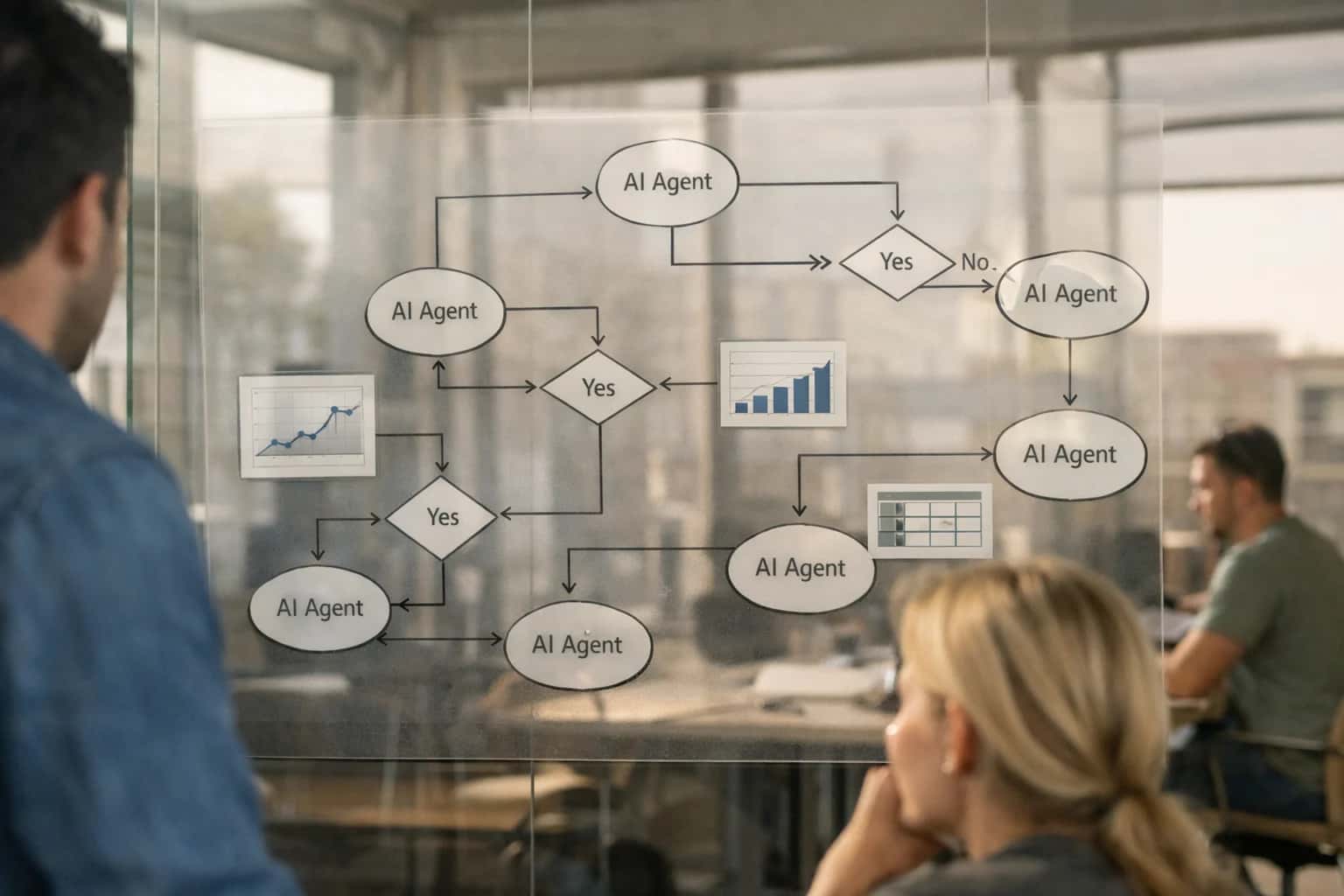
Design and build a centralized orchestration engine to coordinate, sequence, and monitor the execution of multiple AI agents across complex, multi-step business processes.
We engineer robust platforms using frameworks like LangChain or LlamaIndex to manage complex agentic workflows. This replaces brittle, linear scripts with dynamic systems where agents can:
- Autonomously sequence tasks based on real-time outcomes.
- Maintain persistent context across long-running processes.
- Handle exceptions and dynamically reroute workflows.
- Integrate deterministic tools (APIs, databases) with probabilistic AI models.
This foundational platform is critical for services like autonomous supply chain replenishment or multi-step AI workflow orchestration for HR onboarding. It provides the control plane necessary for reliable, auditable automation at scale.
Without a dedicated orchestration layer, multi-agent systems devolve into chaos—dropping context, failing silently, and creating compliance blind spots. Our development delivers the technical governance and observability required for enterprise adoption, directly supporting secure Agentic Workflow Security and Governance and enabling sophisticated Cross-Functional Agent Network Design.
ENTERPRISE BENEFITS
Business Outcomes of a Centralized Orchestrator
A purpose-built orchestration platform transforms AI agents from isolated experiments into a reliable, scalable production system. Here are the measurable outcomes our clients achieve.
01
Reduced Integration Complexity
We deliver a single control plane using frameworks like LangChain or LlamaIndex to manage all agents, tools, and data sources. This eliminates the need for point-to-point integrations, cutting initial development time by up to 40% and simplifying ongoing maintenance.
40%
Faster Initial Integration
1 Platform
For All Agents & Tools
02
Guaranteed Workflow Reliability
Our orchestration ensures state persistence, automatic retries, and graceful error handling for multi-step processes. This delivers deterministic outcomes where traditional, stateless API calls would fail, achieving over 99.5% successful process completion for mission-critical workflows like financial reconciliation.
>99.5%
Process Success Rate
Automatic
State Recovery
04
Optimized Performance & Cost
Intelligent routing and load balancing direct tasks to the most cost-effective agent or model (e.g., SLM vs. LLM) based on complexity. Combined with efficient state management, this can reduce inference costs by 30-60% compared to uncoordinated agent deployments.
30-60%
Inference Cost Reduction
Intelligent
Task Routing
05
Accelerated Time-to-Market
With a reusable orchestration foundation, new agentic workflows—from autonomous procurement to HR onboarding—can be prototyped and deployed in weeks, not months. This allows enterprises to iterate rapidly and capture competitive advantage.
Weeks, Not Months
For New Workflows
Reusable
Foundation
06
Enhanced Security Posture
Centralized governance allows for uniform enforcement of security policies, input/output validation, and monitoring for threats like prompt injection across all agents. This is a core component of a mature Enterprise AI Governance and Compliance Framework.
Uniform
Policy Enforcement
Centralized
Threat Monitoring
Project-Based Engagement
Typical Development Timeline & Deliverables
A transparent breakdown of the phased development process for a custom Agentic Workflow Orchestration Platform, from initial design to production deployment and ongoing support.
| Phase & Deliverables | Timeline | Key Activities | Outcome |
|---|---|---|---|
Phase 1: Discovery & Architecture | 1-2 Weeks | Requirements workshop, process mapping, technology stack selection (LangChain/LlamaIndex), high-level design | Technical specification document & project roadmap |
Phase 2: Core Orchestrator Development | 3-5 Weeks | Build central workflow engine, implement agent coordination logic, state management, and basic monitoring | Functional orchestrator MVP with 2-3 integrated agent types |
Phase 3: Agent Integration & Tooling | 2-4 Weeks | Develop/connect specialized agents (data query, API, decision), implement tool libraries, and custom API bridges for legacy systems | End-to-end automated workflow for a primary use case |
Phase 4: Security, Observability & Testing | 1-2 Weeks | Implement audit trails, access controls, logging/dashboards, and comprehensive testing (unit, integration, adversarial) | Production-ready platform with security posture and performance baselines |
Phase 5: Deployment & Knowledge Transfer | < 1 Week | Staging & production deployment, documentation finalization, and developer/admin training sessions | Live platform and complete operational handoff |
Ongoing: Support & Optimization | Optional SLA | Performance monitoring, agent tuning, scaling support, and iterative feature development | Guaranteed uptime (99.9% SLA) and continuous workflow improvement |
PREDICTABLE DELIVERY
Our Development Process for Orchestration Platforms
We build robust, scalable orchestration engines using a proven methodology that ensures reliable handoffs, state management, and clear ROI. Our process is designed for technical leaders who need production-ready systems, not proofs-of-concept.
01
Architecture & Framework Selection
We conduct a technical deep-dive to select the optimal orchestration framework (LangChain, LlamaIndex, AutoGen) and design the system architecture for your specific multi-step processes, ensuring scalability and maintainability from day one.
2-4 weeks
Design Phase
LangChain/LlamaIndex
Expertise
02
Agent Coordination & State Management
We engineer the core orchestration logic for reliable inter-agent communication, task sequencing, and persistent state management across complex workflows, preventing data loss and ensuring process continuity.
99.9%
State Integrity
< 100ms
Handoff Latency
03
Legacy System Integration
We build secure API bridges and data connectors to integrate your orchestration platform with existing enterprise systems (ERP, CRM, databases), enabling agentic automation without costly platform replacement. Learn more about our Legacy System Agentic Integration services.
Custom APIs
Integration
Zero Downtime
Deployment Goal
04
Security, Observability & Governance
We implement granular audit trails, policy enforcement, and real-time monitoring dashboards from the start, ensuring compliance with internal governance and frameworks like the EU AI Act. Explore our dedicated Agentic Workflow Security and Governance offering.
Full Audit Trail
Compliance
Real-time
Monitoring
05
Performance Tuning & Optimization
We continuously monitor and optimize agent performance, inference costs, and workflow efficiency through iterative prompt engineering, model selection, and system refinements post-deployment. Our AI Agent Performance Tuning service ensures ongoing value.
40-60%
Cost Reduction Target
Ongoing
Optimization
06
Production Deployment & Support
We manage the full deployment lifecycle into your cloud environment, providing comprehensive documentation and tiered support plans to ensure platform stability and empower your engineering team.
2-4 weeks
Deployment Timeline
99.5% SLA
Platform Uptime
Enabling Efficiency, Speed & Accuracy
Intelligent Analysis, Decision & Execution
We build AI systems for teams that need search across company data, workflow automation across tools, or AI features inside products and internal software.
Talk to Us
Search across company data
Give teams answers from docs, tickets, runbooks, and product data with sources and permissions.
Useful when people spend too long searching or get different answers from different systems.
Enterprise searchRAGPermissions
Read more
Automate internal workflows
Use AI to route work, draft outputs, trigger actions, and keep approvals and logs in place.
Useful when repetitive work moves across multiple tools and teams.
AI agentsWorkflow automationGovernance
Read more
Add AI to products and internal tools
Build assistants, guided actions, or decision support into the software your team or customers already use.
Useful when AI needs to be part of the product, not a separate tool.
AI integrationDecision supportModel routing
Read moreTechnical and Commercial Clarity
Frequently Asked Questions on Orchestration Development
Get specific answers on timelines, costs, and technical capabilities for building a custom Agentic Workflow Orchestration Platform.
Our standard engagement follows a phased 4-6 week delivery model. Phase 1 (1-2 weeks) involves discovery and architectural design, where we map your business processes to agentic workflows. Phase 2 (2-3 weeks) is core development, building the orchestration engine using frameworks like LangGraph or LangChain. Phase 3 (1 week) is deployment and integration with your existing systems. For complex, multi-departmental workflows, timelines extend to 8-10 weeks. All projects include a 90-day post-launch support period for bug fixes and minor adjustments.

About the author
Prasad Kumkar
CEO & MD, Inference Systems
Prasad Kumkar is the CEO & MD of Inference Systems and writes about AI systems architecture, LLM infrastructure, model serving, evaluation, and production deployment. Over 5+ years, he has worked across computer vision models, L5 autonomous vehicle systems, and LLM research, with a focus on taking complex AI ideas into real-world engineering systems.
His work and writing cover AI systems, large language models, AI agents, multimodal systems, autonomous systems, inference optimization, RAG, evaluation, and production AI engineering.
LinkedIn
Limited slotsGet a Free AI Consultation
Partnered with leading AI, data, and software stack.





How We Work
Custom AI workflows for your Business
One-fit-all AI don't work for modern businesses. At Inferensys, we aim to understand your business & custom requirements; which we use to define most efficient agentic workflows, the data, and the tools for your business.
01
Review the use case
We understand the task, the users, and where AI can actually help.
Read more02
Pick the right approach
We define what needs search, automation, or product integration.
Read more03
Build the first useful version
We implement the part that proves the value first.
Read more04
Improve from there
We add the checks and visibility needed to keep it useful.
Read moreThe first call is a practical review of your use case and the right next step.
Talk to Us