Green AI Governance is the formal system of policies, oversight, and accountability that embeds energy efficiency and carbon reduction into your organization's AI development lifecycle. It begins by establishing a cross-functional governance board with authority to set mandatory policies, such as carbon budgets per model or requiring Energy-to-Solution (E2S) metrics in all project proposals. This board defines the guardrails that make sustainability a non-negotiable requirement from research to production, aligning technical work with broader ESG and regulatory goals.

Guide
How to Establish Green AI Governance and KPIs
A technical guide for engineering leads and CTOs to institutionalize Green AI. Learn to create a governance board, define policy like carbon budgets, set KPIs like Carbon per Inference, and integrate metrics into MLOps workflows.
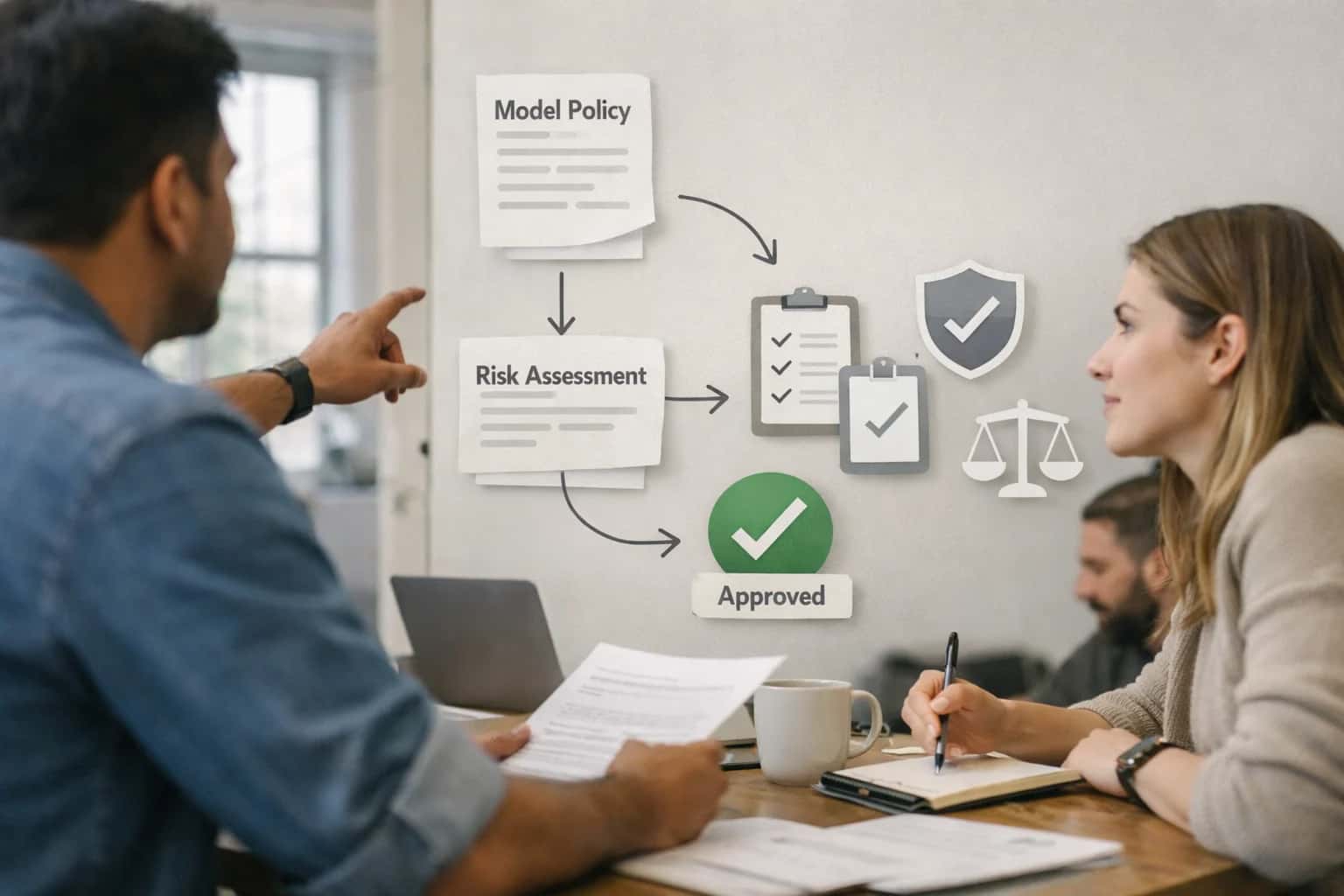
This guide provides engineering leaders with a framework to institutionalize Green AI practices, ensuring computational efficiency and environmental responsibility are core to every AI project.
Effective governance requires concrete, measurable Key Performance Indicators (KPIs). Move beyond vague goals by tracking metrics like Carbon per Inference, Model Efficiency Ratio (accuracy per watt), or Compute Hours per Business Outcome. Integrate these KPIs into your existing MLOps pipelines using tools like CodeCarbon and MLflow, and make them visible in project management dashboards. This creates a feedback loop where teams are accountable for efficiency, driving architectural choices like model pruning, edge inference, and selecting task-specific SLMs to meet their targets.
CORE METRICS
Step 3: Define and Calculate Key Green AI KPIs
A comparison of essential KPIs for measuring and governing the environmental impact of AI systems, from operational efficiency to full lifecycle assessment.
| KPI / Metric | Calculation Method | Target Benchmark | Integration Point |
|---|---|---|---|
Carbon per Inference (CPI) | Total CO2e for inference period / Number of inferences | < 1g CO2e | MLOps Pipeline & API Gateway |
Model Efficiency Ratio (MER) | Task Accuracy / (Training FLOPs + Inference Energy) |
| Model Registry & Evaluation |
Energy-to-Solution (E2S) | Total kWh to achieve business outcome (e.g., 95% accuracy) | Project-specific carbon budget | Project Charter & CI/CD |
Inference Watts per Query (WpQ) | Avg. power draw during inference / Queries per second | < 10W per 1k QPS | Real-time Monitoring Dashboard |
Hardware Utilization Efficiency | (Avg. GPU/CPU utilization % * Avg. load) / Total provisioned capacity |
| Kubernetes Cluster Autoscaler |
Data Efficiency Score | (Model performance) / (Size of training dataset in TB) | Maximize score; reduce data waste | Data Versioning & Experiment Tracking |
Embodied Carbon Amortization | Hardware manufacturing CO2e / (Expected lifespan * Utilization) | Minimize via circular procurement | Hardware Lifecycle Management |
Renewable Energy Matching % | kWh from green sources / Total kWh consumed |
| Cloud Provider Billing & Carbon Tools |
OPERATIONALIZE
Step 4: Integrate KPIs into MLOps Workflows
Transform your Green AI policy into an automated, measurable practice by embedding efficiency KPIs directly into your MLOps pipelines.
Integrate your defined Carbon per Inference and Model Efficiency Ratio KPIs directly into your MLOps toolchain. Use experiment tracking platforms like MLflow or Weights & Biases to log energy consumption alongside accuracy metrics for every training run. In your CI/CD pipelines, add gates that fail deployments if a new model version exceeds predefined carbon budgets, ensuring efficiency is a non-negotiable requirement from research to production. This creates a continuous efficiency monitoring feedback loop.
Automate reporting by connecting your inference endpoints to a centralized dashboard like Grafana. Pull power metrics from cloud provider APIs (e.g., AWS CloudWatch) and model performance data from Prometheus to visualize real-time trends in energy-to-solution. Set alerts for efficiency regressions, enabling proactive optimization. This operational rigor turns governance from a policy document into a measurable, automated system, directly supporting your broader Green AI and Computational Efficiency goals.
Enabling Efficiency, Speed & Accuracy
Intelligent Analysis, Decision & Execution
We build AI systems for teams that need search across company data, workflow automation across tools, or AI features inside products and internal software.
Talk to Us
Search across company data
Give teams answers from docs, tickets, runbooks, and product data with sources and permissions.
Useful when people spend too long searching or get different answers from different systems.
Enterprise searchRAGPermissions
Read more
Automate internal workflows
Use AI to route work, draft outputs, trigger actions, and keep approvals and logs in place.
Useful when repetitive work moves across multiple tools and teams.
AI agentsWorkflow automationGovernance
Read more
Add AI to products and internal tools
Build assistants, guided actions, or decision support into the software your team or customers already use.
Useful when AI needs to be part of the product, not a separate tool.
AI integrationDecision supportModel routing
Read moreTROUBLESHOOTING
Common Mistakes in Green AI Governance
Establishing effective Green AI governance is fraught with pitfalls that can undermine your sustainability goals. This guide addresses the most frequent errors teams make when setting up KPIs, policies, and oversight boards, providing clear fixes to ensure your governance is actionable and impactful.
Teams often conflate cloud cost optimization with energy efficiency, but they are not the same. A cheaper cloud instance may still be highly energy-inefficient if it's underutilized or uses older, less efficient hardware. True Green AI governance requires measuring the direct energy consumption and associated carbon emissions of your workloads.
The Fix: Integrate specialized tools like CodeCarbon or leverage cloud provider carbon footprint APIs (e.g., GCP Carbon Footprint, AWS Customer Carbon Footprint Tool). Track Carbon per Inference (CPI) or Energy-to-Solution (E2S) as primary KPIs, not just dollar spend. This shifts focus from financial to environmental efficiency.

About the author
Prasad Kumkar
CEO & MD, Inference Systems
Prasad Kumkar is the CEO & MD of Inference Systems and writes about AI systems architecture, LLM infrastructure, model serving, evaluation, and production deployment. Over 5+ years, he has worked across computer vision models, L5 autonomous vehicle systems, and LLM research, with a focus on taking complex AI ideas into real-world engineering systems.
His work and writing cover AI systems, large language models, AI agents, multimodal systems, autonomous systems, inference optimization, RAG, evaluation, and production AI engineering.
LinkedIn
Limited slotsGet a Free AI Consultation
Partnered with leading AI, data, and software stack.





How We Work
Custom AI workflows for your Business
One-fit-all AI don't work for modern businesses. At Inferensys, we aim to understand your business & custom requirements; which we use to define most efficient agentic workflows, the data, and the tools for your business.
01
Review the use case
We understand the task, the users, and where AI can actually help.
Read more02
Pick the right approach
We define what needs search, automation, or product integration.
Read more03
Build the first useful version
We implement the part that proves the value first.
Read more04
Improve from there
We add the checks and visibility needed to keep it useful.
Read moreThe first call is a practical review of your use case and the right next step.
Talk to Us