Edge inference shifts AI processing from centralized data centers to devices or local servers, directly addressing the massive energy cost of data transfer. This architectural approach prioritizes Energy-to-Solution by running optimized models on specialized hardware like NVIDIA Jetson or Google Coral. The core principle is to process data where it's generated, eliminating the round-trip network energy and latency of cloud queries. This is foundational for sustainable AI grids and responsive applications in IoT, manufacturing, and smart cities.

Guide
How to Architect for Edge Inference to Reduce Energy Use
A step-by-step technical guide to designing and deploying energy-efficient AI systems at the network edge. Learn model optimization, hardware selection, and hybrid architecture patterns to slash cloud dependency and carbon footprint.
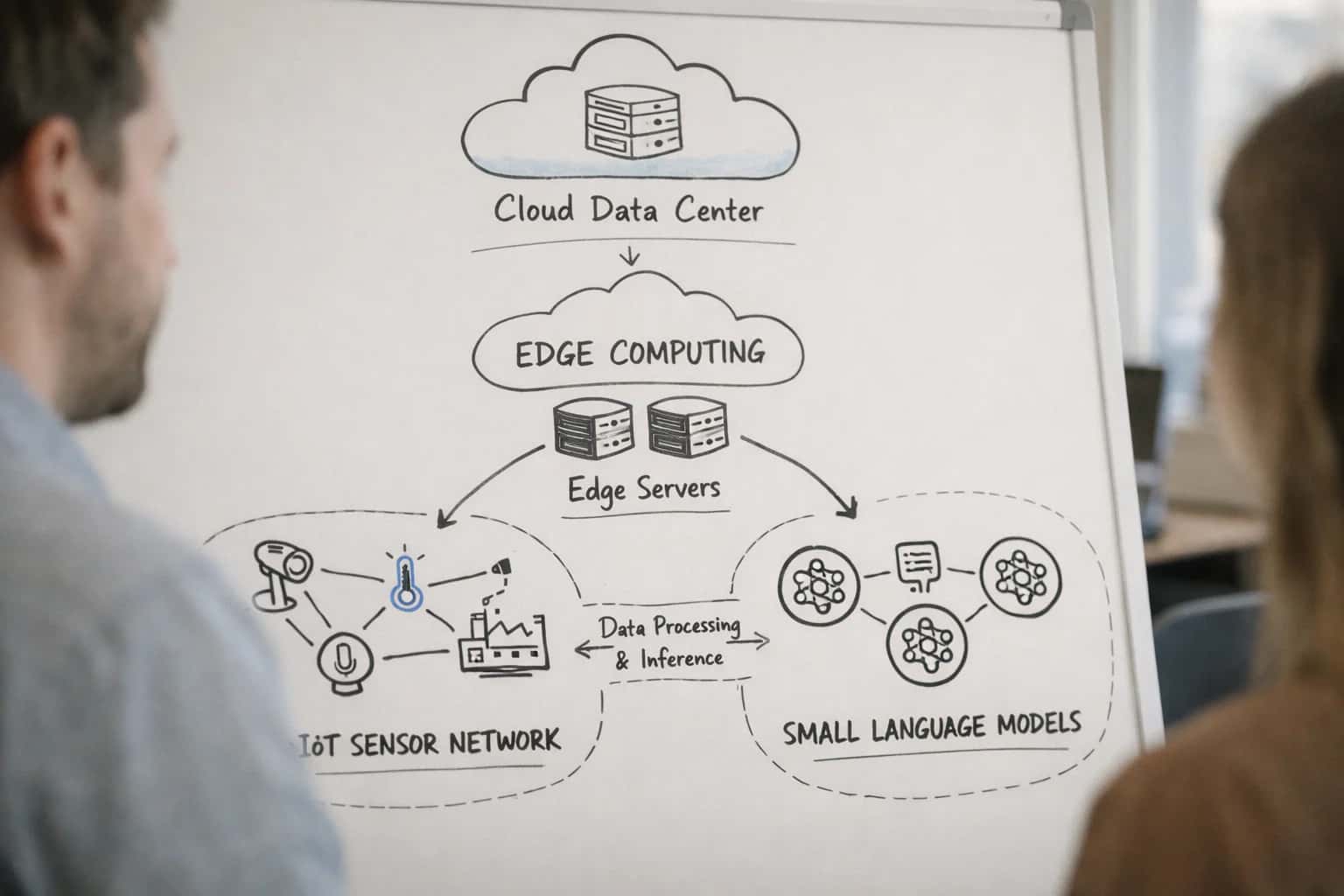
This guide explains the architectural principles for deploying AI at the network edge to drastically cut energy consumption and latency, moving beyond cloud-centric models.
Successful edge architecture requires balancing model capability with hardware constraints. Start by selecting or creating a task-specific Small Language Model (SLM) or a pruned vision model. Apply quantization and use frameworks like TensorRT or TFLite for deployment. Implement a hybrid strategy where only complex, uncertain queries are escalated to the cloud. For management, use tools like Prometheus for monitoring your distributed fleet's power draw and performance. This design slashes operational carbon and builds resilient, low-latency AI systems.
ARCHITECTURE PRIMER
Key Concepts: The Edge Inference Stack
To reduce energy use, you must move computation from the cloud to the edge. This requires a specialized stack of hardware, software, and architectural patterns.
02
Hybrid Cloud-Edge Architecture
Not all inference belongs on the edge. A hybrid architecture intelligently routes requests:
- Edge: Run high-frequency, low-latency, or privacy-sensitive inference locally.
- Cloud: Offload complex, batch, or infrequent tasks to more powerful, centralized servers. This pattern, often called AI Grid management, minimizes the energy cost of constant data transmission to the cloud. Design with service meshes and intelligent load balancers that consider latency, data size, and current edge device battery levels.
03
Energy-Aware Orchestration & Scheduling
Managing a fleet of edge devices requires software that understands power constraints. Key strategies include:
- Dynamic Voltage and Frequency Scaling (DVFS): Adjusting processor power states based on workload.
- Inference Batching: Grouping requests to maximize hardware utilization before powering down.
- Renewable-Aware Scheduling: Prioritizing inference workloads when local renewable energy (e.g., solar) is available. Tools like Kubernetes with K3s and Azure IoT Edge provide frameworks for deploying and managing these policies at scale.
05
Data Pipeline Efficiency
Energy isn't just spent on matrix multiplication. Inefficient data movement is a major hidden cost.
- On-Device Preprocessing: Filter, compress, or downsample sensor data (e.g., video frames) before it enters the inference pipeline.
- Smart Sampling: Don't process every data point. Use change detection or confidence thresholds to trigger inference only when needed.
- Edge Caching: Store frequently accessed reference data or model weights locally to avoid network calls. This reduces the energy burden on sensors, memory, and I/O buses.
06
Measuring Edge Inference Efficiency
You can't improve what you don't measure. Define and track key metrics:
- Inferences per Joule (Inf/J): The primary measure of computational energy efficiency.
- End-to-End Latency: Includes data acquisition, preprocessing, inference, and post-processing.
- Network Energy per Inference: The cost of any necessary cloud communication. Instrument your applications with tools like CodeCarbon and hardware power monitors (e.g., Jetson Stats) to establish a baseline and track improvements. Learn more in our guide on How to Set Up a Framework for Measuring AI Carbon Footprint.
GREEN AI FOUNDATION
Step 1: Optimize Your Model for Edge Hardware
The first step in architecting for edge inference is to fundamentally reshape your model to run efficiently on constrained hardware, directly reducing energy consumption.
Edge hardware like NVIDIA Jetson or Google Coral has strict limits on memory, compute, and power. Your model must be architected for these constraints from the start. This means selecting inherently efficient model architectures (e.g., MobileNetV3 for vision, DistilBERT for NLP) and applying compression techniques like pruning and quantization. The goal is to shrink the model's computational footprint without sacrificing the accuracy needed for the task, a core principle of frugal AI.
Implement this by using frameworks like TensorFlow Lite or ONNX Runtime for conversion. Profile your model's latency and power draw on target hardware using tools like NVIDIA Nsight Systems. Common mistakes include optimizing for cloud metrics (e.g., pure accuracy) instead of energy-to-solution, or failing to test the quantized model on real edge data, leading to accuracy cliffs. For a deeper dive on model efficiency techniques, see our guide on Knowledge Distillation and Model Pruning for Sustainability.
GREEN AI SELECTION
Edge Hardware Comparison: Performance per Watt
A direct comparison of popular edge AI accelerators based on their computational efficiency, a critical metric for sustainable edge inference. This table helps architects select hardware that delivers the required performance while minimizing energy consumption.
| Metric / Feature | NVIDIA Jetson Orin NX | Google Coral Edge TPU | Intel Movidius Myriad X | Qualcomm Cloud AI 100 |
|---|---|---|---|---|
Peak INT8 TOPS/Watt | 5.2 | 4.0 | 1.5 | 12.0 |
Typical Power Draw (W) | 10-25 | 2 | 1-3 | 15-75 |
Memory Bandwidth (GB/s) | 51.2 | N/A | N/A | 200 |
Supports FP16 Inference | ||||
On-Device Toolchain Maturity | ||||
Typical Latency for MobileNetV2 | < 5 ms | < 3 ms | < 10 ms | < 2 ms |
Common Use Case | Robotics, Autonomous Vehicles | IoT Sensors, Smart Cameras | Drones, Wearables | Smart Edge Servers, Telco RAN |
Direct Link to Related Guide |
ARCHITECTURE PRINCIPLES
Step 2: Design a Hybrid Cloud-Edge Architecture
A hybrid cloud-edge architecture strategically splits AI workloads between centralized cloud resources and distributed edge devices to minimize energy consumption and latency.
A hybrid architecture reduces energy use by minimizing data transfer. The core principle is to run inference on edge devices like NVIDIA Jetson or Google Coral, processing data where it's generated. This eliminates the energy cost of sending raw data to the cloud. The cloud is reserved for model training, retraining, and complex aggregation tasks that require massive, centralized compute. This separation creates an AI grid where lightweight, optimized models operate autonomously at the edge.
To implement this, you must first profile your workload. Identify which tasks require low-latency or operate on sensitive data—these are prime for the edge. Next, optimize your models for edge hardware using quantization and pruning via tools like TensorFlow Lite or ONNX Runtime. Finally, implement an orchestration layer (e.g., using Kubernetes K3s) to manage model updates, health checks, and failover between edge nodes and the cloud, ensuring reliability. For a deeper dive on model optimization, see our guide on How to Implement Quantization for Efficient Model Deployment.
Enabling Efficiency, Speed & Accuracy
Intelligent Analysis, Decision & Execution
We build AI systems for teams that need search across company data, workflow automation across tools, or AI features inside products and internal software.
Talk to Us
Search across company data
Give teams answers from docs, tickets, runbooks, and product data with sources and permissions.
Useful when people spend too long searching or get different answers from different systems.
Enterprise searchRAGPermissions
Read more
Automate internal workflows
Use AI to route work, draft outputs, trigger actions, and keep approvals and logs in place.
Useful when repetitive work moves across multiple tools and teams.
AI agentsWorkflow automationGovernance
Read more
Add AI to products and internal tools
Build assistants, guided actions, or decision support into the software your team or customers already use.
Useful when AI needs to be part of the product, not a separate tool.
AI integrationDecision supportModel routing
Read moreGREEN AI & COMPUTATIONAL EFFICIENCY
Common Mistakes in Edge AI Architecture
Architecting for edge inference is a core Green AI strategy, but common pitfalls waste energy and undermine performance. This guide diagnoses frequent errors and provides actionable solutions to build efficient, sustainable edge systems.
The biggest energy waste is excessive data transfer. Sending raw, unprocessed sensor data to the cloud for inference consumes massive network energy and creates latency. The core principle of edge AI is to process data where it's generated.
Solution: Implement a tiered architecture:
- On-device inference for immediate, low-power decisions.
- Local edge server (e.g., a Jetson AGX Orin) for complex models.
- Cloud only for rare aggregation or retraining.
Use data filtering and lightweight preprocessing on the sensor to reduce payload size before any transmission. This directly cuts the energy cost of data movement, a key tenet of our guide on How to Architect AI Systems for Computational Efficiency.

About the author
Prasad Kumkar
CEO & MD, Inference Systems
Prasad Kumkar is the CEO & MD of Inference Systems and writes about AI systems architecture, LLM infrastructure, model serving, evaluation, and production deployment. Over 5+ years, he has worked across computer vision models, L5 autonomous vehicle systems, and LLM research, with a focus on taking complex AI ideas into real-world engineering systems.
His work and writing cover AI systems, large language models, AI agents, multimodal systems, autonomous systems, inference optimization, RAG, evaluation, and production AI engineering.
LinkedIn
Limited slotsGet a Free AI Consultation
Partnered with leading AI, data, and software stack.





How We Work
Custom AI workflows for your Business
One-fit-all AI don't work for modern businesses. At Inferensys, we aim to understand your business & custom requirements; which we use to define most efficient agentic workflows, the data, and the tools for your business.
01
Review the use case
We understand the task, the users, and where AI can actually help.
Read more02
Pick the right approach
We define what needs search, automation, or product integration.
Read more03
Build the first useful version
We implement the part that proves the value first.
Read more04
Improve from there
We add the checks and visibility needed to keep it useful.
Read moreThe first call is a practical review of your use case and the right next step.
Talk to Us