
Blog
Agentic AI and Autonomous Workflow Orchestration
Agentic AI and Autonomous Workflow Orchestration
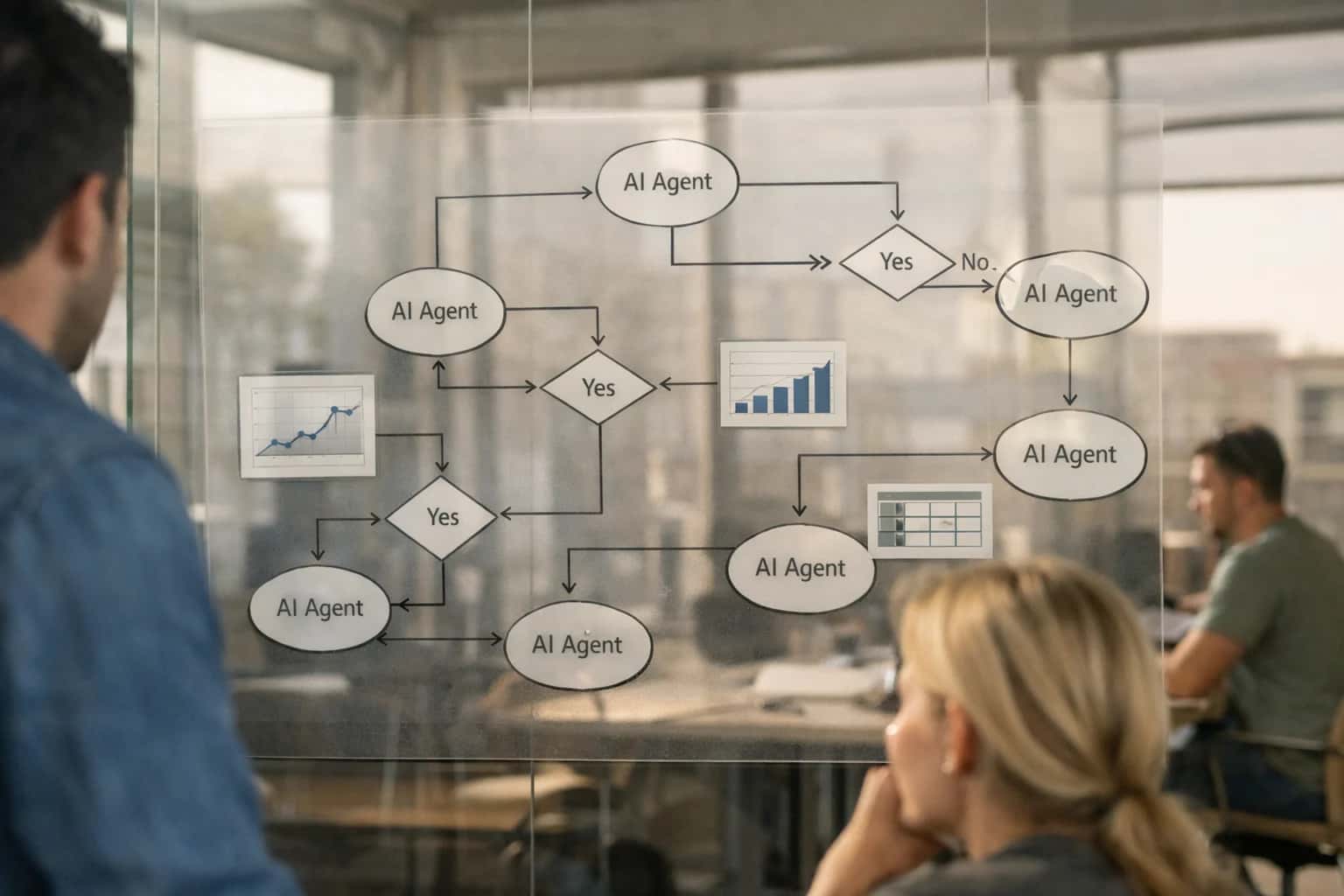
This pillar addresses the fundamental shift from 'talking' AI to 'acting' AI. Agentic systems are designed to navigate APIs, manage multi-step projects, and collaborate within multi-agent systems (MAS) to achieve defined business goals. Development services in this area focus on building the 'Agent Control Plane'—the governance layer that manages permissions, hand-offs between agents, and human-in-the-loop gates. Sub-topics include agentic reasoning frameworks, autonomous procurement agents, and the architecture of 'self-healing' supply chains.
Why the Agent Control Plane is Your Most Critical AI Investment
The agent control plane is the essential governance layer that manages permissions, hand-offs, and human oversight for autonomous workflows.
The Hidden Cost of Ignoring Multi-Agent System Governance
Without a governance layer, multi-agent systems are prone to cascading failures, security breaches, and unaccountable actions.
Why Your Autonomous Workflow Will Fail Without a Semantic Data Strategy
Agentic AI requires a structured semantic data foundation to understand context and execute complex, multi-step tasks accurately.
Why Human-in-the-Loop Gates Are a Strategic Asset, Not a Bottleneck
Properly designed HITL gates provide critical oversight, reduce risk, and are the key to scaling trustworthy agentic systems.
The Future of API Navigation is Agentic Discovery
AI agents are evolving from simple API consumers to autonomous systems that discover, test, and integrate APIs dynamically.
Why Most Agentic Reasoning Frameworks Are Architecturally Flawed
Many frameworks like LangChain and LlamaIndex fail to provide the robust state management and error handling required for production agentic systems.
The Hidden Cost of Agent Sprawl in Your Enterprise
Unmanaged proliferation of AI agents leads to conflicting actions, wasted compute, and ungovernable security vulnerabilities.
Why Your Multi-Agent System Lacks True Collaboration
Without a shared communication protocol and orchestration layer, agents operate in silos, failing to achieve complex, collective goals.
Why Autonomous Workflow Orchestration Demands a New Kind of CTO
Managing agentic systems requires a shift from traditional IT leadership to a focus on dynamic system design, agent ops, and ethical oversight.
The Cost of Not Defining Hand-Off Protocols Between AI Agents
Ambiguous agent hand-offs create data loss, task duplication, and workflow deadlocks that cripple autonomous operations.
Why 'Acting' AI Requires a Fundamentally Different Data Foundation
Moving from generative to agentic AI demands real-time, structured, and semantically rich data, not just static knowledge bases.
Why Multi-Agent Systems Are Prone to Cascading Failure
The interconnected nature of MAS means a single agent's error or hallucination can propagate and destabilize an entire workflow.
Why Agentic AI Will Expose Your Organizational Silos
Autonomous workflows that cross departmental boundaries reveal and break down inefficient data and process barriers.
The Future of Compliance is Built into the Agent Control Plane
Regulatory adherence must be encoded as executable policy within the orchestration layer, not bolted on as an afterthought.
The Hidden Cost of Agentic AI's Appetite for Context
The computational and latency overhead of maintaining sufficient context for long-horizon tasks can cripple performance and cost efficiency.
Why Autonomous Workflow Orchestration is Not a Feature, It's a Platform
True orchestration requires a dedicated platform for agent lifecycle management, monitoring, and cross-system coordination.
The Future of IT is Orchestrating Human-Agent Teams
The new IT mandate is designing and managing collaborative workflows where AI agents and human experts work in concert.
Why Your Agentic AI Lacks the Reasoning for True Autonomy
Most systems built on models like GPT-4 or Claude lack the persistent memory and planning capabilities for reliable, multi-step autonomy.
Why the Agent Control Plane is the New Operating System
The control plane that manages agent interactions, resources, and security is becoming the core OS for the AI-powered enterprise.
The Future of Customer Service is a Network of Specialized Agents
Customer experience will be delivered by orchestrated swarms of narrow AI agents handling intake, triage, resolution, and feedback autonomously.
The Hidden Cost of Agentic AI's Black Box Decisions
When AI agents take actions with real-world consequences, the inability to explain their reasoning creates unacceptable legal and operational risk.
Why Autonomous Workflow Success Hinges on Feedback Loop Design
The architecture of feedback—from outcomes back to agent reasoning—is what enables continuous improvement and prevents goal drift.
The Cost of Agentic AI Without Continuous Learning Mechanisms
Static agents quickly become obsolete; systems must be designed to learn from outcomes, user corrections, and environmental changes.
Why Multi-Agent Collaboration Fails Without a Common Language
Agents built on different frameworks or models require a standardized communication protocol, like a digital constitution, to collaborate effectively.
The Hidden Cost of Ignoring Agentic AI's Security Surface
Every agent with API access expands the attack vector, requiring new security paradigms for authentication, authorization, and action validation.
Why Agentic AI Demands a Shift from Process Maps to Goal Trees
Rigid, linear process maps break down; agents require hierarchical goal structures that allow for dynamic planning and adaptation.
The Cost of Agentic AI's Dependency on Real-Time Data
Agents making decisions based on stale data can cause catastrophic errors, necessitating expensive, low-latency data infrastructure.
Why Your Autonomous Agents Are Stuck in Pilot Purgatory
Failure to design for production-scale orchestration, observability, and governance keeps agentic systems trapped in limited proofs-of-concept.
The Future of Legacy Systems is Agentic Wrappers
AI agents will act as intelligent interfaces, using APIs and RAG to modernize and extract value from monolithic legacy applications.
Why Agentic AI Will Redefine the Concept of a Business Process
Static, documented processes will be replaced by dynamic, goal-oriented agent collectives that can re-architect workflows in real-time.
Partnered with leading AI, data, and software stack.





How We Work
Custom AI workflows for your Business
One-fit-all AI don't work for modern businesses. At Inferensys, we aim to understand your business & custom requirements; which we use to define most efficient agentic workflows, the data, and the tools for your business.
01
Review the use case
We understand the task, the users, and where AI can actually help.
Read more02
Pick the right approach
We define what needs search, automation, or product integration.
Read more03
Build the first useful version
We implement the part that proves the value first.
Read more04
Improve from there
We add the checks and visibility needed to keep it useful.
Read moreThe first call is a practical review of your use case and the right next step.
Talk to Us