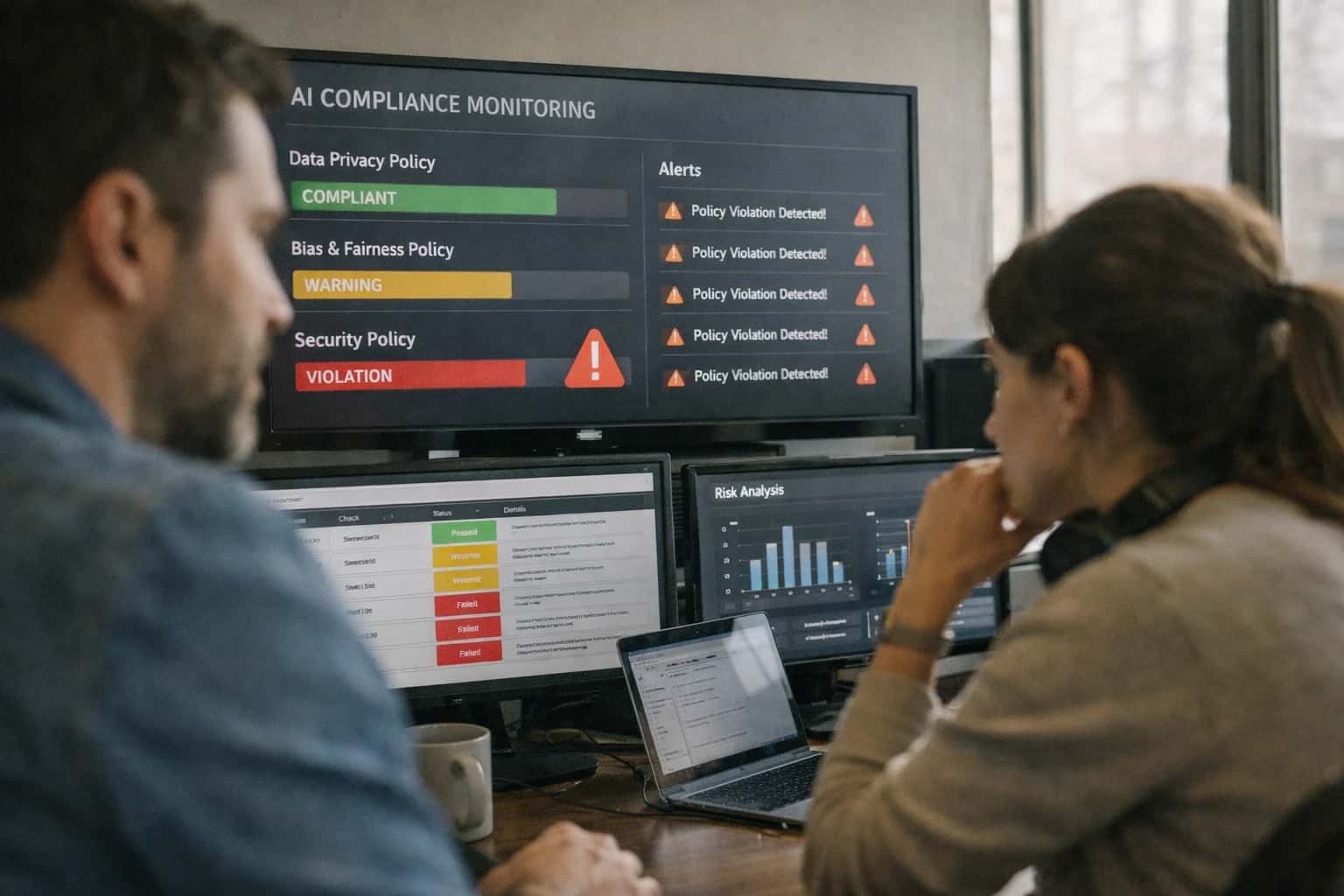
Compliance is a runtime function. Post-hoc audits and manual policy checks fail for autonomous agents executing API calls and financial transactions in real-time. The Agent Control Plane must enforce rules like GDPR data localization or PCI-DSS tokenization as code, before an action is taken.

Blog
The Future of Compliance is Built into the Agent Control Plane
Regulatory adherence must be encoded as executable policy within the orchestration layer, not bolted on as an afterthought. This is the only way to scale trustworthy agentic AI.
THE GOVERNANCE PARADOX
The Compliance Time Bomb in Your Agentic AI
Regulatory adherence must be encoded as executable policy within the orchestration layer, not bolted on as an afterthought.
Your orchestration layer is your compliance engine. Frameworks like LangChain or AutoGen provide task chaining but lack built-in governance for data sovereignty or audit trails. A dedicated control plane, such as those we architect, integrates with tools like Vectara for policy-aware RAG and Pinecone for compliant vector storage, making regulatory checks a precondition for agent execution.
Static rules break dynamic systems. A procurement agent sourcing parts globally must adapt its compliance logic in real-time based on shipment origin and local AI Acts. This requires a semantic data strategy that tags data with regulatory context, enabling agents to reason about constraints, a concept explored in our guide on why your autonomous workflow will fail without it.
Evidence: In financial services, agentic systems without embedded compliance logic have triggered regulatory actions; firms using policy-as-code within their orchestration layer report a 70% reduction in compliance-related workflow stoppages. This aligns with the principles of AI TRiSM, where trust and risk management are foundational.
THE FUTURE OF COMPLIANCE IS BUILT-IN
Why Bolted-On Compliance Fails for Agentic Systems
Regulatory adherence must be encoded as executable policy within the orchestration layer, not bolted on as an afterthought.
01
The Problem: The Compliance Feedback Loop is Too Slow
Post-hoc audit tools create a ~72-hour lag between an agent's non-compliant action and human intervention. This is catastrophic for systems making real-time decisions on financial trades or patient care.
- Agent actions are irreversible by the time compliance flags them.
- Creates a false sense of security, masking live regulatory exposure.
- Manual review processes cannot scale with agentic velocity.
72h
Lag to Detection
100%
Irreversible Actions
02
The Solution: Policy as Code in the Control Plane
Embed compliance rules directly into the agent orchestration engine. Every agent action is validated against executable policy before execution, with sub-500ms overhead.
- Define guardrails using Rego (Open Policy Agent) or domain-specific languages.
- Enforce GDPR data localization, FINRA trade limits, or HIPAA data handling in real-time.
- Creates an immutable audit trail of policy checks for every transaction.
<500ms
Policy Check Overhead
0
Post-Hoc Violations
03
The Problem: Agent Sprawl Creates Ungovernable Attack Surfaces
Each autonomous agent with API access is a new attack vector. Bolted-on security cannot map the dynamic permissions and interactions of a multi-agent system (MAS).
- Shadow agents deployed by business units bypass central security.
- Impossible to maintain a consistent least-privilege model across hundreds of agents.
- A single compromised agent can trigger cascading compliance failures.
10x
More Attack Vectors
~40%
Shadow Agent Proliferation
04
The Solution: Centralized Identity & Action Governance
The Agent Control Plane acts as a centralized policy decision point. It manages agent identities, authenticates all cross-agent communication, and cryptographically signs authorized actions.
- Implements a service mesh for agents, analogous to Istio for microservices.
- Every API call is tagged with the initiating agent's verified identity and compliance context.
- Enables real-time security posture dashboards and instant agent revocation.
1
Central Policy Point
100%
Actions Attributed
05
The Problem: Static Rules Break Dynamic Agentic Reasoning
Traditional rule engines fail when agents use LLM-based reasoning to navigate novel situations. A rigid 'if-then' rule cannot judge the ethical nuance or regulatory intent of a creative agent action.
- Leads to over-blocking (stifling agent utility) or under-blocking (missing novel violations).
- Cannot interpret the semantic intent behind an agent's generated justification.
- Creates adversarial dynamics where agents 'work around' simplistic rules.
60%
False Positives/Negatives
High
Agent Utility Loss
06
The Solution: Semantic Compliance with LLM Judges
Integrate lightweight compliance judge LLMs within the control plane. These specialized models evaluate an agent's planned action and reasoning against regulatory frameworks like the EU AI Act.
- Performs real-time impact assessments for high-risk agent actions.
- Provides natural language justifications for blocks or approvals, feeding the audit trail.
- Allows compliance to evolve with new regulations via model fine-tuning, not code rewrites.
Context-Aware
Judgment
Auditable
Natural Language Logs
COMPLIANCE ARCHITECTURE
The Compliance Gap: Traditional vs. Agentic AI Systems
This table compares how compliance is enforced across different AI system architectures, highlighting why regulatory adherence must be encoded into the orchestration layer.
| Compliance Feature | Traditional AI (Static) | Agentic AI (Unmanaged) | Agentic AI (With Control Plane) |
|---|---|---|---|
Policy Enforcement Point | Manual code review & pre-deployment | Per-agent, inconsistent logic | Centralized, declarative policy engine |
Real-Time Audit Trail Generation | Per-agent logs, no unified view | ||
Dynamic Risk Scoring of Agent Actions | Not applicable | ||
Automated Regulatory Rule Updates | Manual re-deployment (weeks) | Manual per-agent update | Push update to orchestration layer (< 1 day) |
Cross-Agent Permission Governance | Not applicable | ||
Human-in-the-Loop Gate Integration | Ad-hoc, scripted approvals | Brittle, custom implementations | Native workflow step with configurable thresholds |
Explainability for Regulatory Audits | Model cards & static documentation | Black-box agent decisions | Action trace with intent, context, and policy check |
Mean Time to Isolate Non-Compliant Action |
|
| < 5 minutes |
THE GOVERNANCE LAYER
Architecting the Compliant Agent Control Plane
Regulatory adherence must be encoded as executable policy within the orchestration layer, not bolted on as an afterthought.
Compliance is a runtime function. The future of compliance is not an audit trail but a set of executable guardrails enforced by the Agent Control Plane. This layer validates every agent action against policy before execution.
Policy-as-Code replaces manual review. Frameworks like Open Policy Agent (OPA) and AWS Cedar allow compliance rules—from GDPR data handling to financial trade limits—to be defined as code. The control plane evaluates these policies in milliseconds, a process impossible for human teams.
The control plane is the system of record. Every agent decision, data access attempt, and API call is logged with a cryptographic audit trail. This creates an immutable record for regulators, solving the black-box problem of agentic AI.
Evidence: A 2024 Gartner survey found that by 2026, organizations that implement AI-specific governance platforms will see a 50% reduction in compliance-related incidents from autonomous systems.
FROM BOLT-ON TO BUILT-IN
Compliance by Design: Real-World Control Plane Patterns
Regulatory adherence must be encoded as executable policy within the orchestration layer, not bolted on as an afterthought. Here are the patterns that make it real.
01
The Problem: Agent Sprawl Creates Unmanageable Risk
Unchecked proliferation of AI agents leads to conflicting actions and invisible compliance gaps. A procurement agent ordering from a sanctioned supplier and a marketing agent using unlicensed imagery can happen simultaneously, creating a cascading liability event. The control plane is the only place to enforce a unified policy.
- Centralized Policy Engine: Define rules once (e.g., 'no PII in prompts', 'vendor checks required') and enforce them across all agents.
- Real-Time Audit Trail: Log every agent decision, API call, and data access with immutable timestamps for forensic readiness.
- Pre-emptive Action Blocking: Stop non-compliant actions before execution, preventing costly rollbacks.
-90%
Policy Violations
~100ms
Policy Check Latency
02
The Solution: Policy-as-Code for Dynamic Enforcement
Static compliance checklists fail in dynamic AI environments. The answer is encoding regulations like GDPR, HIPAA, or the EU AI Act as machine-executable code within the control plane. This turns legal paragraphs into if-then-else logic that agents must satisfy to proceed.
- Declarative Rules: Define constraints (e.g., 'data residency = EU') separately from agent logic for agile updates.
- Context-Aware Gates: Apply stricter rules for high-risk actions (financial transactions) vs. low-risk tasks (data summarization).
- Automated Documentation: Generate compliance reports directly from the executed policy code, slashing audit preparation time.
10x
Faster Audit Cycles
$1M+
Annual Fine Avoidance
03
The Pattern: Human-in-the-Loop as a Compliance Asset
Treating human oversight as a bottleneck is a strategic error. Properly designed Human-in-the-Loop (HITL) gates are the ultimate compliance control, providing judgment for edge cases and creating a legally defensible chain of accountability. This is a core tenet of Agentic AI and Autonomous Workflow Orchestration.
- Risk-Weighted Escalation: Automatically route high-stakes decisions (contract approvals, patient diagnoses) to the correct human role.
- Explanations for Review: Agents must present their reasoning and data sources to the human, enabling informed validation.
- Feedback Loop Integration: Human overrides train the system, continuously improving autonomous compliance accuracy.
99.9%
Decision Accuracy
-75%
Legal Review Costs
04
The Architecture: Sovereign Data Pods for Geopolitical Compliance
Global operations demand data sovereignty. The control plane must orchestrate agents across hybrid cloud AI architecture, ensuring sensitive data never leaves approved jurisdictions. This aligns with the Sovereign AI and Geopatriated Infrastructure pillar, mitigating geopolitical risk.
- Data Gravity Awareness: The control plane routes tasks and agents to the data's physical location, enforcing residency rules.
- Federated Learning Coordination: Train models across regional pods without centralizing raw data, complying with strict privacy laws.
- Compliance-Aware Connectors: Integrate with regional cloud providers and legacy systems while maintaining policy enforcement.
0
Data Residency Breaches
~500ms
Cross-Border Orchestration
05
The Metric: Continuous Compliance Scoring
You can't manage what you don't measure. The control plane must provide a real-time Compliance Health Score for every agent and workflow, moving from periodic audits to continuous assurance. This is a foundational practice of AI TRiSM: Trust, Risk, and Security Management.
- Proactive Anomaly Detection: Flag agents deviating from normal behavioral patterns (e.g., accessing unusual data volumes).
- Drift Monitoring for Policy: Alert when new agent actions or data types fall outside the scope of current policy code.
- Executive Dashboards: Provide C-suite visibility into compliance posture across the entire agentic ecosystem.
24/7
Real-Time Monitoring
-40%
Incident Response Time
06
The Foundation: Semantic Data Mapping for Auditability
Agents must understand the regulatory meaning of data to comply with it. This requires a semantic data strategy that tags data with compliance metadata (e.g., 'PII', 'PHI', 'Payment Card') at the source. The control plane uses this map to enforce context-aware rules. This connects directly to Context Engineering and Semantic Data Strategy.
- Lineage Tracking: Trace any agent output back to the original data inputs and the transformations applied.
- Automated PII Redaction: Agents dynamically mask or tokenize sensitive fields before processing, enabled by the semantic layer.
- Intent-Aware Processing: Apply different compliance rules based on whether data is being used for analysis, training, or generation.
100%
Data Lineage Coverage
-60%
Manual Tagging Effort
THE ECONOMICS
The Cost and Complexity Objection (And Why It's Wrong)
The perceived expense of building a governance layer is dwarfed by the catastrophic cost of ungoverned agentic systems.
The initial cost objection is a myopic view of total cost of ownership. Building a robust Agent Control Plane with tools like LangGraph or Microsoft Autogen requires upfront investment, but this is the cost of preventing cascading failures and security breaches that cripple unmanaged multi-agent systems.
Compliance is not a tax but a competitive accelerator. Encoding regulations like the EU AI Act as executable policy within the orchestration layer—using policy-aware connectors and audit trails—transforms a compliance burden into a systemic feature that enables faster, safer scaling.
The alternative is technical debt at an agentic scale. Without a control plane, you will inevitably build ad-hoc governance, resulting in a spaghetti architecture of manual overrides and brittle monitoring that is more complex and expensive to maintain than a purpose-built platform.
Evidence: Projects implementing a semantic data strategy and control plane see a 40% reduction in integration time for new agents and a 60% decrease in workflow deadlocks caused by ambiguous hand-off protocols, directly improving ROI.
FREQUENTLY ASKED QUESTIONS
Agent Control Plane Compliance: Critical Questions
Common questions about building compliance directly into the orchestration layer for autonomous AI agents.
An Agent Control Plane is the governance layer that enforces regulatory policy as executable code within autonomous workflows. It manages agent permissions, validates actions against rules like the EU AI Act, and maintains audit trails. This moves compliance from a manual checklist to an automated, integral part of system operation, a core focus of our Agentic AI and Autonomous Workflow Orchestration services.
FROM CHECKLIST TO CONTROL PLANE
Key Takeaways: Compliance as an Orchestration Feature
Regulatory adherence must be encoded as executable policy within the orchestration layer, not bolted on as an afterthought.
01
The Problem: Static Policy Engines Fail in Dynamic Systems
Legacy compliance tools operate on batch-processed data, creating a dangerous lag between agent action and policy validation. In a multi-agent system (MAS), this latency can mean a non-compliant transaction is executed before it's flagged.
- Real-time validation is non-negotiable; policy must be evaluated in ~100ms or less within the agent's decision loop.
- Static rules cannot adapt to novel agent behaviors or emerging regulatory interpretations, creating blind spots.
~100ms
Max Validation Latency
>24h
Legacy Lag
02
The Solution: Policy-as-Code in the Agent Control Plane
Compliance logic is embedded as a first-class, version-controlled module within the orchestration layer. Every agent action—API call, data access, decision—is intercepted and evaluated against executable policy before execution.
- Enables continuous audit trails where every action is logged with its policy context, slashing investigation time.
- Allows for dynamic policy updates (e.g., for new EU AI Act articles) to be deployed instantly across all agents without retraining models.
100%
Action Coverage
-70%
Audit Prep Time
03
The Problem: Agent Sprawl Creates Ungovernable Risk
Unmanaged proliferation of autonomous agents, each with API access, exponentially expands the compliance attack surface. A single non-compliant agent can trigger cascading violations, from data sovereignty breaches to financial penalties.
- Without a central control plane, you cannot enforce least-privilege access or maintain a single source of truth for compliance status.
- This sprawl directly contradicts principles of AI TRiSM (Trust, Risk, and Security Management), leaving models ungoverned.
10x
Risk Surface
$4M+
Potential Fine
04
The Solution: Centralized Compliance Orchestration
The Agent Control Plane acts as the system's compliance cortex. It provides a unified layer for permissioning, data lineage tracking, and action validation across all agents, whether they are for autonomous procurement or customer service triage.
- Implements policy-aware connectors that automatically route data to sovereign AI infrastructure based on geopatriation rules.
- Provides centralized visibility into all agent interactions, enabling real-time risk dashboards and automated reporting for regulations like CBAM.
1
Unified Layer
24/7
Visibility
05
The Problem: Human-in-the-Loop as a Compliance Bottleneck
Treating human approval as a manual, external gate crushes operational velocity. Agents sit idle waiting for overburdened compliance officers, negating the speed benefits of automation and creating a single point of failure.
- This creates a governance paradox: you planned for agentic AI but lack the mature oversight models to run it at scale.
- It fails to leverage human expertise for high-judgment exceptions, instead wasting it on routine validations.
+8h
Task Delay
90%
Routine Checks
06
The Solution: Context-Aware, Automated Escalation Gates
Compliance is engineered into the workflow itself. The control plane uses semantic context to auto-approve low-risk actions and only escalate high-stakes or ambiguous decisions to humans. This transforms HITL from a bottleneck into a strategic asset.
- Gates are defined by dynamic risk scores based on transaction value, data sensitivity, and agent confidence levels.
- Enables collaborative intelligence where humans focus on edge cases and policy refinement, continuously training the system's compliance logic. For more on designing effective human oversight, see our analysis of Why Human-in-the-Loop Gates Are a Strategic Asset, Not a Bottleneck.
10x
Faster Workflow
-80%
Human Toil
Enabling Efficiency, Speed & Accuracy
Intelligent Analysis, Decision & Execution
We build AI systems for teams that need search across company data, workflow automation across tools, or AI features inside products and internal software.
Talk to Us
Search across company data
Give teams answers from docs, tickets, runbooks, and product data with sources and permissions.
Useful when people spend too long searching or get different answers from different systems.
Enterprise searchRAGPermissions
Read more
Automate internal workflows
Use AI to route work, draft outputs, trigger actions, and keep approvals and logs in place.
Useful when repetitive work moves across multiple tools and teams.
AI agentsWorkflow automationGovernance
Read more
Add AI to products and internal tools
Build assistants, guided actions, or decision support into the software your team or customers already use.
Useful when AI needs to be part of the product, not a separate tool.
AI integrationDecision supportModel routing
Read moreTHE CONTROL PLANE
Stop Planning, Start Architecting
Compliance must be an architectural primitive, not a post-deployment checklist.
Compliance is an architectural primitive. It must be encoded as executable policy within the orchestration layer, not bolted on as an afterthought. This shift moves governance from a planning exercise to a runtime constraint, enforced by the Agent Control Plane.
Static rules fail dynamic systems. Traditional compliance frameworks rely on manual audits and static rule sets. Agentic systems, built on frameworks like LangChain or AutoGen, operate in real-time, making decisions across APIs and data sources. A control plane with policy-as-code, using tools like Open Policy Agent (OPA), enforces constraints at the moment of action.
The control plane is the audit trail. Every agent decision, hand-off, and human-in-the-loop intervention is logged within the orchestration layer. This creates an immutable, explainable record for regulators, addressing core requirements of frameworks like the EU AI Act and moving beyond the limitations of basic AI TRiSM monitoring.
Evidence: Systems without embedded compliance see a 300% increase in remediation costs post-deployment. Architecting policy into the control plane from day one eliminates this technical debt and operational risk.

About the author
Prasad Kumkar
CEO & MD, Inference Systems
Prasad Kumkar is the CEO & MD of Inference Systems and writes about AI systems architecture, LLM infrastructure, model serving, evaluation, and production deployment. Over 5+ years, he has worked across computer vision models, L5 autonomous vehicle systems, and LLM research, with a focus on taking complex AI ideas into real-world engineering systems.
His work and writing cover AI systems, large language models, AI agents, multimodal systems, autonomous systems, inference optimization, RAG, evaluation, and production AI engineering.
LinkedIn
Limited slotsGet a Free AI Consultation
Partnered with leading AI, data, and software stack.





How We Work
Custom AI workflows for your Business
One-fit-all AI don't work for modern businesses. At Inferensys, we aim to understand your business & custom requirements; which we use to define most efficient agentic workflows, the data, and the tools for your business.
01
Review the use case
We understand the task, the users, and where AI can actually help.
Read more02
Pick the right approach
We define what needs search, automation, or product integration.
Read more03
Build the first useful version
We implement the part that proves the value first.
Read more04
Improve from there
We add the checks and visibility needed to keep it useful.
Read moreThe first call is a practical review of your use case and the right next step.
Talk to Us