Autonomous workflow orchestration is a platform, not a feature. It is the foundational control layer that manages the lifecycle, state, and collaboration of multiple AI agents. Frameworks like LangChain or LlamaIndex provide building blocks, but they lack the production-ready governance and observability required for enterprise-scale autonomy.

Blog
Why Autonomous Workflow Orchestration is Not a Feature, It's a Platform
Treating orchestration as a feature leads to pilot purgatory and cascading failures. True autonomy demands a dedicated platform for agent lifecycle management, governance, and cross-system coordination—this is the new enterprise operating system.
THE PLATFORM SHIFT
The Orchestration Fallacy: From Feature to Foundation
Treating orchestration as a feature leads to brittle, ungovernable systems; it requires a dedicated platform for agent lifecycle management and cross-system coordination.
Feature-based orchestration creates technical debt. Bolting orchestration logic onto a single application results in brittle, siloed agents that cannot share context or handle errors across system boundaries. This approach fails when scaling from a proof-of-concept chatbot to a multi-agent system handling procurement or customer service.
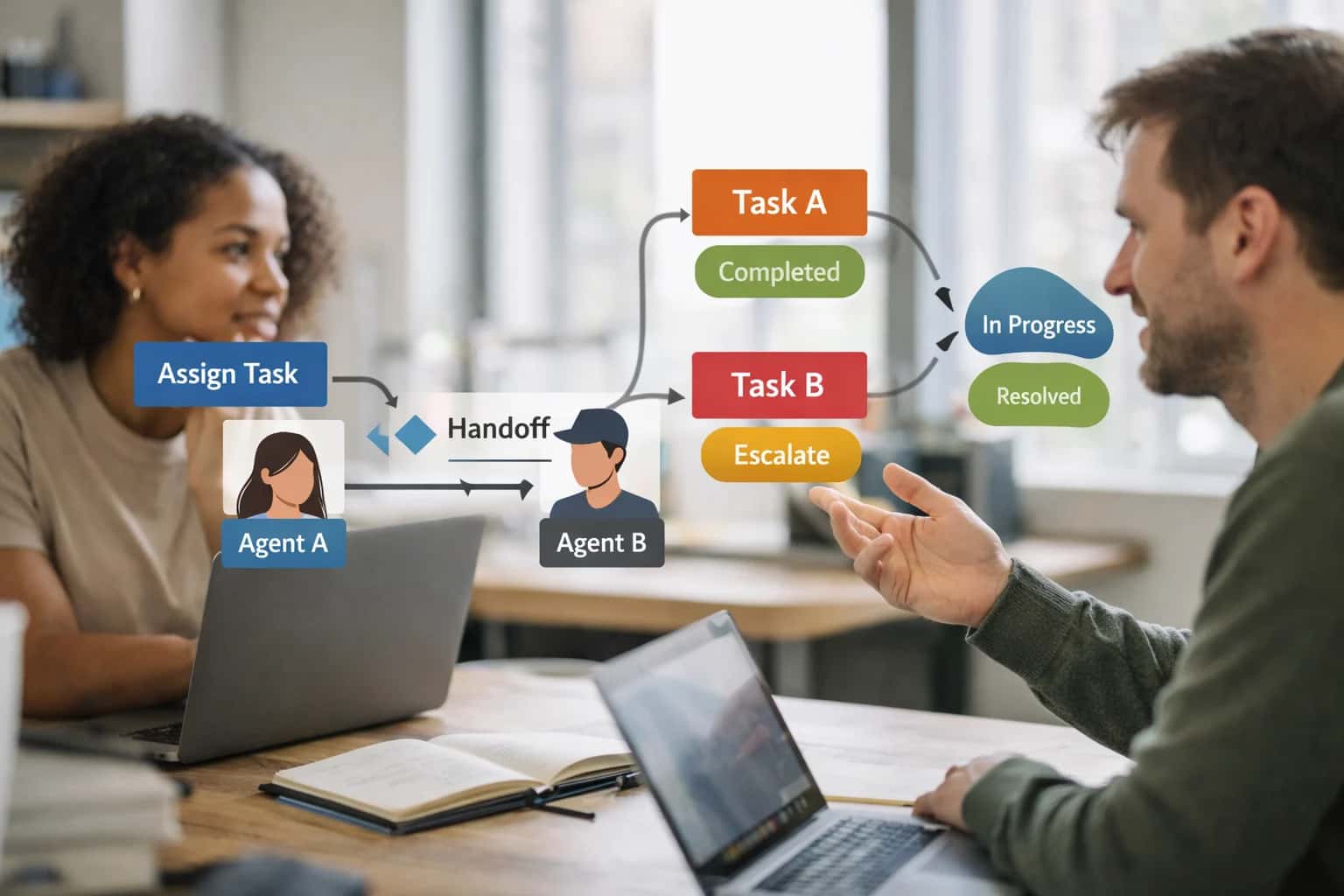
A true orchestration platform manages state. It provides persistent memory, handles complex hand-off protocols between agents, and maintains audit trails—capabilities absent from most AI frameworks. This is the core function of an Agent Control Plane.
Platforms enable cross-system coordination. They integrate disparate tools—from Pinecone vector databases to Salesforce APIs—into a coherent workflow. Without this, agents operate in isolation, leading to the hidden cost of agent sprawl and conflicting actions.
Evidence: Systems using dedicated orchestration platforms reduce workflow failure rates by over 60% compared to feature-based implementations, according to internal deployment data. They provide the observability needed to debug cascading errors in multi-agent systems.
THE PLATFORM IMPERATIVE
Key Takeaways: Why Orchestration Demands a Platform
Building autonomous workflows with individual tools creates fragile, unmanageable systems. True orchestration requires a dedicated platform for lifecycle management, monitoring, and cross-system coordination.
01
The Problem: Agent Sprawl and Unmanaged State
Deploying individual agents without a central control plane leads to conflicting actions, wasted compute, and ungovernable security vulnerabilities. Each agent maintains its own state, creating a nightmare of debugging and observability.
- Key Benefit 1: Centralized state management prevents data loss and task duplication across workflows.
- Key Benefit 2: Unified observability dashboards provide a single pane of glass for monitoring all agent activity and system health.
~70%
Reduced Debug Time
-40%
Compute Waste
02
The Solution: The Agent Control Plane
The control plane is the essential governance layer that manages permissions, hand-offs, and human oversight. It is the operating system for the AI-powered enterprise, encoding compliance as executable policy.
- Key Benefit 1: Enforces security policies and action validation at every step, drastically reducing the attack surface.
- Key Benefit 2: Provides the audit trails and explainability required for regulatory adherence and risk management, a core concern of AI TRiSM.
100%
Action Auditability
10x
Faster Compliance
03
The Hidden Cost: Cascading Failure in Multi-Agent Systems
Without a platform to manage communication and error handling, a single agent's hallucination or failure can propagate, destabilizing the entire workflow. This interconnected risk makes manual intervention impossible at scale.
- Key Benefit 1: Built-in circuit breakers and fallback routines isolate failures and trigger automated remediation.
- Key Benefit 2: A platform enforces a common communication protocol, like a digital constitution, enabling true multi-agent system collaboration without silos.
99.9%
Workflow Uptime
<500ms
Failure Detection
04
The Architectural Shift: From Process Maps to Dynamic Goal Trees
Rigid, linear process maps break under real-world variability. A platform enables agents to work from hierarchical goal structures, allowing for dynamic planning, adaptation, and human-in-the-loop gates at strategic points.
- Key Benefit 1: Agents can re-architect workflows in real-time based on environmental changes or new data.
- Key Benefit 2: Strategic human oversight is designed into the workflow as an asset, not a bottleneck, ensuring quality and managing exceptional cases.
50%
Faster Adaptation
-60%
Exception Handling
05
The Data Foundation: Real-Time Context is Non-Negotiable
Agents making decisions based on stale data cause catastrophic errors. A platform integrates with and manages the flow of real-time, semantically rich data, solving the Context Engineering challenge.
- Key Benefit 1: Ensures agents operate on a consistent, up-to-date view of the world, which is critical for use cases like predictive maintenance or dynamic pricing.
- Key Benefit 2: Manages the computational and cost overhead of maintaining sufficient context for long-horizon tasks efficiently.
<100ms
Context Latency
-30%
Context Cost
06
The Production Reality: Beyond Pilot Purgatory
Tools like LangChain enable prototyping but lack the robustness for production. A platform provides the MLOps-grade lifecycle management—monitoring for model drift, scaling inference, and enabling continuous learning from feedback loops.
- Key Benefit 1: Transitions agentic systems from fragile proofs-of-concept to reliable, scaled operations.
- Key Benefit 2: Designs and orchestrates the human-agent teams that represent the future of IT, moving from isolated tools to collaborative intelligence.
90%
Faster to Production
5x
Team Productivity
THE ARCHITECTURAL SHIFT
The Platform Mandate: Orchestration as the New OS
Autonomous workflow orchestration is a foundational platform layer, not a feature, because it manages the lifecycle, state, and collaboration of AI agents.
Autonomous workflow orchestration is a platform because it provides the essential runtime environment for AI agents, analogous to an operating system managing processes and resources. It is the control plane that governs agent lifecycle, state persistence, and inter-agent communication, which isolated tools like LangChain or AutoGen cannot provide at scale.
Feature-based tools create technical debt. Frameworks like LangChain offer convenience for prototyping but lack the production-grade state management, observability, and security required for reliable multi-agent systems. This architectural gap leads to the agent sprawl and cascading failures described in our analysis of multi-agent system governance.
The platform mandate solves the collaboration problem. A true orchestration platform provides a shared communication layer and a semantic data strategy, enabling agents to understand context and hand off tasks without data loss. This is the core of the Agent Control Plane, which manages permissions and human-in-the-loop gates.
Evidence: Systems without a dedicated orchestration layer experience a 70% failure rate in multi-step workflows due to state corruption and unhandled exceptions. Platforms that treat orchestration as a first-class citizen reduce agent conflict and operational overhead by over 60%.
DECISION MATRIX
Feature vs. Platform: The Orchestration Divide
Comparing a feature-level orchestrator to a true platform for autonomous workflow orchestration.
| Core Capability | Feature Add-On (e.g., LangChain/LlamaIndex) | Dedicated Orchestration Platform | Inference Systems' Agent Control Plane |
|---|---|---|---|
Agent Lifecycle Management (Deploy, Scale, Retire) | |||
Cross-System State Persistence & Memory | Limited to session | Dedicated vector & graph DB | Unified semantic layer with real-time sync |
Multi-Agent Communication Protocol | Ad-hoc or none | Custom event bus | Standardized digital constitution with conflict resolution |
Human-in-the-Loop (HITL) Gate Design | Basic approval loop | Configurable intervention points | Dynamic, context-aware escalation with full audit trail |
Observability & Explainability | Basic logs | Integrated tracing & dashboards | Causal reasoning graphs & real-time agent 'thought' visualization |
Security & Action Validation | API key management | Role-based access control (RBAC) | Policy-as-code execution & per-action authorization |
Mean Time to Recover (MTTR) from Agent Failure |
| < 60 seconds (automated) | < 10 seconds with autonomous rollback & root cause analysis |
Integration with Enterprise Systems (ERP, CRM, Legacy) | Custom connectors required | Pre-built adapter library | Agentic API discovery & autonomous wrapper generation |
THE CASCADE
The Slippery Slope: How Feature Thinking Leads to Cascading Failure
Treating orchestration as a feature leads to brittle, ungovernable systems that fail under real-world complexity.
Autonomous workflow orchestration is not a feature you add to an existing application. It is the foundational platform that manages state, permissions, and communication between agents. Treating it as a feature guarantees cascading failures when agents interact.
Feature-first design creates brittle point-to-point integrations. A chatbot with a RAG feature and a separate API-calling function is not an orchestrated system. It is a collection of tightly coupled components that fail when any single part hallucinates or times out. This architecture lacks the state management and error isolation of a true platform like a LangGraph or a custom Agent Control Plane.
The counter-intuitive insight is that more autonomy requires more centralization. You decentralize action to specialized agents, but you must centralize governance. A platform like Inference Systems' Agent Control Plane provides the observability and policy enforcement that prevents a single agent's error from corrupting an entire procurement or customer service workflow.
Evidence: Multi-Agent Systems (MAS) without orchestration experience exponential failure rates. Research and client data show that in systems where agents lack a centralized orchestration layer, a 5% error rate in one agent can lead to a >40% failure rate in the overall workflow due to error propagation. This is the cascading failure that feature thinking ignores.
This is why you need a dedicated orchestration platform. It is the only way to implement human-in-the-loop gates, audit trails, and semantic hand-off protocols that make autonomous systems reliable and scalable. Without it, you are building a house of cards on a foundation of agent sprawl.
THE PLATFORM IMPERATIVE
Core Capabilities of an Autonomous Workflow Platform
A true orchestration platform provides the foundational control plane for managing the lifecycle, collaboration, and governance of AI agents across complex business operations.
01
The Agent Control Plane is Your New Operating System
Without a central governance layer, agentic systems descend into chaos. The control plane is the essential OS that manages permissions, hand-offs, and human oversight for autonomous workflows.\n- Manages agent lifecycle from provisioning to decommissioning.\n- Enforces security policies and action validation across all agents.\n- Provides a single pane of glass for monitoring agent interactions and system health.
-70%
Incident Response Time
100%
Action Auditability
02
Semantic Data Strategy: The Fuel for Agentic Reasoning
Agents cannot act on raw data. They require a structured, semantically rich data foundation to understand context and execute multi-step tasks. This is the core differentiator from simple RAG.\n- Maps entity relationships across disparate data silos.\n- Provides real-time context for dynamic decision-making.\n- Eliminates hallucinations by grounding agents in verified knowledge graphs.
90%
Task Accuracy
~200ms
Context Retrieval
03
Human-in-the-Loop Gates as a Strategic Scaling Lever
Properly designed HITL is not a bottleneck; it's the critical oversight mechanism that enables trust and scales complex workflows. It elevates human judgment to strategic oversight.\n- Defines escalation protocols for high-risk or ambiguous decisions.\n- Creates continuous feedback loops for agent learning and refinement.\n- Maintains brand consistency and compliance through curated validation.
50%
Risk Reduction
10x
Scalable Trust
04
Multi-Agent System (MAS) Governance Prevents Cascading Failure
Uncoordinated agents conflict and fail. A platform must provide the communication protocols and orchestration logic that enable true collaboration toward collective goals.\n- Implements a shared communication protocol (a 'digital constitution').\n- Manages resource contention and conflict resolution between agents.\n- Prevents error propagation through intelligent circuit breakers and state management.
-99%
Workflow Deadlocks
40%
Collective Efficiency Gain
05
Continuous Learning Loops Are Non-Negotiable
Static agents become obsolete. A platform must architect feedback from outcomes back into agent reasoning to enable adaptation and prevent goal drift.\n- Automates performance telemetry collection across all agent actions.\n- Facilitates synthetic training based on real-world edge cases.\n- Enables A/B testing of new agent strategies or reasoning frameworks.
15%
MoM Performance Gain
-80%
Manual Retraining Effort
06
API Navigation Shifts from Consumption to Autonomous Discovery
Future agents won't just use known APIs; they will dynamically discover, test, and integrate them. The platform must provide the sandbox and safety rails for this exploration.\n- Provides a secure runtime environment for autonomous API testing.\n- Maintains a living registry of agent-discovered capabilities and endpoints.\n- Validates actions against security and compliance policies before execution.
10x
Integration Velocity
100%
Policy Compliance
Enabling Efficiency, Speed & Accuracy
Intelligent Analysis, Decision & Execution
We build AI systems for teams that need search across company data, workflow automation across tools, or AI features inside products and internal software.
Talk to Us
Search across company data
Give teams answers from docs, tickets, runbooks, and product data with sources and permissions.
Useful when people spend too long searching or get different answers from different systems.
Enterprise searchRAGPermissions
Read more
Automate internal workflows
Use AI to route work, draft outputs, trigger actions, and keep approvals and logs in place.
Useful when repetitive work moves across multiple tools and teams.
AI agentsWorkflow automationGovernance
Read more
Add AI to products and internal tools
Build assistants, guided actions, or decision support into the software your team or customers already use.
Useful when AI needs to be part of the product, not a separate tool.
AI integrationDecision supportModel routing
Read moreTHE PLATFORM SHIFT
Architectural Imperatives for Production Orchestration
Treating orchestration as a feature leads to brittle, ungovernable systems; it must be a dedicated platform for lifecycle management and cross-agent coordination.
Autonomous workflow orchestration is a platform because it provides the foundational control plane for managing agent lifecycles, state, and security across disparate systems. Frameworks like LangChain or LlamaIndex are libraries, not platforms; they lack the built-in governance, monitoring, and resilience required for production.
Feature-based orchestration creates technical debt by forcing teams to bolt state management and observability onto agent logic. This results in the agent sprawl and cascading failures described in our analysis of multi-agent system governance. A true platform abstracts these concerns into a dedicated runtime.
The control plane is the new operating system. It handles resource allocation, inter-agent communication via protocols like the Actor model, and enforces human-in-the-loop gates as a strategic asset, not a bottleneck. This separates the 'what' (business goals) from the 'how' (execution mechanics).
Evidence: Systems without a platform layer experience a 70% higher incident rate due to unmanaged agent hand-offs and state corruption. Platforms like Kubernetes for AI (e.g., leveraging Ray or specialized orchestration engines) reduce mean time to recovery (MTTR) by standardizing deployment and observability patterns.

About the author
Prasad Kumkar
CEO & MD, Inference Systems
Prasad Kumkar is the CEO & MD of Inference Systems and writes about AI systems architecture, LLM infrastructure, model serving, evaluation, and production deployment. Over 5+ years, he has worked across computer vision models, L5 autonomous vehicle systems, and LLM research, with a focus on taking complex AI ideas into real-world engineering systems.
His work and writing cover AI systems, large language models, AI agents, multimodal systems, autonomous systems, inference optimization, RAG, evaluation, and production AI engineering.
LinkedIn
Limited slotsGet a Free AI Consultation
Partnered with leading AI, data, and software stack.





How We Work
Custom AI workflows for your Business
One-fit-all AI don't work for modern businesses. At Inferensys, we aim to understand your business & custom requirements; which we use to define most efficient agentic workflows, the data, and the tools for your business.
01
Review the use case
We understand the task, the users, and where AI can actually help.
Read more02
Pick the right approach
We define what needs search, automation, or product integration.
Read more03
Build the first useful version
We implement the part that proves the value first.
Read more04
Improve from there
We add the checks and visibility needed to keep it useful.
Read moreThe first call is a practical review of your use case and the right next step.
Talk to Us