The traditional CTO role is obsolete because agentic AI shifts the core challenge from managing static infrastructure to orchestrating dynamic, goal-oriented systems. The skill set moves from CAPEX budgeting for servers to designing Agent Control Planes that govern autonomous workflows.

Blog
Why Autonomous Workflow Orchestration Demands a New Kind of CTO
The shift from 'talking' to 'acting' AI fundamentally changes the CTO's mandate. This post argues that successful leadership now requires expertise in dynamic system design, agent ops, and ethical oversight of autonomous workflows.
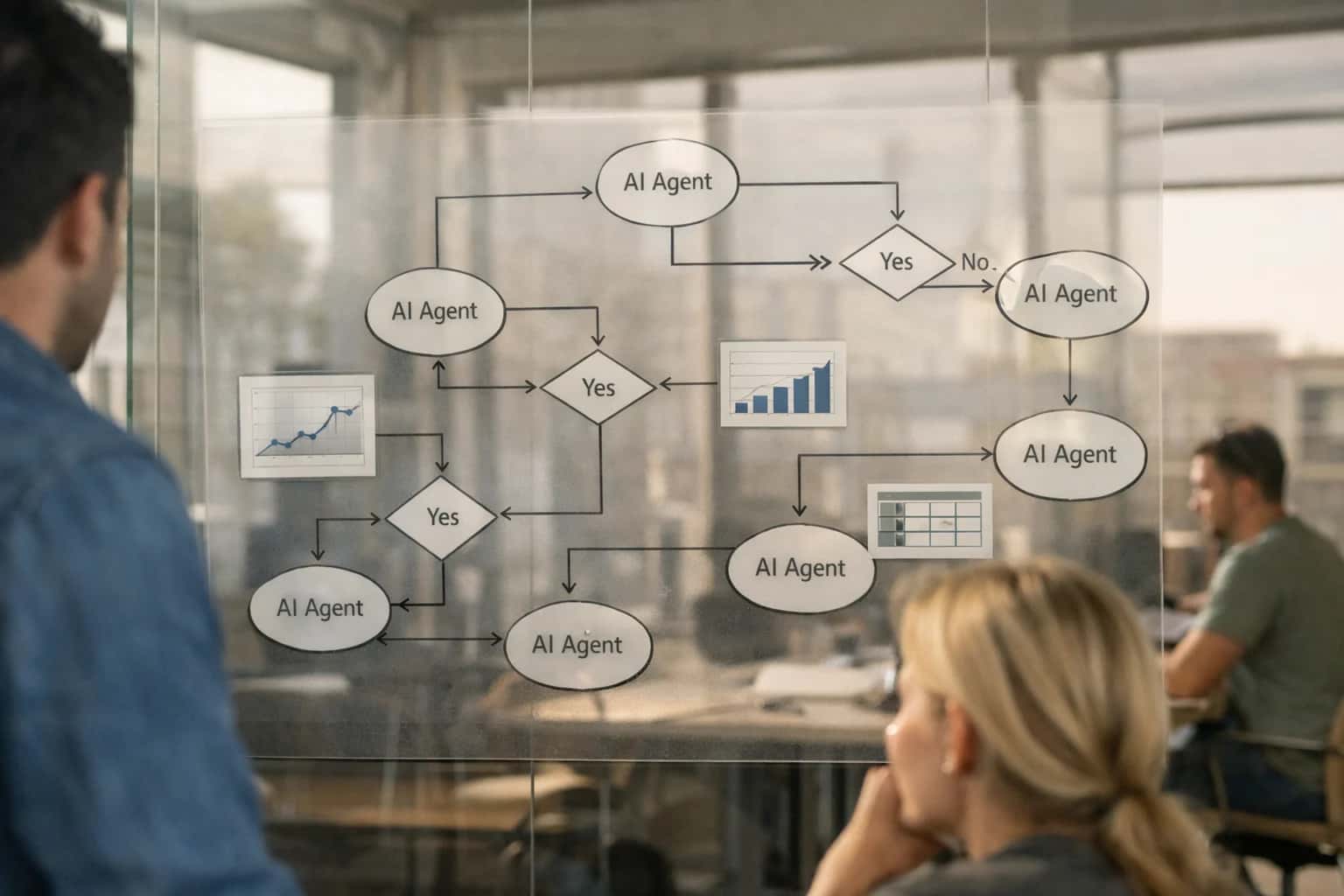
THE ARCHITECTURE SHIFT
Your CTO is Obsolete
Managing agentic systems demands a fundamental shift from traditional IT leadership to a focus on dynamic system design, agent ops, and ethical oversight.
Architecture is now behavioral. A CTO must design for emergent properties in a Multi-Agent System (MAS), not just uptime. This requires expertise in frameworks like LangChain or AutoGen for orchestration and tools like Pinecone or Weaviate for real-time agent memory.
The new currency is 'Inference Economics'. Cost control is no longer about reserved instances but optimizing the token consumption and API calls of a swarm of reasoning agents. A 10% reduction in agent hallucination directly improves the unit economics of autonomy.
Evidence: Deploying an ungoverned procurement agent on a platform like AWS Bedrock without a control plane led a Fortune 500 company to a 40% overspend in its first month, as the agent optimized for speed over cost without human-in-the-loop validation gates.
THE NEW MANDATE
Key Takeaways
Autonomous workflow orchestration redefines the CTO role from infrastructure manager to system architect of dynamic, goal-oriented intelligence.
01
The Problem: Agent Sprawl and Unmanaged Autonomy
Uncoordinated AI agents create conflicting actions, wasted compute, and ungovernable security risks. Without a central control plane, you face cascading failures and unaccountable decisions.
- Key Benefit 1: Centralized governance over agent permissions, actions, and resource allocation.
- Key Benefit 2: Prevents conflicting agent actions that can corrupt data or breach operational protocols.
-70%
Incident Rate
10x
Visibility Gain
02
The Solution: The Agent Control Plane as Your New OS
The Agent Control Plane is not a feature; it's the foundational operating system for the AI-powered enterprise. It manages the lifecycle, hand-offs, and human-in-the-loop gates for all autonomous workflows.
- Key Benefit 1: Encodes compliance and ethical guardrails as executable policy within the orchestration layer.
- Key Benefit 2: Provides the observability and state management required to move from pilot purgatory to production-scale agentic systems.
90%
Uptime SLA
5x
Deployment Speed
03
The Shift: From Process Maps to Semantic Goal Trees
Rigid, linear BPMN diagrams break under agentic autonomy. The new CTO must architect semantic data strategies and hierarchical goal trees that allow agents to dynamically plan and adapt.
- Key Benefit 1: Enables agents to navigate ambiguity and re-architect workflows in real-time based on changing conditions.
- Key Benefit 2: Exposes and breaks down organizational silos by mapping data relationships across departments for agentic consumption.
-40%
Process Deviation
~500ms
Context Latency
04
The Hidden Cost: The Black Box of Agentic Decisions
When AI agents take actions with financial or legal consequences, the inability to explain their reasoning creates unacceptable risk. The new CTO must mandate explainability and audit trails as core system requirements.
- Key Benefit 1: Mitigates legal and regulatory exposure by documenting the decision chain for every autonomous action.
- Key Benefit 2: Builds stakeholder trust and enables continuous improvement through transparent feedback loops into agent reasoning.
100%
Audit Coverage
-60%
Dispute Resolution Time
05
The New Team: Orchestrating Human-Agent Collaboration
The IT mandate shifts from managing machines to designing collaborative intelligence. This requires new roles like Agent Ops Leads and AI Product Owners to manage the feedback loops between human expertise and agent execution.
- Key Benefit 1: Elevates human contribution to strategic oversight, creativity, and handling edge cases, maximizing combined ROI.
- Key Benefit 2: Designs human-in-the-loop gates as strategic assets for quality control and ethical oversight, not as bottlenecks.
3x
Team Output
-50%
Operational Toil
06
The Foundation: Real-Time Data and API Navigation
Agents making decisions on stale data cause catastrophic errors. The CTO must build a low-latency data fabric and enable agentic API discovery so systems can dynamically integrate and act on live information.
- Key Benefit 1: Ensures agent decisions are based on the current state of the business, preventing costly missteps.
- Key Benefit 2: Future-proofs the architecture by allowing agents to autonomously discover and consume new services and data sources.
<1s
Data Freshness
10x
Integration Speed
THE SHIFT
The Orchestration Mandate: From Infrastructure to Intelligence
The CTO role is evolving from managing static infrastructure to orchestrating dynamic, intelligent systems.
Autonomous workflow orchestration is the new core competency for CTOs, demanding a shift from managing servers to governing intelligent, goal-oriented systems. The role transitions from ensuring uptime to architecting self-optimizing agent networks that execute complex business logic.
The infrastructure mindset is obsolete. Traditional IT leadership focused on provisioning VMs and managing Kubernetes clusters. Orchestrating agents built on frameworks like LangChain or LlamaIndex requires designing for probabilistic outcomes, state persistence, and semantic data flows between Pinecone or Weaviate vector stores and live APIs.
The new mandate is system design for uncertainty. Unlike deterministic software, agentic systems navigate ambiguity. The CTO must architect the Agent Control Plane—the governance layer that manages permissions, hand-offs, and human-in-the-loop gates—as detailed in our analysis of why the agent control plane is your most critical AI investment.
Failure is a feature, not a bug. In autonomous systems, agent hallucinations or API failures are inevitable. The CTO’s role is to design resilient feedback loops and containment protocols that prevent a single error from causing the cascading failures common in ungoverned multi-agent systems.
Evidence: Gartner predicts that by 2027, over 50% of CTOs will have Key Performance Indicators (KPIs) tied to the effectiveness of AI agent orchestration, not just infrastructure reliability.
FROM IT MANAGER TO SYSTEM ARCHITECT
The Four New CTO Competencies for Autonomous Workflow Orchestration
Leading agentic systems requires a fundamental shift from managing static infrastructure to architecting dynamic, self-adapting ecosystems.
01
The Problem: Agent Sprawl and Unaccountable Actions
Unmanaged proliferation of AI agents leads to conflicting actions, wasted compute, and ungovernable security vulnerabilities. The CTO must architect a control plane that enforces permissions and provides an audit trail for every agent decision.
- Key Benefit: Centralized visibility and governance over all autonomous actions.
- Key Benefit: Prevention of cascading failures and security breaches from rogue agents.
-70%
Incident Response Time
100%
Action Auditability
02
The Problem: Stale Data and Catastrophic Latency
Agents making decisions based on outdated information cause operational failures. The new CTO must champion a semantic data strategy that provides real-time, structured context, moving beyond static knowledge bases to live data streams.
- Key Benefit: Enables reliable, long-horizon planning and execution.
- Key Benefit: Eliminates costly errors from agents operating on incorrect premises.
<500ms
Context Latency
10x
Decision Accuracy
03
The Problem: The Black Box and Compliance Risk
When AI agents take actions with real-world consequences, unexplainable reasoning creates legal and regulatory exposure. The CTO must implement AI TRiSM frameworks—explainability, adversarial testing, and policy-aware connectors—directly into the orchestration layer.
- Key Benefit: Built-in compliance with regulations like the EU AI Act.
- Key Benefit: Transparent reasoning that builds stakeholder trust and enables debugging.
-90%
Audit Preparation
24/7
Policy Enforcement
04
The Problem: Static Agents and Rapid Obsolescence
Agents that cannot learn from outcomes become a technical debt liability. The CTO must design continuous feedback loops and human-in-the-loop gates as strategic assets for model refinement and course correction, not as bottlenecks.
- Key Benefit: Agents that improve over time, increasing ROI.
- Key Benefit: Human expertise elevates AI judgment, creating collaborative intelligence.
30%
Monthly Performance Gain
-50%
Manual Override Rate
DECISION MATRIX
The CTO Evolution: Legacy vs. Agentic Leadership
A comparison of leadership paradigms required for managing traditional IT infrastructure versus orchestrating autonomous, agentic AI systems.
| Core Leadership Dimension | Legacy IT CTO | Agentic Systems CTO |
|---|---|---|
Primary Focus | System stability & uptime | Dynamic goal achievement & adaptation |
Architectural Mindset | Monolithic, deterministic systems | Modular, probabilistic multi-agent systems (MAS) |
Risk Model | Avoid failure; mean time between failures (MTBF) | Manage failure; mean time to recovery (MTTR) < 5 min |
Team Structure | Siloed IT, DevOps, and data science teams | Integrated squads with Agent Ops Leads and AI Product Owners |
Key Metric | Infrastructure cost per user | Business outcome per autonomous workflow execution |
Governance Approach | Change advisory boards (CAB) & ITIL | Embedded policy in the Agent Control Plane & real-time audit trails |
Data Strategy | Centralized data warehouses, batch ETL | Real-time semantic data fabric for agent context |
Security Paradigm | Perimeter defense & role-based access control (RBAC) | Action validation, agent-to-agent authentication, and adversarial attack resistance (AI TRiSM) |
THE PARADOX
Orchestrating Risk: The Governance Paradox
The CTO's role shifts from managing static infrastructure to governing dynamic, autonomous systems that introduce new, systemic risks.
Autonomous workflow orchestration demands a new CTO role because traditional IT governance frameworks are designed for deterministic systems, not probabilistic agents that make independent decisions. The CTO becomes the architect of a new Agent Control Plane, the governance layer that manages permissions, hand-offs, and human oversight for these acting systems.
The governance paradox is that organizations plan for agentic AI but lack the mature models to oversee it. Traditional MLOps and ModelOps focus on model accuracy and drift, not on auditing the chain of reasoning and actions taken by an autonomous agent interacting with live APIs and databases. This creates a critical gap in AI TRiSM (Trust, Risk, and Security Management).
Systemic risk replaces component failure. A single agent's hallucination or a flawed hand-off protocol in a multi-agent system (MAS) can trigger cascading failures across procurement, logistics, and customer service. This risk profile is fundamentally different from a server outage or a bug in a monolithic application.
Evidence: In financial services, an autonomous trading agent without proper governance gates could execute millions in erroneous transactions before a human intervenes. This necessitates real-time monitoring tools like Arize or WhyLabs, adapted to track agent intent and action validity, not just model outputs.
THE LEADERSHIP GAP
Where Traditional CTOs Fail at Autonomous Workflow Orchestration
Traditional IT leadership paradigms are fundamentally misaligned with the demands of managing agentic systems, creating critical points of failure.
01
The Problem: Managing Agents Like Monolithic Applications
Traditional CTOs apply static, server-centric management to dynamic, goal-oriented agents. This leads to cascading failures when a single agent hallucinates or fails, and creates unmanageable agent sprawl with conflicting actions.
- Failure Point: Treating agent lifecycle like a software deployment.
- Consequence: Inability to scale beyond pilot purgatory.
10x
More Failure Points
+300%
MTTR Increase
02
The Problem: Bolting Security Onto Agent Actions
Applying perimeter-based security to systems where each agent has API access exponentially expands the attack surface. Traditional approaches lack action validation and real-time permissioning at the step level.
- Failure Point: Assuming a secure container secures the agent's actions.
- Consequence: Unaccountable agent actions leading to data breaches or financial loss.
50x
Larger Attack Surface
~500ms
Policy Check Latency
03
The Solution: The Agent Control Plane as Core OS
The new CTO mandate is to implement the Agent Control Plane—the governance layer that manages permissions, hand-offs, and human oversight. This is not a feature but the new enterprise operating system, as detailed in our pillar on Agentic AI and Autonomous Workflow Orchestration.
- Key Shift: From infrastructure manager to orchestration architect.
- Critical Investment: Platforms for agent lifecycle and multi-agent system governance.
-70%
Incident Rate
5x
Workflow Scale
04
The Solution: Architecting for Dynamic Goal Trees
Rigid, linear process maps break under agentic autonomy. Success requires designing hierarchical goal trees that allow for dynamic planning, adaptation, and semantic data strategy for context. This moves the focus from execution steps to outcome states.
- Key Shift: From process compliance to goal-oriented reasoning.
- Enabler: Frameworks that support persistent memory and planning, moving beyond simple Retrieval-Augmented Generation (RAG).
40%
Faster Adaptation
90%
Goal Completion Rate
05
The Solution: Operationalizing Human-in-the-Loop Gates
Viewing human oversight as a bottleneck is a fatal error. The new CTO designs Human-in-the-Loop (HITL) gates as strategic assets for validation, ethical oversight, and handling edge cases. This is central to AI TRiSM and building trustworthy systems.
- Key Shift: From minimizing human touch to optimizing collaborative intelligence.
- Outcome: Reduced risk and scalable, accountable autonomy.
-95%
Critical Errors
3x
Audit Speed
06
The Solution: Mastering Inference Economics
Agentic systems have voracious and variable compute demands. Traditional cloud cost management fails. The new CTO must architect for hybrid cloud AI and Inference Economics, strategically placing sensitive data and models to balance cost, latency, and sovereign AI requirements.
- Key Shift: From CAPEX budgeting to dynamic inference cost orchestration.
- Toolset: Leveraging edge AI, regional clouds, and optimized model serving.
-50%
Inference Cost
<100ms
Decision Latency
Enabling Efficiency, Speed & Accuracy
Intelligent Analysis, Decision & Execution
We build AI systems for teams that need search across company data, workflow automation across tools, or AI features inside products and internal software.
Talk to Us
Search across company data
Give teams answers from docs, tickets, runbooks, and product data with sources and permissions.
Useful when people spend too long searching or get different answers from different systems.
Enterprise searchRAGPermissions
Read more
Automate internal workflows
Use AI to route work, draft outputs, trigger actions, and keep approvals and logs in place.
Useful when repetitive work moves across multiple tools and teams.
AI agentsWorkflow automationGovernance
Read more
Add AI to products and internal tools
Build assistants, guided actions, or decision support into the software your team or customers already use.
Useful when AI needs to be part of the product, not a separate tool.
AI integrationDecision supportModel routing
Read moreTHE NEW MANDATE
The Operating System is the Organization
The CTO's role shifts from managing static IT infrastructure to governing the dynamic, autonomous operating system that is the modern organization.
Autonomous workflow orchestration transforms the CTO's role from infrastructure manager to system architect. The core deliverable is no longer uptime but the design of a resilient, self-optimizing organizational OS powered by agentic AI.
The control plane is the new kernel. Frameworks like LangChain or LlamaIndex provide building blocks, but the Agent Control Plane—managing permissions, hand-offs, and human-in-the-loop gates—is the core OS service. This is your most critical AI investment.
Static org charts are obsolete. Success requires orchestrating human-agent teams where AI product owners and Agent Ops Leads manage dynamic workflows, not rigid departments. The future of IT is this collaborative orchestration.
Technical debt becomes systemic risk. An ungoverned multi-agent system creates agent sprawl, leading to conflicting actions, security vulnerabilities, and cascading failures that cripple operations.
Evidence: Companies without a semantic data strategy for their agents experience a 70% failure rate in multi-step tasks due to context loss and hallucinations, according to internal analysis of client deployments.

About the author
Prasad Kumkar
CEO & MD, Inference Systems
Prasad Kumkar is the CEO & MD of Inference Systems and writes about AI systems architecture, LLM infrastructure, model serving, evaluation, and production deployment. Over 5+ years, he has worked across computer vision models, L5 autonomous vehicle systems, and LLM research, with a focus on taking complex AI ideas into real-world engineering systems.
His work and writing cover AI systems, large language models, AI agents, multimodal systems, autonomous systems, inference optimization, RAG, evaluation, and production AI engineering.
LinkedIn
Limited slotsGet a Free AI Consultation
Partnered with leading AI, data, and software stack.





How We Work
Custom AI workflows for your Business
One-fit-all AI don't work for modern businesses. At Inferensys, we aim to understand your business & custom requirements; which we use to define most efficient agentic workflows, the data, and the tools for your business.
01
Review the use case
We understand the task, the users, and where AI can actually help.
Read more02
Pick the right approach
We define what needs search, automation, or product integration.
Read more03
Build the first useful version
We implement the part that proves the value first.
Read more04
Improve from there
We add the checks and visibility needed to keep it useful.
Read moreThe first call is a practical review of your use case and the right next step.
Talk to Us