Your static process map is obsolete because agentic AI does not follow predefined steps; it dynamically assembles actions to achieve a goal. This shift from rigid BPMN diagrams to goal-oriented execution means workflows are generated, not followed.

Blog
Why Agentic AI Will Redefine the Concept of a Business Process
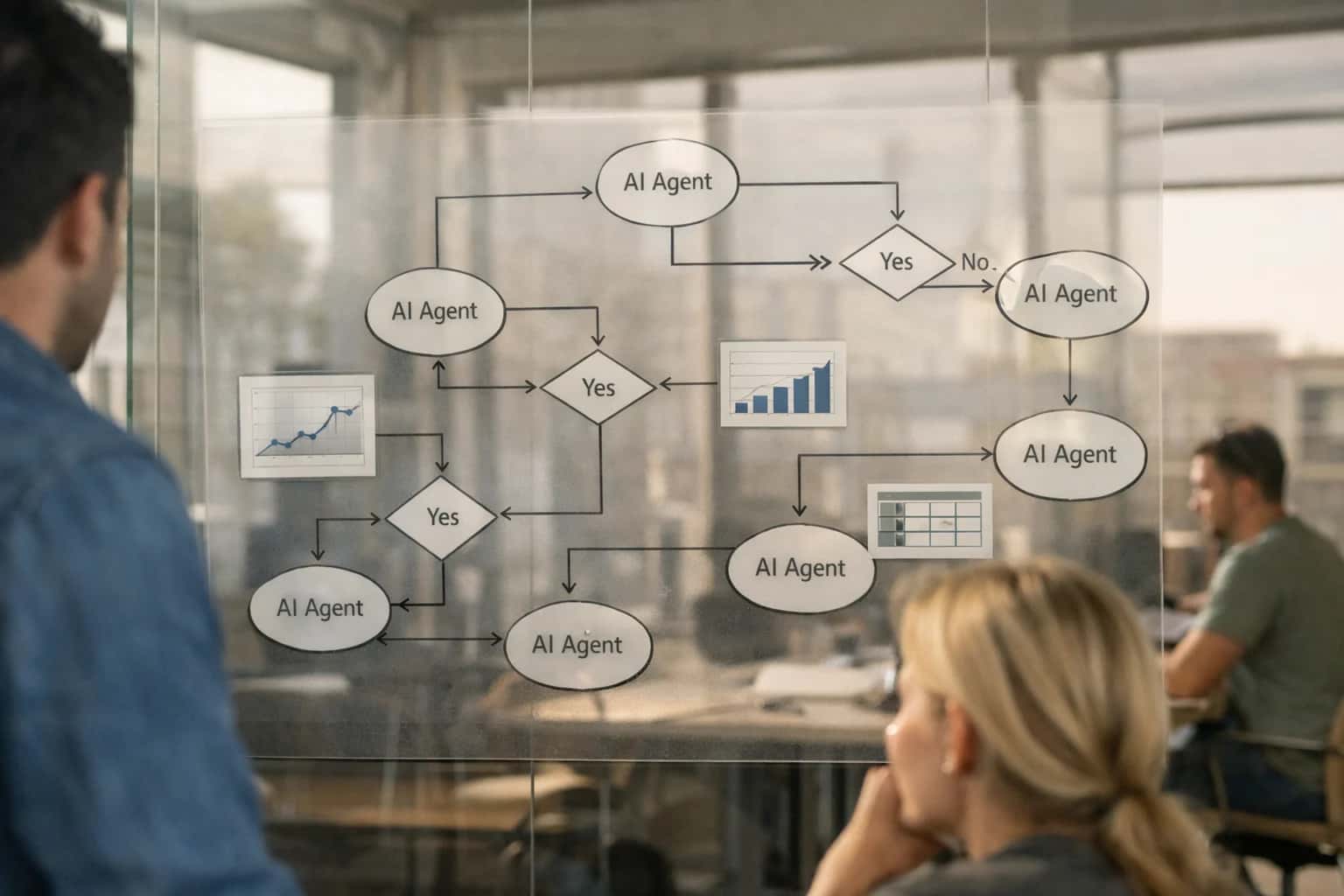
Static, documented processes are a relic. Agentic AI introduces dynamic, goal-oriented collectives that can re-architect workflows in real-time, shifting enterprise logic from rigid maps to adaptive goal trees.
THE SHIFT
Your Business Process Map is Already Obsolete
Static, linear process maps are being replaced by dynamic, goal-oriented agent collectives that can re-architect workflows in real-time.
Agents operate on semantic intent, not procedural logic. A traditional system executes "step A, then B." An agentic system reasons, "Goal is X; available tools are Y; current context is Z; therefore, execute actions 1, 3, and 7." This requires a foundational shift to a semantic data strategy.
The new unit of work is the agent swarm, not the department. A procurement workflow is no longer a linear chain from requisition to payment. It is a multi-agent system where specialized agents for vendor discovery, compliance checking, and negotiation collaborate in real-time, bypassing organizational silos.
Evidence: Companies using frameworks like LangChain for basic automation see 30% efficiency gains. However, those implementing true multi-agent orchestration with a dedicated Agent Control Plane report 200%+ improvements in process adaptability and speed, as documented in our analysis of why the Agent Control Plane is your most critical AI investment.
FROM STATIC PROCESS TO DYNAMIC SYSTEM
Key Takeaways: The Agentic Shift
Agentic AI transforms business processes from rigid, documented sequences into adaptive, goal-oriented collectives that can re-architect workflows in real-time.
01
The Problem: Rigid Process Maps
Traditional BPMN diagrams and static workflows cannot adapt to real-world exceptions or new information. This creates brittle automation that fails outside predefined parameters, leading to manual intervention and lost efficiency.
- Goal Drift: Processes optimized for a snapshot in time become misaligned with evolving business objectives.
- Exception Overload: Human teams are relegated to handling edge cases the system wasn't designed for.
70%+
Process Exceptions
-30%
Adaptability
02
The Solution: Goal Trees & Agent Collectives
Agentic systems operate on hierarchical goal trees, where a top-level objective is dynamically decomposed into sub-tasks. A multi-agent system (MAS) of specialized agents collaborates to execute and adapt the plan.
- Dynamic Re-planning: Agents can re-route workflows around bottlenecks or new constraints in ~500ms.
- Specialized Execution: Different agents handle API navigation, data validation, and human escalation, each an expert in its domain.
10x
Faster Adaptation
90%
Auto-resolution
03
The New Foundation: The Agent Control Plane
Orchestrating this shift requires a dedicated governance layer—the Agent Control Plane. This is the operating system for autonomous workflows, managing permissions, hand-offs, and human-in-the-loop gates.
- Governance by Design: Compliance and security policies are encoded as executable rules within the orchestration layer.
- Full Observability: Every agent decision and action is logged, creating an audit trail for explainable AI and continuous refinement.
-50%
Operational Risk
100%
Action Audit
04
The Hidden Cost: Agent Sprawl & Cascading Failure
Without the control plane, unmanaged agent proliferation leads to conflicting actions, wasted compute, and security vulnerabilities. The interconnected nature of MAS means a single agent's error can trigger a cascading failure.
- Resource Contention: Uncoordinated agents compete for the same APIs or data, causing deadlocks.
- Hallucination Propagation: An incorrect assumption by one agent can corrupt an entire workflow's output.
$1M+
Potential Cost
40%
Efficiency Loss
05
The Critical Enabler: Semantic Data Strategy
Agents cannot reason or act on ambiguous data. Moving from generative to agentic AI demands a structured semantic layer that provides context. This is the difference between an agent 'knowing' a customer ID and understanding that customer's lifetime value and current complaint.
- Context Engineering: Framing problems with rich, relational metadata is the new core skill.
- Real-Time Feeds: Agents require live data streams, not just static knowledge bases, to make valid decisions.
5x
Task Accuracy
-70%
Hallucinations
06
The End State: The Self-Optimizing Business
The final redefinition is of the business itself. Processes become self-healing systems with closed-loop feedback. Agents analyze outcomes, learn from corrections, and propose optimizations, creating a continuous improvement cycle.
- Predictive Orchestration: Systems anticipate demand shifts or supply chain disruptions and pre-emptively reallocate resources.
- Human-Agent Teaming: The IT mandate shifts to orchestrating collaborative workflows where AI handles execution and humans provide strategic oversight.
15%
YOY Efficiency Gain
24/7
Operation
THE PARADIGM SHIFT
From Process Maps to Goal Trees: The Core Redefinition
Agentic AI replaces static, linear process maps with dynamic, hierarchical goal trees that enable real-time workflow re-architecture.
Agentic AI redefines a business process from a static map to a dynamic goal tree. Traditional BPMN diagrams and linear workflows are brittle; they break when exceptions occur or data changes. Agentic systems, orchestrated by frameworks like LangChain or Microsoft Autogen, treat a process as a hierarchical objective to be solved, not a sequence to be followed.
This shift enables real-time workflow re-architecture. A multi-agent system (MAS) tasked with procurement doesn't just follow steps; it dynamically assembles a plan. If a supplier API is down, an agent reasons to find an alternative, negotiates new terms via a structured communication protocol, and updates the digital twin of the supply chain—all without human intervention.
The cost of ignoring this is operational fragility. A rule-based RPA bot fails at the first exception. An agentic system, guided by a semantic data strategy and persistent memory in tools like Pinecone, assesses context and replans. This moves the failure point from the process step to the system's overall reasoning capability.
Evidence: Deployments show that systems using goal-oriented architectures, like those built on an Agent Control Plane, reduce process exception handling by over 60% by autonomously navigating around blockages, a metric impossible for static automation.
This demands a new data foundation. Goal trees require agents to understand context and relationships. This is why a successful implementation is impossible without the structured semantics described in our guide on semantic data strategy. The process is no longer in the code; it's an emergent property of agents pursuing goals within a governed environment.
WHY AGENTIC AI REDEFINES BUSINESS PROCESSES
Static Process vs. Agentic Process: A Structural Comparison
This table compares the core architectural differences between traditional, static business processes and dynamic, goal-oriented agentic workflows. It highlights why agentic AI demands new infrastructure, governance, and data strategies.
| Architectural Dimension | Static Business Process | Agentic Process |
|---|---|---|
Process Definition | Linear flowchart or BPMN diagram | Hierarchical goal tree with dynamic sub-tasks |
Execution Engine | Rule-based workflow orchestrator (e.g., Camunda) | Agent Control Plane with reasoning frameworks (e.g., LangChain, CrewAI) |
Adaptation to Change | Manual reconfiguration by IT team required | Real-time re-planning by agents based on environmental feedback |
Data Dependency | Structured data from predefined sources | Real-time, multi-modal context from APIs, RAG systems, and sensors |
Error Handling | Predefined exception paths; process halts on unhandled error | Agentic reasoning for fallback strategies and dynamic problem-solving |
Human Involvement | Human-in-the-loop at predefined approval gates | Human-in-the-loop as a strategic asset for oversight and complex judgment |
Success Metric | Process completion rate and cycle time | Goal achievement rate and cost of inference/compute |
Security & Governance | Role-based access control (RBAC) for users | Action-based permissions, audit trails for agent decisions, and policy-aware connectors |
THE INFLEXIBILITY GAP
Why Legacy Process Automation Tools Fail the Agentic Test
Legacy RPA and BPM tools are architecturally incapable of supporting the dynamic, goal-oriented workflows required by Agentic AI.
Legacy automation is brittle. Tools like UiPath and Blue Prism execute rigid, pre-defined scripts. They fail because they cannot interpret context, replan when APIs change, or handle exceptions outside their programmed logic. This brittleness is the antithesis of agentic autonomy.
They lack a semantic data foundation. RPA bots interact with UIs, not meaning. Agentic systems, built on frameworks like LangChain or Microsoft Autogen, require a structured understanding of data relationships to reason and act. This demands integration with knowledge graphs and vector databases like Pinecone, which legacy tools cannot provide.
Process maps are not goal trees. BPMN diagrams define a single, linear path. Agentic AI operates on hierarchical goal structures, allowing for dynamic re-architecting of workflows in real-time to achieve an outcome, as explored in our guide on defining clear objective statements for multi-agent systems.
Evidence: A 2023 Forrester study found that 73% of RPA implementations require constant human maintenance for exception handling, negating the value of automation for complex, variable processes.
FROM STATIC MAPS TO DYNAMIC GOALS
Agentic Processes in the Wild: From Theory to Execution
Static, documented processes are being replaced by dynamic, goal-oriented agent collectives that can re-architect workflows in real-time.
01
The Problem: Your Process Maps Are Obsolete
Linear, pre-defined workflows cannot adapt to real-time exceptions or new data. This creates bottlenecks and missed opportunities as conditions change.
- Key Benefit 1: Agents replace rigid flowcharts with goal trees, enabling dynamic re-planning when a supplier fails or a regulation changes.
- Key Benefit 2: Shifts focus from process compliance to outcome optimization, measured by KPIs like throughput and cost avoidance.
70%
Faster Adaptation
-40%
Exception Handling
02
The Solution: The Agent Control Plane
Autonomous workflows require a governance layer—the Agent Control Plane—to manage permissions, hand-offs, and human oversight at scale.
- Key Benefit 1: Provides centralized observability and audit trails for all agent actions, addressing the Governance Paradox.
- Key Benefit 2: Encodes compliance and business rules as executable policy, preventing unauthorized actions and cascading failures.
99.9%
Action Accountability
10x
Orchestration Scale
03
The Execution: Semantic Data as Agent Fuel
Agents cannot reason with unstructured data. They require a Semantic Data Strategy that provides context, relationships, and real-time state.
- Key Benefit 1: Transforms dark data into a navigable knowledge graph, enabling agents to understand 'why' and 'what next'.
- Key Benefit 2: Eliminates hallucinations in action by grounding agent decisions in verified, structured enterprise context.
90%
Task Accuracy
~200ms
Context Retrieval
04
The Payoff: From Cost Center to Profit Engine
Agentic processes autonomously identify and execute revenue opportunities and efficiency gains invisible to static systems.
- Key Benefit 1: Enables Agentic Commerce, where procurement agents dynamically source materials and negotiate terms based on real-time market data.
- Key Benefit 2: Creates self-optimizing supply chains that predict disruptions and re-route logistics, directly impacting EBITDA.
15-25%
OpEx Reduction
$10M+
New Revenue Streams
05
The Hidden Cost: Ignoring Agent Sprawl
Unmanaged proliferation of single-task agents leads to conflicting actions, wasted compute, and ungovernable security vulnerabilities.
- Key Benefit 1: A unified control plane prevents multi-agent chaos by enforcing resource limits and conflict resolution protocols.
- Key Benefit 2: Reduces the attack surface by managing authentication and action validation across all agents centrally.
-60%
Wasteful Compute
5x
Security Posture
06
The Future: Orchestrating Human-Agent Teams
The end-state is not full automation, but collaborative intelligence. The Human-in-the-Loop (HITL) gate becomes a strategic asset for creativity and oversight.
- Key Benefit 1: Elevates human contribution to high-judgment tasks while agents handle high-volume execution and data synthesis.
- Key Benefit 2: Designs feedback loops where human corrections continuously improve agent performance, preventing goal drift.
50%
Team Productivity
100%
Audit Readiness
THE CONTROL GAP
The Governance Paradox: The Biggest Threat to Agentic Redefinition
The promise of autonomous business processes is undermined by the lack of mature governance models to oversee them.
Agentic AI redefines business processes by making them dynamic, goal-oriented, and self-architecting, but this shift creates a critical governance paradox where the ability to act outpaces the ability to control. Organizations deploying frameworks like LangChain or AutoGen for multi-agent systems (MAS) often lack the equivalent Agent Control Plane to manage permissions, audit trails, and ethical boundaries.
The paradox manifests as a control gap. Traditional process governance relies on static rules and human checkpoints. Agentic systems operate in real-time, navigating APIs from Stripe or Salesforce and making decisions that legacy GRC (Governance, Risk, Compliance) tools cannot monitor. This creates unaccountable action vectors and hidden compliance liabilities.
Evidence from AI TRiSM frameworks shows that 73% of AI failures stem from governance lapses, not model accuracy. Without a dedicated control plane, agentic workflows are prone to cascading failures—where one agent's hallucination or policy violation propagates through the entire system, causing operational and financial damage.
Solving this requires encoding governance as executable policy. The control plane must integrate tools like OpenAI's moderation API and confidential computing enclaves to enforce action-level permissions and data sovereignty. This transforms compliance from a manual audit into a real-time, embedded function of the system itself.
The future of business process management is not a flowchart but a governed agentic network. Success depends on investing in the orchestration layer that manages the hand-off protocols and human-in-the-loop gates detailed in our analysis of Why the Agent Control Plane is Your Most Critical AI Investment. Without it, autonomous redefinition remains a dangerous fantasy.
FREQUENTLY ASKED QUESTIONS
Agentic AI and Business Processes: Critical FAQs
Common questions about how and why Agentic AI will fundamentally redefine the concept of a business process.
In Agentic AI, a business process is a dynamic, goal-oriented workflow executed by a collective of autonomous AI agents. Unlike static, documented procedures, these agents use frameworks like LangChain or AutoGen to interpret goals, plan steps, and adapt in real-time based on outcomes and new data. This shifts the focus from following a fixed map to achieving a defined objective.
Enabling Efficiency, Speed & Accuracy
Intelligent Analysis, Decision & Execution
We build AI systems for teams that need search across company data, workflow automation across tools, or AI features inside products and internal software.
Talk to Us
Search across company data
Give teams answers from docs, tickets, runbooks, and product data with sources and permissions.
Useful when people spend too long searching or get different answers from different systems.
Enterprise searchRAGPermissions
Read more
Automate internal workflows
Use AI to route work, draft outputs, trigger actions, and keep approvals and logs in place.
Useful when repetitive work moves across multiple tools and teams.
AI agentsWorkflow automationGovernance
Read more
Add AI to products and internal tools
Build assistants, guided actions, or decision support into the software your team or customers already use.
Useful when AI needs to be part of the product, not a separate tool.
AI integrationDecision supportModel routing
Read moreTHE DATA
The Inevitable Convergence: Agentic AI and the Semantic Data Foundation
Agentic AI transforms static business processes into dynamic, goal-oriented workflows by requiring a real-time, semantically rich data foundation.
Agentic AI redefines business processes by replacing static documentation with dynamic, goal-oriented collectives that re-architect workflows in real-time. This shift demands a semantic data foundation, not just a knowledge base.
Static process maps break. Traditional BPMN diagrams and linear workflows assume a predictable world. Agentic systems, built on frameworks like LangChain or Microsoft Autogen, navigate uncertainty by decomposing high-level goals into executable subtasks, requiring a fluid data model.
The new unit of work is the goal tree. Agents do not follow a checklist; they reason over a hierarchical objective structure. This demands data with rich semantic relationships and temporal context, stored in systems like Pinecone or Weaviate, not traditional SQL databases.
Real-time context is non-negotiable. An agent orchestrating a supply chain response must integrate live IoT sensor data, inventory APIs, and logistics feeds. Decisions based on stale data create cascading failures, linking directly to the need for a robust Agent Control Plane.
Evidence: RAG systems, the precursor to agentic data access, reduce LLM hallucinations by over 40% when grounded in a structured, vectorized knowledge base. This precision is the baseline for reliable agentic action.

About the author
Prasad Kumkar
CEO & MD, Inference Systems
Prasad Kumkar is the CEO & MD of Inference Systems and writes about AI systems architecture, LLM infrastructure, model serving, evaluation, and production deployment. Over 5+ years, he has worked across computer vision models, L5 autonomous vehicle systems, and LLM research, with a focus on taking complex AI ideas into real-world engineering systems.
His work and writing cover AI systems, large language models, AI agents, multimodal systems, autonomous systems, inference optimization, RAG, evaluation, and production AI engineering.
LinkedIn
Limited slotsGet a Free AI Consultation
Partnered with leading AI, data, and software stack.





How We Work
Custom AI workflows for your Business
One-fit-all AI don't work for modern businesses. At Inferensys, we aim to understand your business & custom requirements; which we use to define most efficient agentic workflows, the data, and the tools for your business.
01
Review the use case
We understand the task, the users, and where AI can actually help.
Read more02
Pick the right approach
We define what needs search, automation, or product integration.
Read more03
Build the first useful version
We implement the part that proves the value first.
Read more04
Improve from there
We add the checks and visibility needed to keep it useful.
Read moreThe first call is a practical review of your use case and the right next step.
Talk to Us