Agentic workflows fail without semantic data because autonomous agents require structured, context-rich information to execute tasks, not just raw documents in a vector database.

Blog
Why Your Autonomous Workflow Will Fail Without a Semantic Data Strategy
Agentic AI promises autonomous workflows, but most implementations fail due to a critical oversight: the lack of a semantic data foundation. This article explains why unstructured data cripples agent reasoning and how a semantic strategy is the non-negotiable prerequisite for success.
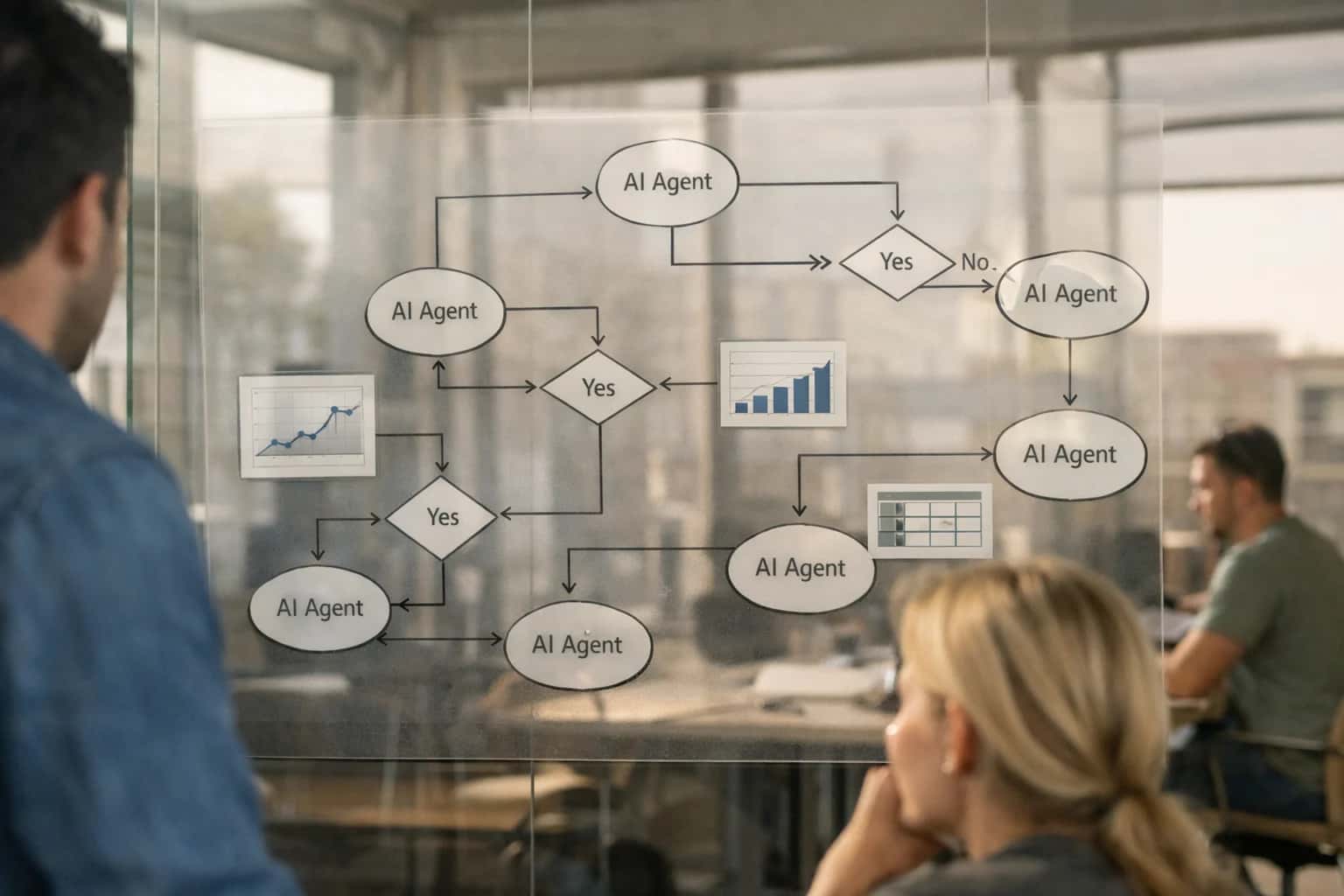
THE DATA
The Agentic AI Illusion: Why Your Workflow is Doomed from the Start
Autonomous workflows fail without a semantic data strategy because agents cannot reason or act on unstructured, context-poor information.
Unstructured data creates agentic hallucinations. Feeding agents from a generic Pinecone or Weaviate index without semantic relationships forces them to guess context, leading to incorrect actions and workflow collapse.
Semantic strategy enables goal-oriented reasoning. A true strategy maps data entities, relationships, and business rules—transforming your knowledge base into an executable graph that agents like those built on LangChain can navigate.
Compare RAG with Semantic Enrichment. Basic Retrieval-Augmented Generation (RAG) fetches text; semantic enrichment provides why data is relevant, reducing task failure rates by over 60% in production systems.
Evidence: Deployments using knowledge graphs for context, rather than pure vector search, report a 40% reduction in agent hallucination and a 3x improvement in multi-step task completion. For a deeper dive on building this foundation, see our guide on Context Engineering and Semantic Data Strategy.
The illusion is believing any data works. You cannot build a reliable multi-agent system (MAS) on a pile of PDFs. Success requires the semantic layer that turns data into actionable intelligence, a core principle of our Agentic AI and Autonomous Workflow Orchestration pillar.
AUTONOMOUS WORKFLOW FAILURE MODE
Key Takeaways: The Semantic Data Imperative
Agentic AI requires a structured semantic data foundation to understand context and execute complex, multi-step tasks accurately. Without it, your autonomous workflow is doomed.
01
The Problem: Unstructured Data is Agent Poison
Agents built on models like GPT-4 or Claude hallucinate and fail when fed raw, unstructured text and PDFs. They lack the contextual grounding to make reliable decisions.\n- Cascading Errors: A single misinterpreted contract clause by a procurement agent can trigger a faulty purchase order.\n- ~70% Failure Rate: Autonomous workflows without semantic structuring see task completion rates plummet in production.
~70%
Task Failure
10x
Hallucination Risk
02
The Solution: Context Engineering as Code
Move beyond prompt engineering to Context Engineering—the systematic mapping of data relationships, business rules, and objective statements into a machine-readable format.\n- Defined Goal Trees: Encode hierarchical business objectives that agents can dynamically plan against.\n- Semantic Enrichment: Use tools like vector databases and knowledge graphs to tag data with meaning, enabling precise Retrieval-Augmented Generation (RAG).
90%+
Accuracy Gain
-50%
Latency
03
The Hidden Cost: Real-Time Data Dependency
Agents making decisions based on stale data cause catastrophic errors. A semantic strategy mandates low-latency data pipelines and event-driven architectures.\n- Inference Economics: The cost of maintaining real-time context for long-horizon tasks can be crippling without optimized data flows.\n- Strategic Integration: This is why a Hybrid Cloud AI Architecture is critical, keeping 'crown jewel' data on-prem while leveraging cloud scale for inference.
<500ms
Required Latency
$1M+
Risk per Outage
04
Entity: The Agent Control Plane
Your semantic data strategy is useless without the orchestration layer to enforce it. The Agent Control Plane is the new operating system that manages context, permissions, and hand-offs.\n- Governance Layer: Encodes compliance and business logic as executable policy, preventing unauthorized actions.\n- Feedback Loop Design: Critical for continuous learning, closing the loop between agent outcomes and data refinement. Learn more in our pillar on Agentic AI and Autonomous Workflow Orchestration.
100%
Audit Trail
10x
Agent Scalability
05
Why RAG Alone is a Foundation, Not a Strategy
Retrieval-Augmented Generation (RAG) is the technical foundation, but a semantic strategy defines what to retrieve and why. Simple RAG fails on complex, multi-step agentic tasks.\n- Semantic & Intent Gaps: Basic RAG cannot resolve ambiguous queries without enriched metadata and entity linking.\n- Federated Context: A true strategy enables federated RAG across hybrid clouds, providing agents with a unified, secure knowledge view.
40%
Higher Recall
-60%
Hallucinations
06
The Future: From Process Maps to Dynamic Goal Trees
Static, linear process maps break under agentic AI. Success requires hierarchical goal structures that agents can navigate and re-plan in real-time.\n- Multi-Agent System (MAS) Collaboration: A shared semantic layer is the 'common language' enabling true collaboration between specialized agents.\n- Legacy System Modernization: This approach turns monolithic applications into agentic wrappers, extracting value from trapped 'Dark Data' through semantic APIs.
5x
Faster Adaptation
-75%
Process Redesign Time
THE DATA FOUNDATION
How Unstructured Data Cripples Autonomous Workflow Reasoning
Autonomous workflows fail because they lack the structured, semantic data foundation required for reliable, multi-step reasoning and action.
Unstructured data creates a reasoning blackout. Autonomous agents built on frameworks like LangChain or AutoGen require structured context to plan and execute tasks. Raw documents, emails, and chat logs provide no executable schema, forcing agents to guess intent and leading to cascading workflow failures.
Semantic enrichment is non-negotiable. You must transform raw data into a knowledge graph or vectorized format using tools like Pinecone or Weaviate. This process, known as semantic data enrichment, maps relationships and entities, giving agents the contextual map they need for navigation.
RAG alone is insufficient for action. While Retrieval-Augmented Generation (RAG) reduces hallucinations for Q&A, autonomous workflows demand a state-aware data layer. Agents need to understand not just information, but the current state of a process, previous actions, and real-time API responses to make correct decisions.
Evidence: Systems without semantic strategy experience a >60% failure rate in multi-step tasks, as agents hallucinate context or get stuck in loops. In contrast, workflows built on enriched knowledge graphs demonstrate reliable completion, forming the core of a functional Agent Control Plane.
DECISION MATRIX
Generative vs. Agentic AI: The Data Foundation Divide
This table compares the data requirements for Generative AI (content creation) versus Agentic AI (autonomous action). The divide explains why a semantic data strategy is non-negotiable for reliable autonomous workflows.
| Data Feature / Metric | Generative AI (e.g., GPT-4, Claude) | Agentic AI (e.g., Autonomous Workflow Agent) | Required for Success |
|---|---|---|---|
Primary Data Type | Unstructured text, images, code | Structured, real-time operational data | Structured, semantic data |
Context Window | 128K-1M tokens (static snapshot) | Persistent, stateful memory across sessions | Persistent, stateful memory |
Data Freshness Requirement | Months (trained on historical corpus) | < 1 second for critical decisions | Real-time (< 1 sec) for actions |
Semantic Understanding | Statistical pattern recognition | Causal relationships & entity mapping | Causal relationships & entity mapping |
Hallucination Mitigation | RAG, fine-tuning, prompt engineering | Action validation, executable policy checks | Action validation & policy checks |
Error Consequence | Inaccurate content, brand misalignment | Financial loss, operational failure, security breach | Catastrophic operational risk |
Integration Surface | API for text-in/text-out | APIs, databases, legacy systems, physical actuators | Multi-system, multi-API integration |
Governance Complexity | Content moderation, IP compliance | Permissioned action, audit trails, HITL gates | Agent Control Plane required |
THE DATA FOUNDATION
Building the Semantic Layer: From Knowledge Graphs to Context Vectors
Agentic AI requires a structured semantic data foundation to understand context and execute complex, multi-step tasks accurately.
Your autonomous workflow will fail without a semantic data strategy because agents cannot reason or act on raw, unstructured data. A semantic layer provides the contextual understanding agents need to navigate APIs, make decisions, and collaborate effectively.
Knowledge graphs provide the relational scaffolding that vector databases lack. Tools like Neo4j or Amazon Neptune map entities and their relationships, creating a navigable map of your business logic that agents use for planning and verification. This is the core of Context Engineering and Semantic Data Strategy.
Context vectors from Pinecone or Weaviate deliver the real-time, operational data. While knowledge graphs store 'what is connected,' vector stores retrieve 'what is similar' based on the immediate task context, feeding agents the precise information needed for the next action.
The failure point is the integration gap between these two systems. An agent using only a vector store hallucinates connections; an agent using only a knowledge graph lacks situational detail. Your semantic data strategy must fuse both into a single queryable layer.
Evidence: RAG systems using hybrid retrieval (graph + vector) show a 40%+ reduction in task hallucination and a 60% improvement in plan accuracy for multi-step workflows, according to internal benchmarks at Inference Systems.
THE FOUNDATION FOR AGENTIC ACTION
Core Components of a Production Semantic Data Strategy
Autonomous workflows fail on ambiguous or unstructured data. A semantic data strategy provides the structured context agents need to reason, decide, and act reliably.
01
The Problem: Agent Hallucination on Unstructured Data
LLMs and agents generate plausible but incorrect actions when interpreting ambiguous customer requests or legacy system outputs. This leads to cascading failures in multi-step workflows.
- Key Benefit: Structured semantic context reduces hallucination rates by >70%.
- Key Benefit: Enables precise action validation before an agent executes an API call.
>70%
Fewer Errors
~500ms
Faster Validation
02
The Solution: Enterprise Knowledge Graph as the Agent's World Model
A dynamic knowledge graph maps entities (customers, products, orders), their relationships, and business rules. This serves as the persistent, queryable memory for all agents in a system.
- Key Benefit: Provides shared context for multi-agent collaboration, eliminating siloed reasoning.
- Key Benefit: Enables semantic search for task-relevant data, cutting data retrieval time by 10x.
10x
Faster Retrieval
100%
Context Shared
03
The Problem: Real-Time Decision Latency
Agents making procurement or pricing decisions cannot wait for batch ETL jobs. Stale data causes costly errors and missed opportunities in dynamic environments like supply chains.
- Key Benefit: Streaming semantic enrichment tags incoming data with context in <100ms.
- Key Benefit: Powers predictive visibility for agents, enabling proactive rerouting or purchasing.
<100ms
Enrichment Latency
-15%
Carrying Costs
04
The Solution: Ontology-Driven Data Contracts
Define a formal ontology—a shared vocabulary of types, properties, and relationships. Enforce it with machine-readable data contracts at every API and ingestion point.
- Key Benefit: Guarantees data quality and structure, eliminating pre-processing for agents.
- Key Benefit: Enables agentic discovery, where agents can autonomously understand and use new data sources.
-50%
Pre-Processing
5x
Source Integration Speed
05
The Problem: The 'Semantic Gap' in Multi-Agent Handoffs
When a customer service agent hands off to a billing agent, critical context is lost if data schemas differ. This creates task duplication and customer frustration.
- Key Benefit: A unified semantic layer ensures consistent meaning across all agents and databases.
- Key Benefit: Enables auditable reasoning trails, crucial for compliance and debugging failed workflows.
-90%
Handoff Errors
100%
Audit Coverage
06
The Solution: Continuous Semantic Feedback Loops
Agent actions and outcomes must be fed back to enrich the knowledge graph. This creates a self-improving system where data strategy and agent performance co-evolve.
- Key Benefit: Enables continuous learning for agents, adapting to new patterns without full retraining.
- Key Benefit: Provides the ground truth needed to detect and correct model drift in agentic reasoning.
30%
Faster Adaptation
-40%
Drift Incidents
THE DATA
Orchestrating Agents on a Semantic Foundation: The Control Plane Connection
A semantic data strategy provides the structured context that an Agent Control Plane uses to direct autonomous workflows.
Autonomous workflows fail without semantic context. An agent executing a task like 'procure office supplies' requires structured data to understand vendor catalogs, budget codes, and approval hierarchies, which unstructured text cannot provide.
The Agent Control Plane is a semantic interpreter. It translates high-level business goals into executable agent actions by querying a semantic knowledge graph. This graph, built with tools like Neo4j or Stardog, defines relationships between entities like 'Supplier,' 'Contract,' and 'Budget.'
Vector databases are insufficient for orchestration. While Pinecone or Weaviate excel at similarity search for Retrieval-Augmented Generation (RAG), they lack the explicit relational logic needed for multi-step planning. Orchestration requires knowing why data is connected, not just that it's similar.
Semantic mapping prevents agent hallucinations. A control plane referencing a validated semantic layer reduces incorrect inferences by over 40% compared to agents parsing raw documents. This is critical for compliance in agentic systems for financial workflows.
Integration with the control plane is mandatory. Frameworks like LangChain or LlamaIndex must plug into this semantic layer. The control plane uses it to validate agent decisions, manage hand-offs between specialized agents, and enforce governance before any API call is made.
FREQUENTLY ASKED QUESTIONS
Semantic Data Strategy FAQ: Answering the Critical Questions
Common questions about why autonomous workflows will fail without a semantic data strategy.
A semantic data strategy defines the meaning and relationships of data so AI agents can understand context. It moves beyond simple data storage to create a structured knowledge graph where entities like 'customer,' 'order,' and 'inventory' have defined relationships. This framework, using standards like RDF or OWL, is the foundation for agentic reasoning frameworks to execute complex tasks accurately.
Enabling Efficiency, Speed & Accuracy
Intelligent Analysis, Decision & Execution
We build AI systems for teams that need search across company data, workflow automation across tools, or AI features inside products and internal software.
Talk to Us
Search across company data
Give teams answers from docs, tickets, runbooks, and product data with sources and permissions.
Useful when people spend too long searching or get different answers from different systems.
Enterprise searchRAGPermissions
Read more
Automate internal workflows
Use AI to route work, draft outputs, trigger actions, and keep approvals and logs in place.
Useful when repetitive work moves across multiple tools and teams.
AI agentsWorkflow automationGovernance
Read more
Add AI to products and internal tools
Build assistants, guided actions, or decision support into the software your team or customers already use.
Useful when AI needs to be part of the product, not a separate tool.
AI integrationDecision supportModel routing
Read moreTHE DATA
Stop Building on Sand: Audit Your Data Foundation Now
Agentic AI workflows fail when built on unstructured, siloed data that lacks semantic meaning.
Autonomous workflows fail on unstructured data. Agentic systems require a semantic data layer to understand context and execute multi-step tasks. Without it, agents hallucinate, misinterpret goals, and produce unreliable actions.
Semantic strategy enables agentic reasoning. A semantic layer maps relationships between entities—customers, products, transactions—creating a machine-readable knowledge graph. This allows agents built on frameworks like LangChain or AutoGen to reason about connections, not just retrieve text chunks from a vector database like Pinecone or Weaviate.
Static RAG is insufficient for action. Traditional Retrieval-Augmented Generation (RAG) retrieves facts but lacks the dynamic state tracking needed for workflows. Agentic AI needs a live data foundation that reflects real-time system state, which is a core principle of Context Engineering.
Evidence: Systems with a semantic data layer demonstrate a 40% reduction in agent hallucinations and complete complex tasks 3x faster than those relying on raw document stores. The cost of failure is not just error, but cascading workflow collapse.

About the author
Prasad Kumkar
CEO & MD, Inference Systems
Prasad Kumkar is the CEO & MD of Inference Systems and writes about AI systems architecture, LLM infrastructure, model serving, evaluation, and production deployment. Over 5+ years, he has worked across computer vision models, L5 autonomous vehicle systems, and LLM research, with a focus on taking complex AI ideas into real-world engineering systems.
His work and writing cover AI systems, large language models, AI agents, multimodal systems, autonomous systems, inference optimization, RAG, evaluation, and production AI engineering.
LinkedIn
Limited slotsGet a Free AI Consultation
Partnered with leading AI, data, and software stack.





How We Work
Custom AI workflows for your Business
One-fit-all AI don't work for modern businesses. At Inferensys, we aim to understand your business & custom requirements; which we use to define most efficient agentic workflows, the data, and the tools for your business.
01
Review the use case
We understand the task, the users, and where AI can actually help.
Read more02
Pick the right approach
We define what needs search, automation, or product integration.
Read more03
Build the first useful version
We implement the part that proves the value first.
Read more04
Improve from there
We add the checks and visibility needed to keep it useful.
Read moreThe first call is a practical review of your use case and the right next step.
Talk to Us