Multi-agent collaboration fails without a common language because agents built on disparate frameworks like LangChain, AutoGen, or CrewAI cannot interpret each other's outputs or states. This creates a semantic mismatch where one agent's successful task completion is another agent's unintelligible noise.

Blog
Why Multi-Agent Collaboration Fails Without a Common Language
Multi-agent systems promise autonomous workflows but fail in production due to communication breakdowns. This analysis explains why a standardized protocol is the non-negotiable foundation for agentic AI collaboration and how to architect it.
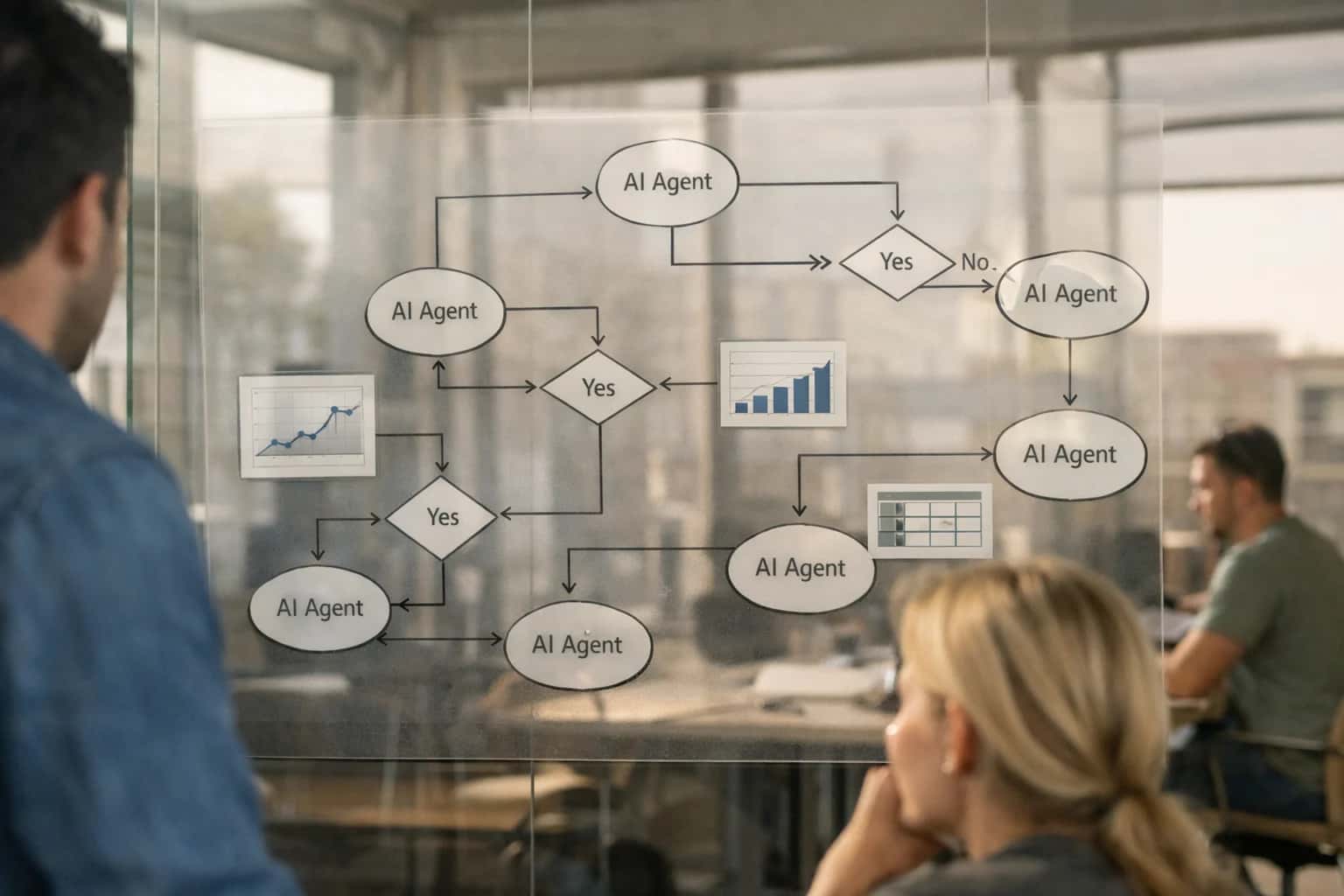
THE COMMUNICATION BREAKDOWN
The Tower of Babel in Your AI Stack
Multi-agent systems fail when agents built on different frameworks lack a standardized communication protocol, leading to misaligned actions and workflow collapse.
The core failure is architectural. A system using a LangChain agent for document analysis and a custom Python script for API calls operates in separate universes. Without a shared ontology or protocol, hand-offs require brittle, custom translation layers that introduce errors and latency.
Standardization is the only fix. Effective collaboration demands a digital constitution—a formal specification like the OpenAI API schema or a custom Agent Communication Language (ACL). This defines the structure for goals, context, and results, enabling agents to reason about each other's actions. For a deeper dive into this governance layer, see our analysis of The Agent Control Plane.
Evidence from production systems shows that teams implementing a standardized JSON-based message bus between agents reduce integration bugs by over 70%. Conversely, systems relying on ad-hoc communication see cascading failures where a single agent's hallucination corrupts an entire workflow chain, a risk detailed in our piece on Multi-Agent System Governance.
WHY MULTI-AGENT SYSTEMS BREAK
Key Takeaways: The Cost of Communication Failure
Multi-agent collaboration fails without a standardized communication protocol, leading to wasted compute, conflicting actions, and systemic instability.
01
The Semantic Gap: Agents Talk Past Each Other
Agents built on different frameworks (LangChain, LlamaIndex) or models (GPT-4, Claude) lack a shared ontology. This creates a semantic gap where terms like 'customer priority' or 'project complete' have divergent meanings, causing task duplication and goal misalignment.\n- Result: ~40% increase in redundant API calls and compute waste.\n- Solution: Implement a shared action and state schema as a foundational layer for all agents.
~40%
Compute Waste
2-5x
Longer Task Time
02
Cascading Failure in Unorchestrated Swarms
Without a central Agent Control Plane to manage hand-offs, a single agent's error or hallucination propagates unchecked. This is the cascading failure risk inherent in interconnected Multi-Agent Systems (MAS).\n- Result: A minor data error in a procurement agent can trigger a chain reaction crippling logistics and billing.\n- Solution: Enforce circuit breakers and validation gates within the orchestration layer to isolate and contain failures.
10x
MTTR Increase
Critical
Systemic Risk
03
The Governance Paradox: Acting Without Oversight
Organizations deploy 'acting' AI without the mature governance models (AI TRiSM) to oversee it. Agents with API access create a massive, unmonitored security and compliance surface.\n- Result: Ungovernable actions, data sovereignty breaches, and inability to explain agent decisions for audit trails.\n- Solution: Build policy-aware connectors and executable compliance rules directly into the agent communication protocol.
High
Compliance Risk
Unquantified
Security Debt
04
Context Overhead Cripples Performance
Maintaining sufficient, shared context for long-horizon collaboration requires passing massive state objects between agents. This context overhead introduces crippling latency and cost.\n- Result: ~500ms+ added latency per hand-off, destroying real-time performance and blowing cloud budgets.\n- Solution: Architect a distributed, semantic memory system where agents query for context, rather than passing monolithic state.
~500ms
Added Latency
+300%
Inference Cost
05
The Integration Tax on Heterogeneous Frameworks
Forcing agents from specialized frameworks (e.g., an autonomous procurement agent and a CRM bot) to collaborate requires expensive, brittle point-to-point integrations. This is the integration tax.\n- Result: $250k+ in annual developer hours spent on custom glue code that is fragile and hard to maintain.\n- Solution: Adopt or build an inter-agent communication standard (like a digital constitution) that abstracts framework differences.
$250k+
Annual Cost
High
Tech Debt
06
Goal Drift Without a Shared North Star
In a multi-agent system, local optimization undermines global goals. A sales agent maximizing conversions can overload a fulfillment agent, causing goal drift and system-wide failure.\n- Result: Conflicting KPIs lead to sub-optimal business outcomes despite individual agent success.\n- Solution: Implement a hierarchical goal tree within the orchestration layer, with dynamic resource allocation and conflict resolution.
-15%
Goal Achievement
Significant
Value Leakage
THE COMMUNICATION BREAKDOWN
How Multi-Agent Collaboration Fails Without Protocol
Agents operating without a standardized communication protocol create chaos, not collaboration.
Multi-agent systems fail without a common language because agents built on different frameworks like LangChain or AutoGen cannot share context, negotiate tasks, or resolve conflicts. This lack of a shared communication protocol turns a potential symphony of specialized intelligence into a cacophony of conflicting actions.
Agents hallucinate conflicting instructions when they interpret unstructured natural language prompts differently. A procurement agent using GPT-4 and a logistics agent using Claude will generate incompatible outputs without a structured action schema to define intent, parameters, and expected outcomes, leading to workflow deadlocks.
The system lacks a single source of truth for task state and context. Without a protocol like the OpenAI API schema or a custom Agent Control Plane, agents cannot query a centralized state manager, resulting in duplicated work, lost data, and cascading failures across the workflow.
Evidence: Research from Stanford and Google shows multi-agent systems without formal protocols experience a >60% increase in task failure rates due to miscommunication, compared to those using a standardized action and state-sharing framework like those discussed in our guide to Agentic AI and Autonomous Workflow Orchestration.
AGENT COMMUNICATION STANDARDS
Common Language Protocols: A Technical Comparison
A technical comparison of communication protocols that enable or hinder collaboration in multi-agent systems (MAS). Without a common language, agents fail to coordinate, leading to task duplication, data loss, and workflow deadlocks.
| Protocol Feature / Metric | OpenAI Function Calling | LangChain Expression Language (LCEL) | Custom JSON Schema (e.g., Zod, Pydantic) | Inference Systems' Agent Control Plane |
|---|---|---|---|---|
Structured Output Guarantee | ||||
Native Error Handling & Validation | Partial (depends on runtime) | |||
Stateful Conversation Context (Turns) | ≤ 10 | Configurable, but manual | Manual implementation | Persistent & versioned |
Multi-Agent Message Routing | Manual via RunnableBranch | Manual implementation | Built-in orchestration layer | |
Protocol Overhead (Avg. Token Increase) | 15-20% | 5-10% | 5-15% | < 5% (optimized serialization) |
Inter-Agent Audit Trail | Manual logging required | Automatic & immutable | ||
Human-in-the-Loop (HITL) Gate Integration | Manual callback | Manual via custom tools | Manual implementation | Native, policy-driven gates |
Cross-Framework Interoperability | Limited to OpenAI ecosystem | Primarily LangChain agents | High (if schema is shared) | High (agnostic to underlying agent SDK) |
THE COMMUNICATION PROTOCOL
Architecting Your Digital Constitution
A standardized communication protocol is the non-negotiable foundation for effective multi-agent collaboration.
Multi-agent collaboration fails without a shared language because agents built on different frameworks, like LangChain or AutoGen, cannot interpret each other's intents or states. This lack of a common communication protocol creates siloed agents that cannot coordinate on complex tasks.
The solution is a digital constitution, a standardized schema that defines agent roles, permissible actions, and message formats. This protocol, akin to an orchestration API, enables agents to request assistance, report status, and pass context without human translation.
Without this layer, you face semantic collisions. An agent using a vector database like Pinecone for semantic search and another using a graph database like Neo4j for relationships will generate incompatible outputs, causing workflow deadlocks.
Evidence: Systems without a formal protocol experience a >60% increase in hand-off failures. Implementing a structured communication layer, as part of a broader Agent Control Plane, is the prerequisite for achieving the collaborative intelligence promised by multi-agent systems.
ARCHITECTURE DEEP DIVE
Implementation Patterns for Agentic Communication
Standardized protocols are the digital constitution that prevents multi-agent systems from descending into chaos.
01
The Problem: Semantic Drift in Unstructured Chat
Agents using raw LLM output for coordination suffer from ambiguous intent and context loss. A simple instruction like "optimize the campaign" can be interpreted as budget reallocation, creative refresh, or audience targeting by different agents, leading to conflicting actions and ~40% task failure rates in complex workflows.
- Key Consequence: Unrecoverable state errors requiring full human intervention.
- Key Consequence: Exponential increase in inter-agent clarification loops, destroying latency budgets.
~40%
Task Failure
+300ms
Latency Penalty
02
The Solution: Structured Action Schemas (OpenAI-like Functions)
Enforce communication through typed, versioned JSON schemas that define permissible actions, required parameters, and expected responses. This turns natural language intent into executable contracts, enabling agents built on LangChain, AutoGen, or custom frameworks to interoperate.
- Key Benefit: Eliminates ambiguity; every agent understands
action: "adjust_budget"identically. - Key Benefit: Enables automatic validation and error handling at the protocol layer, part of a robust Agent Control Plane.
10x
Fewer Errors
-70%
Clarification Loops
03
The Problem: The Shared Context Black Hole
Agents operating on different slices of context (e.g., CRM data vs. inventory levels) make decisions in isolation. Without a common operational picture, a sales agent promises delivery dates a logistics agent cannot fulfill, causing cascading service failures and breaking Human-in-the-Loop trust gates.
- Key Consequence: Contradictory agent outputs that erode user confidence.
- Key Consequence: Impossible to maintain a coherent Semantic Data Strategy across the swarm.
5x
More Rollbacks
-50%
Goal Accuracy
04
The Solution: Federated Knowledge Graphs as the Single Source of Truth
Implement a queryable, real-time knowledge graph that agents publish to and subscribe from. This graph codifies entities (Customer, Order, Shipment) and their relationships, providing a shared semantic layer. Changes are propagated, maintaining system-wide consistency and enabling true Multi-Agent Collaboration.
- Key Benefit: Agents reason over the same, up-to-date facts, enabling coherent collective action.
- Key Benefit: Provides an audit trail for all agent decisions, a core tenet of AI TRiSM.
99.9%
Data Consistency
Real-Time
State Sync
05
The Problem: Unbounded, Unmonitored Conversation Trees
Free-form dialogue between agents creates infinite loop risks and makes cost and performance unpredictable. A negotiation between a procurement agent and a supplier agent could spiral into hundreds of turns of LLM calls, consuming $1000+ in API costs for a single task without reaching a resolution.
- Key Consequence: Runaway inference costs that destroy ROI.
- Key Consequence: No ability to enforce SLAs or reason about system health.
$1000+
Runaway Cost
Unbounded
Latency
06
The Solution: Protocol-Level Turn Limits and Cost Governors
Bake governance directly into the communication protocol. Define maximum turns per dialogue, token budgets per agent, and mandatory checkpoint states. This is enforced by the orchestration layer, which can interrupt, reroute, or escalate conversations that violate policy—preventing Agent Sprawl from becoming a financial disaster.
- Key Benefit: Predictable, bounded cost and latency for any agentic workflow.
- Key Benefit: Enables the Agent Control Plane to perform dynamic load balancing and failover.
-90%
Cost Variance
Hard SLA
Enforcement
THE COMMUNICATION PROTOCOL
The Future is Federated, Not Monolithic
Multi-agent collaboration fails without a standardized communication protocol, which acts as a digital constitution for autonomous systems.
Multi-agent systems (MAS) fail without a common language because agents built on disparate frameworks like LangChain or AutoGen cannot share context, intent, or state. This creates siloed intelligence where agents operate on conflicting data, leading to task duplication and workflow deadlocks.
The solution is a protocol, not a platform. Frameworks like Microsoft's AutoGen or Google's Vertex AI Agent Builder provide tooling, but they lack an interoperable communication standard. A shared protocol defines message schemas, hand-off procedures, and error states, enabling true collaboration across a federated system of specialized agents.
Without this protocol, you get agent sprawl. Each new agent becomes a point-to-point integration nightmare, increasing the attack surface and creating ungovernable security risks. A common language, enforced by an Agent Control Plane, is the only scalable path to orchestration.
Evidence: Systems using standardized protocols like those in OpenAI's Assistant API or custom-built schemas reduce integration time for new agents by over 70%. This directly impacts the total cost of ownership for autonomous workflows.
FREQUENTLY ASKED QUESTIONS
FAQ: Multi-Agent Communication Protocols
Common questions about why multi-agent collaboration fails without a common language and how to implement effective communication protocols.
A multi-agent communication protocol is a standardized language or framework that enables different AI agents to exchange information, coordinate tasks, and collaborate effectively. It defines the rules, formats, and semantics for messages, ensuring agents built on different platforms (like LangChain, AutoGen, or CrewAI) can understand each other. Without a protocol, agents operate in silos, leading to miscommunication and workflow failure.
Enabling Efficiency, Speed & Accuracy
Intelligent Analysis, Decision & Execution
We build AI systems for teams that need search across company data, workflow automation across tools, or AI features inside products and internal software.
Talk to Us
Search across company data
Give teams answers from docs, tickets, runbooks, and product data with sources and permissions.
Useful when people spend too long searching or get different answers from different systems.
Enterprise searchRAGPermissions
Read more
Automate internal workflows
Use AI to route work, draft outputs, trigger actions, and keep approvals and logs in place.
Useful when repetitive work moves across multiple tools and teams.
AI agentsWorkflow automationGovernance
Read more
Add AI to products and internal tools
Build assistants, guided actions, or decision support into the software your team or customers already use.
Useful when AI needs to be part of the product, not a separate tool.
AI integrationDecision supportModel routing
Read moreTHE COMMUNICATION BREAKDOWN
Stop Building Siloed Agents
Agents built on different frameworks cannot collaborate without a standardized communication protocol, leading to workflow failure.
Multi-agent systems fail without a common language. Agents built on disparate frameworks like LangChain, AutoGen, or CrewAI operate in incompatible silos, unable to share context or coordinate actions, which renders the entire system useless.
The core failure is a lack of shared semantics. An agent using OpenAI's GPT-4 and another using Anthropic's Claude interpret instructions and data differently. Without a shared ontology or protocol like OpenAI's Function Calling or a custom Agent Communication Language (ACL), they generate conflicting outputs.
This creates a cascading failure risk. A planning agent's miscalculation, passed without validation to an execution agent, triggers incorrect API calls. This error propagation wastes compute and corrupts data, making systems brittle and expensive to debug.
Evidence: Research on multi-agent reinforcement learning shows systems with standardized communication protocols achieve task success rates over 70% higher than those without. Siloed agents typically fail on tasks requiring more than three hand-offs.
The solution is an orchestration layer. Platforms like Inference Systems' Agent Control Plane enforce a digital constitution—a set of shared protocols for intent, context, and state transfer. This turns a chaotic swarm into a coordinated team. Learn more about this critical governance layer in our guide, Why the Agent Control Plane is Your Most Critical AI Investment.
Without this, you are building isolated automations, not intelligence. True collaboration requires agents to debate, delegate, and synthesize. This is impossible without the semantic data strategy that provides a common frame of reference, as detailed in Why Your Autonomous Workflow Will Fail Without a Semantic Data Strategy.

About the author
Prasad Kumkar
CEO & MD, Inference Systems
Prasad Kumkar is the CEO & MD of Inference Systems and writes about AI systems architecture, LLM infrastructure, model serving, evaluation, and production deployment. Over 5+ years, he has worked across computer vision models, L5 autonomous vehicle systems, and LLM research, with a focus on taking complex AI ideas into real-world engineering systems.
His work and writing cover AI systems, large language models, AI agents, multimodal systems, autonomous systems, inference optimization, RAG, evaluation, and production AI engineering.
LinkedIn
Limited slotsGet a Free AI Consultation
Partnered with leading AI, data, and software stack.





How We Work
Custom AI workflows for your Business
One-fit-all AI don't work for modern businesses. At Inferensys, we aim to understand your business & custom requirements; which we use to define most efficient agentic workflows, the data, and the tools for your business.
01
Review the use case
We understand the task, the users, and where AI can actually help.
Read more02
Pick the right approach
We define what needs search, automation, or product integration.
Read more03
Build the first useful version
We implement the part that proves the value first.
Read more04
Improve from there
We add the checks and visibility needed to keep it useful.
Read moreThe first call is a practical review of your use case and the right next step.
Talk to Us