
Blog
Smart City Infrastructure and Urban AI
Smart City Infrastructure and Urban AI
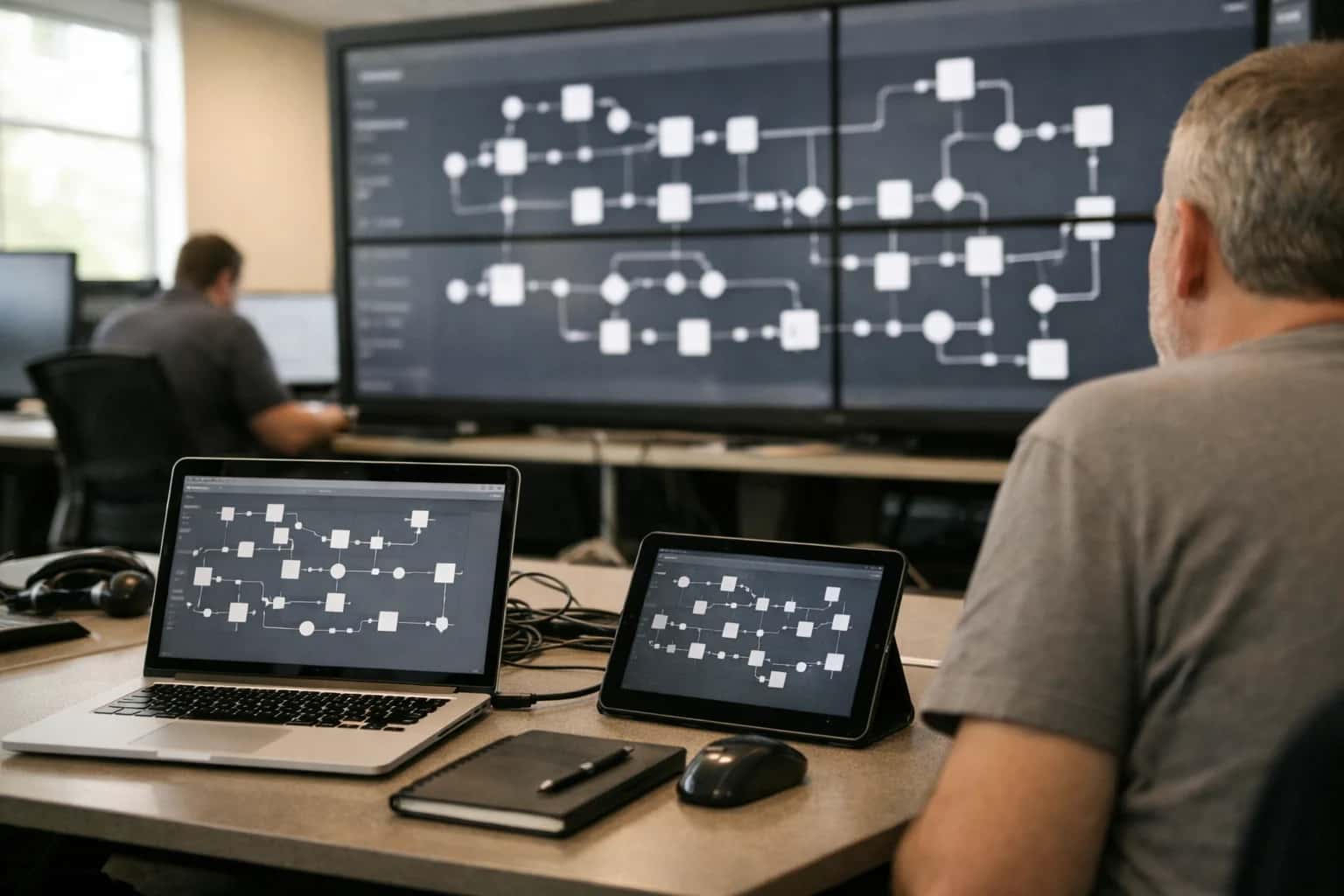
The professional audiovisual sector is the backbone of smart infrastructure in 2026. This pillar covers the convergence of IoT sensing, AI displays, and control room visualization. Sub-topic clusters include AI-powered spatial intelligence for collaborative environments, adaptive noise control for smart offices, and IoT-driven retail ecosystems.
Why IoT Sensing Without AI Is Just Expensive Data Hoarding
Deploying sensors without a real-time AI inference layer creates massive data lakes that are costly to store and impossible to analyze for actionable urban insights.
Why Edge AI Will Make or Break Smart City Reliability
Latency and bandwidth constraints mean that critical infrastructure decisions, from traffic signals to emergency response, must be made on-device, not in the cloud.
Why Sensor Fusion AI Is the Unsung Hero of Smart Infrastructure
Combining data from disparate IoT sources—video, LiDAR, acoustic sensors—into a single coherent model is the only way to achieve accurate situational awareness for urban operations.
Why Your Smart City's Digital Twin Is Useless Without Live AI
A static 3D model offers no operational value; real-time AI calibration with physical sensor data is required for predictive simulation and effective urban planning.
Why Multi-Modal AI Is Non-Negotiable for Urban Infrastructure
Cities generate text, video, audio, and sensor data simultaneously, requiring models like GPT-4V and Claude 3 to understand complex, real-world scenarios for public safety and services.
Why Federated Learning Is Essential for Sovereign Urban AI
Training models on sensitive municipal data across distributed IoT networks without centralizing it is critical for privacy, compliance with laws like the EU AI Act, and maintaining data sovereignty.
Why Explainable AI Is a Legal Imperative for Smart City Contracts
When AI allocates resources or makes safety-critical decisions, municipalities must be able to audit and justify those outcomes to avoid liability and public distrust.
Why AI-Powered Spatial Intelligence Will Redefine Urban Planning
AI models that understand human movement, occupancy, and interaction within physical spaces enable dynamic zoning, optimized public space design, and efficient collaborative environments.
Why Control Room AI Must Evolve Beyond Dashboards
Modern municipal operations require agentic AI systems that can correlate alerts, propose actions, and even execute predefined responses, moving from visualization to autonomous orchestration.
Why Adaptive Noise Control Requires On-Device Machine Learning
Real-time acoustic management in smart offices or public spaces demands low-latency inference on edge devices like NVIDIA Jetson, not cloud-based processing.
The Hidden Cost of AI Model Drift in Long-Term Infrastructure Projects
Urban AI systems deployed for decades will degrade as city dynamics change, requiring continuous MLOps monitoring and retraining pipelines that most municipalities fail to budget for.
The Hidden Cost of Siloed AI Models in Municipal Operations
Separate AI systems for traffic, waste, and energy cannot optimize city-wide resource allocation, leading to inefficiencies that a unified agentic AI control plane could solve.
The Hidden Cost of Insecure AI Endpoints in IoT Networks
Every camera and sensor running an AI model is a potential attack vector; securing these endpoints requires a dedicated AI TRiSM strategy beyond traditional cybersecurity.
The Hidden Cost of Not Having an AI TRiSM Framework for Cities
Without governance for trust, risk, and security, smart city AI projects incur massive ethical, legal, and operational debts that inevitably lead to public backlash and system failure.
The Hidden Cost of Vendor Lock-In with Proprietary Urban AI Platforms
Choosing closed-source AI solutions traps municipal data and workflows, preventing integration with best-in-class tools and inflating long-term total cost of ownership.
The Future of Traffic Management Is Predictive, Not Reactive, AI
Leveraging historical and real-time data with reinforcement learning models allows AI to anticipate congestion and dynamically adjust signals and routing before gridlock occurs.
The Future of Public Safety Hinges on Real-Time Video Analytics AI
Computer vision models from providers like NVIDIA Metropolis must process live feeds to detect anomalies, automate forensic search, and support first responders, not just record footage.
The Future of Energy Grids in Smart Cities Is AI Orchestration
AI agents must dynamically balance supply from renewables, manage demand response, and perform predictive maintenance to create a resilient and efficient urban power network.
The Future of Waste Management Is Computer Vision on Trucks
On-vehicle AI cameras can identify and classify waste types, optimize collection routes in real-time, and provide data for recycling compliance, moving beyond simple fill-level sensors.
The Future of Urban Air Quality Monitoring Is Hyperlocal AI Models
Fine-grained pollution forecasting requires AI that fuses data from fixed sensors, mobile units, and weather models to create block-by-block insights for public health intervention.
The Future of Public Transit Is Dynamically Routed by AI
AI systems using real-time ridership, traffic, and event data can adjust bus and micro-transit routes on-the-fly, maximizing efficiency and rider experience.
The Future of Water Management Depends on Anomaly Detection AI
Machine learning models analyzing pressure and flow data from IoT sensors can instantly identify leaks, predict pipe failures, and prevent catastrophic infrastructure loss.
The Future of Construction Sites: AI-Powered Site Intelligence
Combining computer vision, drone data, and digital twins, AI provides real-time oversight of safety compliance, progress tracking, and resource allocation on chaotic urban construction sites.
The Future of Parking: AI-Optimized Space Utilization
Computer vision and sensor fusion AI don't just find empty spots; they predict demand, enable dynamic pricing, and integrate with mobility apps to reduce urban congestion.
The Future of Disaster Response Lies in AI-Powered Simulation
Generative AI and digital twin technology can model thousands of disaster scenarios, from floods to fires, to optimize evacuation plans and first responder deployment before a crisis hits.
Why Graph Neural Networks Are Key to Understanding Urban Dynamics
Modeling a city as a graph of interconnected entities—people, vehicles, buildings, utilities—allows AI to uncover complex, non-linear relationships that traditional analytics miss.
Why Autonomous Drone Fleets for Inspection Need Robust AI
Inspecting bridges, power lines, and cell towers requires drones with advanced computer vision and obstacle avoidance AI, managed by a central agentic system for fleet coordination.
Why Smart City AI Initiatives Fail Without Cross-Departmental Data Sharing
Effective urban AI requires breaking down data silos between transportation, utilities, and public works to create a unified operational picture, a political and technical challenge most cities underestimate.
The Cost of Over-Reliance on Centralized AI for Distributed IoT
Sending all sensor data to a central cloud for processing creates unsustainable latency, bandwidth costs, and a single point of failure for critical city functions.
The Cost of Bias in AI-Powered Public Service Allocation
If training data reflects historical inequities, AI models for allocating services like policing, sanitation, or park maintenance will perpetuate and even amplify those biases at scale.
Partnered with leading AI, data, and software stack.





How We Work
Custom AI workflows for your Business
One-fit-all AI don't work for modern businesses. At Inferensys, we aim to understand your business & custom requirements; which we use to define most efficient agentic workflows, the data, and the tools for your business.
01
Review the use case
We understand the task, the users, and where AI can actually help.
Read more02
Pick the right approach
We define what needs search, automation, or product integration.
Read more03
Build the first useful version
We implement the part that proves the value first.
Read more04
Improve from there
We add the checks and visibility needed to keep it useful.
Read moreThe first call is a practical review of your use case and the right next step.
Talk to Us