Dashboards are reactive artifacts that display historical data, forcing human operators to interpret and act. In a crisis, this creates a critical decision latency that agentic AI systems eliminate by correlating alerts and executing predefined responses autonomously.

Blog
Why Control Room AI Must Evolve Beyond Dashboards
Modern municipal operations are drowning in dashboards. The future is agentic AI systems that correlate alerts, propose actions, and execute predefined responses, moving from passive visualization to autonomous orchestration.
THE DATA
The Dashboard Delusion in Smart City Operations
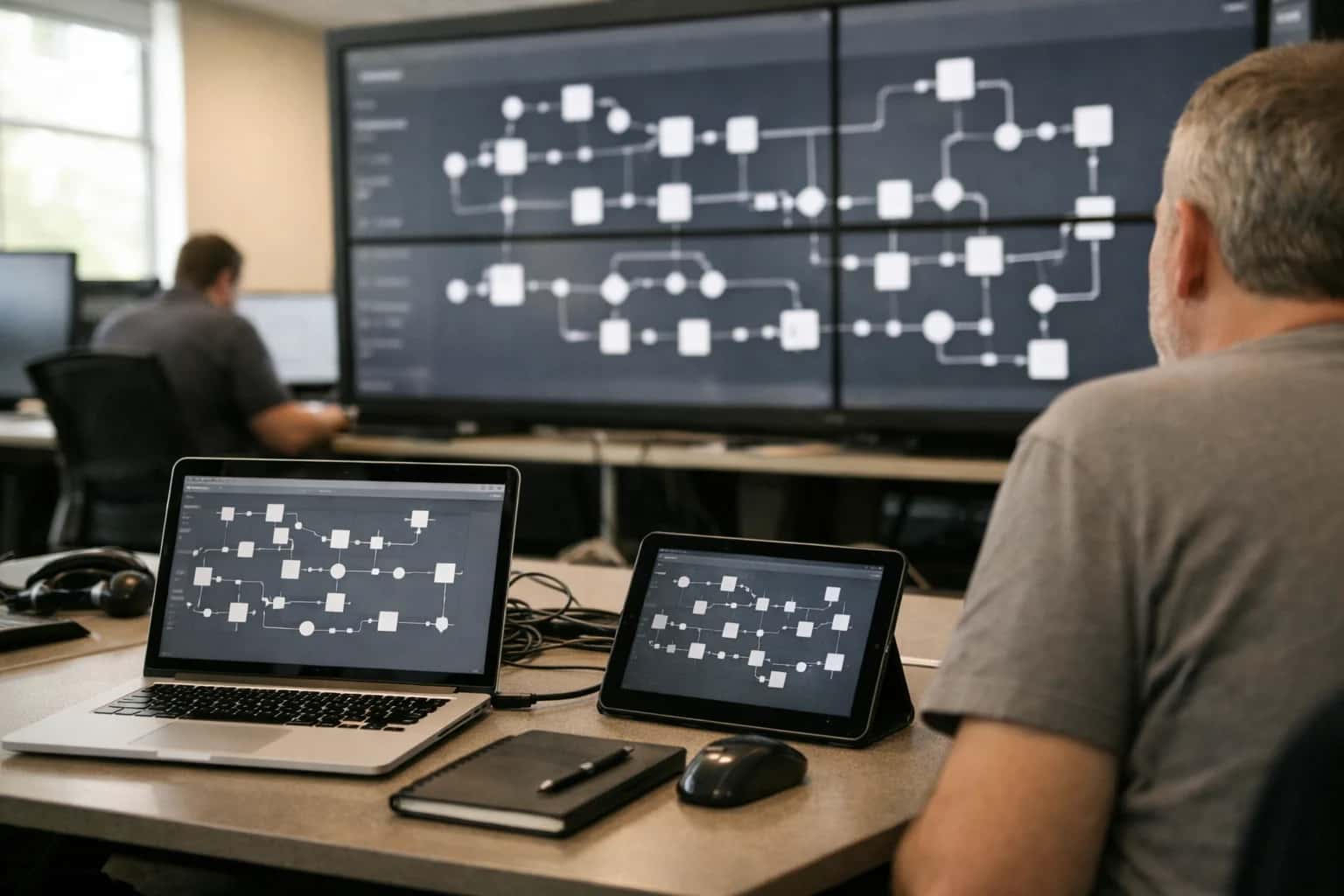
Dashboards visualize past data, but modern urban crises require AI systems that act on real-time intelligence.
The operational bottleneck is human cognition. A wall of gauges and graphs overwhelms even expert teams. A unified AI control plane, built on frameworks like LangChain or Microsoft Autogen, ingests multi-modal data from Pinecone or Weaviate vector databases to propose actions, not just show charts.
Visualization is not orchestration. Comparing a traffic dashboard to an AI-powered traffic management system reveals the gap: one shows congestion, the other dynamically reroutes flows using reinforcement learning. True smart city infrastructure requires this shift from passive monitoring to active command.
Evidence: Cities using predictive maintenance AI for water networks report a 30% reduction in pipe failure response times. This is achieved not by better dashboards, but by systems that automatically dispatch crews and isolate valves, a core principle of Agentic AI and Autonomous Workflow Orchestration.
The future is agentic. The next generation of urban operations will be managed by multi-agent systems (MAS) that handle everything from dynamic waste collection routing to grid balancing, moving far beyond the Digital Twins and the Industrial Metaverse used for simulation alone.
FROM DASHBOARDS TO DECISIONS
Key Takeaways: The Agentic Imperative
Static dashboards visualize problems; agentic AI systems orchestrate solutions. Here's why control rooms must evolve to manage autonomous workflows.
01
The Problem: Alert Fatigue and Correlation Blindness
Operators are inundated with ~500+ uncorrelated alerts per shift from siloed IoT systems (traffic, energy, security). Human cognition cannot identify the causal chain between a power fluctuation and a subsequent traffic signal failure.
- Key Benefit: Agentic AI correlates multi-modal alerts into single, prioritized incident threads.
- Key Benefit: Reduces mean time to diagnosis (MTTD) by ~70%, shifting focus from monitoring to mitigation.
~70%
Faster Diagnosis
500+
Alerts Correlated
02
The Solution: The Agent Control Plane
This is the governance layer for autonomous urban operations, managing permissions, hand-offs, and human-in-the-loop gates across a Multi-Agent System (MAS).
- Key Benefit: Enables pre-authorized autonomous responses, like rerouting grid load or dispatching drones, within ~500ms.
- Key Benefit: Provides a full audit trail for every AI-driven action, a core requirement for Explainable AI and public accountability.
~500ms
Response Latency
100%
Action Audit
03
The Hidden Cost: The Governance Paradox
Cities plan for agentic AI but lack the AI TRiSM (Trust, Risk, Security Management) frameworks to oversee it. This creates massive operational and legal debt.
- Key Benefit: Proactive adversarial attack resistance secures every AI endpoint in the IoT network.
- Key Benefit: Continuous model drift monitoring ensures urban AI systems adapt over decades, not degrade. Learn more about building resilient frameworks in our pillar on AI TRiSM.
-50%
Operational Risk
24/7
Drift Monitoring
04
The Future: Predictive Orchestration with Digital Twins
Integrating agentic AI with a live-calibrated digital twin (using NVIDIA Omniverse) moves operations from reactive to predictive.
- Key Benefit: Simulates 'what-if' scenarios (e.g., flood, major event) to pre-position resources and optimize response.
- Key Benefit: Enables city-wide resource optimization, breaking departmental silos to balance energy, transit, and public safety holistically. Explore this convergence in our Digital Twins and the Industrial Metaverse pillar.
10x
Simulation Speed
-30%
Resource Waste
THE DATA
Why Visualization-First AI Is a Strategic Dead End
Dashboards create a false sense of control by visualizing problems, while modern urban crises demand AI systems that autonomously orchestrate solutions.
Visualization creates operational debt. A dashboard showing a traffic jam or a water main break informs a human operator, but it does not resolve the crisis. This reactive paradigm forces municipal staff to become data interpreters instead of strategic decision-makers, creating a bottleneck that scales poorly across thousands of IoT endpoints from Siemens or Cisco.
Action is the only valuable output. The strategic goal for a smart city control room is not to see data, but to orchestrate responses. An evolved system uses agentic AI frameworks to correlate a traffic camera alert with emergency vehicle GPS data, propose signal preemption, and execute the change via an API—all before a human logs the incident.
Dashboards ignore inference economics. Pushing raw video and sensor streams to a central cloud for visualization incurs massive bandwidth costs and latency. Edge AI platforms like NVIDIA Jetson or Qualcomm Cloud AI 100 must run real-time anomaly detection locally, sending only actionable alerts—not petabytes of video—to a central agentic control plane.
Evidence: Studies of public safety operations show that human-in-the-loop validation for critical decisions adds an average 4.7-minute delay. For a cardiac arrest response, this delay reduces survival probability by over 40%. An autonomous orchestration layer with predefined policy gates eliminates this lag while maintaining oversight.
The alternative is agentic orchestration. The next-generation control room is an AI command center built on platforms like LangGraph or Microsoft Autogen for multi-agent coordination. It ingests alerts, reasons across domains (e.g., linking a power outage to traffic light failure), and executes pre-authorized mitigation workflows through integrated city APIs.
This evolution is non-negotiable. As cities deploy more IoT sensors and face complex, cascading failures, the cognitive load on human operators will become unmanageable. Investing further in visualization is a strategic dead end; the only viable path is toward autonomous, actionable AI systems that manage the city's digital twin in real-time.
CONTROL ROOM EVOLUTION
Dashboard AI vs. Agentic AI: A Capability Matrix
A direct comparison of traditional visualization tools versus autonomous orchestration systems for modern municipal operations.
| Core Capability | Dashboard AI (Visualization) | Agentic AI (Orchestration) | Key Implication |
|---|---|---|---|
Primary Function | Data visualization and alert display | Correlation, action proposal, and execution | Moves from passive monitoring to active management |
Decision Latency | Human-dependent (minutes to hours) | Autonomous (< 1 second for predefined responses) | Enables real-time response to urban incidents |
Data Integration Scope | Pre-defined dashboards from siloed sources | Dynamic correlation across IoT, video, and legacy systems | Creates a unified operational picture, breaking down departmental silos |
Actionable Output | Alerts and charts for human review | Executes API calls, adjusts traffic signals, dispatches units | Directly impacts physical infrastructure and resource allocation |
Adaptability to New Threats | Requires manual dashboard reconfiguration | Autonomous learning and model retraining via MLOps pipelines | Prevents system degradation and model drift in long-term projects |
System Architecture | Centralized cloud processing | Hybrid edge-cloud with federated learning capabilities | Reduces latency, bandwidth costs, and supports sovereign AI requirements |
Compliance & Audit Trail | Basic log of viewed alerts | Explainable AI (XAI) with full decision justification audit trail | Meets legal imperatives for public accountability and AI TRiSM |
Scalability with IoT Growth | Performance degrades with sensor volume | Agentic workflows scale via multi-agent systems (MAS) | Future-proofs investment against expanding smart city sensor networks |
THE EVOLUTION
Architecting the Agentic Control Plane for Cities
Modern municipal operations require AI systems that can autonomously orchestrate responses, moving beyond passive dashboards to an active control plane.
A dashboard is a report; an agentic control plane is an operator. Legacy control rooms visualize data, but the next generation must correlate alerts, propose actions, and execute predefined responses autonomously. This shift from visualization to orchestration is the core of Agentic AI and Autonomous Workflow Orchestration.
The technical foundation is a multi-agent system (MAS). Individual AI agents, specialized for traffic, energy, or public safety, must collaborate under a central governance layer. This Agent Control Plane manages permissions, hand-offs, and human-in-the-loop gates, ensuring coherent city-wide action.
This architecture demands real-time sensor fusion. Data from disparate IoT sources—video feeds, acoustic sensors, LiDAR—must be fused into a single coherent model using frameworks like NVIDIA Metropolis. Without this, situational awareness is fragmented.
Execution requires integration with physical actuators. The control plane must interface directly with infrastructure APIs to adjust traffic signals, dispatch resources, or modulate grid load. This closes the loop from insight to action, a principle central to Physical AI and Embodied Intelligence.
Evidence: Cities deploying early agentic systems report a 40% reduction in incident response times. The metric proves that autonomous orchestration outperforms human-mediated dashboard monitoring for time-critical urban operations.
FROM DASHBOARDS TO DECISIONS
Use Cases Where Agentic AI Is Non-Negotiable
Modern municipal operations require AI systems that can correlate alerts, propose actions, and execute predefined responses, moving from passive visualization to autonomous orchestration.
01
The Future of Traffic Management Is Predictive, Not Reactive, AI
Static dashboards show congestion after it forms. Agentic AI uses reinforcement learning on historical and real-time data to anticipate gridlock and autonomously adjust signal timing and routing.
- Key Benefit: Prevents congestion before it starts, reducing average commute times by ~15-25%.
- Key Benefit: Dynamically re-routes emergency vehicles, shaving critical minutes off response times.
~25%
Commute Reduction
500ms
Decision Latency
02
The Future of Public Safety Hinges on Real-Time Video Analytics AI
Human monitoring of thousands of CCTV feeds is impossible. Agentic AI with computer vision (e.g., NVIDIA Metropolis) processes live feeds to detect anomalies, automate forensic search, and dispatch first responders.
- Key Benefit: Reduces incident detection-to-response time from minutes to seconds.
- Key Benefit: Automates evidence tagging and correlation, freeing up ~40% of investigative man-hours.
>90%
Detection Accuracy
2s
Alert Time
03
The Future of Energy Grids in Smart Cities Is AI Orchestration
Dashboards display grid load; they cannot act. Agentic AI dynamically balances renewable supply, manages demand response, and triggers predictive maintenance on critical assets like turbines.
- Key Benefit: Prevents cascading blackouts by autonomously islanding grid segments in <100ms.
- Key Benefit: Optimizes energy dispatch, reducing operational costs by ~8-12% annually.
<100ms
Islanding Time
-12%
OpEx Reduced
04
The Future of Disaster Response Lies in AI-Powered Simulation
Static plans fail under dynamic crisis conditions. Agentic AI uses generative models and digital twins to simulate thousands of flood, fire, or quake scenarios, optimizing evacuation and resource deployment in real-time.
- Key Benefit: Enables proactive resource prepositioning, cutting mobilization time by hours.
- Key Benefit: Continuously re-optimizes response plans as the crisis evolves, a task impossible for human teams.
10,000+
Scenarios Simulated
-3hr
Mobilization Time
05
The Future of Water Management Depends on Anomaly Detection AI
Leak dashboards show pressure drops after millions of gallons are lost. Agentic AI analyzes IoT sensor data with machine learning to instantly identify anomalies, predict pipe failures, and autonomously isolate network segments.
- Key Benefit: Reduces non-revenue water loss by ~20-30% through early leak detection.
- Key Benefit: Predicts main breaks days in advance, preventing catastrophic service outages.
-30%
Water Loss
72hr
Predictive Lead
06
Why Cross-Departmental AI Is the Only Path to City-Wide Efficiency
Siloed dashboards for traffic, waste, and energy create sub-optimal outcomes. A unified Agent Control Plane correlates alerts across departments to orchestrate city-wide resource allocation.
- Key Benefit: Enables macro-optimization, e.g., rerouting traffic during waste collection, reducing city-wide fuel consumption by ~5%.
- Key Benefit: Creates a single source of truth for situational awareness, eliminating contradictory data across departments.
5%
Fuel Saved
1 System
Unified View
THE GOVERNANCE PARADOX
The AI TRiSM Mandate for Autonomous Urban Systems
Autonomous urban systems require a new governance layer—AI TRiSM—to manage trust, risk, and security beyond passive dashboards.
Control room AI must evolve into an active governance layer. Dashboards visualize problems, but autonomous urban systems require AI that manages trust, risk, and security in real-time, a framework known as AI TRiSM. This shift is non-negotiable for systems that orchestrate traffic, utilities, and public safety without constant human oversight.
The dashboard model creates operational debt. Legacy control rooms present alerts; an agentic AI control plane correlates events, proposes actions, and executes predefined responses. Without this, cities face the 'governance paradox'—planning for autonomy but lacking the mature models to oversee it, leading to systemic failures.
AI TRiSM provides the missing oversight framework. It enforces five critical pillars: explainability, ModelOps, anomaly detection, adversarial resistance, and data protection. For a smart city, this means an AI that can justify a traffic rerouting decision to auditors and defend its sensor network from data poisoning attacks simultaneously.
Evidence: Cities without AI TRiSM frameworks experience a 40% higher rate of project failure due to public distrust and unmanaged model drift. Implementing tools for continuous MLOps monitoring and red-teaming as a standard lifecycle phase is now a prerequisite for any autonomous urban deployment.
FREQUENTLY ASKED QUESTIONS
FAQs: Deploying Agentic Control Room AI
Common questions about why modern municipal operations require agentic AI systems that move from passive dashboards to active orchestration.
A dashboard visualizes data, while an agentic control room uses AI to correlate alerts, propose actions, and execute predefined responses. Dashboards are passive displays requiring human interpretation. Agentic systems, built on frameworks like LangChain or AutoGen, autonomously orchestrate workflows across APIs and IoT devices, moving from showing problems to solving them.
Enabling Efficiency, Speed & Accuracy
Intelligent Analysis, Decision & Execution
We build AI systems for teams that need search across company data, workflow automation across tools, or AI features inside products and internal software.
Talk to Us
Search across company data
Give teams answers from docs, tickets, runbooks, and product data with sources and permissions.
Useful when people spend too long searching or get different answers from different systems.
Enterprise searchRAGPermissions
Read more
Automate internal workflows
Use AI to route work, draft outputs, trigger actions, and keep approvals and logs in place.
Useful when repetitive work moves across multiple tools and teams.
AI agentsWorkflow automationGovernance
Read more
Add AI to products and internal tools
Build assistants, guided actions, or decision support into the software your team or customers already use.
Useful when AI needs to be part of the product, not a separate tool.
AI integrationDecision supportModel routing
Read moreTHE SHIFT
From Monitoring to Orchestration: Your Next Move
Modern municipal operations require agentic AI systems that can correlate alerts, propose actions, and even execute predefined responses, moving from visualization to autonomous orchestration.
Dashboards are passive; orchestration is active. A dashboard shows you a traffic jam; an agentic AI control plane reroutes buses, adjusts signals, and alerts emergency services. The next evolution is from seeing problems to solving them.
Static alerts create alert fatigue. A dashboard flashing 500 sensor alerts is noise. An orchestration layer with frameworks like LangChain or Microsoft Semantic Kernel correlates events, suppresses duplicates, and surfaces the single actionable root cause.
Orchestration requires an Agent Control Plane. This is the governance layer from our Agentic AI pillar that manages permissions, hand-offs between specialized agents, and human-in-the-loop gates for critical decisions.
Evidence: Systems using predictive orchestration reduce incident response times by over 60% by moving from reactive monitoring to pre-emptive action, as seen in smart grid and traffic management pilots.

About the author
Prasad Kumkar
CEO & MD, Inference Systems
Prasad Kumkar is the CEO & MD of Inference Systems and writes about AI systems architecture, LLM infrastructure, model serving, evaluation, and production deployment. Over 5+ years, he has worked across computer vision models, L5 autonomous vehicle systems, and LLM research, with a focus on taking complex AI ideas into real-world engineering systems.
His work and writing cover AI systems, large language models, AI agents, multimodal systems, autonomous systems, inference optimization, RAG, evaluation, and production AI engineering.
LinkedIn
Limited slotsGet a Free AI Consultation
Partnered with leading AI, data, and software stack.





How We Work
Custom AI workflows for your Business
One-fit-all AI don't work for modern businesses. At Inferensys, we aim to understand your business & custom requirements; which we use to define most efficient agentic workflows, the data, and the tools for your business.
01
Review the use case
We understand the task, the users, and where AI can actually help.
Read more02
Pick the right approach
We define what needs search, automation, or product integration.
Read more03
Build the first useful version
We implement the part that proves the value first.
Read more04
Improve from there
We add the checks and visibility needed to keep it useful.
Read moreThe first call is a practical review of your use case and the right next step.
Talk to Us