
Blog
Physical AI and Embodied Intelligence
Physical AI and Embodied Intelligence
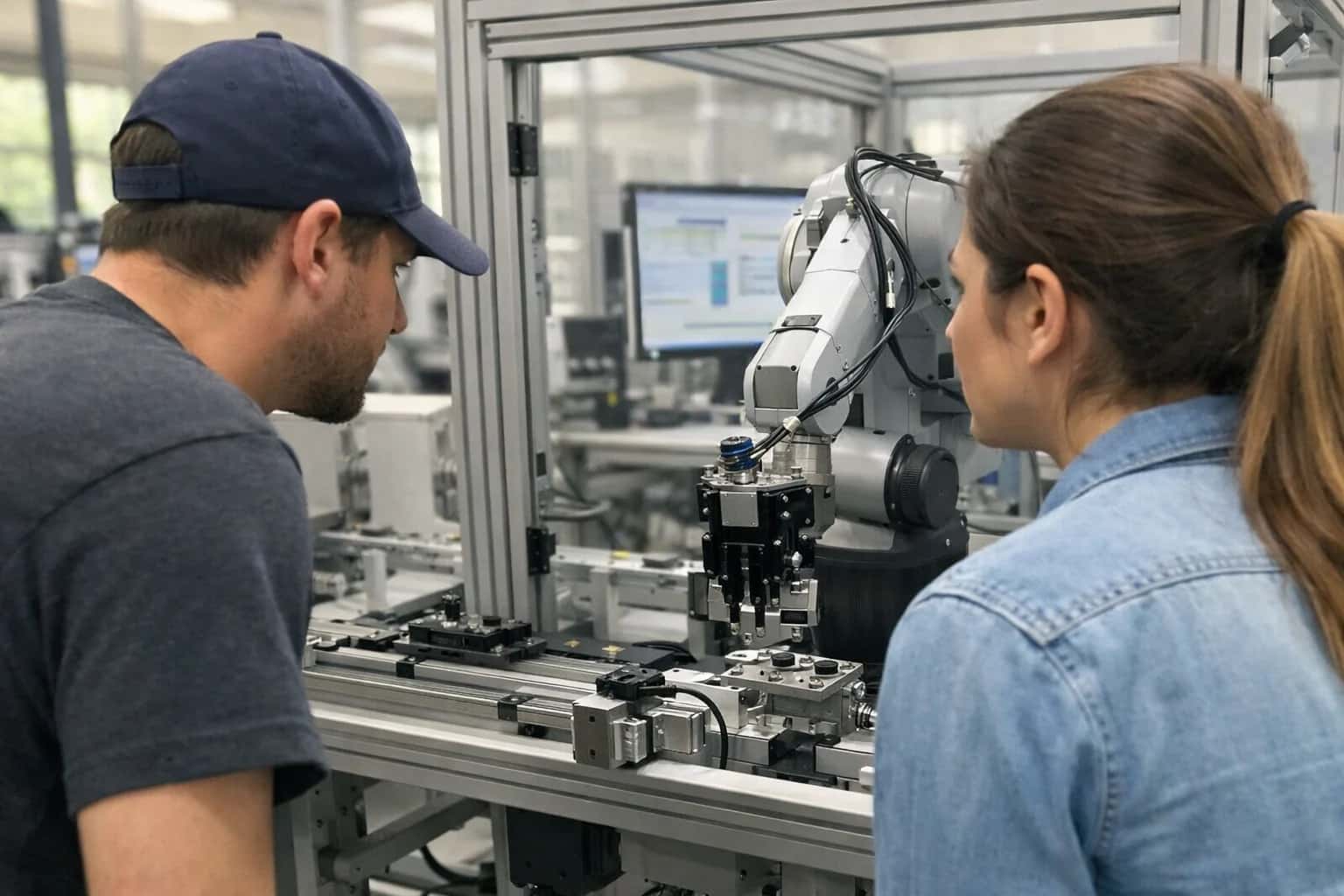
Physical AI represents the convergence of machine learning with robotics and machinery in industrial and commercial settings. This pillar targets the $97.5 billion market for professional audiovisual and integrated smart systems. It covers the 'Data Foundation Problem,' explaining how machines learn to operate in the unstructured world of construction sites or factory floors through perception, intelligence, and actuation. Sub-topic clusters include collaborative robotics (cobots) for assembly lines, autonomous soil removal in construction, and the use of NVIDIA's Jetson Thor platform for intelligent machines.
Why the Data Foundation Problem Will Sink Your Physical AI Investment
The unstructured nature of real-world environments like construction sites creates an insurmountable data collection and labeling bottleneck for machine learning in robotics.
The Future of Embodied Intelligence Is Not in the Cloud
Latency, reliability, and data sovereignty demands force the intelligence for robots and machinery onto the edge, requiring a new compute paradigm.
Why Most Cobot Deployments Are Doomed to Fail
Collaborative robots fail without context-aware AI that understands dynamic human intent, not just pre-programmed safety zones.
The Future of Autonomous Construction Is a Simulation-First Strategy
Physically accurate digital twins in NVIDIA Omniverse are the only viable training ground for AI to master chaotic, high-stakes construction tasks.
Why NVIDIA's Jetson Thor Won't Solve Your Edge AI Problems
Raw compute power is meaningless without a software stack that solves the perception-action loop for your specific industrial environment.
The Future of Factory Floors Lies in Multi-Agent Robotic Systems
Goal-oriented AI agents coordinating fleets of heterogeneous robots will outperform any single, centrally controlled autonomous machine.
Why Simulation-to-Reality Transfer Is the Biggest Bottleneck in Physical AI
The reality gap between pristine synthetic data and messy sensor inputs breaks most machine learning models upon real-world deployment.
The Future of Industrial Autonomy Is Not Fully Autonomous
Hybrid human-AI systems with seamless task handoff, governed by a robust control plane, deliver higher ROI than pursuit of full autonomy.
Why Edge AI Processors Are Creating a New Vendor Lock-in
Proprietary toolchains and model optimization pipelines for chips like NVIDIA Jetson or Qualcomm RB5 create long-term dependency and stifle innovation.
The Future of Machine Perception Requires Beyond-Camera Sensing
Robust environmental understanding for robotics demands fusion of LiDAR, radar, acoustic, and haptic data, not just computer vision.
Why Actuator Intelligence Is the Next Frontier in Robotics
Smart, self-diagnosing actuators with embedded force and thermal sensing are critical for dexterous manipulation and predictive maintenance.
The Future of Physical AI Demands Explainable Motion Planning
Black-box neural controllers are unacceptable for safety-critical machinery; planners must provide causal reasoning for every trajectory.
Why Multi-Modal Learning Is Non-Negotiable for Embodied Agents
Robots that only 'see' cannot understand material properties, friction, or intent; true physical intuition requires fused sensor modalities.
The Future of Cobots Is in Adaptive Gripping, Not Pre-Programmed Paths
AI-driven grippers that sense material compliance and slip in real-time enable handling of infinite part variations without reprogramming.
Why Current SLAM Algorithms Fail in Dynamic Industrial Environments
Simultaneous Localization and Mapping that assumes a static world breaks down amidst moving people, machinery, and changing layouts.
The Future of Construction Robotics Is Material-Aware AI
Excavators and compactors need models that understand soil dynamics and concrete curing, not just geometric path planning.
Why On-Device Learning Is Critical for the Next Generation of Industrial Robots
Continual adaptation to tool wear, new parts, and environmental drift must happen at the edge, without cloud round-trips.
The Future of Physical AI Is in Continual, Not Batch, Learning
Models that learn incrementally from a stream of real-world experience will outlast those trained once on a static, synthetic dataset.
Why Reinforcement Learning from Human Feedback Fails for Physical Tasks
The cost and danger of real-world trial-and-error make RLHF impractical for training industrial robots; demonstration and simulation are paramount.
The Future of Embodied AI Demands a Unified Body-Brain API
The fragmentation between perception, planning, and control stacks necessitates a standardized interface to accelerate development and deployment.
Why Self-Supervised Learning Is the Only Path to Scalable Physical AI
The scale of data needed for robustness makes manual annotation impossible; models must learn physical concepts from unlabeled sensor streams.
The Future of Smart Factories Hinges on Interoperable AI Agents
Proprietary systems from Siemens, Rockwell, and Fanuc must give way to open standards for multi-vendor robotic coordination and data exchange.
Why Physics-Informed Neural Networks Are Overpromised for Control
While useful for simulation, PINNs struggle with the real-time inference speeds and uncertainty handling required for closed-loop robotic control.
The Future of Physical AI Is Not General Purpose—It's Hyper-Specialized
The winning strategy is domain-specific models for welding, palletizing, or inspection, not a single 'general robot brain'.
Why Real-World Reinforcement Learning Is an Oxymoron for Heavy Industry
The risk and cost of exploration in environments with million-dollar equipment make pure RL a research fantasy, not an engineering solution.
The Future of Assembly Line AI Is in Dynamic Workcell Reconfiguration
AI that can autonomously replan robot tasks and human roles in response to line stoppages or part shortages maximizes throughput.
Why Embodied AI Will Force a Reckoning with Product Liability Law
When an AI-driven machine causes damage, assigning fault between the model developer, integrator, and operator becomes a legal quagmire.
The Future of Machinery Depends on AI That Understands Its Own Limitations
The most critical capability for safe deployment is a calibrated uncertainty estimate that triggers a graceful handoff to a human operator.
Partnered with leading AI, data, and software stack.





How We Work
Custom AI workflows for your Business
One-fit-all AI don't work for modern businesses. At Inferensys, we aim to understand your business & custom requirements; which we use to define most efficient agentic workflows, the data, and the tools for your business.
01
Review the use case
We understand the task, the users, and where AI can actually help.
Read more02
Pick the right approach
We define what needs search, automation, or product integration.
Read more03
Build the first useful version
We implement the part that proves the value first.
Read more04
Improve from there
We add the checks and visibility needed to keep it useful.
Read moreThe first call is a practical review of your use case and the right next step.
Talk to Us