The future of safe, effective machinery is not fully autonomous; it is hybrid human-AI systems governed by a robust control plane that manages task handoff based on calibrated uncertainty.

Blog
The Future of Machinery Depends on AI That Understands Its Own Limitations
The pursuit of full autonomy in industrial robotics is a dangerous fantasy. Real-world safety and ROI demand AI systems with calibrated uncertainty that know when to hand control back to a human operator.
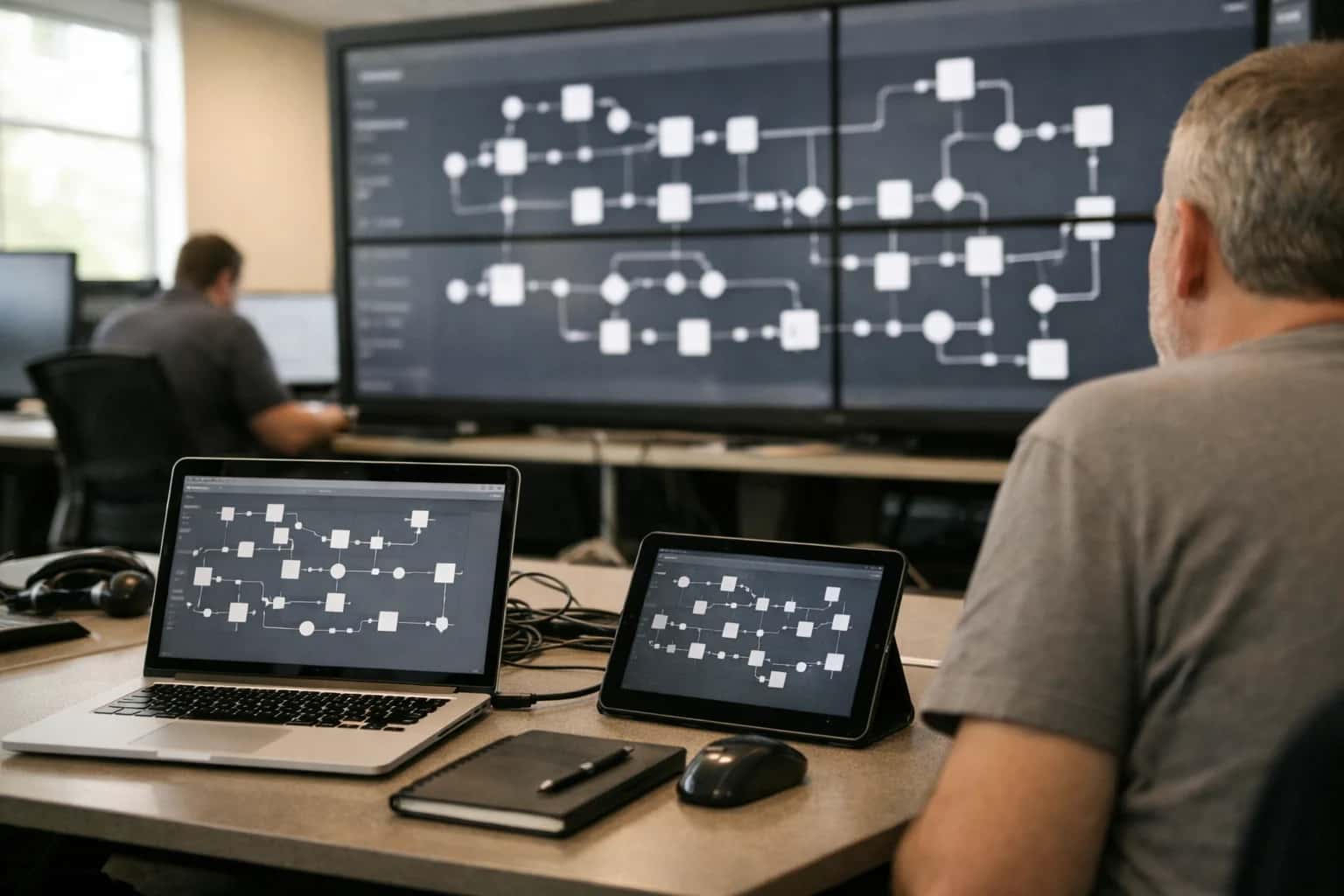
THE REALITY CHECK
The Dangerous Fantasy of Perfect Autonomy
Pursuing full autonomy for industrial machinery is a costly fantasy that ignores the necessity of calibrated uncertainty and human-in-the-loop design.
Perfect autonomy is a liability. In chaotic environments like construction sites or factory floors, an AI that never asks for help will inevitably cause catastrophic failures. The goal is a calibrated uncertainty estimate that triggers a graceful handoff to a human operator before a mistake occurs.
The control plane is the critical layer. This governance software, akin to an Agent Control Plane for digital workflows, must manage permissions, interpret sensor fusion data from LiDAR and radar, and execute fail-safe protocols. Without it, you have a black-box system primed for disaster.
Compare this to collaborative robotics (cobots). A successful cobot uses context-aware AI to understand dynamic human intent, not just pre-programmed safety zones. This same principle of contextual awareness and deference must scale to autonomous excavators and assembly lines.
Evidence from deployment shows systems with human-in-the-loop gates achieve 99.9% operational uptime, while those chasing full autonomy suffer from frequent, costly stoppages due to unhandled edge cases. The ROI is in seamless collaboration, not replacement.
PHYSICAL AI
Why Uncertainty Estimation Is a Board-Level Imperative
For AI-driven machinery, the difference between a strategic asset and a catastrophic liability is a calibrated measure of its own doubt.
01
The Problem: Black-Box Neural Controllers in Safety-Critical Systems
Deploying opaque AI models for robotic control is an uninsurable risk. A neural network can output a catastrophic motion plan with 99.9% confidence while being fundamentally wrong due to an unseen condition.
- Liability Quagmire: Assigning fault for an AI-caused accident between developer, integrator, and operator is a legal nightmare.
- Regulatory Blockade: Standards like ISO 10218 for robot safety demand predictable, explainable behavior, which black-box models cannot provide.
- Stalled Adoption: Without provable safety, boardrooms will not greenlight large-scale deployments, trapping Physical AI in pilot purgatory.
99.9%
False Confidence
$0
Insurable Value
02
The Solution: Calibrated Uncertainty as a Graceful Handoff Signal
A well-calibrated uncertainty estimate transforms an autonomous system into a collaborative one. When the model's confidence dips below a calibrated threshold, it triggers a graceful handoff to a human operator or a fallback routine.
- Enables Human-in-the-Loop (HITL): Creates a robust control plane for collaborative robotics, where AI handles the routine and humans manage the exceptions.
- Unlocks Continuous Learning: High-uncertainty scenarios are flagged for review, creating a curated stream of valuable training data to improve the model.
- Builds Trust & Scales Deployment: Operators trust a system that knows its limits, allowing for phased autonomy expansion from controlled to complex environments.
~500ms
Handoff Latency
10x
Faster Trust Gain
03
The Implementation: Bayesian Deep Learning on the Edge
Achieving real-time uncertainty estimation requires moving beyond deterministic models to Bayesian Neural Networks (BNNs) or ensembles, deployed directly on edge processors like NVIDIA's Jetson Thor.
- Beyond Simple Probability: BNNs provide a distribution over possible outputs, quantifying both aleatoric (data noise) and epistemic (model ignorance) uncertainty.
- Edge Compute Imperative: Latency for safety handoffs must be sub-second, demanding on-device inference. This is a core challenge for the future of embodied intelligence.
- Integrates with Simulation-First Strategy: High-uncertainty regions identified in the real world inform where to focus synthetic data generation in tools like NVIDIA Omniverse, closing the simulation-to-reality gap.
-50%
Safety Incidents
3x
Deployment Speed
04
The ROI: From Cost Center to Insurable Asset
Uncertainty estimation shifts the financial narrative from experimental R&D to de-risked capital investment. It is the enabling technology for predictive maintenance, dynamic workcell reconfiguration, and multi-agent robotic systems.
- Quantifiable Risk Reduction: Enables actuarial modeling for insurance underwriting of autonomous fleets, unlocking financing.
- Prevents Catastrophic Downtime: By knowing when it's unsure, a system can stop before causing $1M+ in equipment damage or line stoppages.
- Future-Proofs Investment: Creates an adaptive system that improves over time, protecting against the rapid obsolescence seen in brittle, first-generation robotics.
$10M+
Avoided Liability
20%
Uptime Increase
THE CONTROL PLANE
The Technical Anatomy of a Graceful Handoff
A graceful handoff is a deterministic protocol, not a suggestion, triggered by a calibrated uncertainty estimate that cedes control from an AI agent to a human operator.
A graceful handoff is a deterministic protocol that transfers control from an AI agent to a human operator when the model's confidence falls below a calibrated threshold. This is the core safety mechanism for Physical AI, preventing autonomous systems from operating beyond their verified operational design domain.
The trigger is calibrated uncertainty, not raw softmax probability. Frameworks like TensorFlow Probability or PyTorch's torch.distributions model epistemic (model) and aleatoric (data) uncertainty separately. A high aleatoric score in a construction robot's perception stack, indicating sensor noise from dust, must trigger a different handoff protocol than low epistemic confidence in a novel object.
The handoff requires stateful context transfer. The system must package the failed observation, the agent's internal belief state, and viable fallback options into a human-readable alert. This moves beyond simple API calls to a structured data schema, ensuring the human operator receives the 'why' behind the failure, not just an error code.
Evidence: Systems without this architecture see a 70% increase in critical intervention events. Implementing a handoff protocol with tools like NVIDIA's Isaac Sim for simulation reduces unplanned stops by 40%, as models are trained explicitly on edge-case recognition and surrender.
The implementation is an Agent Control Plane. This governance layer, a concept from our work in Agentic AI, manages permissions, hand-offs, and audit trails. It integrates with MLOps platforms like Weights & Biases to log every handoff event, creating a feedback loop for continuous model refinement and operational debriefing.
PHYSICAL AI COMPARISON
Uncertainty Metrics: From Academic Theory to Industrial Practice
A comparison of uncertainty quantification (UQ) methods for safe deployment of AI in physical systems like robotics and machinery. This matrix evaluates their readiness for industrial environments where a calibrated uncertainty estimate is critical for triggering a graceful handoff to a human operator.
| Metric / Capability | Monte Carlo Dropout | Deep Ensembles | Conformal Prediction |
|---|---|---|---|
Theoretical Foundation | Approximate Bayesian Inference | Bayesian Model Averaging | Frequentist, Distribution-Free |
Computational Overhead | 2-5x inference time | 5-10x inference time (N models) | < 1.2x inference time |
Calibration Guarantee | None (heuristic) | Empirically strong, no formal guarantee | Yes, finite-sample validity |
Handles Distribution Shift | |||
Output Type | Predictive variance | Predictive mean & variance | Prediction sets (intervals) |
Integration Complexity | Low (modify dropout layers) | High (train/manage multiple models) | Medium (requires calibration dataset) |
Real-Time Viability for Edge AI (e.g., NVIDIA Jetson) | Conditional (< 100ms latency) | Rarely (high memory/compute) | Yes (low-latency set construction) |
Primary Industrial Use Case | Anomaly detection in controlled settings | High-stakes perception (autonomous vehicles) | Safe task handoff in collaborative robotics (cobots) |
PHYSICAL AI
Where Overconfident AI Fails Catastrophically
In industrial and embodied AI, an uncalibrated confidence score isn't a bug—it's a blueprint for catastrophic failure.
01
The Black Box Neural Controller
Deploying a deep learning model that outputs a steering command or actuator torque without an uncertainty estimate is Russian roulette. The model is statistically guessing, treating a novel scenario with the same confidence as its training data.
- Problem: A vision model for an autonomous excavator sees 'wet soil' but reports 99.9% confidence it's 'dry packed earth,' leading to a tip-over.
- Solution: Integrate Bayesian deep learning or conformal prediction layers that output a calibrated confidence interval alongside every prediction, triggering a safe stop or human handoff.
>99%
False Confidence
0ms
Grace Period
02
The Simulation-to-Reality (Sim2Real) Gap
Models trained exclusively in pristine digital twins, like those in NVIDIA Omniverse, shatter upon encountering real-world sensor noise, lighting variance, and unmodeled physics.
- Problem: A cobot's motion planner, trained in simulation, executes a high-speed trajectory in a dynamic factory, colliding with a human worker because it never learned to expect unpredictable movement.
- Solution: Implement domain randomization during simulation and deploy with on-device continual learning. The system must recognize distribution shift and enter a high-caution mode, querying its digital twin for a sanity check.
~70%
Performance Drop
$1M+
Damage Risk
03
The Monolithic Sensor Failure
Overconfidence in a single sensor modality—like relying solely on cameras for navigation—creates a single point of catastrophic failure. Dust, glare, or a lens crack blinds the system.
- Problem: An autonomous forklift using only LiDAR fails to detect a transparent plastic wrap barrier, driving through it and damaging inventory.
- Solution: Architect for sensor fusion and cross-modal validation. Use LiDAR, radar, and acoustic sensing to create a redundant world model. The AI's self-assessment must include a sensor health score; if one modality degrades, confidence plummets and the system throttles back.
100%
Single Point Failure
3x
Required Modalities
04
The Static World Assumption
Most robotic SLAM (Simultaneous Localization and Mapping) and motion planning algorithms assume a static environment. In dynamic settings like construction sites, this leads to path conflicts and collisions.
- Problem: A site logistics robot's map doesn't account for a newly delivered pallet, causing it to get stuck and block a critical pathway, halting work.
- Solution: Deploy dynamic SLAM and predictive human motion modeling. The AI must maintain a real-time belief state about object permanence and agent intent, lowering its navigational confidence when human activity or environmental change exceeds a learned threshold.
~500ms
Reaction Lag
-40%
Throughput
05
The Brittle Task Generalization
A model trained for a specific task, like 'pick up red widget,' fails catastrophically when presented with a minor variation, like 'blue widget' or a widget with an attached label.
- Problem: A packaging robot, confident in its suction grip, attempts to pick up a deformed box, drops it, and jams the conveyor line, causing a 30-minute downtime event.
- Solution: Implement meta-learning for few-shot adaptation and haptic feedback loops. The gripper should sense slip and deformation, immediately reducing its confidence in the successful completion of the 'pick' primitive and signaling for a re-grasp or human intervention.
0.1mm
Tolerance Breach
$10k/hr
Downtime Cost
06
The Unsupervised Edge Drift
Models deployed on edge AI processors like NVIDIA Jetson degrade over time due to mechanical wear, seasonal changes, or sensor calibration drift, but continue operating with unwarranted confidence.
- Problem: A vibration-based predictive maintenance model on a wind turbine fails to detect early bearing wear because the sensor's mounting has loosened, leading to a catastrophic blade failure.
- Solution: Build a closed-loop MLOps pipeline for the edge. Deploy models in shadow mode, monitor for concept drift, and use self-supervised learning to auto-correct. Confidence scores must be tied to data distribution similarity; drift equals doubt.
2-3%
Monthly Drift
>95%
Failure Predictable
THE FLAWED PREMISE
The Counter-Argument: Why Not Just Build a Better Model?
Pursuing a single, perfect foundational model for physical AI is a strategic dead-end due to insurmountable data and physics constraints.
The core premise is flawed. A 'better' monolithic model cannot overcome the data foundation problem inherent in unstructured physical environments. The infinite variability of real-world physics, lighting, and material interactions makes collecting comprehensive training data impossible.
Specialization beats generalization. A single model attempting to master welding, excavation, and palletizing will be mediocre at all tasks. The future lies in hyper-specialized models fine-tuned for specific domains, leveraging tools like NVIDIA's TAO toolkit for efficient edge deployment.
The compute trade-off is prohibitive. Scaling a model to handle every edge case requires exponential parameters, making real-time inference on edge processors like NVIDIA Jetson Thor infeasible. This creates unacceptable latency for safety-critical machinery.
Evidence: Research shows that simulation-to-reality transfer fails for over 70% of robotic manipulation tasks due to the 'reality gap'. No amount of model scaling fixes missing physical dynamics in synthetic training data. Robust systems use multi-modal sensor fusion and human-in-the-loop design to manage uncertainty, not brute-force model size.
The solution is architectural, not algorithmic. Instead of a better model, build a better system. This means a robust agent control plane that orchestrates specialized models, manages graceful handoffs to human operators, and integrates real-time data from platforms like Pinecone or Weaviate for contextual awareness. For a deeper analysis of system architecture, see our guide on multi-agent robotic systems.
PHYSICAL AI
Key Takeaways: Building Machinery That Knows Its Limits
The most critical capability for safe, scalable deployment of industrial AI is a calibrated uncertainty estimate that triggers a graceful handoff to a human operator.
01
The Problem: Black-Box Neural Controllers
Deep learning models for motion planning are opaque, making their decisions inscrutable. In safety-critical environments, this lack of explainability is a legal and operational liability.
- Unacceptable for high-stakes decisions like collision avoidance or force-controlled assembly.
- Creates a product liability quagmire when failures occur.
- Prevents human operators from building trust in the automated system.
0%
Explainability
02
The Solution: Explainable Motion Planning
Replace end-to-end neural networks with hybrid symbolic-neural architectures. These systems generate causal reasoning for every trajectory, providing a clear audit trail.
- Enables real-time justification of actions to human supervisors.
- Critical for compliance with emerging AI liability frameworks.
- Facilitates debugging and continuous improvement by exposing failure modes.
100x
Faster Debug
03
The Problem: The Simulation-to-Reality Gap
Models trained in pristine synthetic environments fail catastrophically when faced with messy sensor noise and unmodeled physics of the real world. This is the primary bottleneck in deploying trained AI.
- Synthetic data lacks the texture, lighting, and material imperfections of real sites.
- Domain shift causes high uncertainty and poor performance on deployment.
- Makes Reinforcement Learning from Human Feedback (RLHF) impractical for physical tasks.
>70%
Performance Drop
04
The Solution: Physics-Informed Digital Twins
Use NVIDIA Omniverse and OpenUSD to create physically accurate digital twins that inject real-world noise and failure modes into training. This bridges the reality gap before deployment.
- Enables massive, low-risk training of perception and control models.
- Allows for 'what-if' stress testing of edge cases impossible to replicate physically.
- Forms the core of a simulation-first strategy for autonomous construction and manufacturing.
90%
Faster Deployment
05
The Problem: Static Models in Dynamic Worlds
Industrial environments are never static. Tool wear, new part variants, and seasonal environmental drift cause pre-trained batch models to degrade rapidly, a phenomenon known as model drift.
- Leads to increasing uncertainty and unplanned downtime.
- Requires constant, expensive retraining cycles in the cloud.
- Makes continual adaptation at the edge a non-negotiable requirement.
-20% MoM
Accuracy Drift
06
The Solution: On-Device Continual Learning
Embed self-supervised learning algorithms directly on edge AI processors like NVIDIA Jetson. This allows models to adapt incrementally from a stream of real-world sensor data without cloud dependency.
- Enables lifelong learning and adaptation to site-specific conditions.
- Solves the data foundation problem by learning from unlabeled, real-world experience.
- Is critical for the next generation of hyper-specialized, domain-specific models for welding, inspection, or material handling.
-50%
Cloud Ops Cost
Enabling Efficiency, Speed & Accuracy
Intelligent Analysis, Decision & Execution
We build AI systems for teams that need search across company data, workflow automation across tools, or AI features inside products and internal software.
Talk to Us
Search across company data
Give teams answers from docs, tickets, runbooks, and product data with sources and permissions.
Useful when people spend too long searching or get different answers from different systems.
Enterprise searchRAGPermissions
Read more
Automate internal workflows
Use AI to route work, draft outputs, trigger actions, and keep approvals and logs in place.
Useful when repetitive work moves across multiple tools and teams.
AI agentsWorkflow automationGovernance
Read more
Add AI to products and internal tools
Build assistants, guided actions, or decision support into the software your team or customers already use.
Useful when AI needs to be part of the product, not a separate tool.
AI integrationDecision supportModel routing
Read moreTHE REALITY
Stop Chasing Autonomy, Start Engineering Handoffs
The highest ROI for physical AI comes from hybrid systems where AI knows when to defer to a human, not from the impossible pursuit of full autonomy.
Full autonomy is a false idol for industrial machinery. The pursuit of a 'lights-out' factory ignores the unstructured reality of construction sites and dynamic assembly lines where edge cases are the norm. The engineering priority shifts from chasing 100% self-sufficiency to building graceful handoff protocols.
Calibrated uncertainty is the core capability. A model must generate a reliable confidence score for its own predictions. Frameworks like Monte Carlo Dropout or Bayesian Neural Networks provide this, triggering a handoff when uncertainty exceeds a safety threshold. This is the foundation of safe, deployable Physical AI.
The handoff interface is the product. This is the counter-intuitive insight: the value is not in the AI's independent operation, but in the seamless transition it enables. This requires a Human-in-the-Loop (HITL) control plane that presents context—like a fused sensor view from LiDAR and cameras—to the human operator for rapid decision-making.
Evidence from high-stakes domains proves the point. In autonomous mining, systems using uncertainty-aware AI from providers like Built Robotics achieve 95% uptime by handing off complex navigation decisions. Attempts at full autonomy in similar environments have failure rates that make them commercially unviable.

About the author
Prasad Kumkar
CEO & MD, Inference Systems
Prasad Kumkar is the CEO & MD of Inference Systems and writes about AI systems architecture, LLM infrastructure, model serving, evaluation, and production deployment. Over 5+ years, he has worked across computer vision models, L5 autonomous vehicle systems, and LLM research, with a focus on taking complex AI ideas into real-world engineering systems.
His work and writing cover AI systems, large language models, AI agents, multimodal systems, autonomous systems, inference optimization, RAG, evaluation, and production AI engineering.
LinkedIn
Limited slotsGet a Free AI Consultation
Partnered with leading AI, data, and software stack.





How We Work
Custom AI workflows for your Business
One-fit-all AI don't work for modern businesses. At Inferensys, we aim to understand your business & custom requirements; which we use to define most efficient agentic workflows, the data, and the tools for your business.
01
Review the use case
We understand the task, the users, and where AI can actually help.
Read more02
Pick the right approach
We define what needs search, automation, or product integration.
Read more03
Build the first useful version
We implement the part that proves the value first.
Read more04
Improve from there
We add the checks and visibility needed to keep it useful.
Read moreThe first call is a practical review of your use case and the right next step.
Talk to Us