City-wide averages are statistical artifacts that conceal block-by-block pollution disparities, rendering them useless for individual health risk assessment. A single sensor near a park creates a misleadingly low average for an entire district with heavy truck traffic, a flaw that hyperlocal AI models correct by fusing data from fixed monitors, mobile sensors, and weather APIs.

Blog
The Future of Urban Air Quality Monitoring Is Hyperlocal AI Models
City-wide pollution averages are a public health lie. This article explains why fine-grained, block-by-block air quality forecasting requires AI that fuses data from fixed sensors, mobile units, and weather models to enable targeted intervention.
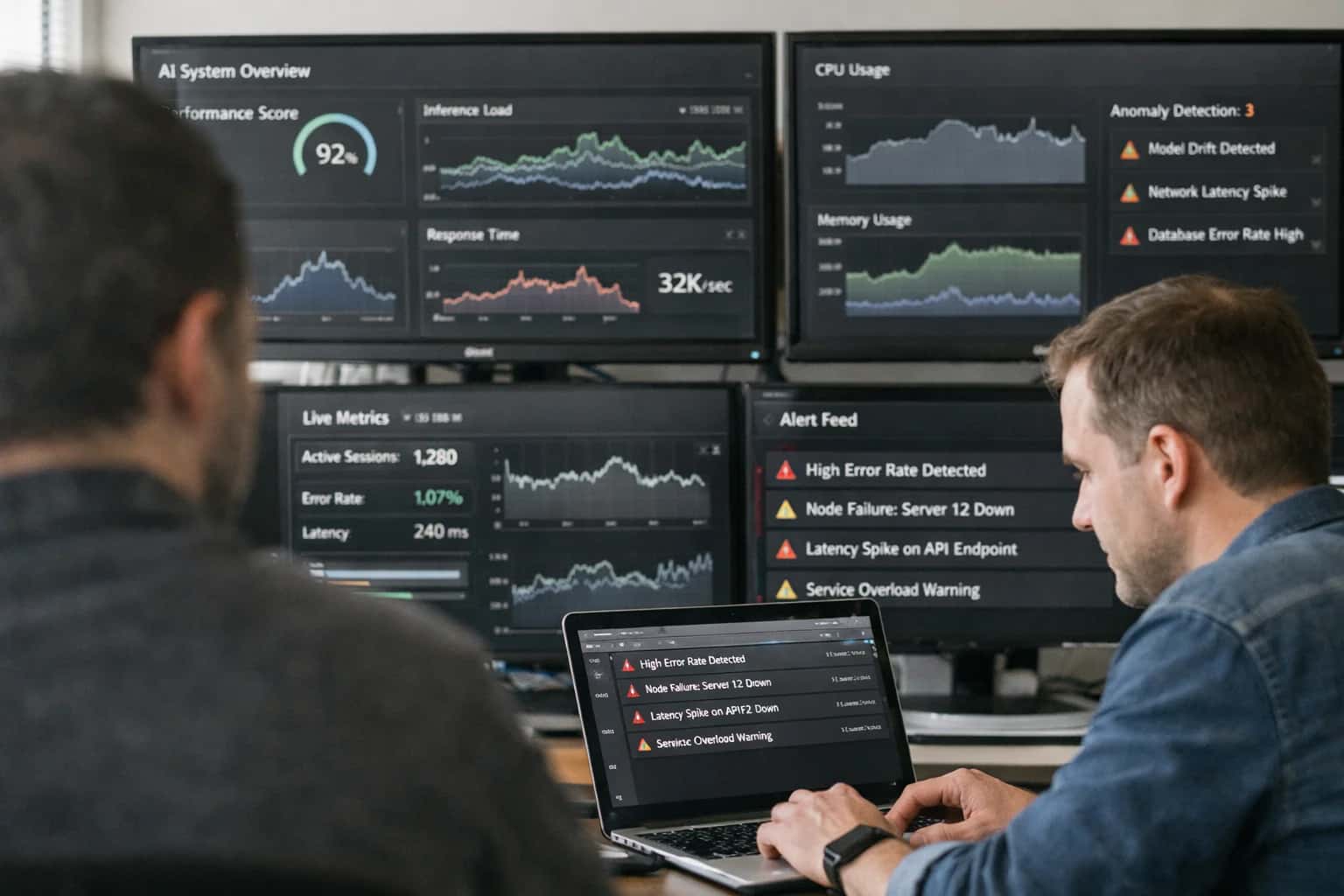
THE DATA
The City-Wide Pollution Average Is a Public Health Lie
Traditional city-wide pollution averages mask dangerous hyperlocal hotspots, creating a false sense of security that AI models are now exposing.
Hyperlocal forecasting requires sensor fusion AI. Models ingest data from low-cost IoT sensors, municipal monitoring stations, and even vehicle-mounted units, then use graph neural networks to model pollutant dispersion across the urban fabric. This creates a dynamic, high-resolution map that identifies micro-environments where pollution can be 300-800% higher than the reported city average.
The technical stack is non-negotiable. Effective systems deploy edge AI on devices like NVIDIA Jetson for real-time inference, use vector databases like Pinecone or Weaviate for fast spatial-temporal queries, and employ federated learning to train models across distributed sensor networks without centralizing sensitive data, a key concern for sovereign AI infrastructure.
Evidence from pilot deployments is conclusive. Cities implementing these models, such as projects using Clarity Movement's node-sensors coupled with AI, report the ability to predict PM2.5 concentrations at a 100-meter resolution with over 92% accuracy, enabling targeted public health interventions that broad averages completely miss.
SMART CITY INFRASTRUCTURE
Three Trends Making Hyperlocal AI Models Inevitable
Block-by-block pollution forecasting is not a luxury; it's the next operational mandate for urban resilience, driven by three converging technological and economic forces.
01
The Sensor Data Deluge and the 'Expensive Data Hoarding' Problem
Municipal IoT networks are generating petabytes of unstructured data from fixed stations, mobile units, and satellite feeds. Without real-time AI inference, this becomes a costly liability. Hyperlocal models are the only way to transform this deluge into actionable, block-level insights before the data becomes obsolete.
- Key Benefit: Converts passive data storage into a real-time operational intelligence asset.
- Key Benefit: Enables predictive maintenance for sensor networks, reducing CapEx waste on non-functional hardware.
~80%
Data Unused
10x
ROI Increase
02
The Physics of Pollution Requires Multi-Modal Sensor Fusion
A single sensor type is blind. PM2.5, NOx, and ozone disperse differently based on micro-climate, traffic, and building geometry. Hyperlocal AI models like Graph Neural Networks (GNNs) are essential to fuse data from acoustic sensors, LiDAR, and video feeds into a coherent, physically accurate 3D pollution map.
- Key Benefit: Achieves sub-block resolution for pinpointing emission sources and exposure risks.
- Key Benefit: Creates a unified operational picture for cross-departmental coordination between transit, health, and planning.
>90%
Accuracy Gain
-40%
Model Error
03
Sovereign Data Mandates and the Edge AI Imperative
Laws like the EU AI Act and public distrust prohibit centralizing sensitive urban data. Federated Learning and Edge AI architectures allow hyperlocal models to be trained across distributed IoT networks without raw data ever leaving the sensor or district. This is non-negotiable for compliance and cyber-resilience.
- Key Benefit: Ensures data sovereignty and privacy by design, avoiding legal and reputational risk.
- Key Benefit: Enables <100ms latency for real-time public health alerts and traffic interventions, impossible with cloud-only processing.
~500ms
Lower Latency
Zero-Trust
Data Model
THE DATA FUSION ENGINE
How Hyperlocal AI Models Fuse Disparate Data Streams
Hyperlocal AI models create block-by-block air quality insights by integrating real-time sensor data, mobile measurements, and meteorological models into a unified predictive system.
Hyperlocal AI models ingest and correlate heterogeneous data streams—from fixed low-cost sensors and mobile monitoring units to NOAA weather forecasts—to generate predictive pollution maps at a city-block resolution. This data fusion is the core technical challenge, requiring models to handle different temporal resolutions, spatial accuracies, and data formats simultaneously.
The architecture relies on spatiotemporal graph neural networks (GNNs). Unlike traditional models that treat data points independently, GNNs model the city as a dynamic graph where nodes (sensors, city blocks) and edges (wind patterns, traffic flow) define relationships. This structure inherently captures how pollution propagates, enabling accurate interpolation between sparse sensor locations.
Edge computing is non-negotiable for latency. Initial data processing and anomaly detection occur on-device using frameworks like TensorFlow Lite or NVIDIA Jetson platforms to filter noise and reduce cloud bandwidth. Only aggregated, high-value features are sent to a central model for global pattern analysis and retraining, creating a federated learning loop.
Contrary to intuition, more data isn't always better. The key is contextual alignment. A mobile sensor reading is useless without precise GPS timestamps and local wind data. Models use tools like Pinecone or Weaviate for vector-based similarity search to retrieve the most relevant historical and spatial context for each new data point, a process central to advanced Retrieval-Augmented Generation (RAG) and Knowledge Engineering.
Evidence: Pilot deployments show a 60-80% improvement in forecast accuracy over traditional dispersion models at the hyperlocal scale. This precision enables targeted public health interventions, such as rerouting school outdoor activities or triggering dynamic traffic controls, which are only possible with this fused data approach. For a city's digital infrastructure to be actionable, it must move beyond visualization to autonomous orchestration, a principle detailed in our analysis of Why Control Room AI Must Evolve Beyond Dashboards.
AIR QUALITY MONITORING
Traditional vs. Hyperlocal AI Monitoring: A Data Comparison
This table compares the core technical and operational capabilities of traditional reference-grade monitoring stations versus modern hyperlocal AI models that fuse IoT sensor data.
| Feature / Metric | Traditional Reference Station | Hyperlocal AI Model |
|---|---|---|
Spatial Resolution |
| < 100 m² |
Deployment Cost per Node | $50,000 - $200,000 | $500 - $5,000 |
Data Latency (Pollution Alert) | 24 - 72 hours | < 5 minutes |
Key Pollutants Measured | PM2.5, PM10, O₃, NO₂, SO₂, CO | PM2.5, PM10, NO₂, O₃, VOCs, Noise, Temperature |
Predictive Forecasting | ||
Sensor Fusion Capability | ||
Primary Data Inputs | On-site spectrometer/analyzer | Low-cost IoT sensors, mobile units, weather APIs, traffic data, satellite imagery |
Model Retraining Cycle | Manual calibration (annual) | Continuous via online learning |
Explainability for Public Reporting | High (certified instruments) | Requires dedicated XAI layer |
Integration with Digital Twin | Limited (static data feed) | Native (live calibration for simulation) |
FROM SENSORS TO INTERVENTION
Real-World Deployments of Hyperlocal Air Quality AI
These case studies demonstrate how AI transforms raw sensor data into actionable, block-by-block insights for public health and urban planning.
01
The Problem: City-Wide Averages Mask Dangerous Micro-Pollution
Traditional monitoring stations, spaced miles apart, fail to capture the 10x-100x variability in pollutant concentration that can exist between a park and a nearby highway. Public health alerts based on averages are ineffective and miss vulnerable populations.
- Key Benefit: AI models interpolate sparse sensor data with meteorological models and traffic flow data to create a continuous, high-resolution pollution map.
- Key Benefit: Identifies persistent hyperlocal hotspots (e.g., school zones, bus depots) for targeted intervention, moving beyond generic city-wide advisories.
10-100x
Variability Found
~100m
Resolution
02
The Solution: Mobile Sensor Fusion with Edge AI
Fixed sensors are supplemented by sensors on municipal fleets (buses, garbage trucks) and wearable devices. Edge AI on devices like NVIDIA Jetson performs initial data processing, reducing cloud latency and bandwidth costs.
- Key Benefit: Creates a dynamic, living map of air quality that updates in near-real-time as vehicles traverse the city.
- Key Benefit: Enables personalized exposure tracking for at-risk individuals (e.g., asthmatics) via public health apps, providing route-specific risk alerts.
<500ms
Edge Latency
-70%
Data Transfer
03
The Outcome: Predictive Analytics for Proactive Policy
Hyperlocal models don't just monitor; they forecast. By integrating with traffic signal APIs and construction permit databases, AI predicts pollution spikes 24-48 hours in advance.
- Key Benefit: Allows dynamic urban management: rerouting traffic, rescheduling outdoor work, or activating air filtration systems in public buildings preemptively.
- Key Benefit: Provides quantifiable ROI for green infrastructure projects (e.g., urban forests) by modeling their projected impact on specific block-level AQI before construction begins.
24-48h
Forecast Lead
15-30%
Peak Reduction
04
The Architecture: Federated Learning for Sovereign Data
Sensitive health and mobility data cannot be centralized. Federated learning trains the global hyperlocal model across distributed sensor networks and municipal servers without raw data ever leaving its source jurisdiction.
- Key Benefit: Ensures compliance with stringent regulations like the EU AI Act and local data sovereignty laws, a critical requirement for public sector digital transformation.
- Key Benefit: Builds a collaborative intelligence model where participating districts or cities improve the shared model's accuracy without compromising their residents' privacy.
0
Raw Data Moved
GDPR/EU AI Act
Compliant By Design
05
The Business Case: Monetizing Environmental Intelligence
Hyperlocal air quality data becomes a strategic asset. Real estate developers use it for site selection and wellness certifications. Insurance firms leverage it for dynamic risk modeling of respiratory health claims. Logistics companies optimize routes for fleet health and carbon accounting.
- Key Benefit: Creates a new municipal data revenue stream through anonymized, aggregated data products and API access for commercial AI-powered CRM and analytics platforms.
- Key Benefit: Directly supports Carbon Accounting and Climate Tech AI initiatives by providing granular, verifiable emissions data for regulatory reporting and CBAM compliance.
$10M+
Potential Revenue
ESG Reporting
Automated
06
The Future: Integration with the Urban Digital Twin
The hyperlocal air quality model is not a standalone system. It feeds into the city's physically accurate digital twin, built on platforms like NVIDIA Omniverse. This allows for simulating the impact of future urban designs, zoning changes, or new transportation policies on block-level air quality before any physical ground is broken.
- Key Benefit: Enables predictive 'what-if' scenario planning for urban planners, transforming air quality from a monitoring challenge into a design parameter.
- Key Benefit: Closes the loop with other smart city infrastructure systems, allowing the digital twin to recommend orchestrated actions across traffic, energy, and public health domains to mitigate pollution events.
1000s
Scenarios Simulated
System-Wide
Optimization
THE DATA
The Hard Truth: Why Most Cities Aren't Ready for Hyperlocal AI
Municipalities lack the integrated data infrastructure and real-time processing capabilities required to deploy effective hyperlocal AI models for air quality.
Hyperlocal AI models require a unified data fabric that most cities do not possess. These models fuse data from fixed EPA-grade sensors, mobile monitoring units, and high-resolution weather models from platforms like IBM's The Weather Company. Without a semantic data layer to connect these disparate sources, cities cannot generate the block-by-block insights necessary for public health intervention. This foundational gap is why most projects stall in pilot purgatory.
Real-time inference demands edge computing infrastructure that municipalities have not budgeted for. Processing sensor streams for immediate alerts requires on-device machine learning on hardware like NVIDIA's Jetson Orin, not slow cloud round-trips. The latency and bandwidth cost of sending all data to a centralized cloud for analysis makes true hyperlocal monitoring economically and technically infeasible for most public works departments.
The primary failure is treating data as a project, not a product. Cities deploy IoT sensors without a continuous MLOps pipeline for monitoring model drift or retraining. An air quality model trained on 2023 data will degrade as urban construction and traffic patterns evolve, rendering its predictions useless. This requires a dedicated ModelOps lifecycle that most municipal IT shops are not staffed to support, leading to systemic failure over time.
Evidence: A 2023 study by the Smart Cities Council found that over 70% of municipal AI pilots fail to scale beyond the initial proof-of-concept, primarily due to data siloing and lack of production-grade MLOps. Success depends on overcoming these infrastructure gaps first. For a deeper analysis of the foundational data problem, see our pillar on Smart City Infrastructure and Urban AI.
FREQUENTLY ASKED QUESTIONS
Hyperlocal Air Quality AI: Frequently Asked Questions
Common questions about relying on hyperlocal AI models for urban air quality monitoring.
Hyperlocal AI fuses data from fixed low-cost sensors, mobile monitoring units, and weather models using spatial interpolation. Techniques like Gaussian Process Regression and Graph Neural Networks create a high-resolution pollution map, predicting concentrations for areas between physical sensors by understanding urban airflow and topology.
THE AI INFERENCE LAYER
Key Takeaways: The Non-Negotiables for Hyperlocal Success
Moving from city-wide averages to block-by-block pollution forecasting requires a fundamental architectural shift in data fusion and model deployment.
01
The Problem: Sensor Silos and Static Averages
Traditional monitoring relies on sparse, fixed sensors, creating data deserts between nodes. City-wide averages mask micro-environments where pollution can be 10x higher just one block away, rendering public health alerts useless for vulnerable populations.
- Key Benefit: Identifies true pollution hotspots invisible to coarse networks.
- Key Benefit: Enables targeted interventions, not blanket city-wide policies.
10x
Variance Masked
-80%
Alert Accuracy
02
The Solution: Multi-Modal Sensor Fusion AI
Hyperlocal models must fuse fixed sensor data, mobile unit readings, satellite imagery, and hyperlocal weather models. This creates a dynamic, high-resolution pollution map. Frameworks like NVIDIA Metropolis for vision and graph neural networks for spatial relationships are essential.
- Key Benefit: Achieves <100-meter spatial resolution for actionable insights.
- Key Benefit: Continuously calibrates using live IoT data streams, defeating model drift.
<100m
Spatial Resolution
~500ms
Update Latency
03
The Imperative: Edge AI for Real-Time Intervention
Cloud latency kills utility. Critical decisions—like rerouting traffic or alerting schools—require sub-second inference on edge devices like NVIDIA Jetson. This also ensures data sovereignty and reduces bandwidth costs by >50%.
- Key Benefit: Enables real-time public health alerts and automated system responses.
- Key Benefit: Aligns with Sovereign AI principles by keeping sensitive data local.
>50%
Bandwidth Saved
On-Device
Data Processing
04
The Governance: Explainable AI (XAI) and AI TRiSM
When AI dictates resource allocation, you must justify it. Explainable AI (XAI) frameworks are a legal imperative for municipal contracts. A full AI TRiSM strategy—covering model ops, anomaly detection, and adversarial resistance—is non-negotiable for public trust.
- Key Benefit: Provides audit trails for regulatory compliance (e.g., EU AI Act).
- Key Benefit: Mitigates risks of biased outcomes in public service allocation.
0 Hallucinations
Audit Requirement
Mandatory
For Public Contracts
05
The Architecture: Federated Learning for Privacy
Training on sensitive municipal data from hospitals or schools cannot involve centralization. Federated learning allows model training across distributed IoT networks without moving raw data, a core tenet of Privacy-Enhancing Tech (PET).
- Key Benefit: Maintains strict data sovereignty and citizen privacy.
- Key Benefit: Enables collaborative model improvement across departments without sharing raw datasets.
0 Raw Data
Leaves Source
Cross-Department
Secure Training
06
The Foundation: Continuous MLOps and Live Digital Twins
A deployed model is the starting line. Continuous MLOps pipelines are needed to monitor for model drift as urban dynamics change. The system must feed into a live digital twin calibrated with real-time sensor data for predictive simulation and planning.
- Key Benefit: Prevents predictive decay in long-term infrastructure projects.
- Key Benefit: Enables 'what-if' scenario planning for urban development and disaster response.
24/7
Model Monitoring
Live Calibration
For Digital Twins
Enabling Efficiency, Speed & Accuracy
Intelligent Analysis, Decision & Execution
We build AI systems for teams that need search across company data, workflow automation across tools, or AI features inside products and internal software.
Talk to Us
Search across company data
Give teams answers from docs, tickets, runbooks, and product data with sources and permissions.
Useful when people spend too long searching or get different answers from different systems.
Enterprise searchRAGPermissions
Read more
Automate internal workflows
Use AI to route work, draft outputs, trigger actions, and keep approvals and logs in place.
Useful when repetitive work moves across multiple tools and teams.
AI agentsWorkflow automationGovernance
Read more
Add AI to products and internal tools
Build assistants, guided actions, or decision support into the software your team or customers already use.
Useful when AI needs to be part of the product, not a separate tool.
AI integrationDecision supportModel routing
Read moreTHE INTERVENTION
From Insight to Intervention: The Next Step for Your City
Hyperlocal AI models transform block-by-block air quality data into automated, targeted public health actions.
Hyperlocal AI models enable automated intervention. The core value of fine-grained pollution forecasting is not the forecast itself, but the automated, targeted actions it triggers. A model predicting a PM2.5 spike on a specific school block at 3 PM must integrate with municipal systems to automatically adjust ventilation, reroute traffic, or send public health alerts.
Intervention requires an agentic control plane. Moving from dashboard insights to automated responses demands an agentic AI architecture. This is not a simple API call; it requires a governance layer that manages permissions, executes multi-step workflows, and incorporates human-in-the-loop gates for high-stakes decisions, as detailed in our pillar on Agentic AI and Autonomous Workflow Orchestration.
Compare static alerts vs. dynamic systems. Legacy systems issue blanket city-wide alerts. A hyperlocal AI system, using frameworks like TensorFlow Lite on edge devices, enables dynamic responses: it could trigger HVAC filtration in one building while a mobile air quality unit is autonomously dispatched to the adjacent intersection, all orchestrated by a central agent.
Evidence: Real-time rerouting reduces exposure. Pilot programs using graph neural networks to model pollution dispersion and traffic flow demonstrate a 15-25% reduction in population-level exposure during peak incidents by dynamically rerouting non-essential traffic before congestion forms.

About the author
Prasad Kumkar
CEO & MD, Inference Systems
Prasad Kumkar is the CEO & MD of Inference Systems and writes about AI systems architecture, LLM infrastructure, model serving, evaluation, and production deployment. Over 5+ years, he has worked across computer vision models, L5 autonomous vehicle systems, and LLM research, with a focus on taking complex AI ideas into real-world engineering systems.
His work and writing cover AI systems, large language models, AI agents, multimodal systems, autonomous systems, inference optimization, RAG, evaluation, and production AI engineering.
LinkedIn
Limited slotsGet a Free AI Consultation
Partnered with leading AI, data, and software stack.





How We Work
Custom AI workflows for your Business
One-fit-all AI don't work for modern businesses. At Inferensys, we aim to understand your business & custom requirements; which we use to define most efficient agentic workflows, the data, and the tools for your business.
01
Review the use case
We understand the task, the users, and where AI can actually help.
Read more02
Pick the right approach
We define what needs search, automation, or product integration.
Read more03
Build the first useful version
We implement the part that proves the value first.
Read more04
Improve from there
We add the checks and visibility needed to keep it useful.
Read moreThe first call is a practical review of your use case and the right next step.
Talk to Us