A Responsible AI Development Policy is a mandatory, enforceable document that translates ethical principles into concrete engineering requirements. It defines specific standards for fairness, transparency, accountability, privacy, and safety across the AI lifecycle. The policy must provide actionable directives for data sourcing, model documentation, and human oversight, ensuring every technical team operates from the same ethical baseline. This is not a theoretical exercise; it is the operational blueprint for mitigating risk and building trust in your AI systems.

Guide
Setting Up a Responsible AI Development Policy
A tactical guide to drafting, socializing, and enforcing a comprehensive AI development policy that mandates fairness, transparency, and accountability.
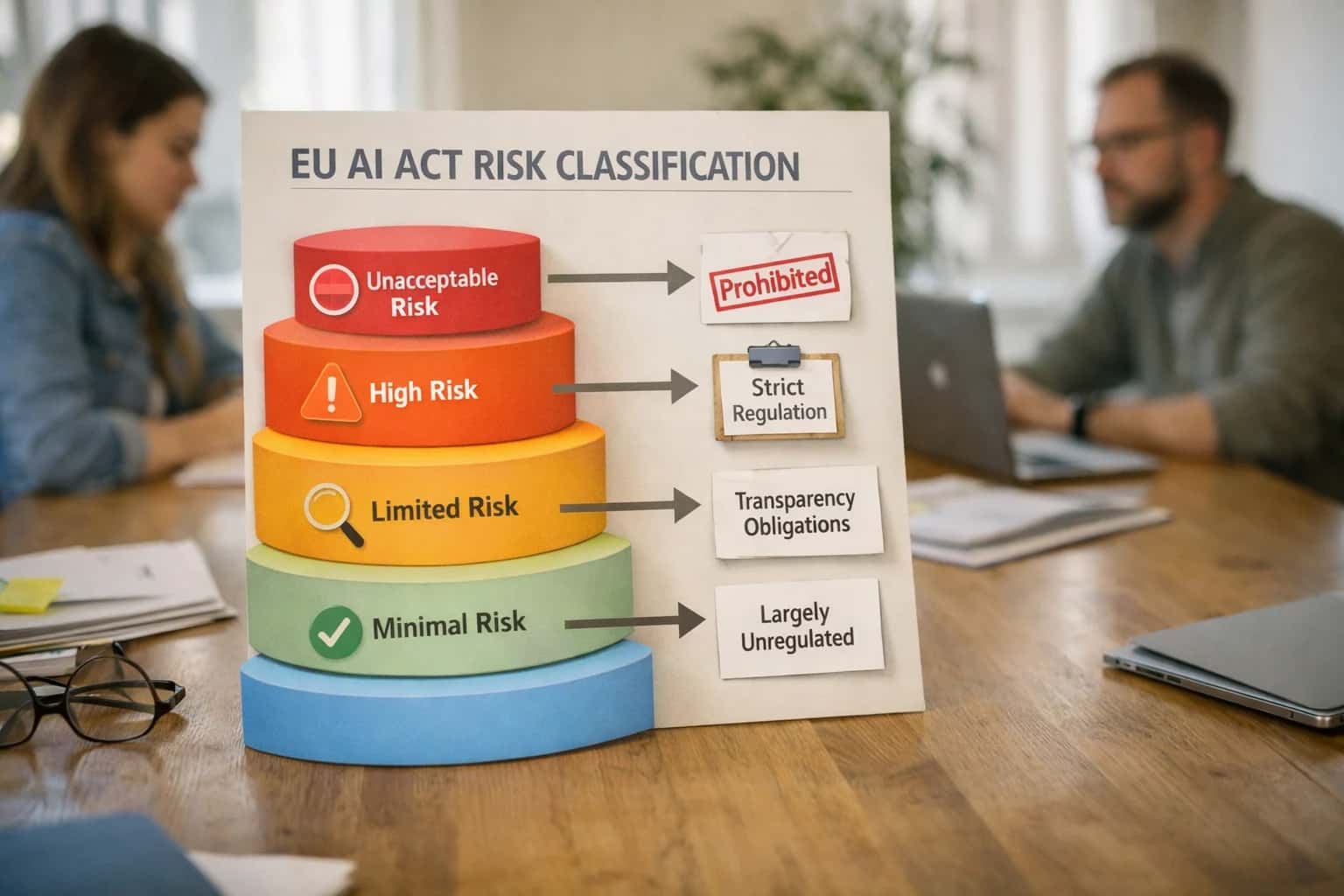
A Responsible AI Development Policy is the foundational document that codifies your organization's commitment to building ethical, safe, and compliant AI systems. This guide explains its core purpose and how to make it actionable.
To be effective, the policy must be integrated directly into engineering workflows. This involves socializing the document across teams, embedding its requirements into MLOps pipelines and code review checklists, and establishing clear mechanisms for periodic review and updates. A static policy is a failed policy. You must treat it as a living document, evolving with new regulations like the EU AI Act, technological advances, and lessons from internal audits and AI ethics incident post-mortems to remain relevant and enforceable.
MANDATORY SECTIONS
Core Policy Requirements Template
Essential components for a Responsible AI Development Policy, with implementation options.
| Policy Requirement | Basic Implementation | Standard Implementation | Advanced Implementation |
|---|---|---|---|
Fairness & Bias Mitigation | Manual pre-deployment bias check on training data | Automated bias testing for protected attributes using tools like Fairlearn | Continuous monitoring for demographic parity and equalized odds in production |
Transparency & Explainability | Basic model documentation in a shared registry | Local interpretability (LIME/SHAP) for individual predictions | Global model explainability reports and traceable reasoning logs for all high-risk decisions |
Accountability & Human Oversight | Designated model owner for incident response | Mandatory human-in-the-loop review for high-stakes outputs | Integrated approval workflows with auditable logs and automated escalation triggers |
Privacy & Data Governance | Data anonymization for training datasets | Differential privacy techniques and data minimization protocols | End-to-end encrypted data pipelines with confidential computing (TEEs) |
Safety & Robustness | Adversarial testing for common input attacks | Formal verification for critical system components | Real-time anomaly detection and self-healing failover mechanisms |
Monitoring & Auditing | Monthly manual review of key performance metrics | Automated dashboards for model drift and performance degradation (e.g., Arize, Fiddler) | Continuous audit program with automated triggers for fairness, explainability, and safety deviations |
Documentation & Compliance | Internal model card for developer reference | Public-facing model cards and Algorithmic Impact Assessments (AIA) for high-risk systems | Automated generation of compliance artifacts for regulations like the EU AI Act |
IMPLEMENTATION
Step 3: Integrate Policy into Your SDLC
A policy document is inert without integration. This step embeds your Responsible AI Development Policy into the daily workflows of your engineering teams, transforming principles into enforceable practice.
Integrate policy requirements as mandatory gates in your existing Software Development Lifecycle (SDLC) and MLOps pipelines. This means adding specific checkpoints for fairness assessments, model documentation, and human oversight reviews before code merges or model deployments. Use tools like MLflow for experiment tracking and Weights & Biases for model governance to automate compliance logging. This ensures ethical review is a non-negotiable part of the technical process, not a separate, bureaucratic hurdle.
Socialize the integrated process through training and clear documentation. Provide engineers with pre-deployment checklists and automated scripts that validate policy adherence, such as running bias detection on training data splits. Establish a clear escalation path to your AI Ethics Officer for edge cases. Finally, schedule periodic policy reviews tied to your product release cycles to update requirements based on new regulations, incident learnings, and technological shifts, ensuring your governance evolves with your systems.
IMPLEMENTATION GUIDE
Tools for Policy Compliance
A Responsible AI Development Policy is only as strong as its enforcement. These tools and frameworks provide the concrete mechanisms to translate policy mandates into engineering practice.
01
Model Cards & Datasheets
These are standardized documents that provide essential facts about your AI models. They are the cornerstone of transparency and accountability.
- Model Cards detail a model's performance characteristics, intended uses, and limitations.
- Datasheets for Datasets document the provenance, composition, and collection processes of your training data. Implementing these creates auditable documentation, fulfilling key requirements of frameworks like the EU AI Act and our guide on Explainability and Traceability for High-Risk AI.
EXPLORE
02
Bias & Fairness Auditing Tools
Proactively detect and mitigate unwanted bias in your models. These tools integrate into your MLOps pipeline to run automated checks.
- Arize AI and Fiddler AI offer continuous monitoring for fairness metric deviations and performance disparities across subgroups.
- IBM AI Fairness 360 is an open-source toolkit with a comprehensive set of algorithms for bias detection and mitigation. Use these to operationalize the fairness mandates in your policy and support a Continuous AI Audit Program.
EXPLORE
03
ML Model Registries
A centralized system to track, version, and govern the lifecycle of every model. This is critical for enforcing pre-deployment reviews and maintaining an inventory of AI assets.
- MLflow Model Registry and Weights & Biases provide lineage tracking, stage transitions (staging -> production), and approval workflows.
- Seldon Alibi integrates explainability and drift detection directly into the registry. This tool directly enables the governance gates outlined in How to Integrate an AI Ethics Board into Your SDLC.
EXPLORE
04
Explainability (XAI) Libraries
Make your model's decisions interpretable to developers, auditors, and end-users. These libraries generate reasoning traces required for high-risk applications.
- SHAP (SHapley Additive exPlanations) and LIME provide local, instance-level explanations for any model.
- Captum is PyTorch's native library for model interpretability. Integrating XAI is a non-negotiable step for building defensible AI systems, as detailed in our pillar on Neuro-Symbolic AI for Legal and Medical Reasoning.
EXPLORE
06
Incident Response & Logging
Prepare for when things go wrong. Specialized logging and case management tools are essential for executing your AI Incident Response Plan.
- Robust Logging: Implement structured logging for all model inputs, outputs, and confidence scores using frameworks like structlog.
- Case Management: Use platforms like Jira Service Management or ServiceNow to create dedicated workflows for triaging, investigating, and resolving AI ethics incidents, ensuring audit trails and accountability.
Enabling Efficiency, Speed & Accuracy
Intelligent Analysis, Decision & Execution
We build AI systems for teams that need search across company data, workflow automation across tools, or AI features inside products and internal software.
Talk to Us
Search across company data
Give teams answers from docs, tickets, runbooks, and product data with sources and permissions.
Useful when people spend too long searching or get different answers from different systems.
Enterprise searchRAGPermissions
Read more
Automate internal workflows
Use AI to route work, draft outputs, trigger actions, and keep approvals and logs in place.
Useful when repetitive work moves across multiple tools and teams.
AI agentsWorkflow automationGovernance
Read more
Add AI to products and internal tools
Build assistants, guided actions, or decision support into the software your team or customers already use.
Useful when AI needs to be part of the product, not a separate tool.
AI integrationDecision supportModel routing
Read morePOLICY IMPLEMENTATION
Common Mistakes
A Responsible AI Development Policy is only as strong as its execution. This section addresses the frequent pitfalls that undermine policy effectiveness, from vague principles to unenforced technical reviews.
This happens when the policy is written in abstract, non-actionable language. A policy stating 'We will be fair' is useless to an engineer. Instead, it must translate principles into specific, testable requirements.
Common Mistake: Defining goals without engineering guardrails. Fix: For each principle, define concrete actions. For example:
- Fairness: 'All classification models must be evaluated for demographic parity using a predefined bias assessment suite (e.g., Fairlearn) before deployment. Disparate impact ratios must fall within [0.8, 1.25].'
- Transparency: 'All model cards must be completed in the registry, including intended use, known limitations, and performance across key slices.' Link policy mandates directly to tools in your MLOps and Model Lifecycle Management pipeline.

About the author
Prasad Kumkar
CEO & MD, Inference Systems
Prasad Kumkar is the CEO & MD of Inference Systems and writes about AI systems architecture, LLM infrastructure, model serving, evaluation, and production deployment. Over 5+ years, he has worked across computer vision models, L5 autonomous vehicle systems, and LLM research, with a focus on taking complex AI ideas into real-world engineering systems.
His work and writing cover AI systems, large language models, AI agents, multimodal systems, autonomous systems, inference optimization, RAG, evaluation, and production AI engineering.
LinkedIn
Limited slotsGet a Free AI Consultation
Partnered with leading AI, data, and software stack.





How We Work
Custom AI workflows for your Business
One-fit-all AI don't work for modern businesses. At Inferensys, we aim to understand your business & custom requirements; which we use to define most efficient agentic workflows, the data, and the tools for your business.
01
Review the use case
We understand the task, the users, and where AI can actually help.
Read more02
Pick the right approach
We define what needs search, automation, or product integration.
Read more03
Build the first useful version
We implement the part that proves the value first.
Read more04
Improve from there
We add the checks and visibility needed to keep it useful.
Read moreThe first call is a practical review of your use case and the right next step.
Talk to Us