Integrating an AI Ethics Board into your SDLC transforms ethical review from a retrospective audit into a proactive design constraint. This requires establishing mandatory review gates at key stages: design conception, data sourcing, model training, and pre-deployment. By linking these gates to existing tools like MLflow for experiment tracking and Weights & Biases for dataset versioning, you create a lightweight, auditable process that prevents bottlenecks while ensuring accountability and regulatory compliance from the start.

Guide
How to Integrate an AI Ethics Board into Your SDLC
A tactical guide to embedding mandatory, lightweight ethical review gates into your standard software and MLOps pipelines to prevent bottlenecks and ensure accountability.
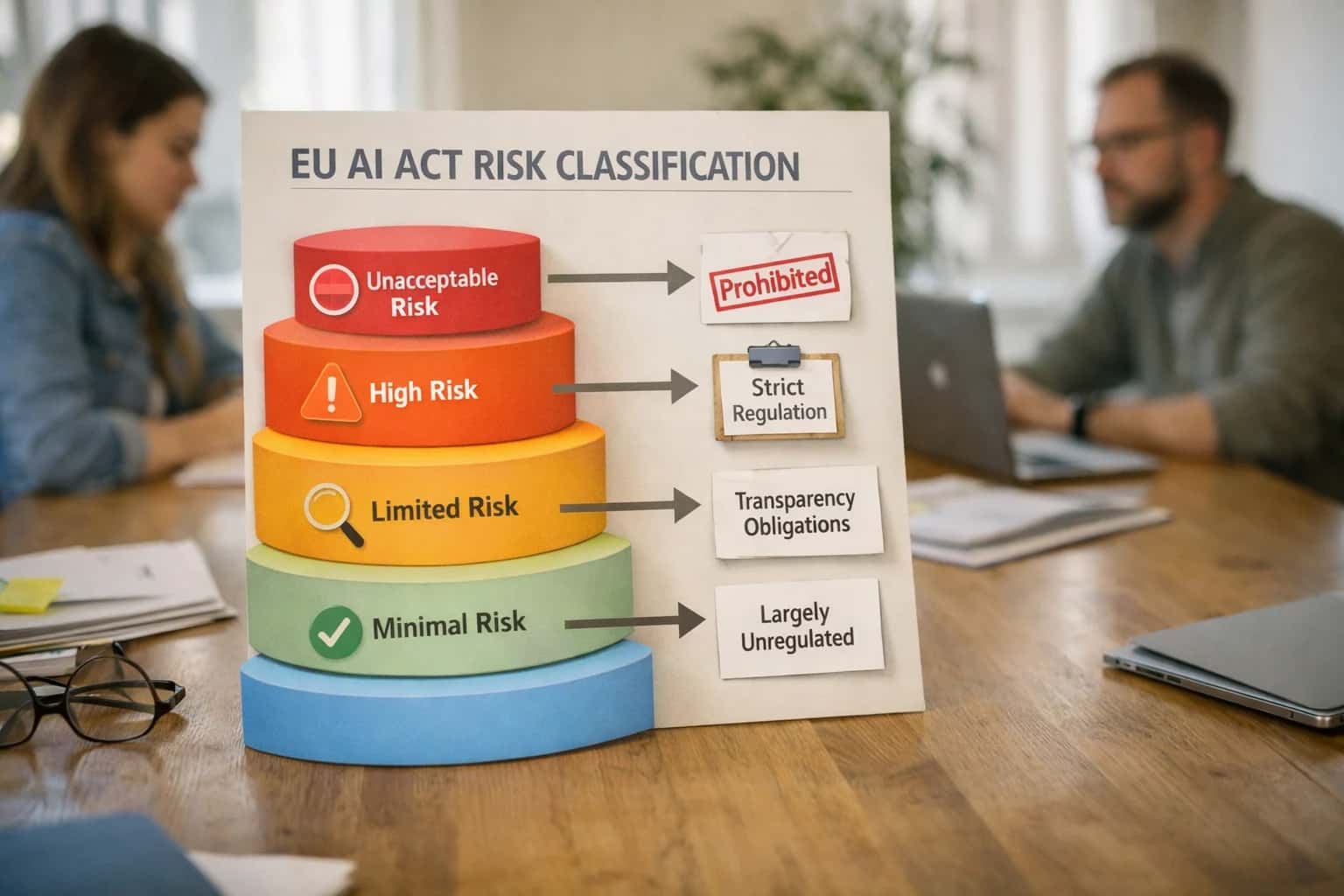
This guide explains how to embed ethical review gates into your standard Software Development Lifecycle (SDLC) and MLOps pipelines.
The core deliverable is a concrete ethics review checklist that engineering teams complete asynchronously. This checklist must cover data provenance audits, bias testing results, explainability requirements, and post-launch monitoring plans. This structured approach, detailed in our guide on Setting Up a Responsible AI Development Policy, ensures your AI governance is operational, not theoretical, and directly reduces deployment risk.
SDLC PHASE GATES
Ethical Review Gate Checklist Table
Mandatory checklist items for each ethical review gate integrated into the Software Development Lifecycle (SDLC). Use this to ensure accountability and prevent bottlenecks.
| Review Gate | Design Review | Pre-Deployment Assessment | Post-Launch Monitoring |
|---|---|---|---|
Primary Objective | Identify ethical risks in system design and data strategy | Validate model fairness, explainability, and safety | Monitor for performance drift, emergent bias, and real-world impact |
Required Artifacts | System architecture diagram, Data provenance report, Intended use statement | Model card, Bias audit results, Explainability report | Production performance dashboard, User feedback logs, Incident reports |
Key Stakeholders | Product Manager, Lead Architect, Data Engineer, AI Ethics Officer | ML Engineer, Data Scientist, Compliance Lead, AI Ethics Board delegate | DevOps/SRE, Customer Support, AI Ethics Officer, Legal |
Approval Authority | AI Ethics Officer (sign-off required) | AI Ethics Board (majority vote required) | AI Ethics Officer (continuous oversight) |
Common Tools | Draw.io, Weights & Biases (lineage tracking), Internal wikis | Arize AI, Fiddler AI, SHAP, LIME | Datadog/Grafana, MLflow, Custom monitoring agents |
Exit Criteria | All high-risk design flaws mitigated or accepted via documented waiver | All fairness metrics within defined thresholds; explainability requirements met | No severity-1 incidents for 30 days; drift metrics stable |
Output Documentation | Ethical Design Review memo filed in model registry | Pre-Deployment Compliance Certificate | Monthly Ethics & Performance Report for leadership |
Escalation Path | To AI Ethics Board for unresolved high-risk disputes | To CTO and CEO if board cannot reach consensus | To AI Incident Response Plan for severe production issues |
IMPLEMENTATION
Step 3: Integrate Gates with MLOps Tools
This step operationalizes your AI Ethics Board's oversight by embedding automated review gates directly into your MLOps pipelines. It transforms governance from a manual checklist into a scalable, auditable engineering practice.
Integrate ethical review gates as mandatory stages within your MLOps pipeline using tools like MLflow, Weights & Biases, or Kubeflow. For example, configure a pipeline to automatically trigger a data provenance audit before model training begins, checking for bias and lineage using a custom script. A second gate can require a pre-deployment model assessment, where the system blocks promotion to production until a fairness report from a tool like Arize AI is attached to the model registry entry. This creates enforceable, asynchronous checkpoints.
To prevent bottlenecks, design these gates to run automatically and fail fast. Use the pipeline's metadata to generate a standardized ethics review artifact—a JSON file containing audit results, model cards, and compliance flags—that is stored alongside the model. This artifact serves as the definitive record for your AI Ethics Board and feeds into your AI Governance Dashboard. The goal is continuous compliance, where governance is a seamless byproduct of the development workflow, not a separate, manual approval queue.
Enabling Efficiency, Speed & Accuracy
Intelligent Analysis, Decision & Execution
We build AI systems for teams that need search across company data, workflow automation across tools, or AI features inside products and internal software.
Talk to Us
Search across company data
Give teams answers from docs, tickets, runbooks, and product data with sources and permissions.
Useful when people spend too long searching or get different answers from different systems.
Enterprise searchRAGPermissions
Read more
Automate internal workflows
Use AI to route work, draft outputs, trigger actions, and keep approvals and logs in place.
Useful when repetitive work moves across multiple tools and teams.
AI agentsWorkflow automationGovernance
Read more
Add AI to products and internal tools
Build assistants, guided actions, or decision support into the software your team or customers already use.
Useful when AI needs to be part of the product, not a separate tool.
AI integrationDecision supportModel routing
Read moreTROUBLESHOOTING
Common Mistakes
Integrating an AI Ethics Board into your SDLC is a critical but nuanced process. These are the most frequent pitfalls that derail governance efforts, creating bottlenecks or rendering reviews ineffective.
This happens when the review is treated as a monolithic, end-of-cycle gate. The board becomes a single point of failure, waiting for a fully built model before raising fundamental ethical concerns.
Fix: Integrate lightweight, asynchronous checkpoints throughout the SDLC. Use a gated review process:
- Design Phase: Review the problem statement, intended use, and data sourcing plan.
- Development Phase: Audit the training dataset for bias and review the model card.
- Pre-Deployment: Conduct a final impact assessment and validate monitoring hooks.
This spreads the review load and allows for early course correction, preventing last-minute blockers. Tools like MLflow for model lineage and Weights & Biases for experiment tracking make this asynchronous review feasible by providing a shared source of truth.

About the author
Prasad Kumkar
CEO & MD, Inference Systems
Prasad Kumkar is the CEO & MD of Inference Systems and writes about AI systems architecture, LLM infrastructure, model serving, evaluation, and production deployment. Over 5+ years, he has worked across computer vision models, L5 autonomous vehicle systems, and LLM research, with a focus on taking complex AI ideas into real-world engineering systems.
His work and writing cover AI systems, large language models, AI agents, multimodal systems, autonomous systems, inference optimization, RAG, evaluation, and production AI engineering.
LinkedIn
Limited slotsGet a Free AI Consultation
Partnered with leading AI, data, and software stack.





How We Work
Custom AI workflows for your Business
One-fit-all AI don't work for modern businesses. At Inferensys, we aim to understand your business & custom requirements; which we use to define most efficient agentic workflows, the data, and the tools for your business.
01
Review the use case
We understand the task, the users, and where AI can actually help.
Read more02
Pick the right approach
We define what needs search, automation, or product integration.
Read more03
Build the first useful version
We implement the part that proves the value first.
Read more04
Improve from there
We add the checks and visibility needed to keep it useful.
Read moreThe first call is a practical review of your use case and the right next step.
Talk to Us