A continuous AI audit program is the operational engine of modern AI governance. It moves beyond one-time compliance checks to establish automated, ongoing oversight of models in production. This program systematically monitors for model drift, performance degradation, and fairness metric deviations using platforms like Arize and Fiddler. The goal is to detect issues before they impact users or violate regulations, transforming governance from a reactive cost center into a proactive value driver.

Guide
Launching a Continuous AI Audit Program
A technical guide to building an automated, ongoing audit system for AI models in production. Covers monitoring, triggers, remediation, and compliance reporting.
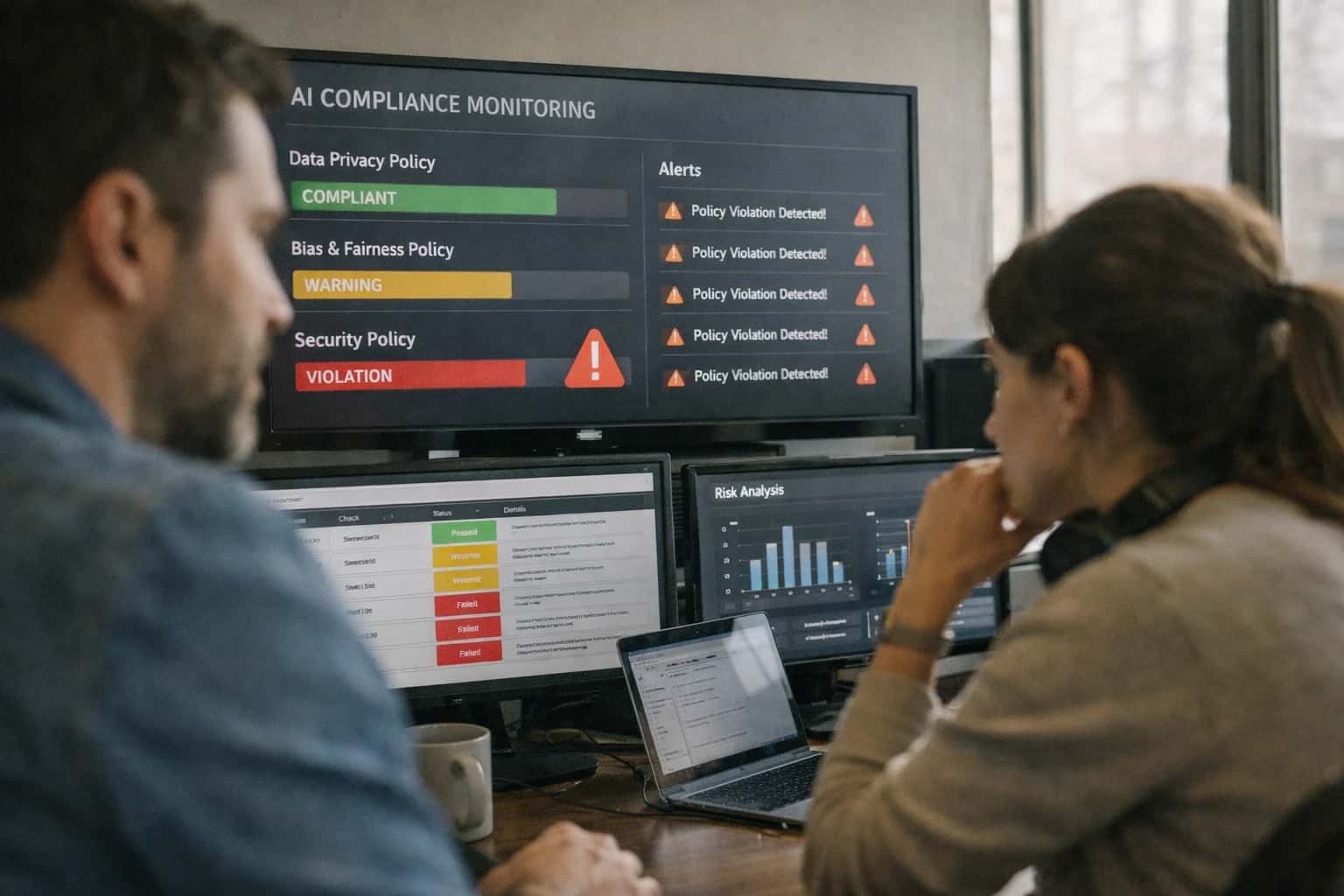
A continuous AI audit program is the operational engine of modern AI governance, moving from periodic manual checks to automated, ongoing oversight of models in production.
Launching this program requires defining clear audit triggers—specific thresholds for metrics like prediction drift or demographic parity difference—that automatically flag anomalies. You then establish remediation workflows to investigate and resolve issues, and generate periodic compliance reports for internal governance boards and external regulators. This creates a closed-loop system that satisfies both ethical mandates and operational resilience, as detailed in our guide on Setting Up Key Performance Indicators for AI Governance.
CONTINUOUS MONITORING
AI Audit Trigger Matrix
Defines the specific conditions that should automatically initiate an audit of a production AI system. This matrix links observable metrics to concrete governance actions.
| Audit Trigger | Low-Risk System | Medium-Risk System | High-Risk System |
|---|---|---|---|
Model Performance Drift (Accuracy/F1) |
|
|
|
Data Drift (PSI/Feature Distribution) | PSI > 0.25 | PSI > 0.15 | PSI > 0.10 |
Fairness Metric Deviation (Demographic Parity) |
|
|
|
Prediction Latency Increase |
|
|
|
Input/Output Anomaly Detection Alert | 3+ alerts in 24h | 2+ alerts in 24h | 1+ alert |
Human-in-the-Loop (HITL) Override Rate |
|
|
|
Regulatory Change (e.g., EU AI Act) | Review within 90 days | Review within 30 days | Immediate review & impact assessment |
Adversarial Attack or Security Breach | Post-incident review | Immediate audit & model retraining | Immediate audit, retraining, and system isolation |
Enabling Efficiency, Speed & Accuracy
Intelligent Analysis, Decision & Execution
We build AI systems for teams that need search across company data, workflow automation across tools, or AI features inside products and internal software.
Talk to Us
Search across company data
Give teams answers from docs, tickets, runbooks, and product data with sources and permissions.
Useful when people spend too long searching or get different answers from different systems.
Enterprise searchRAGPermissions
Read more
Automate internal workflows
Use AI to route work, draft outputs, trigger actions, and keep approvals and logs in place.
Useful when repetitive work moves across multiple tools and teams.
AI agentsWorkflow automationGovernance
Read more
Add AI to products and internal tools
Build assistants, guided actions, or decision support into the software your team or customers already use.
Useful when AI needs to be part of the product, not a separate tool.
AI integrationDecision supportModel routing
Read moreLAUNCHING A CONTINUOUS AI AUDIT PROGRAM
Common Mistakes
Avoid these critical errors that derail continuous AI audit programs, leading to ineffective monitoring, compliance failures, and unmanaged risk.
You are likely auditing post-facto instead of continuously. A common mistake is scheduling monthly or quarterly manual reviews, which creates a dangerous lag between when a model drifts and when you detect it.
Continuous auditing requires automated, real-time monitoring of key metrics. Set up audit triggers in platforms like Arize or Fiddler to fire alerts based on thresholds for:
- Prediction drift (changes in input data distribution)
- Performance degradation (drop in accuracy, precision, recall)
- Fairness metric deviations (disparate impact across protected groups)
Without these real-time triggers, your program is reactive, not proactive, violating the core principle of continuous governance outlined in our guide on Implementing continuous audit mechanisms for AI governance.

About the author
Prasad Kumkar
CEO & MD, Inference Systems
Prasad Kumkar is the CEO & MD of Inference Systems and writes about AI systems architecture, LLM infrastructure, model serving, evaluation, and production deployment. Over 5+ years, he has worked across computer vision models, L5 autonomous vehicle systems, and LLM research, with a focus on taking complex AI ideas into real-world engineering systems.
His work and writing cover AI systems, large language models, AI agents, multimodal systems, autonomous systems, inference optimization, RAG, evaluation, and production AI engineering.
LinkedIn
Limited slotsGet a Free AI Consultation
Partnered with leading AI, data, and software stack.





How We Work
Custom AI workflows for your Business
One-fit-all AI don't work for modern businesses. At Inferensys, we aim to understand your business & custom requirements; which we use to define most efficient agentic workflows, the data, and the tools for your business.
01
Review the use case
We understand the task, the users, and where AI can actually help.
Read more02
Pick the right approach
We define what needs search, automation, or product integration.
Read more03
Build the first useful version
We implement the part that proves the value first.
Read more04
Improve from there
We add the checks and visibility needed to keep it useful.
Read moreThe first call is a practical review of your use case and the right next step.
Talk to Us