Cloud latency breaks real-time control loops. A centralized AI model hosted on AWS or Azure introduces a 100-500ms round-trip delay; this is unacceptable for a robotic arm avoiding a collision or a quality control system rejecting a defective part on a high-speed assembly line. Real-time decisioning systems require sub-10ms inference, which is only possible with on-device or on-premise edge computing.

Blog
The Future of Industrial Autonomy Is Decentralized Intelligence
The centralized cloud model is failing industrial automation. This article explains why smart factories require networks of edge-powered robots and cobots making autonomous, real-time decisions, and outlines the architectural shift towards decentralized intelligence.
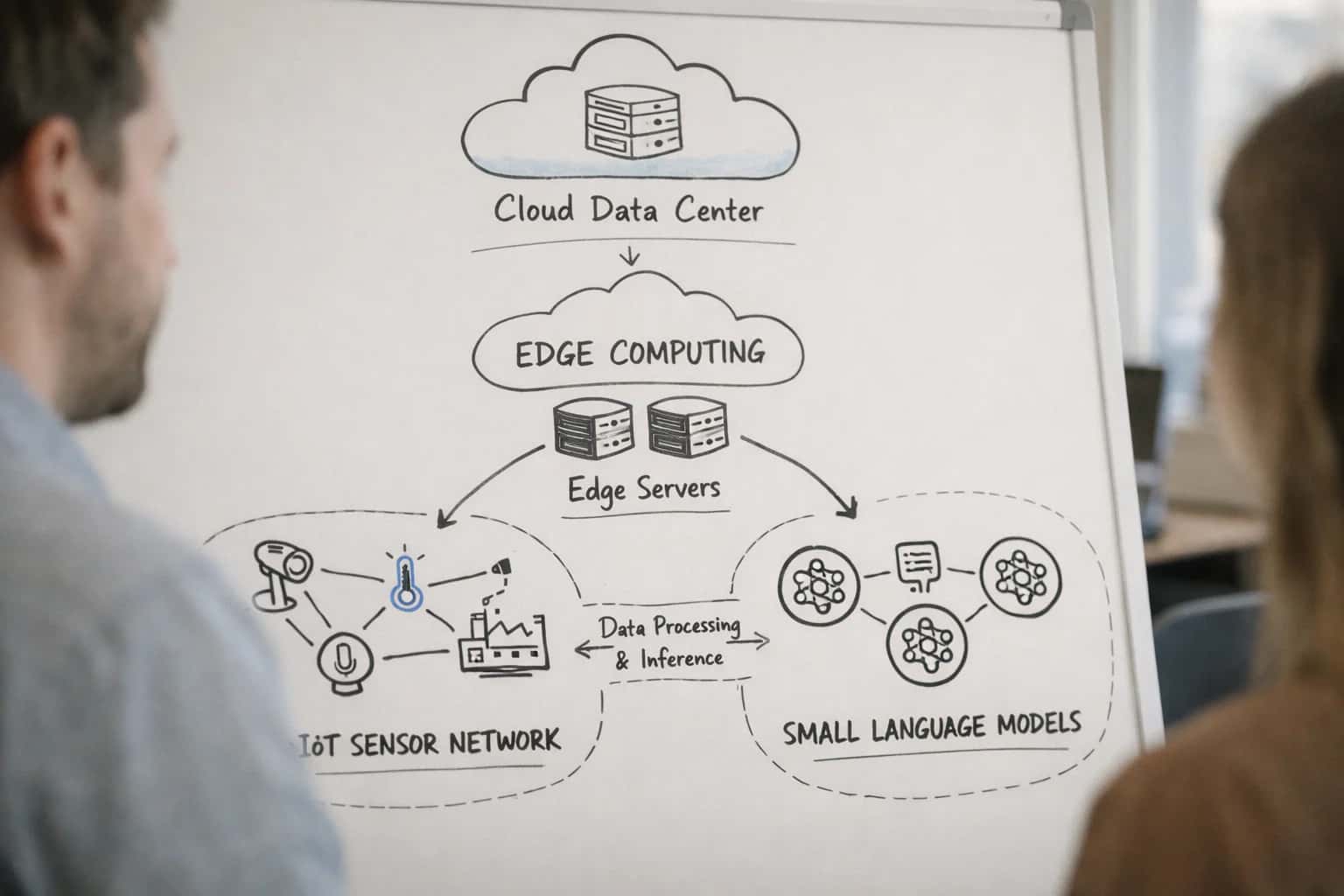
THE LATENCY PROBLEM
The Centralized Cloud Is a Bottleneck for Factory Floors
Cloud round-trip latency makes centralized AI architectures unsuitable for real-time industrial control and safety systems.
Bandwidth costs cripple video analytics. Streaming raw, high-resolution video from hundreds of factory cameras to the cloud for analysis is economically and technically infeasible. Edge-native computer vision models from frameworks like TensorFlow Lite or ONNX Runtime must run directly on NVIDIA Jetson-powered cameras or industrial PCs to filter and process only relevant events, sending kilobytes of metadata instead of gigabytes of video.
Network reliability is a single point of failure. A factory floor cannot halt production because of an internet outage or cloud region downtime. Autonomous edge intelligence ensures that collaborative robots (cobots), automated guided vehicles (AGVs), and predictive maintenance systems continue to operate. This architecture aligns with the principles of Physical AI and Embodied Intelligence, where machines act independently in the physical world.
Evidence: Studies in predictive maintenance show that analyzing vibration sensor data at the edge reduces data transfer volume by over 99% and enables fault detection 10x faster than cloud-based analysis. This is the core of a functional Industrial Internet of Things (IIoT) strategy.
INDUSTRIAL AUTONOMY
Three Trends Forcing the Shift to Decentralized Intelligence
The centralized cloud model is breaking under the weight of real-time industrial demands. Here are the three critical pressures making decentralized intelligence inevitable.
01
The Problem: Unacceptable Cloud Round-Trip Latency
For autonomous systems like cobots and drones, ~500ms of cloud latency is a safety and productivity failure. This delay makes real-time collision avoidance and precision manipulation impossible.
- Key Benefit: Enables sub-10ms on-device decision loops for safe human-robot collaboration.
- Key Benefit: Eliminates the risk of network outages halting production, ensuring 99.99% operational uptime.
~500ms
Cloud Latency
<10ms
Edge Latency
02
The Problem: The Prohibitive Cost of Data Movement
A single high-resolution industrial camera can generate over 1 TB of data per day. Streaming this raw video to the cloud for analysis is economically and technically infeasible.
- Key Benefit: Reduces bandwidth costs by over 90% by processing video feeds locally on smart cameras.
- Key Benefit: Enables real-time video analytics for quality control and anomaly detection without congesting the network.
1 TB/Day
Data Per Camera
-90%
Bandwidth Cost
03
The Problem: The Data Sovereignty and Privacy Imperative
Regulations like the EU AI Act and intellectual property concerns prevent sensitive production data from leaving the factory floor. Centralized cloud processing creates unacceptable compliance risk.
- Key Benefit: Ensures data never leaves the secure perimeter, simplifying compliance with GDPR and sector-specific regulations.
- Key Benefit: Builds customer and partner trust by making privacy-preserving AI a core architectural feature, not an add-on.
GDPR
Compliance
Zero-Export
Data Policy
ARCHITECTURAL DECISION MATRIX
Centralized Cloud vs. Decentralized Edge: A Performance Breakdown
A quantitative comparison of core performance, cost, and operational metrics for industrial autonomy systems, critical for CTOs evaluating the strategic imperative of on-device inference.
| Feature / Metric | Centralized Cloud AI | Decentralized Edge AI | Hybrid Edge-Cloud |
|---|---|---|---|
Inference Latency (Round-Trip) | 100-500 ms | < 10 ms | 10-50 ms (edge-first) |
Data Sovereignty & Privacy | |||
Bandwidth Consumption (per camera stream) | 2-8 Mbps | < 100 Kbps | 100-500 Kbps |
Offline Operational Capability | |||
Model Update & Deployment Cadence | Hours | Weeks (constrained) | Days (orchestrated) |
Hardware Cost per Node (CAPEX) | $0 (cloud OPEX) | $500-$5,000 | $200-$2,000 + OPEX |
Operational Resilience to Network Outage | 0% | 100% |
|
Scalability for 10,000+ Node Fleets | Requires federated learning |
THE ARCHITECTURE
Architecting the Decentralized Industrial Nervous System
A decentralized intelligence architecture replaces fragile, centralized control with resilient, autonomous edge agents that make real-time decisions.
Centralized control is a single point of failure. A cloud-dependent command center creates unacceptable latency for robotic arms and autonomous guided vehicles (AGVs), making real-time coordination impossible. The future is a mesh of intelligent edge nodes.
The unit of intelligence shifts from the cloud to the device. Each robot, sensor, and PLC becomes an autonomous agent running optimized models on hardware like the NVIDIA Jetson Orin or Qualcomm RB5. This eliminates the round-trip to a central server.
Local consensus replaces remote commands. Machines coordinate via low-latency protocols like DDS or ROS 2, forming dynamic coalitions to handle tasks. This is superior to waiting for a cloud orchestrator's delayed instructions.
Data sovereignty is enforced by design. Sensitive operational data never leaves the factory floor, complying with regulations like the EU AI Act by default. This architecture is a core component of a Sovereign AI and Geopatriated Infrastructure strategy.
Evidence: Deploying predictive maintenance models directly on vibration sensors reduces unplanned downtime by up to 30%, as analysis happens in milliseconds, not the minutes required for cloud data transfer. This is a foundational use case for Physical AI and Embodied Intelligence.
THE ARCHITECTURAL REALITY CHECK
The Hidden Costs and Risks of Decentralized Edge AI
Decentralizing intelligence to the edge is a strategic imperative, but it introduces a new class of operational and financial burdens that cloud-centric MLOps fails to address.
01
The Problem: Silent Model Degradation in the Field
Edge models degrade due to changing environmental data, a phenomenon known as model drift. Without a continuous feedback loop, failures are silent until they cause a safety or quality incident.
- Detection Lag: Drift can go undetected for weeks, as data isn't automatically centralized for analysis.
- Remediation Cost: Physically updating thousands of remote devices is an OpEx nightmare, often requiring manual intervention.
- Risk Amplification: A single degraded vision model on an autonomous forklift can lead to a $500k+ collision and production halt.
Weeks
Undetected Drift
10x
Remediation Cost
02
The Problem: The Heterogeneous Hardware Tax
An industrial fleet mixes ARM, x86, and RISC-V chips from NVIDIA, Qualcomm, and Intel. Each requires a custom-compiled model variant, exploding your MLOps complexity.
- Vendor Lock-In: Proprietary SDKs and toolchains from chipmakers create long-term strategic dependency.
- Compilation Overhead: Maintaining a build pipeline for a dozen target architectures consumes ~30% of engineering cycles.
- Performance Fragmentation: Inconsistent inference latency across devices breaks system-wide timing guarantees.
12+
Model Variants
30%
Eng. Overhead
03
The Problem: The Bandwidth & Sovereignty Double Bind
You can't stream all sensor data to the cloud due to cost and data sovereignty laws like GDPR and the EU AI Act, but you still need aggregated insights.
- Data Gravity: Critical telemetry is trapped on local edge nodes, creating analytics blind spots.
- Compliance Risk: Unintended cross-border data flows during model updates can trigger multi-million euro fines.
- Architectural Debt: Ad-hoc solutions for local processing and compliant aggregation become unmaintainable.
$10M+
Compliance Risk
~80%
Data Unobserved
04
The Solution: Federated Learning as an Operational Layer
Federated Learning isn't just a privacy tool; it's the operational backbone for continuous edge model improvement without centralizing raw data.
- Drift Mitigation: Models learn from distributed data patterns, combating degradation in near-real-time.
- Bandwidth Efficiency: Only tiny model updates (~1-10 MB) are transmitted, not terabytes of sensor data.
- Sovereignty by Design: Data never leaves its legal jurisdiction, automating compliance. This is a core component of a mature Edge AI and Real-Time Decisioning Systems strategy.
-99%
Data Transfer
Auto
Compliance
05
The Solution: Inference Economics with Hybrid Orchestration
A hybrid cloud AI architecture strategically splits workloads: lightweight models run at the edge, while complex retraining happens in the cloud, optimizing for cost and latency.
- Cost Control: Avoids the prohibitive expense of streaming high-frequency sensor data to the cloud for simple inferences.
- Strategic Resilience: Keeps critical real-time loops on-premises, insulating operations from cloud outages.
- Toolchain Unification: A single MLOps control plane manages models across both environments, reducing fragmentation. This approach is critical for managing the lifecycle covered in our MLOps and the AI Production Lifecycle pillar.
-70%
Cloud egress
<100ms
Critical Latency
06
The Solution: Proactive Edge TRiSM and Red-Teaming
Edge AI demands a specialized subset of AI TRiSM. You must proactively test for adversarial attacks, data poisoning, and physical tampering in offline environments.
- Security by Obscurity is Dead: Offline doesn't mean secure. Models are vulnerable to physical sensor spoofing.
- Explainability Mandate: For safety-critical decisions (e.g., autonomous emergency braking), you need interpretable models, not black boxes.
- Continuous Validation: Red-teaming must be integrated into the CI/CD pipeline, simulating real-world edge failure modes before deployment.
Pre-Deploy
Red Team
Non-Negotiable
Explainability
THE ARCHITECTURE
The Cloud Isn't Dead—It's Evolving into a Strategic Layer
The cloud's role is shifting from a centralized compute hub to a strategic orchestration and training layer for decentralized edge intelligence.
The cloud is not obsolete; it is becoming the strategic brain for a distributed nervous system of edge devices. Its primary function is shifting from real-time inference to model training, orchestration, and data synthesis, while the edge handles latency-critical decisioning. This hybrid architecture is the only viable path for scalable industrial autonomy.
Centralized training, decentralized execution defines the new paradigm. Massive models are trained in the cloud using frameworks like PyTorch and TensorFlow, then distilled into lightweight versions deployed via MLOps platforms like BentoML or KubeFlow to thousands of edge nodes. The cloud manages the lifecycle, while the edge performs the work.
The cloud becomes a data refinery, not a data lake. It ingests aggregated, anonymized telemetry from edge devices to create synthetic training data and continuously improve models through techniques like federated learning. This closed-loop system, referenced in our guide to Federated Learning, ensures models adapt without compromising on-site privacy.
Strategic orchestration replaces raw compute. Cloud platforms like AWS IoT Greengrass or Azure Arc now function as control planes, managing deployments, monitoring for model drift across a heterogeneous fleet, and orchestrating updates. This is the core of modern MLOps maturity at scale.
Evidence: Deploying a digital twin in the cloud for simulation and planning, while its real-time counterpart operates on the factory floor, can reduce operational downtime by up to 30%. The cloud simulates 'what-if' scenarios; the edge executes the optimized plan.
THE ARCHITECTURAL SHIFT
Key Takeaways: The Path to Decentralized Industrial Autonomy
The future of smart factories hinges on moving intelligence from centralized clouds to the network edge, where autonomous decisions happen in real-time.
01
The Problem: Cloud Round-Trip Latency Breaks Real-Time Control
Sending sensor data to a central cloud for analysis introduces ~100-500ms latency, making it impossible for robots to react to dynamic line conditions. This delay creates a fundamental bottleneck for safety and throughput.
- Key Benefit: Enables sub-10ms reaction times for collision avoidance and precision assembly.
- Key Benefit: Eliminates the single point of failure and bandwidth costs of constant cloud streaming.
~500ms
Cloud Latency
<10ms
Edge Latency
02
The Solution: Federated Learning for Continuous, Private Improvement
Centralizing sensitive production data for model training violates data sovereignty and creates a security risk. Federated learning allows on-device model training across a fleet of cobots, aggregating only learned weights.
- Key Benefit: Maintains data privacy and compliance with regulations like the EU AI Act by keeping raw data on-premise.
- Key Benefit: Enables continuous model adaptation to new part designs or process variations without manual retraining cycles.
0%
Raw Data Exposed
Continuous
Model Adaptation
03
The Hidden Cost: Silent Model Drift in Heterogeneous Fleets
An AI model trained in a lab performs perfectly, but deployed across hundreds of machines in varying environments, it degrades silently. Traditional MLOps cannot monitor thousands of remote, offline deployments.
- Key Benefit: Implementing edge-native MLOps with lightweight monitoring agents detects drift and triggers federated updates, preventing catastrophic failures.
- Key Benefit: Reduces mean-time-to-repair (MTTR) for AI systems by >70%, turning a reactive cost center into a proactive asset.
>70%
Lower MTTR
Thousands
Monitored Nodes
04
The Strategic Imperative: Hardware-Software Co-Design
Deploying cloud-optimized models on generic edge hardware leads to poor performance and high energy costs. Success requires tailoring algorithms to specific silicon, like NVIDIA Jetson or Qualcomm AI Engine.
- Key Benefit: Achieves 10-100x better inference efficiency through model quantization, pruning, and compiler-level optimizations for the target hardware.
- Key Benefit: Unlocks new use cases on battery-powered or thermally constrained devices, expanding the scope of industrial autonomy.
10-100x
Efficiency Gain
Watt-Hours
Critical Constraint
05
The New Paradigm: Edge Consensus for Multi-Agent Coordination
A fleet of autonomous forklifts in a warehouse cannot rely on a cloud server to avoid collisions. They need a distributed consensus protocol running at the edge to negotiate right-of-way in real-time.
- Key Benefit: Enables truly resilient systems that continue operating during network partitions or cloud outages.
- Key Benefit: Facilitates emergent swarm intelligence, where simple local rules among agents create complex, optimized global behaviors for material flow.
Resilient
During Outages
Swarm
Intelligence
06
The Business Advantage: Privacy as a Product Feature
On-device processing isn't just about compliance; it's a competitive moat. Customers in defense, pharmaceuticals, and proprietary manufacturing will pay a premium for systems that guarantee their operational data never leaves the factory floor.
- Key Benefit: Creates trust and enables new markets where data sensitivity previously blocked cloud-based AI adoption.
- Key Benefit: Aligns with the strategic shift towards Sovereign AI and geopatriated infrastructure, mitigating regulatory and geopolitical risk.
Premium
Product Feature
Zero-Trust
Data Model
Enabling Efficiency, Speed & Accuracy
Intelligent Analysis, Decision & Execution
We build AI systems for teams that need search across company data, workflow automation across tools, or AI features inside products and internal software.
Talk to Us
Search across company data
Give teams answers from docs, tickets, runbooks, and product data with sources and permissions.
Useful when people spend too long searching or get different answers from different systems.
Enterprise searchRAGPermissions
Read more
Automate internal workflows
Use AI to route work, draft outputs, trigger actions, and keep approvals and logs in place.
Useful when repetitive work moves across multiple tools and teams.
AI agentsWorkflow automationGovernance
Read more
Add AI to products and internal tools
Build assistants, guided actions, or decision support into the software your team or customers already use.
Useful when AI needs to be part of the product, not a separate tool.
AI integrationDecision supportModel routing
Read moreTHE ARCHITECTURAL SHIFT
Stop Planning for Centralized Control, Start Architecting for Edge Autonomy
Industrial autonomy requires moving intelligence from the cloud to the device, enabling real-time decisions without latency or connectivity dependencies.
Centralized control is obsolete for industrial autonomy. Cloud round-trip latency and network brittleness make real-time decisioning impossible for safety-critical systems like collaborative robots and autonomous guided vehicles.
Edge autonomy demands local inference. Devices must process sensor data and execute models using frameworks like TensorFlow Lite or ONNX Runtime directly on hardware from NVIDIA (Jetson) or Qualcomm. This eliminates the cloud bottleneck.
Decentralized intelligence creates resilient systems. A network of autonomous edge nodes, communicating via lightweight protocols like MQTT, forms a fault-tolerant mesh. The failure of one node or the central server does not cascade.
Evidence: Predictive maintenance models running on on-site edge gateways analyze vibration data in under 10 milliseconds, enabling failure prediction before a cloud-based system even receives the packet. This is the core of our work in Physical AI and Embodied Intelligence.
The strategic imperative is sovereignty. Processing data locally complies with regulations like the EU AI Act and avoids the vendor lock-in and egress costs of cloud-only AI, a principle central to Sovereign AI and Geopatriated Infrastructure.

About the author
Prasad Kumkar
CEO & MD, Inference Systems
Prasad Kumkar is the CEO & MD of Inference Systems and writes about AI systems architecture, LLM infrastructure, model serving, evaluation, and production deployment. Over 5+ years, he has worked across computer vision models, L5 autonomous vehicle systems, and LLM research, with a focus on taking complex AI ideas into real-world engineering systems.
His work and writing cover AI systems, large language models, AI agents, multimodal systems, autonomous systems, inference optimization, RAG, evaluation, and production AI engineering.
LinkedIn
Limited slotsGet a Free AI Consultation
Partnered with leading AI, data, and software stack.





How We Work
Custom AI workflows for your Business
One-fit-all AI don't work for modern businesses. At Inferensys, we aim to understand your business & custom requirements; which we use to define most efficient agentic workflows, the data, and the tools for your business.
01
Review the use case
We understand the task, the users, and where AI can actually help.
Read more02
Pick the right approach
We define what needs search, automation, or product integration.
Read more03
Build the first useful version
We implement the part that proves the value first.
Read more04
Improve from there
We add the checks and visibility needed to keep it useful.
Read moreThe first call is a practical review of your use case and the right next step.
Talk to Us