Edge AI exposes cloud-native MLOps as incomplete. Your pipeline built for Kubernetes and cloud GPUs collapses when deploying to a fleet of NVIDIA Jetson devices, Qualcomm Snapdragon platforms, and ARM-based microcontrollers. The fantasy ends where the WAN connection drops.

Blog
Why Edge AI Is the True Test of MLOps Maturity
Managing a single cloud model is easy. Edge AI—with thousands of remote, heterogeneous deployments—exposes every weakness in your MLOps stack. This is where maturity is forged.
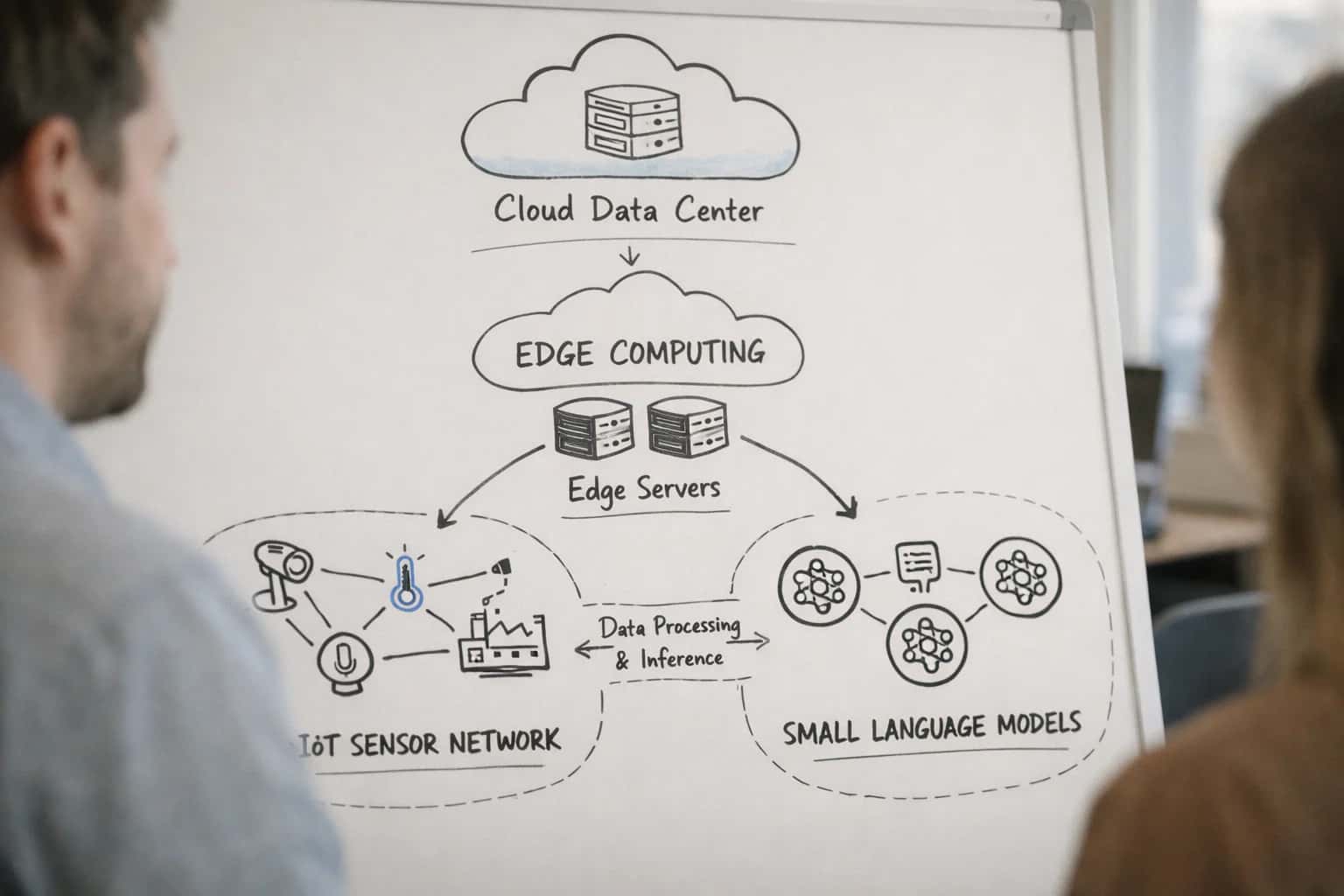
THE REALITY CHECK
Your MLOps Stack Is a Cloud-Native Fantasy
Managing thousands of remote model deployments across heterogeneous hardware requires a new level of automation and monitoring that cloud-centric MLOps fails to provide.
True MLOps maturity is measured by fleet management, not pipeline automation. Tools like MLflow or Kubeflow excel in controlled environments but lack the primitives for over-the-air (OTA) updates, health monitoring, and drift detection across 10,000 offline edge nodes. The real challenge is orchestration at scale.
The cloud model of 'deploy once, monitor centrally' is a liability. An edge model degrading in a wearable health monitor or an autonomous forklift creates silent, cascading failures. You need a distributed ModelOps layer that treats each device as a sovereign, reporting node in a federated system, a concept central to our work in AI TRiSM.
Evidence: Bandwidth economics force the issue. Analyzing a 4K video stream from an industrial camera in the cloud costs ~$1,500/month in egress fees alone. Running a TensorRT-optimized model on an NVIDIA Orin at the edge reduces that cost to near-zero, making the business case for edge MLOps non-negotiable, a principle that extends to Physical AI and Embodied Intelligence.
WHY EDGE AI IS THE TRUE TEST
The Inevitable Shift Forcing the MLOps Reckoning
Managing thousands of remote model deployments across heterogeneous hardware requires a new level of automation and monitoring.
01
The Problem: Silent Model Drift in the Field
Edge models degrade silently without centralized data feedback loops. Traditional cloud MLOps monitoring fails because you can't stream petabytes from remote devices.
- Detecting drift requires inferring performance from indirect telemetry like inference latency spikes or hardware sensor anomalies.
- A single model update can require orchestrating staged rollouts across 10,000+ different device SKUs and chipset architectures (ARM, x86, RISC-V).
- The operational burden shifts from data scientists to Site Reliability Engineering (SRE) teams managing a distributed, stateful fleet.
10k+
Device SKUs
~0%
Data Feedback
02
The Solution: Federated Learning as Continuous Integration
Privacy-preserving federated learning transforms each edge device into a data-less training node. This is the unsung hero for maintaining model relevance without violating data sovereignty.
- Enables continuous model improvement across a distributed fleet without centralizing sensitive raw data (e.g., health metrics, video feeds).
- Requires a fundamentally new CI/CD pipeline where model updates are aggregated from encrypted weight deltas, not code commits.
- Directly addresses compliance with regulations like GDPR and the EU AI Act by design, turning a constraint into a strategic advantage.
100%
Data On-Device
-70%
Cloud Data Transfer
03
The Problem: The Brutal Economics of Inference
Cloud round-trip latency and bandwidth costs make centralized inference economically and technically infeasible for real-time systems.
- Streaming raw video for cloud analytics can cost >$10,000/month per camera in bandwidth alone, crushing ROI.
- For autonomous systems, ~500ms of cloud latency is unacceptable; edge inference delivers decisions in <10ms.
- Battery-powered devices force a trade-off between model accuracy and operational lifespan, dictating aggressive model compression and quantization.
>500ms
Cloud Latency
<10ms
Edge Latency
04
The Solution: Hardware-Software Co-Design as a Service
Overcoming edge bottlenecks requires designing the model, compiler, and silicon in concert. This is beyond the reach of most in-house teams.
- Specialized AI accelerators from NVIDIA (Jetson), Qualcomm, and Intel require proprietary toolchains (TensorRT, SNPE, OpenVINO) for optimal performance.
- Model quantization and pruning must be tailored to the target hardware's integer/floating-point capabilities to maximize inferences per watt.
- Success means treating the edge deployment target as a first-class architectural constraint, not an afterthought.
10x
Inferences/Watt
3+
Toolchains
05
The Problem: The Orchestration Nightmare
Kubernetes was built for the cloud, not for managing a globally distributed, intermittently connected, resource-constrained fleet of AI endpoints.
- Deploying a model update requires handling partial failures and rollbacks across devices with poor or metered cellular connectivity.
- Security patching and access control must be enforced locally, without constant cloud checks, demanding a zero-trust architecture at the edge.
- The sheer heterogeneity of the fleet breaks simple deployment patterns, requiring intelligent canary testing and health scoring per device class.
Global
Distribution
Intermittent
Connectivity
06
The Solution: The Agent Control Plane for Physical Systems
Mature Edge MLOps requires a governance layer that extends the principles of Agentic AI orchestration to the physical world. This is the Agent Control Plane for machines.
- Manages permissions, hand-offs, and human-in-the-loop gates for networks of autonomous edge agents (robots, cameras, sensors).
- Provides centralized visibility and policy enforcement across thousands of remote deployments, bridging the gap to cloud-based ModelOps platforms.
- Enables predictive maintenance and real-time optimization by treating the entire distributed system as a single, manageable entity—the industrial nervous system.
1
Control Plane
1000s
Managed Agents
FEATURED SNIPPETS
The MLOps Maturity Gap: Cloud vs. Edge
A direct comparison of core MLOps capabilities, highlighting why managing models at the edge is a more complex and revealing test of an organization's production readiness.
| MLOps Capability | Cloud-Centric MLOps | Edge-Native MLOps | Maturity Implication |
|---|---|---|---|
Deployment Unit & Orchestration | Container (Docker/K8s) | Container, Binary, Firmware | Heterogeneous packaging and OTA update orchestration |
Model Update Latency | < 5 minutes | Hours to days (batched, OTA) | Asynchronous, network-constrained rollout |
Inference Latency SLA | 50-200 ms | < 10 ms | Real-time decisioning is non-negotiable |
Monitoring & Observability | Centralized logs & metrics (Prometheus) | Federated health checks, partial telemetry | Intermittent connectivity demands local buffering |
Hardware Heterogeneity | Limited (CPU/GPU instance types) | Extreme (ARM, x86, NPU, MCU) | Requires hardware-software co-design and cross-compilation |
Data Privacy & Sovereignty | Centralized data lake (potential risk) | On-device processing, Federated Learning | Privacy-by-design is a core architectural constraint |
Model Drift Detection | Centralized, near real-time | Delayed, statistical sampling | Silent failures require proactive canary testing |
Rollback & Recovery | Instant (K8s rollback) | Complex (staged OTA, A/B partitions) | Bricked devices are a catastrophic cost center |
THE INFRASTRUCTURE
Why Heterogeneous Hardware Breaks Standardized Deployment
Standardized cloud MLOps toolchains fail when confronted with the fragmented reality of edge hardware.
Edge AI deployment is infrastructure-native. The core challenge is not the model, but the heterogeneous hardware landscape of ARM, x86, and RISC-V processors, alongside specialized accelerators from NVIDIA, Qualcomm, and Intel. A containerized model built for an NVIDIA Jetson will not run on a Raspberry Pi without significant re-engineering, breaking the promise of a single, portable artifact.
Standardized toolchains assume homogeneity. Cloud-native MLOps platforms like MLflow or Kubeflow are designed for uniform, scalable infrastructure. They fail at the edge because they cannot abstract away the fundamental differences in compute, memory, and power profiles across thousands of unique devices. Deploying a model becomes a manual, device-specific compilation and optimization task.
The counter-intuitive insight is that more abstraction creates more fragility. Attempting to force a unified deployment layer across a Qualcomm Snapdragon, an NVIDIA Orin, and a legacy industrial PLC increases complexity. The solution is a hardware-aware orchestration layer that manages discrete, optimized model binaries for each target, a concept central to our approach in Edge AI and Real-Time Decisioning Systems.
Evidence: Model conversion failure rates exceed 30% when moving from a standard PyTorch or TensorFlow format to hardware-specific runtimes like TensorRT, OpenVINO, or TFLite for Microcontrollers. Each conversion requires unique quantization, pruning, and kernel fusion strategies, making automated pipelines brittle.
THE PRODUCTION CHASM
Real-World Edge AI Failures and Their MLOps Root Causes
Edge AI exposes the fragility of cloud-centric MLOps, where silent model degradation and deployment chaos lead to catastrophic system failures.
01
The Phantom Model Drift in Autonomous Vehicles
A perception model trained on sunny California roads fails silently in a Michigan snowstorm, causing a safety-critical disengagement. Traditional cloud MLOps, which samples data weekly, cannot detect this real-time environmental drift. The root cause is a lack of continuous, on-device validation and feedback loops.
- Failure Mode: Silent performance degradation in new environments.
- MLOps Gap: No framework for real-time edge performance telemetry.
- Solution: Implementing shadow mode inference with human-in-the-loop validation gates for all new operational domains.
~500ms
To Detect Drift
0%
Coverage in OTA Updates
02
The Bandwidth Bankruptcy of Smart City Cameras
A municipal video analytics project streams raw 4K feeds to the cloud, incurring $50k+ monthly bandwidth costs and >2-second latency, rendering real-time crime detection useless. The MLOps pipeline had no stage for model compression or hardware-aware optimization.
- Failure Mode: Economically and technically infeasible cloud offloading.
- MLOps Gap: No 'build for edge' stage in the CI/CD pipeline.
- Solution: A mandatory hardware-in-the-loop testing phase enforcing quantization-aware training and pruning before deployment.
$50k+
Monthly Overage
>2s
Analytics Latency
03
The Heterogeneous Deployment Nightmare
A manufacturer's predictive maintenance model works flawlessly on test NVIDIA Jetson devices but fails to deploy across a fleet mixing ARM, x86, and RISC-V chips on the factory floor. The MLOps platform lacked a unified artifact registry and hardware abstraction layer.
- Failure Mode: 'Works on my machine' syndrome at industrial scale.
- MLOps Gap: No centralized orchestration for heterogeneous edge targets.
- Solution: Adopting a container-first strategy with a unified orchestration layer like K3s or AWS IoT Greengrass to manage deployments across disparate architectures.
3x
Longer Rollout
40%
Fleet Inoperable
04
The Privacy Breach via Model Update
A wearable health monitor's firmware update inadvertently pulls a new model from a centralized server, leaking anonymized ECG patterns that could be re-identified. The MLOps process treated model updates as mere software patches, ignoring data sovereignty implications.
- Failure Mode: Compliance violation through the update mechanism itself.
- MLOps Gap: No privacy-preserving update protocol like federated learning in the deployment workflow.
- Solution: Implementing federated learning or secure aggregation protocols to decentralize model improvement, keeping sensitive data on-device.
GDPR
Violation
100%
Recall Required
05
The Battery Assassination of Wearable AI
A new, more accurate fall-detection model for a smartwatch drains the battery in 4 hours instead of 18, rendering the product useless. The MLOps team optimized only for accuracy (F1 score), not for the inference economics of the target hardware.
- Failure Mode: Product-killing power consumption from an 'improved' model.
- MLOps Gap: No power profiling stage in the model validation pipeline.
- Solution: Integrating hardware energy proxies and strict millijoule-per-inference budgets as a gating metric for model promotion.
-75%
Battery Life
4h
Runtime
06
The Uncoordinated Edge Consensus Failure
A swarm of autonomous warehouse robots receives conflicting navigation updates, causing a system-wide deadlock. The MLOps platform treated each robot as an independent endpoint, with no capability for coordinated model rollouts or state synchronization.
- Failure Mode: Distributed system failure due to inconsistent model states.
- MLOps Gap: No fleet-level orchestration or canary rollout strategies for interdependent edge agents.
- Solution: Deploying an agent control plane that manages model versioning, canary releases, and rollback across the entire distributed system as a single logical unit.
100%
Fleet Deadlock
$250k
Downtime Cost
THE DATA
The Cloud-Only Fallacy: "We'll Just Stream the Data"
Streaming all data to the cloud for AI processing is a naive strategy that fails under the weight of latency, cost, and bandwidth constraints.
Edge AI is the true test of MLOps maturity because managing thousands of remote model deployments across heterogeneous hardware requires a new level of automation and monitoring that cloud-centric platforms lack. This is the core challenge of Edge AI and Real-Time Decisioning Systems.
Cloud streaming creates a latency tax that breaks real-time systems. A round-trip to AWS or Azure for inference adds 100-500ms, a delay that is fatal for autonomous vehicles, industrial robots, and AR glasses. True real-time decisioning is only possible with on-device inference.
Bandwidth costs are economically prohibitive. Streaming raw, high-resolution video from thousands of security cameras or industrial sensors to the cloud for analysis in platforms like Google Vertex AI Vision incurs unsustainable egress fees and saturates network capacity.
Data gravity and sovereignty dictate edge processing. Regulations like GDPR and the EU AI Act make moving sensitive personal or operational data across borders legally complex. Processing data locally on NVIDIA Jetson or Qualcomm Snapdragon platforms is a compliance necessity.
Evidence: A single 4K security camera stream requires ~20 Mbps. For 100 cameras, the 2 Gbps continuous bandwidth cost makes cloud-only video analytics financially impossible, forcing the analytics to the camera itself.
THE PRODUCTION REALITY CHECK
Key Takeaways: The Edge AI MLOps Mandate
Managing thousands of remote model deployments across heterogeneous hardware requires a new level of automation and monitoring.
01
The Problem: Silent Model Drift in the Field
Edge models degrade silently without centralized data streams, making traditional cloud-based monitoring blind. A model performing flawlessly in a San Francisco test lab can fail catastrophically on a factory floor in Munich due to unseen environmental drift.
- Key Benefit: Continuous validation against local edge data streams.
- Key Benefit: Automated rollback triggers when performance drops below a >5% accuracy threshold.
0 Visibility
Without Edge MLOps
~500ms
Alert Latency
02
The Solution: Federated Learning Orchestration
This privacy-preserving technique is the unsung hero of continuous edge improvement. It aggregates learnings from distributed devices to update a global model without ever centralizing raw, sensitive data.
- Key Benefit: Enables model evolution while maintaining data sovereignty and compliance with GDPR/EU AI Act.
- Key Benefit: Reduces required bandwidth by >90% compared to streaming raw sensor data to the cloud.
0 Raw Data
Leaves Device
-90%
Bandwidth Cost
03
The Problem: Heterogeneous Hardware Sprawl
A single fleet may contain chips from NVIDIA Jetson, Qualcomm Snapdragon, and ARM Cortex architectures. Deploying and optimizing a single model across this sprawl is a manual, unsustainable nightmare.
- Key Benefit: Automated model compilation and quantization for each target (e.g., INT8 for TPU, FP16 for GPU).
- Key Benefit: Unified health dashboard across x86, ARM, and RISC-V devices.
3x+
DevOps Effort
10+ Variants
Per Model
04
The Solution: Containerized, Orchestrated Deployment
Success requires microservices and orchestration designed for resource constraints. Technologies like Docker and Kubernetes (K3s) enable atomic, rollback-safe updates across thousands of edge nodes.
- Key Benefit: A/B testing and shadow mode deployment of new models with zero downtime.
- Key Benefit: Drastically reduces the mean time to repair (MTTR) for faulty deployments from days to minutes.
Minutes
Fleet-Wide Update
-70%
Deployment Errors
05
The Problem: The Inference Economics Trap
Battery life and operational cost are dictated by a brutal trade-off between model accuracy and energy consumption. A large model can drain a device in hours, while an over-compressed model fails its core task.
- Key Benefit: Real-time profiling of energy consumption per inference across device types.
- Key Benefit: Automated selection of the most efficient model variant (TinyML, pruned, quantized) for each operational context.
10x
Battery Life Variance
$M+
Opex Impact
06
The Solution: Hardware-Aware MLOps Automation
Mature Edge MLOps integrates directly with hardware abstraction layers. It automates the profiling, benchmarking, and deployment of models optimized for specific NPUs, TPUs, and GPUs, turning hardware diversity from a burden into a leveraged advantage.
- Key Benefit: Maximizes throughput (FLOPS/Watt) for each chipset in the fleet.
- Key Benefit: Creates a vendor-agnostic deployment layer, mitigating long-term strategic lock-in with NVIDIA, Intel, or Qualcomm.
2-5x
Throughput Gain
0 Lock-in
Strategic Goal
Enabling Efficiency, Speed & Accuracy
Intelligent Analysis, Decision & Execution
We build AI systems for teams that need search across company data, workflow automation across tools, or AI features inside products and internal software.
Talk to Us
Search across company data
Give teams answers from docs, tickets, runbooks, and product data with sources and permissions.
Useful when people spend too long searching or get different answers from different systems.
Enterprise searchRAGPermissions
Read more
Automate internal workflows
Use AI to route work, draft outputs, trigger actions, and keep approvals and logs in place.
Useful when repetitive work moves across multiple tools and teams.
AI agentsWorkflow automationGovernance
Read more
Add AI to products and internal tools
Build assistants, guided actions, or decision support into the software your team or customers already use.
Useful when AI needs to be part of the product, not a separate tool.
AI integrationDecision supportModel routing
Read moreTHE REALITY CHECK
Stop Pretending Your Cloud MLOps Will Scale to the Edge
Cloud-native MLOps toolchains fail at the edge due to latency, bandwidth, and heterogeneity constraints.
Cloud MLOps is insufficient for the edge because its core assumptions of high bandwidth, constant connectivity, and homogeneous compute are invalid in distributed environments. The true test of MLOps maturity is managing thousands of remote, resource-constrained deployments.
Latency is non-negotiable. A cloud round-trip for a model inference introduces 100-500ms of delay, which is catastrophic for autonomous vehicles or medical wearables. Real-time decisioning requires on-device inference measured in microseconds, a fundamental architectural shift.
Bandwidth economics break. Streaming raw sensor data, like 4K video from security cameras, to a central cloud for analysis is cost-prohibitive and slow. True scale demands edge-native analytics where models run on the camera's own NVIDIA Jetson or Qualcomm Snapdragon chip.
Heterogeneity is the rule. Your fleet will contain ARM, x86, and RISC-V chips with varying memory and power profiles. A single Docker container or PyTorch model will not deploy universally. Mature MLOps requires a hardware-agnostic orchestration layer that can target NVIDIA, Intel, and Raspberry Pi devices simultaneously.
Silent model drift is deadly. A vision model degrading on a thousand retail shelf cameras won't trigger your cloud-based monitoring alerts. Edge MLOps requires distributed health checks and federated update mechanisms that traditional platforms like MLflow or Weights & Biases are not built to handle.
Evidence: Deploying a computer vision model across 10,000 edge devices can reduce cloud data transfer costs by over 70%, but it increases the operational burden of model updates and monitoring by an order of magnitude compared to a single cloud endpoint.

About the author
Prasad Kumkar
CEO & MD, Inference Systems
Prasad Kumkar is the CEO & MD of Inference Systems and writes about AI systems architecture, LLM infrastructure, model serving, evaluation, and production deployment. Over 5+ years, he has worked across computer vision models, L5 autonomous vehicle systems, and LLM research, with a focus on taking complex AI ideas into real-world engineering systems.
His work and writing cover AI systems, large language models, AI agents, multimodal systems, autonomous systems, inference optimization, RAG, evaluation, and production AI engineering.
LinkedIn
Limited slotsGet a Free AI Consultation
Partnered with leading AI, data, and software stack.





How We Work
Custom AI workflows for your Business
One-fit-all AI don't work for modern businesses. At Inferensys, we aim to understand your business & custom requirements; which we use to define most efficient agentic workflows, the data, and the tools for your business.
01
Review the use case
We understand the task, the users, and where AI can actually help.
Read more02
Pick the right approach
We define what needs search, automation, or product integration.
Read more03
Build the first useful version
We implement the part that proves the value first.
Read more04
Improve from there
We add the checks and visibility needed to keep it useful.
Read moreThe first call is a practical review of your use case and the right next step.
Talk to Us