Cloud offloading introduces fatal latency that breaks the immersive promise of AR glasses. A 100ms round-trip to a cloud data center for object recognition creates a perceptible lag between a user's movement and the digital overlay, causing nausea and destroying the illusion of a unified reality.

Blog
Why AR Glasses Demand a New Breed of Edge Models
The promise of seamless spatial computing is broken by cloud latency. This article explains why AR glasses require a fundamental redesign of edge AI models, focusing on ultra-low latency, privacy, and energy efficiency that current architectures cannot deliver.
THE LATENCY PROBLEM
The Cloud is a Crutch for Spatial Computing
Cloud offloading introduces fatal latency that breaks the immersive promise of augmented reality glasses.
Spatial context demands instant inference. Recognizing a colleague in a hallway or interpreting a safety warning on machinery requires sub-20ms response times. This is only achievable with on-device models running on specialized silicon like the Qualcomm Snapdragon AR2 Gen 1 Platform, not by querying a cloud API.
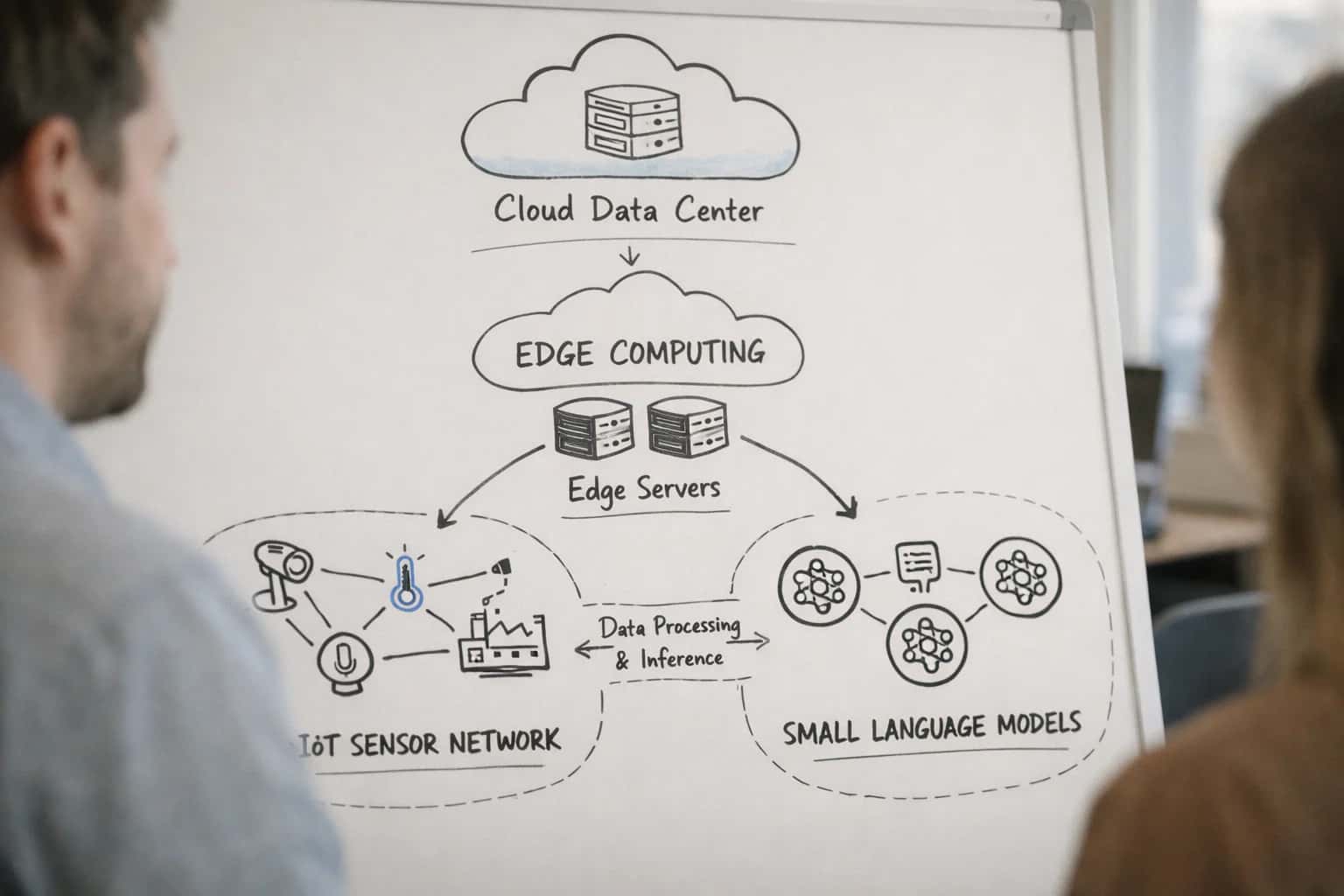
Bandwidth is the hidden economic constraint. Streaming high-fidelity camera feeds and sensor data for cloud processing consumes excessive power and cellular data. Edge-native architectures process this raw sensory input locally, sending only lightweight metadata or queries when necessary, a principle central to our work on Edge AI and Real-Time Decisioning Systems.
Evidence: Apple's Vision Pro performs key computer vision tasks like hand tracking and scene understanding entirely on-device. This architectural choice isn't just about privacy; it's a technical mandate for sub-millisecond latency that cloud pipelines cannot physically provide.
WHY CLOUD AI FAILS
The Three Unforgiving Constraints of AR Edge Models
Spatial computing requires ultra-efficient, low-latency computer vision models that current cloud-offloading architectures cannot support.
01
The Problem: The Physics of Perception
Human visual perception operates at ~13ms for smooth motion. Cloud round-trip latency of ~100-300ms induces nausea and breaks immersion. This isn't a software bug; it's a fundamental physics constraint that cloud-centric AI cannot solve.
- Constraint: End-to-end latency must be <20ms for visual comfort.
- Consequence: Every millisecond of delay degrades user experience and adoption.
<20ms
Latency Budget
10-15x
Cloud Lag
02
The Problem: The Privacy Paradox
AR glasses process a continuous, first-person video feed of the user's life—the ultimate privacy nightmare. Transmitting this stream to the cloud for object recognition or scene understanding is a non-starter for consumer adoption and GDPR compliance.
- Constraint: All sensitive visual data must be processed on-device.
- Consequence: Models must be small enough to run locally but accurate enough for real-world recognition.
0%
Cloud Data
100%
On-Device
03
The Problem: The Power Wall
AR glasses are thermally and power-constrained, often running on <5W total system budget. Running a modern vision transformer (ViT) or even a large CNN can consume this budget in seconds, melting the frame and killing the battery.
- Constraint: Total inference power must be in the milliwatt range.
- Consequence: This demands radical model compression, quantization, and hardware-software co-design, a core principle of our approach to Edge AI and Real-Time Decisioning Systems.
<5W
System Budget
mW
Inference Target
ARCHITECTURAL DECISION MATRIX
Cloud vs. Edge: The Latency and Power Trade-Off
This table compares the core architectural paradigms for deploying AI in Augmented Reality glasses, quantifying the trade-offs that define the user experience.
| Critical Metric | Cloud-Offloading Architecture | Hybrid (Cloud + Thin Edge) | Edge-Native Architecture |
|---|---|---|---|
End-to-End Latency (Object Recognition) | 150-500 ms | 50-100 ms | < 16 ms |
Power Consumption (Peak Inference) | Device: 2-3W, Network: 1-2W | Device: 1-2W, Network: 0.5-1W | Device: < 500 mW |
Offline Functionality | Limited (cached models) | ||
Data Privacy / Sovereignty | Data leaves device | Partial data egress | Data never leaves device |
Model Update Cadence | Continuous (centralized) | Weekly/Monthly | Over-the-Air (OTA), as needed |
Required Uplink Bandwidth (per stream) | 5-20 Mbps | 1-5 Mbps | 0 Mbps |
Architectural Dependency | 5G/Wi-Fi & Cloud Region | Intermittent Connectivity | On-Device NPU/TPU |
Real-Time World Understanding | Basic scene persistence |
THE ARCHITECTURE
Architecting the AR-Optimized Edge Model
AR glasses require a fundamentally new edge AI architecture that prioritizes ultra-low latency, extreme power efficiency, and robust on-device intelligence.
AR glasses demand a new edge AI architecture because cloud-offloading introduces fatal latency. A 100ms delay in rendering digital objects causes spatial misalignment and user disorientation, breaking the illusion of augmented reality. The solution is a hybrid inference pipeline that runs core perception tasks on-device while intelligently offloading complex reasoning.
The core challenge is the 'Sensor-to-Photon' latency budget, which must be under 20 milliseconds. This eliminates any cloud dependency for the perception loop. Models must perform simultaneous localization and mapping (SLAM), object recognition, and depth estimation directly on specialized silicon like the Qualcomm Snapdragon XR2+ platform.
This necessitates a radical model compression strategy beyond standard quantization. Techniques like neural architecture search (NAS) and conditional computation create sparse, task-specific sub-networks that activate only when needed, slashing power consumption. Frameworks like TensorFlow Lite for Microcontrollers and ONNX Runtime are essential for deploying these ultra-lean models.
The counter-intuitive design is a 'context-aware offload'. While low-level perception is on-device, complex queries for retrieval-augmented generation (RAG) against a user's personal knowledge graph can be handled by a nearby edge server. This requires intelligent prefetching and caching, similar to strategies used in high-speed RAG systems.
Evidence: Deploying a 50-layer convolutional neural network (CNN) for real-time object detection on an AR glasses SoC consumes over 3 watts, draining a typical battery in under 90 minutes. An optimized, NAS-designed model for the same task reduces power to under 500 milliwatts, enabling all-day use. This level of optimization is a core tenet of hardware-software co-design.
WHY CLOUD ARCHITECTURES FAIL
The Hardware-Software Stack for AR Edge AI
Spatial computing requires ultra-efficient, low-latency computer vision models that current cloud-offloading architectures cannot support.
01
The Problem: Cloud Round-Trip Latency
Sending sensor data to the cloud and back introduces ~100-500ms of latency, which breaks the perceptual loop for real-time spatial overlays. This delay causes visual lag, induces motion sickness, and makes interactions feel unnatural.
- Critical Constraint: AR requires <20ms motion-to-photon latency for a seamless experience.
- Bandwidth Cost: Streaming raw camera feeds is economically infeasible at scale.
>20ms
Breaks UX
~500ms
Cloud Latency
02
The Solution: On-Device Neural Processing Units (NPUs)
Dedicated silicon like the Qualcomm Snapdragon XR2+ Gen 2 or Apple's M-series chips provide the TOPS (Tera Operations Per Second) needed for real-time inference. These NPUs are optimized for the matrix multiplications fundamental to transformer and CNN architectures.
- Performance: Modern NPUs deliver 20-50 TOPS within a <5W thermal envelope.
- Efficiency: Enables all-day battery life by offloading compute from the main CPU/GPU.
20-50
TOPS
<5W
Power Budget
03
The Problem: Model Size vs. Memory Constraints
State-of-the-art vision models like ViT-Huge can be >1GB, far exceeding the ~4-8GB of unified memory available in current AR glasses. Loading these models is impossible, and swapping to storage kills latency.
- Memory Wall: High-resolution scene understanding requires large models, but device RAM is severely limited.
- Storage I/O: Accessing model weights from flash storage introduces unacceptable jitter.
>1GB
Model Size
4-8GB
Available RAM
04
The Solution: Aggressive Model Compression & Quantization
Techniques like pruning, knowledge distillation, and INT8 quantization reduce model footprints by 10-50x with minimal accuracy loss. Frameworks like TensorFlow Lite, PyTorch Mobile, and ONNX Runtime are essential for deployment.
- Result: A 50MB model can deliver comparable performance to its 1GB predecessor.
- Tooling: Requires specialized MLOps for the edge to manage compressed model lifecycles.
10-50x
Size Reduction
~50MB
Deployable Size
05
The Problem: The Privacy Imperative
AR glasses process the most intimate data stream possible: a continuous first-person video feed of the user's life. Transmitting this to the cloud creates unacceptable privacy and security risks, violating regulations like GDPR and the EU AI Act.
- Data Sovereignty: Raw visual data cannot leave the device in many regulated contexts.
- Trust: Users will reject glasses that are perceived as surveillance devices.
GDPR
Compliance Driver
0-Cloud
Data Transfer
06
The Solution: Federated Learning & On-Device Training
Federated Learning (FL) allows a global model to improve by aggregating weight updates from thousands of devices, without ever exporting raw data. Emerging on-device training capabilities enable personalization.
- Architecture: Enables continuous model improvement while maintaining data sovereignty.
- Evolution: Shifts the paradigm from centralized training to distributed, privacy-preserving intelligence. This is a core component of a mature Edge AI and Real-Time Decisioning Systems strategy.
0-Raw-Data
Leaves Device
Continuous
Model Improvement
THE LATENCY TRAP
The 5G Fallacy: Why Edge-Cloud Hybrid Isn't the Answer
Cloud offloading, even with 5G, introduces unacceptable latency for spatial computing, demanding a new architectural paradigm.
The 5G promise of low-latency cloud offloading is a myth for AR glasses. Round-trip network latency, even in optimal 5G conditions, adds 10-50 milliseconds, which destroys the perceptual synchronization required for convincing spatial overlays.
Cloud dependency creates a brittle user experience. Network jitter, dead zones, and bandwidth contention cause visual stutter and tracking loss. A true always-on contextual assistant cannot buffer.
The hybrid model fails the privacy test. Streaming live first-person video to a cloud endpoint for object recognition is a data sovereignty nightmare. On-device processing is the only viable path for consumer adoption.
Evidence: Leading AR platforms like Apple Vision Pro and Meta Ray-Ban Smart Glasses run core computer vision models, like those from PyTorch Mobile or TensorFlow Lite, directly on their custom silicon. They treat the cloud as a periodic sync, not the primary inference engine.
WHY AR GLASSES DEMAND A NEW BREED
The Hidden Pitfalls of Deploying AR Edge Models
Spatial computing requires ultra-efficient, low-latency computer vision models that current cloud-offloading architectures cannot support.
01
The Problem: Cloud Round-Trip Latency Breaks Immersion
Sending sensor data to the cloud and back introduces ~100-500ms of delay, shattering the illusion of real-time spatial overlay. This lag causes visual jitter, misalignment, and user discomfort.
- Critical Constraint: AR requires <20ms motion-to-photon latency for a seamless experience.
- Bandwidth Cost: Streaming dual 4K camera feeds consumes >1 Gbps, making continuous cloud offload economically impossible.
>20x
Latency Over Budget
1 Gbps+
Bandwidth Per Device
02
The Solution: On-Device SLAM & Scene Understanding
AR glasses must run Simultaneous Localization and Mapping (SLAM) and object recognition locally. This demands a new class of sparse, event-based neural networks that process only relevant visual changes.
- Key Benefit: Enables persistent, world-locked holograms without a network connection.
- Key Benefit: Drastically reduces power consumption by ~60-80% compared to dense, frame-by-frame processing.
0ms
Network Latency
-70%
Power Draw
03
The Problem: The Thermal & Power Wall
Traditional convolutional neural networks (CNNs) generate too much heat for a device worn on the face. Sustained high compute risks thermal throttling or forces bulky, consumer-unfriendly designs.
- Critical Constraint: Wearable form-factors have a <3W thermal design power (TDP) envelope.
- Battery Life: Running a standard ResNet-50 model would drain a glasses-sized battery in <30 minutes.
3W
Max TDP
<30 min
Battery Life (Legacy Model)
04
The Solution: Hardware-Software Co-Design
Efficient AR requires dedicated neural processing units (NPUs) and models built with pruning, quantization, and knowledge distillation. Frameworks like TensorFlow Lite Micro and ONNX Runtime are essential for deployment.
- Key Benefit: Enables all-day battery life with continuous contextual awareness.
- Key Benefit: Unlocks advanced use cases like real-time text translation and persistent object memory directly on the glasses. Learn more about the strategic necessity of this approach in our pillar on Edge AI and Real-Time Decisioning Systems.
8+ hrs
Target Battery Life
95%
Model Size Reduced
05
The Problem: Silent Model Degradation in the Wild
An AR model trained in a lab fails on novel lighting, weather, or unseen objects. Without a cloud connection, there's no easy way to detect this model drift or push updates, leading to unreliable performance.
- Critical Constraint: Edge deployments lack centralized monitoring tools from standard MLOps platforms.
- Operational Burden: Manually updating thousands of devices is logistically impossible.
30-50%
Accuracy Drop (Unseen Data)
1000s
Unmonitored Devices
06
The Solution: Federated Learning & Edge-Centric MLOps
Federated learning allows devices to collaboratively improve a global model by sharing only model updates, not raw data. This requires a new edge-native MLOps layer for secure aggregation and orchestration.
- Key Benefit: Continuously improves model accuracy while preserving user privacy.
- Key Benefit: Enables A/B testing and canary deployments of new model versions across device fleets. This approach is a core component of building trustworthy systems, a principle explored in our AI TRiSM: Trust, Risk, and Security Management pillar.
0%
Raw Data Exposed
Continuous
Model Improvement
THE ARCHITECTURAL SHIFT
Beyond Glasses: The Ripple Effect of AR Edge Models
AR glasses force a fundamental architectural shift from cloud-offloading to on-device intelligence, creating new requirements for edge models.
AR glasses require a new edge model architecture because cloud latency breaks the spatial computing illusion. The 100-200ms round-trip to a cloud API creates a perceptible lag between a user's movement and the digital overlay's response, causing nausea and destroying immersion. This makes ultra-low latency inference a non-negotiable requirement, achievable only with models running directly on the device's processor, like a Qualcomm Snapdragon XR chip.
The computational burden is unprecedented compared to other edge devices. A smartphone camera processes a 2D image, but AR glasses must perform continuous 3D scene reconstruction, object recognition, and pose estimation in real-time. This demands a fusion of specialized neural networks—like SLAM (Simultaneous Localization and Mapping) and lightweight vision transformers—that current mobile-optimized models cannot handle efficiently.
Privacy becomes a core feature, not an afterthought. Streaming a live video feed of a user's environment to the cloud is a non-starter for corporate and consumer adoption. On-device processing ensures data sovereignty, a principle central to frameworks like the EU AI Act. This eliminates the risk of sensitive visual data being intercepted or stored externally, turning a compliance hurdle into a competitive advantage.
Evidence: Apple's Vision Pro dedicates its entire R1 chip solely to sensor processing, achieving a 12-millisecond latency from camera input to display output. This hardware-software co-design proves that sub-20ms latency is the benchmark for viable consumer AR, a target impossible with cloud dependency. This architectural mandate ripples out, influencing the design of all real-time Edge AI and Real-Time Decisioning Systems.
WHY CLOUD MODELS FAIL
Key Takeaways: The Non-Negotiables for AR Edge AI
Spatial computing requires ultra-efficient, low-latency computer vision models that current cloud-offloading architectures cannot support.
01
The Problem: Cloud Round-Trip Latency Breaks Immersion
Sending sensor data to the cloud and back introduces ~100-500ms delays, shattering the illusion of instant, anchored digital objects. This lag is unacceptable for interactive overlays and safety-critical navigation cues.
- Key Benefit 1: Enables <20ms end-to-end inference for seamless visual fusion.
- Key Benefit 2: Eliminates dependency on unreliable or high-latency network connectivity.
<20ms
Latency Target
~500ms
Cloud Penalty
02
The Solution: Hardware-Software Co-Design
Off-the-shelf models and generic NPUs waste precious power and memory. Success requires tailoring architectures like TensorFlow Lite Micro or ONNX Runtime to exploit specific hardware features of Qualcomm's Snapdragon XR platforms or Apple's R1 chip.
- Key Benefit 1: Achieves 10-100x better efficiency per watt than generic deployments.
- Key Benefit 2: Unlocks advanced features like always-on contextual awareness within a <1W power budget.
10-100x
Efficiency Gain
<1W
Power Envelope
03
The Problem: Bandwidth and Privacy Are Deal-Breakers
Streaming continuous high-resolution camera feeds and inertial data to the cloud consumes gigabytes per hour and creates an unacceptable privacy surface area. Users will not tolerate their personal environment being externally processed.
- Key Benefit 1: Keeps all raw sensor data on-device, a core tenet of Privacy-Enhancing Technologies (PET).
- Key Benefit 2: Reduces required cellular/Wi-Fi bandwidth to near zero for core inference tasks.
>1 GB/hr
Data Avoided
0
Cloud Data
04
The Solution: Federated Learning for Continuous Improvement
Static models degrade. Federated Learning allows models to learn from anonymized, aggregated user experiences across a device fleet without ever exporting raw personal data, directly addressing the Model Drift challenge in deployed Edge AI.
- Key Benefit 1: Enables continuous model refinement while maintaining data sovereignty and user trust.
- Key Benefit 2: Creates a sustainable MLOps lifecycle for thousands of remote, heterogeneous devices.
0
Raw Data Exported
100%
On-Device Learning
05
The Problem: The Brutal Accuracy-Size-Power Trade-Off
State-of-the-art models like Segment Anything (SAM) are too large for glasses. Deploying them requires aggressive model compression, quantization (INT8/FP16), and pruning, which can catastrophically impact accuracy for complex scene understanding.
- Key Benefit 1: Specialized architectures like MobileOne or MobileViT deliver high accuracy in <5MB.
- Key Benefit 2: Enables all-day battery life by optimizing the Inference Economics of every millijoule.
<5MB
Model Size
INT8/FP16
Precision
06
The Solution: Context-Aware, Multi-Modal Fusion Engines
AR intelligence isn't just vision. It fuses camera, IMU, GPS, and microphone data. Edge models must perform sensor fusion locally to understand user intent and environmental context, a core capability of Physical AI and Embodied Intelligence systems.
- Key Benefit 1: Enables robust pose estimation and object permanence in dynamic, unstructured environments.
- Key Benefit 2: Drives real-time decisioning systems for navigation, annotation, and interaction without cloud queries.
6-DOF
Real-Time Tracking
Multi-Modal
Sensor Fusion
Enabling Efficiency, Speed & Accuracy
Intelligent Analysis, Decision & Execution
We build AI systems for teams that need search across company data, workflow automation across tools, or AI features inside products and internal software.
Talk to Us
Search across company data
Give teams answers from docs, tickets, runbooks, and product data with sources and permissions.
Useful when people spend too long searching or get different answers from different systems.
Enterprise searchRAGPermissions
Read more
Automate internal workflows
Use AI to route work, draft outputs, trigger actions, and keep approvals and logs in place.
Useful when repetitive work moves across multiple tools and teams.
AI agentsWorkflow automationGovernance
Read more
Add AI to products and internal tools
Build assistants, guided actions, or decision support into the software your team or customers already use.
Useful when AI needs to be part of the product, not a separate tool.
AI integrationDecision supportModel routing
Read moreTHE ARCHITECTURAL IMPERATIVE
Stop Prototyping, Start Architecting
AR glasses require a fundamental shift from cloud-dependent prototypes to edge-native, production-ready AI architectures.
AR glasses fail with cloud offloading. The round-trip latency for cloud inference destroys the real-time spatial awareness required for useful overlays, making on-device edge-native intelligence a non-negotiable architectural requirement.
Current model architectures are inefficient. Standard convolutional neural networks (CNNs) or vision transformers (ViTs) trained for data center GPUs consume too much power and memory for wearable form factors. Success requires hardware-aware model design using techniques like neural architecture search (NAS) and quantization-aware training (QAT) for chipsets from Qualcomm or Apple.
The data pipeline is the real bottleneck. Prototypes use curated datasets, but production AR models must process a continuous, noisy stream of sensor fusion data from LiDAR, cameras, and IMUs. This demands real-time sensor fusion pipelines built with frameworks like NVIDIA's Isaac Sim or Apple's ARKit, not just a fine-tuned model.
Evidence: Deploying a standard ResNet-50 for object detection on AR glasses can incur a 300+ millisecond inference latency, while a hardware-optimized MobileNetV3 variant on a dedicated NPU achieves sub-30ms, the threshold for seamless user experience. This is the core challenge of Edge AI and Real-Time Decisioning Systems.
Architect for continuous learning. A static model deployed to thousands of devices will fail as environments change. The production system must support federated learning or efficient on-device adaptation loops, a concept central to managing The Hidden Cost of Model Drift in Deployed Edge AI.
Tooling defines scalability. Prototyping in PyTorch or TensorFlow is insufficient. Production demands MLOps for the edge—tools like AWS SageMaker Edge Manager or Azure IoT Edge to manage deployment, monitoring, and updates across a heterogeneous fleet, a maturity test few teams pass.

About the author
Prasad Kumkar
CEO & MD, Inference Systems
Prasad Kumkar is the CEO & MD of Inference Systems and writes about AI systems architecture, LLM infrastructure, model serving, evaluation, and production deployment. Over 5+ years, he has worked across computer vision models, L5 autonomous vehicle systems, and LLM research, with a focus on taking complex AI ideas into real-world engineering systems.
His work and writing cover AI systems, large language models, AI agents, multimodal systems, autonomous systems, inference optimization, RAG, evaluation, and production AI engineering.
LinkedIn
Limited slotsGet a Free AI Consultation
Partnered with leading AI, data, and software stack.





How We Work
Custom AI workflows for your Business
One-fit-all AI don't work for modern businesses. At Inferensys, we aim to understand your business & custom requirements; which we use to define most efficient agentic workflows, the data, and the tools for your business.
01
Review the use case
We understand the task, the users, and where AI can actually help.
Read more02
Pick the right approach
We define what needs search, automation, or product integration.
Read more03
Build the first useful version
We implement the part that proves the value first.
Read more04
Improve from there
We add the checks and visibility needed to keep it useful.
Read moreThe first call is a practical review of your use case and the right next step.
Talk to Us