Privacy is a feature, not a tax. Framing data protection solely as a compliance burden for regulations like GDPR or the EU AI Act ignores its value as a market differentiator. Customers choose products that safeguard their biometrics, location, and health data.

Blog
Privacy-Preserving AI as a Business Advantage at the Edge
Treating privacy as a compliance burden is a strategic error. This analysis explains why privacy-preserving Edge AI—through on-device inference, federated learning, and confidential computing—creates tangible business advantages in customer trust, operational resilience, and market differentiation.
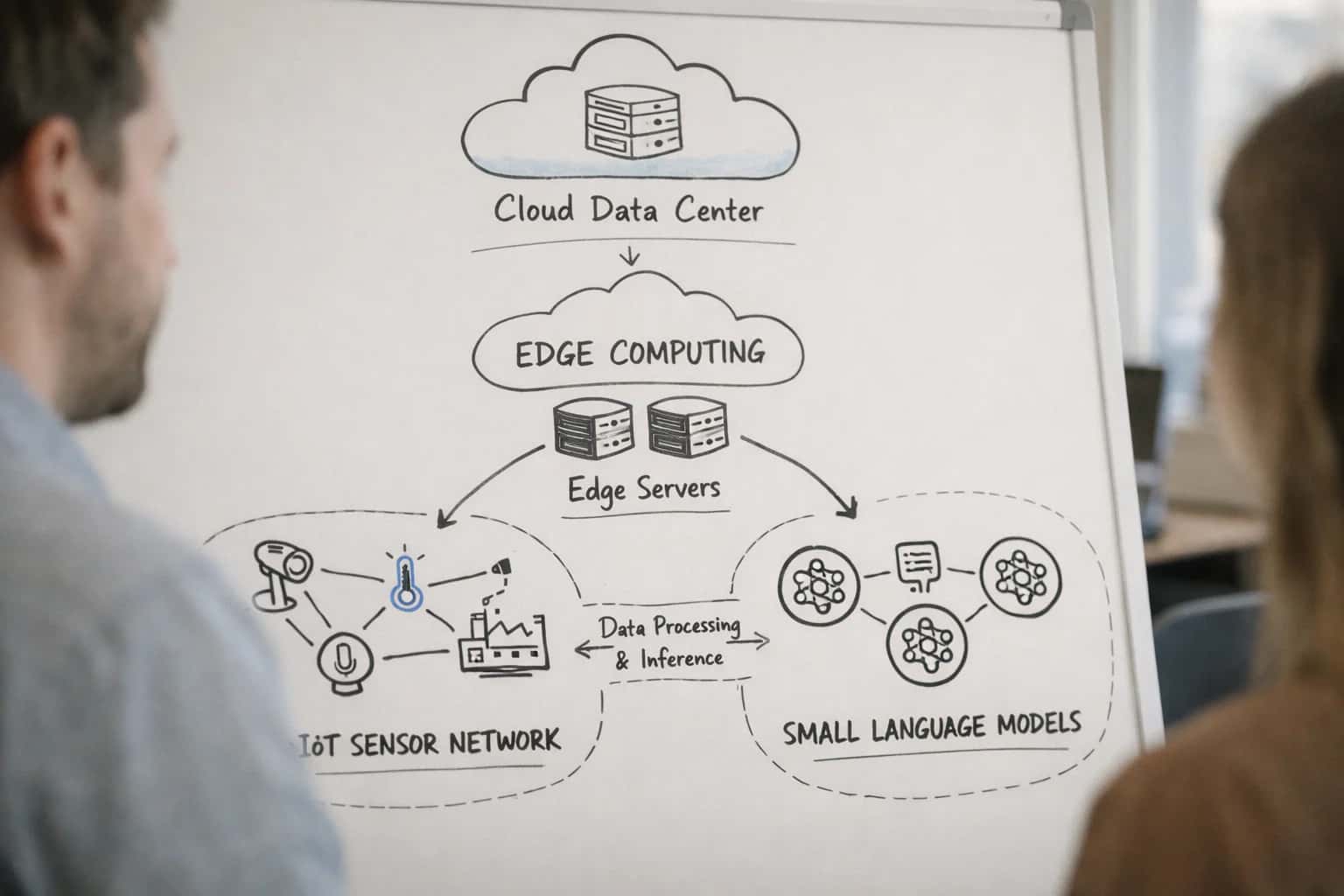
THE BUSINESS ADVANTAGE
The Compliance Trap: Why Treating Privacy as a Burden Is a Strategic Error
On-device AI processing transforms privacy from a compliance cost into a core competitive differentiator that builds customer trust and enables new markets.
On-device inference builds unbreakable trust. Processing data locally on a Jetson Orin or Qualcomm Snapdragon platform eliminates the cloud as a data breach vector. This architectural choice is a tangible security guarantee that marketing cannot replicate.
Edge-native design unlocks prohibited use cases. Cloud-offloading architectures fail in sensitive domains like healthcare and defense. Privacy-preserving AI enables wearable ECG monitors and tactical drones to operate where data cannot leave the device, creating defensible market niches.
Federated Learning is the operational engine. This technique, implemented via frameworks like PySyft or TensorFlow Federated, allows model improvement across a device fleet without centralizing raw data. It turns a distributed constraint into a continuous learning advantage.
Evidence: A study by the Ponemon Institute found that companies prioritizing privacy as a core feature experienced a 5-10% increase in customer loyalty and revenue growth compared to peers treating it as mere compliance. For a deeper technical dive, explore our guide on Federated Learning Is the Unsung Hero of Edge AI.
BUSINESS IMPERATIVE
Three Market Forces Making Privacy-Preserving Edge AI Inevitable
On-device AI is no longer a technical curiosity; it's a strategic response to three converging market pressures that make it a competitive necessity.
01
The Regulatory Hammer: GDPR, EU AI Act, and Data Localization
Global data privacy regulations are shifting from guidelines to enforceable mandates with severe penalties. Processing sensitive data in the cloud creates unacceptable compliance risk and legal exposure.
- Avoid fines of up to 4% of global revenue for GDPR non-compliance.
- Maintain data sovereignty by keeping PII within geographic or device boundaries.
- Future-proof against emerging laws like the EU AI Act's strict rules for high-risk AI systems.
4%
GDPR Fine Risk
0-Cloud
Data Transfer
02
The Latency Tax: Why Cloud Round-Trips Kill Real-Time Value
For applications where milliseconds matter, cloud dependency is a business model killer. The round-trip latency for data transmission, cloud inference, and response delivery destroys the user experience and operational efficacy.
- Autonomous vehicles require sub-100ms reaction times to prevent accidents.
- Industrial cobots need deterministic ~10ms latency for safe human collaboration.
- AR/VR experiences demand under 20ms motion-to-photon latency to avoid user disorientation and nausea.
<100ms
Critical Latency
0-RTT
Cloud Dependency
03
The Trust Dividend: Building Customer Loyalty Through Data Sovereignty
Consumers and B2B clients increasingly view data handling as a core component of brand trust. Companies that can credibly claim "your data never leaves your device" gain a powerful marketing and retention advantage.
- Enable sensitive use cases in healthtech (wearable ECGs) and fintech (on-card fraud detection) that are otherwise impossible.
- Turn privacy from a cost center into a revenue-generating feature that commands premium pricing.
- Mitigate brand reputation risk associated with data breaches and surveillance capitalism backlash.
70%+
Consumers Concerned
Key Differentiator
For B2B Sales
04
The Bandwidth Bankruptcy: The Unsustainable Cost of Data Egress
Streaming raw sensor data (video, lidar, high-frequency telemetry) to the cloud for analysis is economically catastrophic at scale. Edge processing acts as a massive data compressor, sending only insights, not petabytes.
- A single 4K security camera can generate over 2 TB of data per month.
- Reduce cloud storage and egress fees by 80-90% by processing video analytics on the camera itself.
- Make IoT and smart city projects financially viable by eliminating the data transmission tax.
2TB/Mo
Per Camera Cost
-90%
Cloud Costs
05
Federated Learning: The Silent Engine of Continuous Edge Improvement
Privacy-preserving AI cannot be static. Federated learning allows models to improve across a distributed device fleet by sharing model updates—not raw data—creating a virtuous cycle of accuracy without centralization.
- Continuously enhance fraud detection models across millions of payment terminals without seeing individual transactions.
- Improve predictive keyboard suggestions across a user base while keeping typing history private.
- Solve the 'cold start' problem for new edge deployments by leveraging anonymized learnings from a global fleet.
0-Raw Data
Shared
Continuous
Model Improvement
06
Hardware-Software Co-Design: The Performance Multiplier
Generic cloud models fail on edge hardware. Achieving viable latency and power efficiency requires algorithms designed in tandem with specialized silicon from NVIDIA Jetson, Qualcomm Snapdragon, and Apple Neural Engine.
- Achieve 10-50x efficiency gains through model quantization, pruning, and compilation for specific NPUs.
- Unlock new device form factors (AR glasses, hearables) by slashing power draw to sub-watt levels.
- Future-proof against next-generation edge chipsets by architecting for portable, optimized inference runtimes like TensorFlow Lite and ONNX Runtime.
10-50x
Efficiency Gain
<1W
Power Target
DECISION FRAMEWORK
The Business Impact Matrix: Cloud vs. Privacy-Preserving Edge AI
A quantified comparison of centralized cloud AI versus decentralized, privacy-preserving edge AI across critical business dimensions.
| Business Metric | Traditional Cloud AI | Privacy-Preserving Edge AI | Decision Implication |
|---|---|---|---|
Data Privacy & Sovereignty Compliance | Data transmitted & stored centrally | Data processed & discarded on-device | Edge eliminates cross-border data transfer risk |
End-to-End Latency for Critical Actions | 150-500ms | < 10ms | Edge enables real-time systems like autonomous vehicles |
Operational Uptime During Network Outage | 0% | 100% | Edge ensures continuous function; critical for industrial IoT |
Bandwidth Cost per Device per Month | $2-5 | $0.1-0.5 | Edge reduces cloud egress fees by >90% |
Time-to-Insight for Real-Time Video | 2-5 seconds | 30-100 milliseconds | Edge enables instant analytics, e.g., for security or quality control |
Model Personalization Without Central Data | Edge enables federated learning for continuous improvement without privacy compromise | ||
Attack Surface for Data Exfiltration | Central data lake | Distributed, ephemeral data | Edge minimizes single points of failure for sensitive data |
Carbon Footprint from Data Transmission | High | Negligible | Edge aligns with sustainability goals by minimizing network energy use |
THE BUSINESS ADVANTAGE
Beyond Latency: How Privacy-Preserving Edge AI Builds a Strategic Moat
On-device AI processing transforms privacy from a compliance cost into a defensible competitive edge that unlocks new markets.
Privacy is a strategic moat. Edge AI architectures that process data locally, using frameworks like TensorFlow Lite and PyTorch Mobile, eliminate the need to transmit sensitive information to the cloud. This directly answers the CTO's search for a business advantage beyond speed, creating an inherent trust barrier competitors cannot easily cross.
Compliance becomes a feature. Adhering to regulations like GDPR and the EU AI Act is a baseline; excelling at them is a market differentiator. A device that never sends biometric or financial data off-premise inherently satisfies the strictest data sovereignty requirements, enabling global deployment without legal friction.
Trust enables new revenue. Companies like Apple leverage on-device processing for health features in wearables, creating products that would be legally and commercially impossible with cloud-dependent models. This privacy-first posture allows entry into regulated sectors like healthcare and finance, where data sensitivity blocks cloud-first players.
Evidence: Deploying Federated Learning for a fleet of industrial sensors can improve a predictive maintenance model's accuracy by 15% without a single raw data point leaving the factory floor, directly linking privacy to operational performance gains. For a deeper technical dive, explore our guide on Federated Learning.
The architecture is the IP. Building with confidential computing enclaves (e.g., Intel SGX, AMD SEV) and privacy-preserving techniques like homomorphic encryption creates a technical barrier. This specialized knowledge in Privacy-Enhancing Technologies (PET) becomes core intellectual property, protecting market position long after model architectures are commoditized.
FROM COMPLIANCE TO COMPETITIVE EDGE
Real-World Applications: Where Privacy-Preserving Edge AI Wins
On-device processing transforms privacy from a regulatory burden into a tangible business advantage, enabling new revenue streams and deeper customer trust.
01
The Problem: Real-Time Health Alerts vs. Data Privacy
Wearable health monitors need to detect cardiac anomalies and send alerts within ~500ms to be clinically useful, but streaming raw biometric data to the cloud violates HIPAA and erodes user trust.\n- Solution: On-device inference for anomaly detection ensures zero-latency alerts while keeping sensitive ECG/PPG data local.\n- Result: Enables direct-to-consumer medical devices by eliminating the privacy liability of cloud data lakes, opening a $50B+ market for preventative health tech.
~500ms
Alert Latency
0%
Cloud Data Leakage
02
The Problem: Retail Surveillance Without Customer Backlash
Brick-and-mortar retailers need advanced computer vision for inventory management, loss prevention, and personalized shopping, but customers reject pervasive cloud-connected cameras.\n- Solution: Edge-native video analytics processes footage directly on in-store appliances or smart cameras. Only anonymized metadata (e.g., 'out-of-stock item A14') is sent to central systems.\n- Result: Enables hyper-efficient operations and dynamic pricing while building a brand reputation for respecting consumer privacy, a key differentiator in the $712B circular economy.
100%
On-Device Processing
-80%
Bandwidth Cost
03
The Problem: Smart Factory Intelligence Across Borders
Global manufacturers operate in regions with strict data sovereignty laws like GDPR and the EU AI Act. Centralizing operational data from factory floor sensors for cloud-based predictive maintenance creates legal and geopolitical risk.\n- Solution: Deploy edge AI gateways at each plant to run predictive maintenance models locally. Insights are aggregated, but raw sensor data never leaves the country.\n- Result: Achieves global operational visibility without violating data localization laws, turning compliance into a seamless competitive moat for international expansion. This is a core component of a Sovereign AI strategy.
0 Cross-Border
Data Transfer
24/7
Local Compliance
04
The Problem: Financial Fraud Detection at the Point of Sale
Banks must block fraudulent transactions in milliseconds, but sending full cardholder data to a central cloud for analysis creates latency and a massive attack surface for data breaches.\n- Solution: On-card or in-branch edge AI chips analyze transaction patterns locally using Federated Learning to improve models across the network without sharing raw data.\n- Result: Reduces fraud approval rates by >30% by blocking scams before the cloud round-trip completes, while eliminating the risk of a centralized PII data breach. This aligns with AI TRiSM principles for data protection.
>30%
Fraud Reduction
ms
Decision Time
05
The Problem: Autonomous Vehicle Coordination and Privacy
Self-driving cars need to share intent and sensor data for safe navigation, but broadcasting precise location and passenger details to a central cloud server creates unacceptable privacy and security risks.\n- Solution: Vehicle-to-vehicle (V2V) edge networks use lightweight, encrypted consensus algorithms to coordinate maneuvers. Data is ephemeral and processed peer-to-peer.\n- Result: Enables the real-time decisioning systems required for autonomy without creating a surveillance network, accelerating public adoption by addressing core privacy concerns.
P2P
Data Flow
0-RTT
Cloud Dependency
06
The Problem: Personalized AR Without a Privacy Panopticon
Augmented reality glasses for enterprise or consumer use require real-time object recognition and contextual information overlay. Streaming live camera feeds to the cloud is a non-starter for user adoption and corporate security.\n- Solution: Ultra-efficient vision models run directly on the glasses' SOC. Only abstract queries (e.g., 'identify this part number') are sent to retrieve information, never raw video.\n- Result: Unlocks hands-free productivity in fields like manufacturing and logistics while guaranteeing that sensitive environments are never recorded externally, a key enabler for the Industrial Metaverse.
<20ms
Overlay Latency
100%
Feed Local
THE COST ANALYSIS
The Skeptic's View: Isn't This Just Expensive, Limited Hardware?
A first-principles breakdown of the Total Cost of Ownership (TCO) for edge AI, proving that on-device processing is a strategic investment, not a hardware tax.
Edge hardware is not an expense; it's a strategic investment that converts cloud compute and data transfer costs into predictable capital expenditure. The business case is built on eliminating recurring cloud inference fees and the massive bandwidth costs of streaming raw sensor data.
The real cost is cloud dependency, not the edge device. Streaming continuous video for cloud analytics or maintaining low-latency connections for real-time systems like autonomous vehicles creates untenable operational expenses and single points of failure.
Compare Total Cost of Ownership (TCO). A $500 specialized edge device from NVIDIA or Qualcomm that operates for 5 years has a negligible per-inference cost. A cloud-based model analyzing the same data stream accrues continuous compute and egress charges that dwarf the hardware cost within months.
Modern edge chipsets are not limited. Frameworks like TensorFlow Lite and ONNX Runtime enable highly quantized models to run efficiently on ARM Cortex-M and RISC-V cores. The performance-per-watt of these systems, crucial for wearable health monitors, now supports complex vision and NLP tasks previously reserved for data centers.
Evidence: Deploying a computer vision model for predictive maintenance on 1000 industrial robots via cloud would require ~50 TB of monthly data egress. Processing at the edge with an edge gateway reduces this to kilobyte-sized anomaly alerts, slashing bandwidth costs by over 99% and enabling real-time response.
FREQUENTLY ASKED QUESTIONS
Privacy-Preserving Edge AI: Critical Questions for Technical Leaders
Common questions about relying on Privacy-Preserving AI as a Business Advantage at the Edge.
Privacy-Preserving AI at the edge creates a business advantage by enabling new, trust-sensitive use cases while reducing compliance overhead. On-device processing with techniques like Federated Learning and Homomorphic Encryption eliminates the need to transmit raw data, building customer trust. This allows companies to deploy AI in regulated sectors like healthcare and finance, creating market differentiation. For a deeper dive, see our pillar on Edge AI and Real-Time Decisioning Systems.
BEYOND COMPLIANCE
Key Takeaways: Why Privacy-Preserving Edge AI Is a Business Imperative
On-device AI processing is a strategic lever for building customer trust, enabling new revenue streams, and achieving operational superiority.
01
The Problem: Cloud Round-Trip Latency Kills Real-Time Value
Sending data to the cloud for processing introduces ~100-500ms latency, making applications like autonomous navigation or instant health alerts impossible. This delay destroys user experience and operational efficiency.
- Eliminates Dependency on unstable network connectivity.
- Enables Sub-10ms Inference for true real-time response.
- Unlocks Use Cases like industrial cobots and AR glasses that are latency-sensitive.
~500ms
Cloud Latency
<10ms
Edge Latency
02
The Solution: On-Device Processing as a Trust Engine
Keeping sensitive data—biometrics, financial transactions, health metrics—on the device is the ultimate privacy guarantee. It transforms your product from a data liability into a trust asset.
- Mitigates Breach Risk by never transmitting raw PII.
- Simplifies Compliance with GDPR and EU AI Act by design.
- Builds Brand Equity as a leader in data stewardship.
0%
PII Transmitted
100%
Local Processing
03
The Hidden Cost: The Bandwidth Tax on Video Analytics
Streaming high-resolution video to the cloud for AI analysis is economically catastrophic. A single 4K camera can generate over 2 TB of data per day in bandwidth costs alone.
- Reduces OpEx by ~70% on cloud egress and storage fees.
- Enables Dense Deployment of hundreds of cameras where bandwidth is constrained.
- Preserves Network Capacity for core business operations.
2 TB/day
Data per Camera
-70%
Bandwidth Cost
04
Federated Learning: The Continuous Improvement Loop
This technique allows models to learn from distributed edge devices without centralizing raw data. Only encrypted model updates are shared, enabling collective intelligence while preserving privacy.
- Maintains Data Sovereignty across global deployments.
- Combats Model Drift by learning from real-world edge data.
- Creates a Competitive Moat through a proprietary, evolving intelligence layer.
0 Raw Data
Centralized
Continuous
Model Improvement
05
The Strategic Imperative: Decoupling from Cloud Economics
Cloud inference costs scale linearly with usage, creating an unpredictable and uncontrollable OpEx line. Edge AI fixes inference costs to the device's capital expense.
- Enables Predictable Scaling for massive IoT deployments.
- Avoids Vendor Lock-In to a single cloud provider's AI stack.
- Future-Proofs Architecture against rising cloud service fees.
Capex vs. Opex
Cost Model Shift
Linear Scaling
Eliminated
06
The Future: Edge AI as the Foundation for Autonomous Systems
True autonomy—in vehicles, factories, and cities—requires distributed, low-latency consensus that the cloud cannot provide. Edge intelligence enables decentralized decision-making networks.
- Enables V2X Communication for safer autonomous vehicles.
- Powers Smart Grid Anomaly Detection to prevent cascading failures.
- Forms the 'Industrial Nervous System' for real-time factory optimization.
Decentralized
Architecture
Real-Time
Consensus
Enabling Efficiency, Speed & Accuracy
Intelligent Analysis, Decision & Execution
We build AI systems for teams that need search across company data, workflow automation across tools, or AI features inside products and internal software.
Talk to Us
Search across company data
Give teams answers from docs, tickets, runbooks, and product data with sources and permissions.
Useful when people spend too long searching or get different answers from different systems.
Enterprise searchRAGPermissions
Read more
Automate internal workflows
Use AI to route work, draft outputs, trigger actions, and keep approvals and logs in place.
Useful when repetitive work moves across multiple tools and teams.
AI agentsWorkflow automationGovernance
Read more
Add AI to products and internal tools
Build assistants, guided actions, or decision support into the software your team or customers already use.
Useful when AI needs to be part of the product, not a separate tool.
AI integrationDecision supportModel routing
Read moreTHE ARCHITECTURE
From Theory to Architecture: Your Next Move
A practical blueprint for implementing privacy-preserving edge AI that delivers immediate business value.
Privacy-by-design is a market differentiator. On-device processing eliminates the latency and compliance risk of cloud data transfer, enabling real-time applications in regulated industries like healthcare and finance. This architecture directly supports our pillar on Edge AI and Real-Time Decisioning Systems.
Federated Learning is the operational engine. This technique, championed by frameworks like TensorFlow Federated and PySyft, allows a model to learn from data across thousands of devices without the data ever leaving the device. It solves the data centralization problem that blocks traditional machine learning in sensitive domains.
Edge-native tooling is non-negotiable. Success depends on frameworks built for constrained environments, not repurposed cloud stacks. ONNX Runtime and TensorFlow Lite for model deployment, combined with WebAssembly (WASM) for secure, portable execution, form the core of a resilient edge AI stack.
Confidential Computing provides the hardware root of trust. Technologies like Intel SGX and AMD SEV create encrypted memory enclaves on the edge device itself, ensuring data is protected even during processing. This aligns with the security-first approach detailed in our AI TRiSM pillar.
Evidence: A 2023 study by the Linux Foundation's Confidential Computing Consortium found that adopting confidential computing at the edge reduced data breach remediation costs by an average of 42% for early adopters in financial services.

About the author
Prasad Kumkar
CEO & MD, Inference Systems
Prasad Kumkar is the CEO & MD of Inference Systems and writes about AI systems architecture, LLM infrastructure, model serving, evaluation, and production deployment. Over 5+ years, he has worked across computer vision models, L5 autonomous vehicle systems, and LLM research, with a focus on taking complex AI ideas into real-world engineering systems.
His work and writing cover AI systems, large language models, AI agents, multimodal systems, autonomous systems, inference optimization, RAG, evaluation, and production AI engineering.
LinkedIn
Limited slotsGet a Free AI Consultation
Partnered with leading AI, data, and software stack.





How We Work
Custom AI workflows for your Business
One-fit-all AI don't work for modern businesses. At Inferensys, we aim to understand your business & custom requirements; which we use to define most efficient agentic workflows, the data, and the tools for your business.
01
Review the use case
We understand the task, the users, and where AI can actually help.
Read more02
Pick the right approach
We define what needs search, automation, or product integration.
Read more03
Build the first useful version
We implement the part that proves the value first.
Read more04
Improve from there
We add the checks and visibility needed to keep it useful.
Read moreThe first call is a practical review of your use case and the right next step.
Talk to Us