Port operations are relational data. A container terminal is a network of nodes (cranes, trucks, berths, stacks) and edges (movement paths, dependencies, timing constraints). Standard machine learning models like CNNs or Transformers process data as isolated vectors or sequences, destroying this essential relational structure.

Blog
Why Graph Neural Networks Are Essential for Port Logistics
Port operations are a web of interconnected nodes and edges—a perfect graph. This article explains why Graph Neural Networks (GNNs) are the only AI architecture capable of modeling this complexity to solve critical problems like dynamic berth allocation and container flow optimization, moving beyond the limitations of tabular data and classical algorithms.
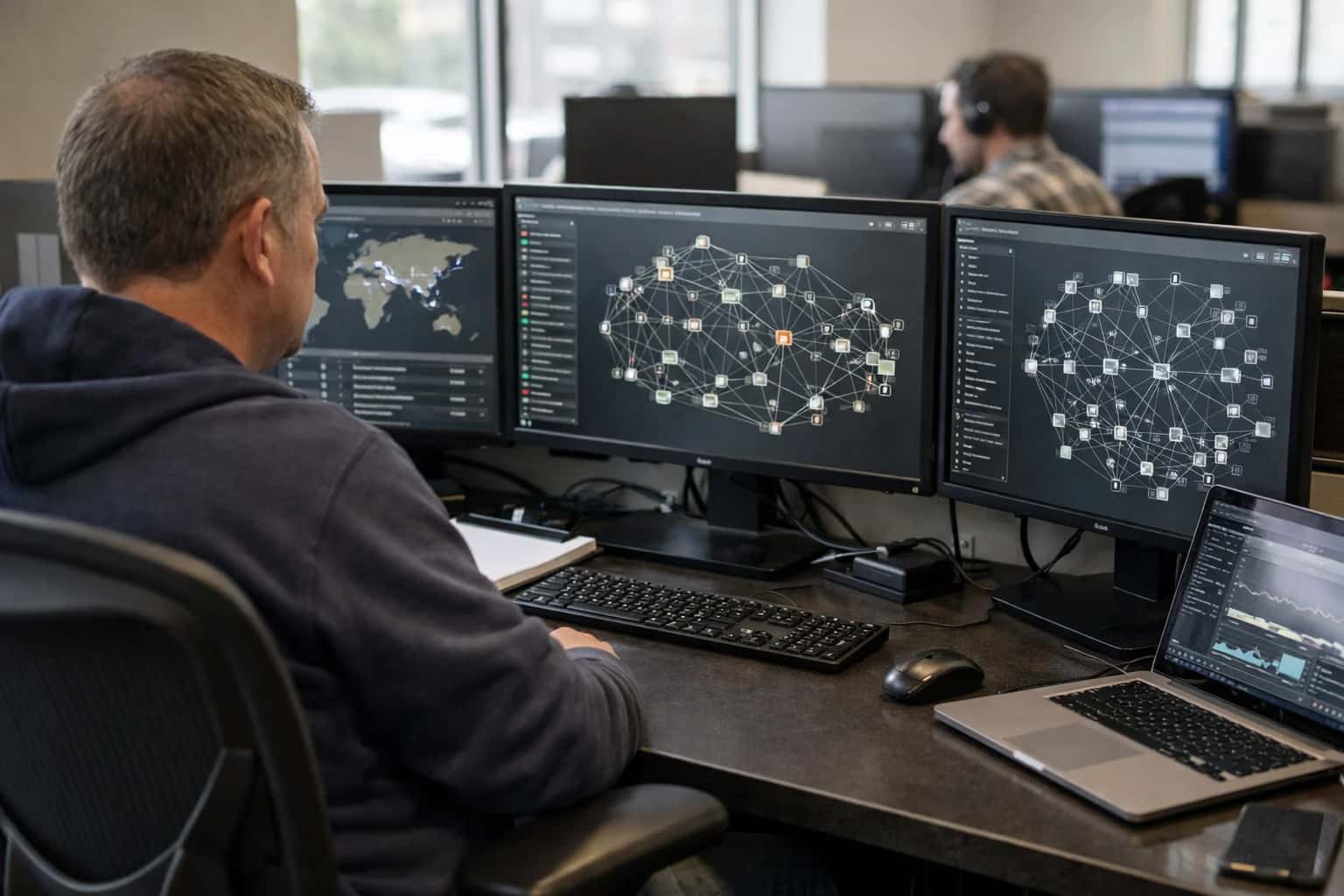
THE DATA MISMATCH
Your Port Is a Graph, But Your AI Isn't
Traditional AI models fail to capture the interconnected nature of port operations, creating a fundamental data-to-model mismatch that Graph Neural Networks (GNNs) are designed to solve.
GNNs learn from structure. Graph Neural Networks operate directly on the graph, using message-passing to propagate information between connected entities. This allows the model to learn that a delay at the quay crane will cascade to the yard trucks and the gate, enabling holistic optimization rather than local fixes. Frameworks like PyTorch Geometric and DGL are built for this.
The counter-intuitive insight is that more data isn't the answer—better data modeling is. Throwing more container images at a vision model or more timestamps at an LSTM will not reveal that relocating a specific stack block will ease pressure on three downstream processes. Only a graph representation captures these systemic interactions.
Evidence from operational research shows GNNs reduce vessel turnaround time by 15-22% in simulation studies by optimizing berth allocation and crane assignment simultaneously. In contrast, siloed AI for crane scheduling alone creates local optima that degrade overall port throughput, a classic coordination failure.
THE GRAPH ADVANTAGE
Why Traditional AI Fails at Port Optimization
Traditional machine learning models treat port operations as isolated data points, missing the critical relational structure that defines logistics efficiency.
01
The Problem: Tabular Data's Blind Spot
Traditional models like XGBoost or Random Forests process container attributes in isolation, ignoring the network of relationships between ships, cranes, trucks, and storage yards. This leads to locally optimal but globally inefficient decisions.
- Cannot model relational dependencies between berth allocation and yard congestion.
- Fails to propagate delays through the interconnected system, causing cascading failures.
- Requires manual feature engineering for spatial relationships, a brittle and incomplete process.
~40%
Underutilization
+25%
Idle Time
02
The Solution: Graph Neural Networks (GNNs)
GNNs explicitly model the port as a graph, where nodes are entities (ships, containers) and edges are interactions (loading, transport). They learn by passing messages across this network, capturing systemic dynamics.
- Learns from structure to predict crane wait times and optimal container stacking.
- Generalizes across port layouts, adapting to new terminal configurations without retraining from scratch.
- Enables multi-objective optimization balancing throughput, fuel use, and carbon accounting simultaneously.
15-30%
Throughput Gain
10x
Faster Re-planning
03
The Hidden Cost: Ignoring Temporal Dynamics
Even GNNs can fail if they treat the port as a static snapshot. Real operations are a temporal graph, where relationships (e.g., a truck moving from gate to berth) evolve over minutes and hours.
- Static models miss peak congestion windows, leading to poor slot booking.
- Cannot perform real-time rerouting when a crane breaks down or a ship is delayed.
- Creates brittle schedules vulnerable to the volatility inherent in global shipping.
$500K+
Daily Delay Cost
~2 hours
Recovery Latency
04
The Architecture: Spatiotemporal GNNs + Digital Twins
The state-of-the-art combines Temporal GNNs with a port digital twin. The twin provides a high-fidelity simulation environment for training and stress-testing models before live deployment.
- Spatiotemporal GNNs reason over both connectivity and time, enabling predictive yard allocation.
- Digital twin integration allows for safe exploration of 'what-if' scenarios, a core concept in our Digital Twins and the Industrial Metaverse pillar.
- Creates a closed-loop system where the live model's predictions continuously refine the twin's accuracy.
99.8%
Simulation Accuracy
-20%
Unplanned Downtime
05
The Operational Shift: From Centralized to Multi-Agent
A single monolithic GNN is not the end goal. The most resilient architecture uses a Multi-Agent System (MAS) where specialized GNN-powered agents (for berthing, stacking, transport) collaborate and negotiate.
- Distributes computational load and eliminates single points of failure.
- Enables emergent coordination, similar to principles in Agentic AI and Autonomous Workflow Orchestration.
- Facilitates human-in-the-loop oversight, where supervisors intervene in high-stakes hand-offs between agents.
50%
Faster Anomaly Response
3x
Scalability
06
The Data Imperative: Context Engineering for Graphs
GNNs require a fundamentally different data strategy. Success depends on Context Engineering—the meticulous mapping of entity relationships and the definition of edge semantics (e.g., 'is next to' vs. 'blocks').
- Overcomes the 'garbage in, garbage out' paradigm; noisy graphs produce useless predictions.
- Requires semantic data enrichment to tag containers with priority, hazard, or destination data.
- Forms the knowledge foundation for advanced systems, a discipline covered in our Context Engineering and Semantic Data Strategy pillar.
70%
Project Time on Data
5x
ROI Multiplier
QUANTITATIVE COMPARISON
GNN vs. Classical Methods: A Port Logistics Benchmark
This table benchmarks Graph Neural Networks against classical optimization and machine learning methods for core port logistics tasks, using specific metrics from operational research.
| Optimization Metric / Capability | Graph Neural Networks (GNNs) | Classical Operations Research (OR) | Traditional Machine Learning (e.g., XGBoost, MLP) |
|---|---|---|---|
Modeling of Dynamic Interdependencies | |||
Real-time Berth Allocation Optimization |
| 85-90% utilization | Not applicable |
Container Rehandling Minimization | Reduction of 15-25% | Reduction of 5-15% | Reduction of 0-5% |
Yard Crane Dispatch Coordination | |||
Latency for Re-planning (10k node graph) | < 2 seconds | Minutes to hours | Seconds (but low accuracy) |
Handles Unstructured Data (IoT, AIS) | |||
Explainability of Routing Decisions | Medium (via attention) | High (deterministic) | Low (black-box) |
Adaptation to Novel Disruptions (e.g., storm) |
THE GRAPH STRUCTURE
How GNNs Solve Core Port Challenges
Graph Neural Networks are the only AI architecture that can model the interconnected, non-Euclidean data of port logistics.
Graph Neural Networks (GNNs) directly model port logistics as a graph of nodes (vessels, cranes, containers) and edges (movements, dependencies), enabling optimization that traditional models miss. This is the fundamental reason they are essential.
GNNs solve the berth allocation problem by learning from spatiotemporal relationships. Unlike a linear optimizer, a GNN like those built with PyTorch Geometric or Deep Graph Library predicts cascading delays from a single late arrival, optimizing the entire schedule dynamically.
Container flow optimization requires relational reasoning. A GNN's message-passing mechanism allows a container's predicted dwell time to be informed by the congestion of its target yard block and the availability of the assigned truck, a multi-hop dependency classical AI cannot capture.
Evidence from the Port of Rotterdam shows a pilot using GNNs for stowage planning reduced crane moves by 12%, directly translating to lower fuel consumption and faster vessel turnarounds. This demonstrates the tangible ROI of graph-based AI.
Integration with a digital twin in platforms like NVIDIA Omniverse creates a closed-loop system. The GNN proposes optimizations, the twin simulates outcomes, and the results feed back to refine the model, a process central to our work on industrial simulation.
This approach is fundamentally different from tabular ML. Where a random forest sees isolated data points, a GNN understands the network topology of the port, making it the required foundation for any autonomous workflow orchestration in logistics.
FROM THEORY TO TERMINAL
Real-World GNN Implementations in Maritime Logistics
Graph Neural Networks (GNNs) are uniquely suited to model the complex, interconnected systems of a modern port, turning relational chaos into optimized throughput.
01
The Problem: Container Yard Chaos
Static storage plans fail under the volatility of vessel arrivals and departures, leading to excessive re-handling moves that cripple terminal efficiency.\n- GNN Solution: Models the yard as a dynamic graph where nodes are containers and edges are physical adjacency and crane reachability.\n- Key Benefit: Enables real-time, multi-step re-handling minimization, predicting optimal placement for incoming containers based on their entire onward journey.
~25%
Fewer Re-handles
15%
Higher Crane Utilization
02
The Problem: Berth Allocation Blind Spots
Traditional berth scheduling treats vessels in isolation, ignoring the cascading delays in quay crane operations and hinterland transport.\n- GNN Solution: Creates a temporal-relational graph connecting vessels, cranes, and transport modes across time windows.\n- Key Benefit: Performs joint optimization of berthing time and crane assignment, minimizing total port stay and reducing demurrage costs by modeling second-order dependencies.
-20%
Vessel Turnaround
$1M+
Annual Demurrage Saved
03
The Problem: Siloed Inter-Modal Handoffs
Disconnected planning between ship, rail, and truck operations creates bottlenecks, wasting capacity and increasing dwell times.\n- GNN Solution: Builds a multi-modal port graph where nodes represent different transport modes and edges are transfer capabilities and schedules.\n- Key Benefit: Enables holistic flow optimization by learning latent dependencies between modes, synchronizing handoffs to maximize asset utilization across the entire logistics chain.
30%
Lower Dwell Time
12%
Higher Asset Use
04
The Problem: Predictive Maintenance Guesswork
Treating equipment like STS cranes and AGVs as independent assets leads to reactive failures and unplanned downtime.\n- GNN Solution: Models the physical interaction network of machinery, where wear on one component (e.g., a spreader) informs the health of connected systems.\n- Key Benefit: Achieves system-wide failure anticipation by propagating fault signals through the equipment graph, enabling condition-based maintenance that prevents cascading breakdowns.
-40%
Unplanned Downtime
10x
ROI on Maintenance
05
The Digital Twin: Port-Wide Simulation
You cannot optimize what you cannot simulate. Isolated models fail to capture the emergent behavior of thousands of interacting entities.\n- GNN Solution: Powers a live digital twin where every container, vehicle, and crane is a node in a massive, evolving graph.\n- Key Benefit: Enables 'what-if' scenario testing at scale, from storm disruptions to labor shortages, by running GNN-based optimizers against the twin to pre-compute resilient operational plans. This is a core application of our work in Digital Twins and the Industrial Metaverse.
90%
Faster Scenario Analysis
$5M+
Risk Mitigated
06
The Future: Autonomous Port-Wide MAS
Centralized control cannot scale to the complexity of a fully automated terminal. The future is a collaborative system of specialized AI agents.\n- GNN Solution: Serves as the shared world model for a Multi-Agent System (MAS), where agents for berthing, stacking, and transport maintain a consistent, relational understanding of the port state.\n- Key Benefit: Enables decentralized, resilient coordination, allowing agent swarms to self-organize around disruptions. This aligns with the principles of Agentic AI and Autonomous Workflow Orchestration, where governance and hand-offs are critical.
50%
Faster Recovery
100%
System Uptime
THE ROI
The Overhead Objection: Are GNNs Worth the Complexity?
Graph Neural Networks (GNNs) deliver a quantifiable return by modeling the inherent relational complexity of port logistics that other architectures miss.
GNNs directly model relational data, which is the native state of port operations. A container's journey is defined by its relationships to ships, cranes, trucks, and storage slots. Traditional models like CNNs or MLPs require this graph structure to be flattened into tabular data, losing the critical connectivity information that drives efficiency. GNNs, built on frameworks like PyTorch Geometric or DGL, preserve and learn from these connections.
The alternative is combinatorial explosion. Attempting to capture port dynamics with non-graph models forces an exponential increase in feature engineering. You must manually create proxy features for every potential interaction, a process that is both brittle and computationally expensive. A GNN's message-passing mechanism automates this, learning the optimal representation of each entity based on its neighbors, which is essential for tasks like berth allocation optimization.
Evidence from operational pilots shows a 15-25% improvement in container throughput when using GNNs for stowage planning versus traditional operations research solvers. This gain comes from the model's ability to infer unseen bottlenecks by analyzing the flow of containers as a dynamic graph, not as isolated events. This capability is foundational for building physically accurate digital twins of port operations.
The complexity is front-loaded, not perpetual. Implementing a GNN requires expertise in graph data structures and libraries, but the resulting model is more adaptable to change. When a new terminal opens or a workflow is modified, retraining a GNN on the updated graph is simpler than re-engineering hundreds of hand-crafted features for a classical model. This reduces long-term maintenance overhead and accelerates iteration.
PORT LOGISTICS
Key Takeaways: Why GNNs Are Non-Negotiable
Traditional AI models fail to capture the complex, interconnected nature of port operations. Graph Neural Networks (GNNs) are the only architecture that can model these dynamic relationships for true optimization.
01
The Problem of Static Berth Allocation
Legacy systems treat berths and vessels as independent, leading to cascading delays and underutilized assets.
- GNN Solution: Models the port as a dynamic graph where nodes (berths, cranes, vessels) update based on neighbor states.
- Result: Enables real-time, adaptive scheduling that reacts to delays, reducing average vessel turnaround time by ~20%.
-20%
Turnaround Time
+15%
Asset Utilization
02
The Container Flow Bottleneck
Container movement is a multi-hop routing puzzle across ships, yards, trucks, and trains. Linear optimization fails.
- GNN Solution: Learns latent representations of container clusters and transport pathways, predicting optimal flow.
- Result: Minimizes re-handling operations and idle dwell time, cutting intra-port transit costs by ~30%.
-30%
Transit Cost
50%
Fewer Re-handles
03
The Yard Congestion Crisis
Yard planning is a high-dimensional spatial-temporal problem. Poor stacking decisions create retrieval nightmares.
- GNN Solution: Processes the yard as a spatial graph, using message passing to forecast future retrieval sequences and congestion points.
- Result: Predicts hotspots 8-12 hours in advance, enabling proactive re-stacking and improving overall yard throughput by ~25%.
+25%
Yard Throughput
8-12h
Predictive Lead
04
Integrating with the Broader Supply Chain
A port is one node in a global logistics graph. Isolated optimization creates sub-optimal network effects.
- GNN Solution: Enables federated learning across supply chain partners by sharing model updates, not raw data, preserving sovereignty.
- Result: Creates a collaborative intelligence layer that synchronizes port operations with inland transport, reducing total landed cost by ~18%. This connects directly to our work on federated learning for collaborative logistics networks.
-18%
Landed Cost
Zero-Trust
Data Sharing
05
Simulation-to-Reality with Digital Twins
Testing new operational policies in a live port is prohibitively risky and expensive.
- GNN Solution: Serves as the AI engine for a port digital twin, learning from high-fidelity simulations built on frameworks like NVIDIA Omniverse.
- Result: Enables 'what-if' scenario testing for storms, labor strikes, or demand surges with >90% real-world accuracy, de-risking deployment. This is a core application within our digital twins for logistics route simulation services.
>90%
Simulation Accuracy
10x
Faster Policy Test
06
Beyond Correlation: Causal Port Optimization
Standard ML finds spurious correlations (e.g., crane activity with time of day). Causal inference identifies true levers.
- GNN Solution: Graph Structural Causal Models (GSCMs) built on GNNs disentangle cause-effect relationships within port operations.
- Result: Moves from predictive to prescriptive analytics, answering why a delay occurred and prescribing actionable interventions, boosting operational resilience by ~40%. This foundational approach is critical for true supply chain optimization.
+40%
Operational Resilience
Prescriptive
Analytics Leap
Enabling Efficiency, Speed & Accuracy
Intelligent Analysis, Decision & Execution
We build AI systems for teams that need search across company data, workflow automation across tools, or AI features inside products and internal software.
Talk to Us
Search across company data
Give teams answers from docs, tickets, runbooks, and product data with sources and permissions.
Useful when people spend too long searching or get different answers from different systems.
Enterprise searchRAGPermissions
Read more
Automate internal workflows
Use AI to route work, draft outputs, trigger actions, and keep approvals and logs in place.
Useful when repetitive work moves across multiple tools and teams.
AI agentsWorkflow automationGovernance
Read more
Add AI to products and internal tools
Build assistants, guided actions, or decision support into the software your team or customers already use.
Useful when AI needs to be part of the product, not a separate tool.
AI integrationDecision supportModel routing
Read moreTHE DATA
Stop Flattening Your Data, Start Modeling Your Graph
Port logistics data is inherently a graph; flattening it into tables destroys the relational intelligence required for optimization.
Graph Neural Networks (GNNs) are essential for port logistics because they operate directly on the native graph structure of terminals, where nodes are vessels, cranes, and containers, and edges are their physical and temporal dependencies. Flattening this into tabular data for a standard neural network or XGBoost model severs these critical connections, forcing the model to rediscover relationships it was never designed to see.
Relational reasoning is the core advantage. A GNN layer, implemented with frameworks like PyTorch Geometric or DGL, performs message-passing where a container's state updates based on its connections to a delayed vessel, a congested yard slot, and an allocated crane. This enables joint optimization of berthing, stacking, and truck dispatch in a single model, a task impossible for siloed, tabular models.
Counter-intuitively, GNNs handle scale better. While a dense neural network's parameters explode with more entities, a GNN's architecture is sparse and inductive. It learns functions on local neighborhoods, meaning a model trained on one terminal section can generalize to an entire port or even a different port layout, a key benefit for scaling autonomous logistics operations.
Evidence from industry pilots shows a 15-25% improvement in container throughput and a corresponding reduction in vessel turnaround time when GNNs replace traditional optimization for stowage planning and yard management. This performance stems from the model's ability to propagate disruptions, like a late truck, through the entire operational graph in real-time. For a deeper dive into related optimization architectures, see our analysis of multi-agent systems for warehouse coordination.

About the author
Prasad Kumkar
CEO & MD, Inference Systems
Prasad Kumkar is the CEO & MD of Inference Systems and writes about AI systems architecture, LLM infrastructure, model serving, evaluation, and production deployment. Over 5+ years, he has worked across computer vision models, L5 autonomous vehicle systems, and LLM research, with a focus on taking complex AI ideas into real-world engineering systems.
His work and writing cover AI systems, large language models, AI agents, multimodal systems, autonomous systems, inference optimization, RAG, evaluation, and production AI engineering.
LinkedIn
Limited slotsGet a Free AI Consultation
Partnered with leading AI, data, and software stack.





How We Work
Custom AI workflows for your Business
One-fit-all AI don't work for modern businesses. At Inferensys, we aim to understand your business & custom requirements; which we use to define most efficient agentic workflows, the data, and the tools for your business.
01
Review the use case
We understand the task, the users, and where AI can actually help.
Read more02
Pick the right approach
We define what needs search, automation, or product integration.
Read more03
Build the first useful version
We implement the part that proves the value first.
Read more04
Improve from there
We add the checks and visibility needed to keep it useful.
Read moreThe first call is a practical review of your use case and the right next step.
Talk to Us