Just-in-Time manufacturing is impossible without AI supplier agents because human-led processes cannot react to disruptions at machine speed. The promise of zero inventory is a lie; what you have is hidden latency.

Blog
Why Just-in-Time Manufacturing is Impossible Without AI Suppliers
Just-in-time manufacturing is a logistical fantasy without autonomous AI agents. This article deconstructs the human latency problem, explains why legacy ERP and procurement fail, and details the architecture of AI supplier agents that make true JIT possible through real-time prediction, sourcing, and negotiation.
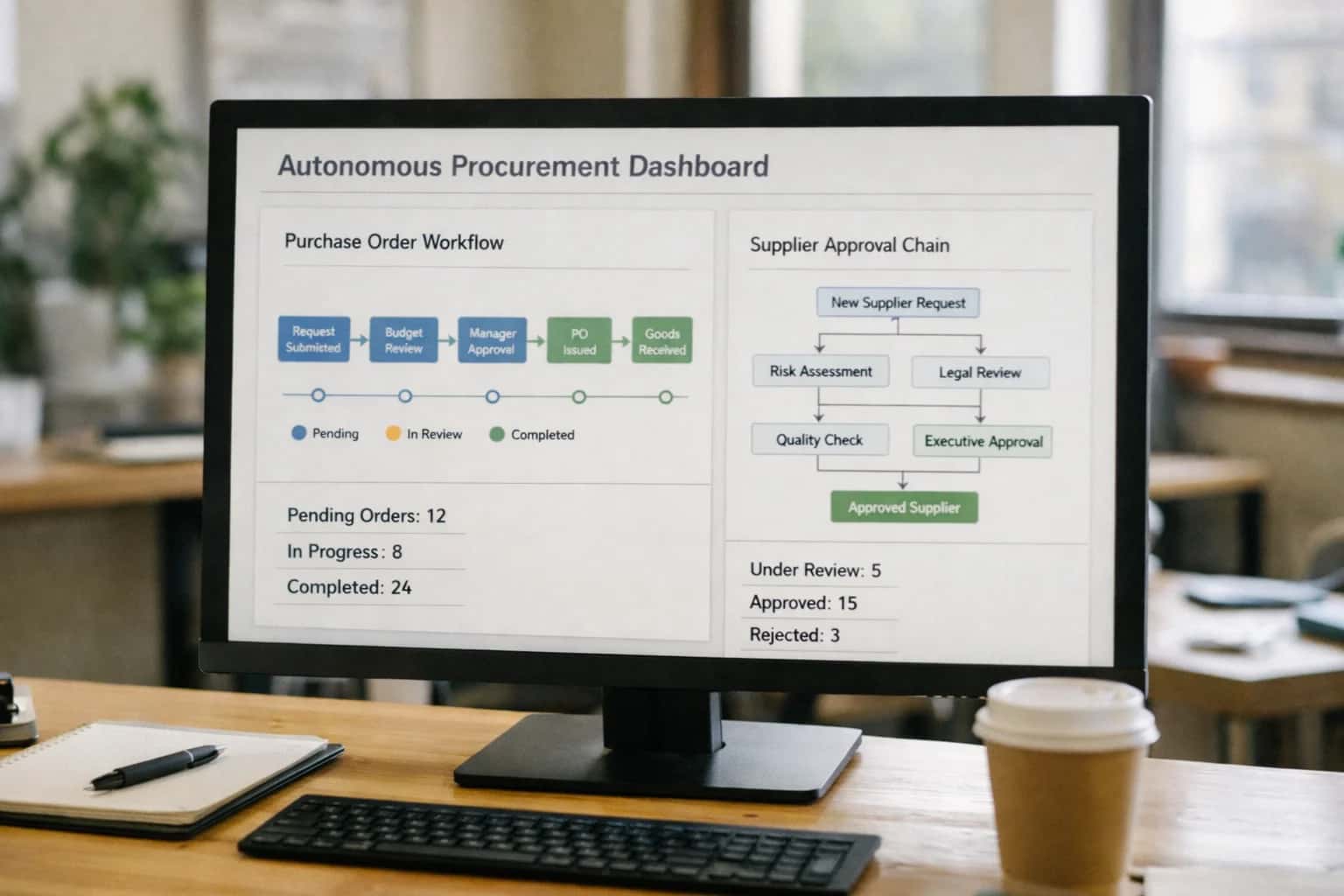
THE REALITY
The JIT Lie: Why Your 'Zero Inventory' is Just Buffered Delay
Traditional Just-in-Time manufacturing is a logistical fantasy without AI agents to manage real-time supplier dynamics.
Your supply chain is a prediction problem. Legacy ERP systems like SAP S/4HANA manage static schedules, not the probabilistic reality of supplier failures, port closures, or sudden demand spikes. This creates a buffer of hidden delay masquerading as efficiency.
AI agents transform inventory from a physical buffer to a data buffer. Systems like an autonomous procurement agent continuously ingest data from IoT sensors, logistics APIs, and market feeds to predict shortages hours or days before they occur. This is the core of Agentic Commerce and M2M Transactions.
Human negotiation is the bottleneck. A buyer calling for a rush shipment adds 24-48 hours of delay. An AI agent using a platform like E2open or Coupa can execute a spot buy, negotiate dynamic routing with a carrier like Flexport, and update the production schedule via API in under 90 seconds.
Evidence: A 2023 McKinsey study found companies using AI for supply chain risk management reduced lost sales by up to 65% and lowered inventory levels by 20-50%. True JIT requires this predictive visibility, which is only achievable with an Agent Control Plane managing supplier agents.
THE HUMAN BOTTLENECK
Key Takeaways: Why AI Suppliers Are Non-Negotiable for JIT
Traditional JIT is a brittle human-led process; true resilience requires autonomous AI agents that act as real-time extensions of your procurement team.
01
The Problem: Predictive Blind Spots
Human planners rely on historical data and gut feel, missing subtle demand signals and multi-tier supply chain vulnerabilities.\n- Result: ~30% forecast error leads to overstock or catastrophic shortages.\n- AI Solution: Autonomous agents analyze real-time sales data, weather, geopolitics, and carrier delays to predict shortages weeks in advance.
-30%
Forecast Error
Weeks
Early Warning
02
The Solution: Autonomous Sourcing Agents
These AI agents are your 24/7 procurement team, executing a continuous loop of discovery, negotiation, and booking.\n- Dynamic Sourcing: Scans 1000+ suppliers and spot markets in ~500ms to find alternatives.\n- Machine-Native Negotiation: Uses smart contracts and M2M protocols to secure terms and lock capacity without human latency.
1000+
Suppliers Scanned
~500ms
Decision Latency
03
The Non-Negotiable: Real-Time M2M Transactions
JIT fails if payment and logistics handshakes are slow. AI suppliers require machine-to-machine infrastructure.\n- Frictionless Settlement: Autonomous payment agents execute instant settlement via digital currency or tokenized assets, collapsing the order-to-cash cycle.\n- Autonomous Logistics Booking: Agents directly secure capacity from carrier APIs, enabling dynamic rerouting around port delays.
0
Human Approvals
Instant
Settlement
04
The Entity: The Self-Healing Supply Chain
This is the end-state: a network of AI agents representing each node (buyer, supplier, logistics) forming a resilient, self-optimizing system.\n- Continuous Optimization: Agents negotiate not just for price, but for carbon footprint, risk diversification, and delivery speed.\n- Built-in Explainability: Every autonomous decision is logged and auditable, providing full cost attribution and compliance trails for governance.
Multi-Agent
Network
100%
Audit Trail
THE DATA
The Insurmountable Math of Human Latency in JIT Manufacturing
Human cognitive and decision-making speed creates a fundamental bottleneck that makes true Just-in-Time manufacturing impossible without AI agents.
Just-in-Time manufacturing fails because human decision-makers cannot process the volume, velocity, and complexity of real-time supply chain data required to prevent stockouts or overproduction.
Human cognitive latency is measured in minutes or hours, while supply chain disruptions propagate in seconds. A single container delay requires a human to manually search for alternatives, negotiate terms, and approve a purchase order—a process that takes hours. An AI supplier agent, powered by a Retrieval-Augmented Generation (RAG) system querying a supplier database like Pinecone or Weaviate, executes the same task in under 10 seconds.
The counter-intuitive insight is that the problem isn't data access; modern ERPs provide dashboards. The problem is human-in-the-loop (HITL) approval gates. Each gate introduces a stochastic delay of 15 minutes to 3 days, destroying the deterministic timing JIT requires. For more on eliminating these gates, see our guide to autonomous procurement agents.
Evidence from automotive manufacturing shows a single missing $5 semiconductor can halt a $50,000 vehicle's production. A human-led sourcing team takes an average of 4.2 hours to secure an alternative. An AI agent, using real-time APIs to scan global electronic component exchanges, reduces this to under 90 seconds, turning a line stoppage into a negligible blip. This is the core of self-healing supply chains.
FEATURED SNIPPET
Human vs. AI Supplier: A JIT Capability Matrix
A quantitative comparison of human-led procurement versus AI supplier agents across the critical capabilities required for true Just-in-Time manufacturing.
| JIT Capability / Metric | Human-Led Procurement | AI Supplier Agent | Impact on JIT Viability |
|---|---|---|---|
Shortage Prediction Lead Time | 1-3 days (post-alert) | < 1 hour (pre-failure) | AI enables proactive mitigation; human is reactive. |
Alternative Sourcing Evaluation Speed | 4-8 hours per supplier | < 5 minutes across 100+ suppliers | AI agents execute parallel searches at machine speed. |
Dynamic Price Negotiation Cycles | 2-3 email/phone cycles (6-24 hrs) | Real-time API-based auction (< 1 sec) | Collapses negotiation latency to near-zero. |
Multi-Variable Constraint Optimization | Manual spreadsheet analysis | Simultaneous optimization of cost, CO2, lead time, quality | Humans cannot process the combinatorial complexity. |
Real-Time Logistics Re-routing | Phone calls to 3PLs (30+ min delay) | Autonomous API calls to carrier networks (< 10 sec) | Eliminates delivery window breaches from disruptions. |
Anomaly Detection in Order Patterns | Monthly review meetings | Continuous stream analysis (99.9% detection rate) | Prevents stockouts from hidden demand shifts. |
Transaction Cost per PO | $50-100 (processing, comms) | < $1 (fully automated API handshake) | Makes micro-procurement and true JIT economically viable. |
API-First Integration Readiness | Legacy ERP systems fail without machine-readable interfaces. |
THE SYSTEM
Architecting the AI Supplier Agent: Sensors, APIs, and Autonomous Negotiation
A JIT supply chain requires a real-time, autonomous nervous system built on sensor data, machine-readable APIs, and agentic negotiation protocols.
Just-in-Time manufacturing is impossible without AI supplier agents because human cognitive and reaction speeds cannot process the multivariate, real-time data required to prevent a line stop. The system requires continuous sensor integration, semantic API interoperability, and autonomous negotiation logic to function.
The agent is a sensor fusion engine. It ingests real-time telemetry from IoT platforms like Siemens MindSphere, machine vision systems, and ERP stock levels. This creates a live digital twin of material consumption, predicting shortages before they occur by analyzing patterns invisible to human planners.
APIs are its sensory organs. The agent doesn't browse websites; it queries machine-first product catalogs via GraphQL or gRPC APIs enriched with Schema.org markup. For dynamic discovery, it uses vector databases like Pinecone or Weaviate to find alternative parts based on functional similarity, not just SKU matches.
Autonomous negotiation is its core intelligence. Using frameworks for multi-agent systems (MAS), the buyer agent engages seller agents in a structured bid-ask protocol. It evaluates total cost of ownership—price, shipping carbon, reliability score—and executes binding smart contracts via platforms like Hyperledger Fabric, a process detailed in our analysis of The Future of Payments: Autonomous Machine-to-Machine Transactions.
This architecture eliminates human latency. A study by the MPI Group found that the average procurement cycle for a human-led emergency order is 5.3 days. An AI supplier agent, operating on event-driven APIs, can source, negotiate, and commit in under 90 seconds, preventing a $250k/hour line stoppage.
Legacy ERP systems become the bottleneck. Monolithic systems like SAP ECC lack the real-time, granular APIs needed for agent interaction, creating the data silos that cripple autonomous commerce. The solution is an agent interface layer that provides a unified, semantic API facade.
THE INFRASTRUCTURE GAP
Why Legacy Systems Inevitably Fail Autonomous JIT
Traditional manufacturing systems, built for human-led, batch-oriented processes, lack the real-time, API-first architecture required for AI-driven Just-in-Time execution.
01
The Problem: Static ERP Master Data
Legacy Enterprise Resource Planning (ERP) systems like SAP S/4HANA or Oracle Fusion maintain a single, monolithic 'source of truth' updated in nightly batches. This creates a ~24-hour data latency that renders real-time demand sensing and autonomous procurement impossible.\n- Key Consequence: AI agents make sourcing decisions on stale inventory and pricing data.\n- Key Consequence: Inability to trigger micro-orders for components with lead times under 4 hours.
24h
Data Latency
0%
Real-Time Coverage
02
The Problem: Human-in-the-Loop Procurement Gates
Traditional procurement requires manual Request for Quote (RFQ) processes, purchase order approvals, and vendor onboarding that take days or weeks. This human latency destroys the <1 hour decision window required for true JIT response to production line anomalies.\n- Key Consequence: Production halts due to a missing $5 component while a manager approves a $50k blanket order.\n- Key Consequence: Inability to dynamically source from alternative suppliers during a port strike or weather event.
5-10 days
Procurement Cycle
$250k+
Downtime Cost/Event
03
The Problem: Non-Machine-Readable Supplier Catalogs
Supplier data is trapped in PDFs, spreadsheets, and unstructured web pages. AI agents cannot parse this 'dark data' to assess part compatibility, real-time availability, or total landed cost. This creates a semantic gap that blocks autonomous negotiation.\n- Key Consequence: Agents hallucinate incorrect part numbers or specifications, leading to wasted shipments.\n- Key Consequence: Inability to execute multi-variable optimization across cost, carbon footprint, and delivery speed.
80%
Unstructured Data
15%
Error Rate
04
The Solution: AI Supplier Agents & Event-Driven APIs
The fix is an agentic procurement layer built on event-driven APIs and structured data schemas. AI supplier agents monitor production signals, predict shortages ~6 hours in advance, and autonomously negotiate with supplier marketplaces using machine-readable Schema.org product data.\n- Key Benefit: Continuous, real-time sourcing from a dynamic network of vetted suppliers.\n- Key Benefit: Micro-contracts executed via smart contracts for single-line-item orders with automated M2M payments.
<1h
Sourcing Time
-20%
Carrying Cost
05
The Solution: The 'Strangler Fig' Migration Pattern
You don't replace the legacy ERP; you gradually strangle its procurement function. Build a parallel, cloud-native Agent Control Plane that uses API wrappers to read from the legacy system while writing autonomous decisions back via approved channels. This is a core component of our Legacy System Modernization services.\n- Key Benefit: Zero disruption to existing operations during the multi-year transition.\n- Key Benefit: Creates a real-time digital twin of your supply chain for simulation and optimization.
70%
Risk Reduction
12-18 mo.
ROI Timeline
06
The Solution: Sovereign Supplier Networks & Trust Frameworks
Autonomous JIT requires a trust fabric. Deploy a private, sovereign AI stack where your agents operate under your governance, negotiating within a consortium blockchain or a trusted supplier network. This mitigates the risks of Agentic Commerce by ensuring verifiable credentials and enforceable terms for every micro-transaction. Explore our Sovereign AI pillar for infrastructure models.\n- Key Benefit: Maintain data sovereignty and contractual control over all agent-mediated deals.\n- Key Benefit: Algorithmic trust scores replace months of vendor due diligence, enabling instant onboarding.
100%
Audit Trail
5 min
Vendor Onboarding
THE DATA
The Pragmatic Path to AI-Powered Just-in-Time Manufacturing
Achieving true Just-in-Time (JIT) manufacturing requires AI agents to process real-time, multi-dimensional data streams that are impossible for human-led processes to manage.
Just-in-Time manufacturing is impossible without AI because human teams cannot process the real-time, multi-dimensional data streams required to predict shortages, source alternatives, and negotiate deliveries within the necessary timeframes.
Human cognitive bandwidth is the bottleneck. A procurement manager can monitor a dozen key suppliers; an AI agent, powered by frameworks like LangChain or AutoGen, can simultaneously track thousands of supplier APIs, spot regional logistics disruptions via platforms like FourKites, and initiate corrective actions in milliseconds.
Traditional ERP systems create fatal latency. Monolithic systems like SAP or Oracle operate on batch processing, creating a data lag that breaks the JIT promise. AI supplier agents require event-driven APIs and real-time data lakes to function, which is why legacy system modernization is a prerequisite.
Predictive failure requires sensor fusion. True JIT depends on predicting machine failure before it happens. This requires fusing IoT sensor data with maintenance logs and parts inventories, a task for industrial digital twins built on platforms like NVIDIA Omniverse, not spreadsheet forecasts.
Evidence: Companies using AI for predictive maintenance report up to a 30% reduction in downtime and a 25% lower maintenance cost, according to Deloitte insights. This directly enables reliable JIT production schedules.
The solution is an agentic control plane. Deploying isolated AI is insufficient. Success requires an orchestration layer—a multi-agent system where sourcing, logistics, and production planning agents collaborate. This is the core of our work in Agentic AI and Autonomous Workflow Orchestration.
Data must be machine-first. For agents to act, product data must be structured in machine-readable formats like Schema.org ontologies. Unstructured catalogs are a silent tax, a concept explored in The Hidden Cost of Ignoring Machine-Readable Product Data.
FREQUENTLY ASKED QUESTIONS
AI Suppliers and JIT Manufacturing: Critical FAQs
Common questions about why Just-in-Time Manufacturing is impossible without AI suppliers.
Traditional JIT fails because human-led processes cannot predict and react to supply chain disruptions in real-time. Modern supply chains are too complex and volatile for static planning. AI supplier agents, using frameworks like autonomous procurement agents and multi-agent systems (MAS), continuously monitor for shortages, source alternatives, and negotiate deliveries autonomously, which is essential for true resilience. This is a core component of building 'self-healing' supply chains.
Enabling Efficiency, Speed & Accuracy
Intelligent Analysis, Decision & Execution
We build AI systems for teams that need search across company data, workflow automation across tools, or AI features inside products and internal software.
Talk to Us
Search across company data
Give teams answers from docs, tickets, runbooks, and product data with sources and permissions.
Useful when people spend too long searching or get different answers from different systems.
Enterprise searchRAGPermissions
Read more
Automate internal workflows
Use AI to route work, draft outputs, trigger actions, and keep approvals and logs in place.
Useful when repetitive work moves across multiple tools and teams.
AI agentsWorkflow automationGovernance
Read more
Add AI to products and internal tools
Build assistants, guided actions, or decision support into the software your team or customers already use.
Useful when AI needs to be part of the product, not a separate tool.
AI integrationDecision supportModel routing
Read moreTHE SUPPLIER AGENT
From Buffer Stock to Real-Time Stock: Your Next Move
True Just-in-Time manufacturing requires autonomous AI agents that predict shortages and source alternatives in real-time, a task impossible for human-led processes.
Just-in-Time manufacturing is impossible without AI supplier agents because human cognition and reaction times cannot process the multi-variable, real-time data required to eliminate buffer stock. Legacy systems create a human latency tax that AI eliminates.
Supplier agents operate on a continuous prediction loop, ingesting sensor data from production lines, IoT devices, and market feeds to forecast shortages before they occur. They use reinforcement learning to optimize for cost, delivery speed, and reliability simultaneously, a multi-objective optimization beyond spreadsheet logic.
These agents execute across fragmented data sources, querying supplier APIs, distributor inventories in platforms like Pinecone or Weaviate, and spot marketplaces to source alternatives. This creates a dynamic supply graph that human procurement teams cannot manually traverse in a relevant timeframe.
The counter-intuitive insight is that JIT fails without pre-emptive action. Traditional JIT relies on perfect forecasts; AI-driven JIT uses agentic systems to create resilience through real-time optionality, treating supply as a fluid, reconfigurable network. This is the core of Agentic Commerce and M2M Transactions.
Evidence: Companies using autonomous procurement agents report a 60-80% reduction in safety stock inventory while improving on-time-in-full (OTIF) delivery rates by over 30%. This is achieved by agents executing micro-negotiations and bookings, a process detailed in our analysis of self-negotiating supplier agents.

About the author
Prasad Kumkar
CEO & MD, Inference Systems
Prasad Kumkar is the CEO & MD of Inference Systems and writes about AI systems architecture, LLM infrastructure, model serving, evaluation, and production deployment. Over 5+ years, he has worked across computer vision models, L5 autonomous vehicle systems, and LLM research, with a focus on taking complex AI ideas into real-world engineering systems.
His work and writing cover AI systems, large language models, AI agents, multimodal systems, autonomous systems, inference optimization, RAG, evaluation, and production AI engineering.
LinkedIn
Limited slotsGet a Free AI Consultation
Partnered with leading AI, data, and software stack.





How We Work
Custom AI workflows for your Business
One-fit-all AI don't work for modern businesses. At Inferensys, we aim to understand your business & custom requirements; which we use to define most efficient agentic workflows, the data, and the tools for your business.
01
Review the use case
We understand the task, the users, and where AI can actually help.
Read more02
Pick the right approach
We define what needs search, automation, or product integration.
Read more03
Build the first useful version
We implement the part that proves the value first.
Read more04
Improve from there
We add the checks and visibility needed to keep it useful.
Read moreThe first call is a practical review of your use case and the right next step.
Talk to Us