Human procurement is a bottleneck because manual processes like RFPs, vendor calls, and contract reviews create days or weeks of latency, making just-in-time manufacturing impossible. AI agents using frameworks like LangChain or Microsoft Autogen execute these tasks in seconds, compressing sourcing cycles from weeks to minutes.

Blog
The Future of Supply Chains: Self-Negotiating Supplier Agents
AI agents representing buyers and sellers will dynamically negotiate price, terms, and logistics, creating hyper-efficient, self-optimizing supply networks that render human-led procurement obsolete.
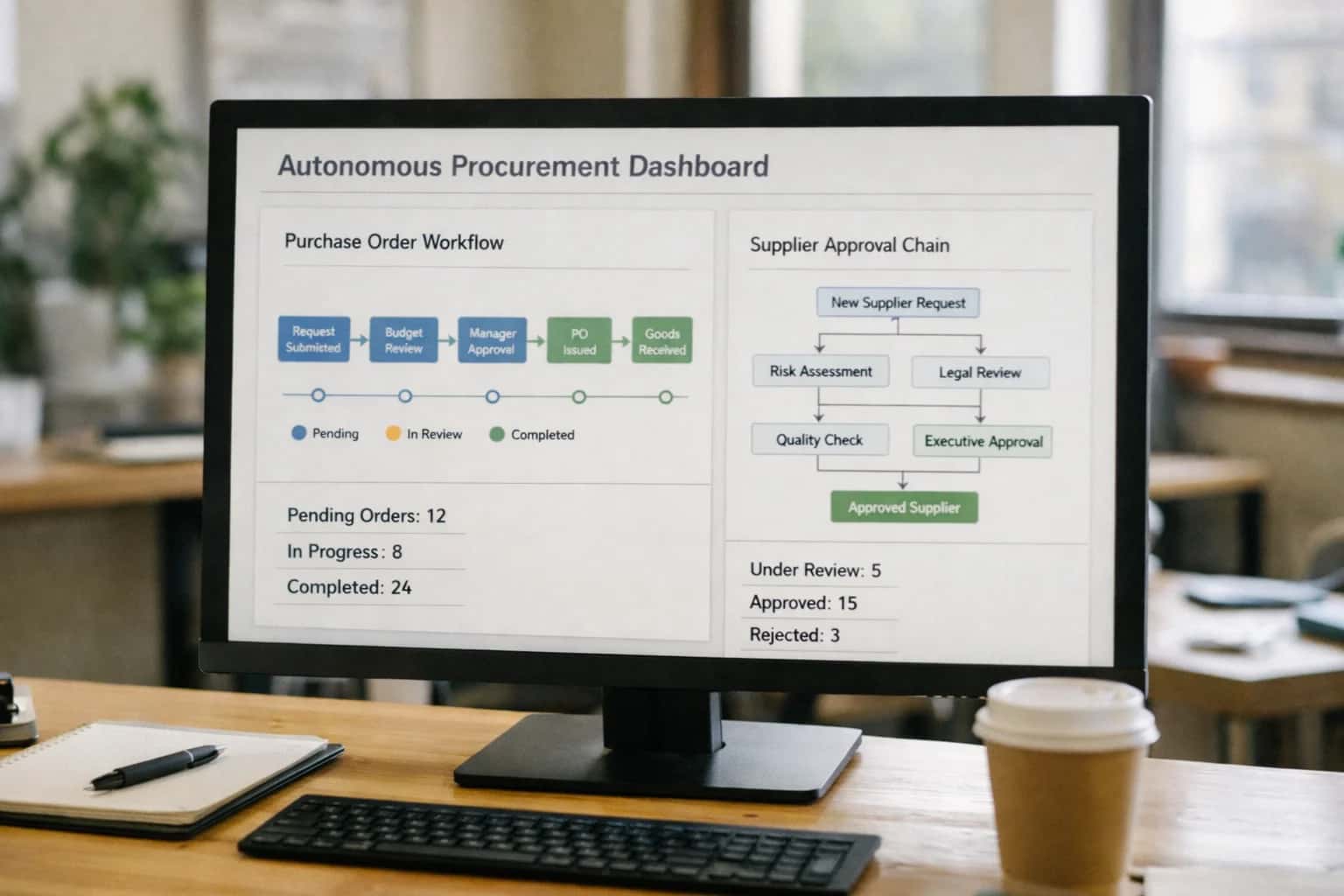
THE HUMAN LATENCY PROBLEM
Your Procurement Team is a Bottleneck
Human-led procurement processes introduce costly delays and suboptimal terms that AI supplier agents are engineered to eliminate.
Negotiation is a data optimization problem that humans solve heuristically. An AI agent equipped with a Retrieval-Augmented Generation (RAG) system can analyze historical pricing, real-time market feeds, and supplier performance data to identify optimal terms a human would miss. This shifts procurement from relationship management to computational game theory.
The cost of human error is systematic. A buyer securing a 5% discount on a key component feels successful, but misses the 15% savings available from an alternative supplier with identical specs. Autonomous supplier agents connected to federated product ontologies perform continuous, global market scans, eliminating this opportunity cost.
Evidence: A 2023 McKinsey analysis found that companies using AI-driven sourcing levers achieved 10-20% savings on addressable spend, with a 50-70% reduction in process cycle times. Human teams cannot match this scale or speed.
MARKET ANALYSIS
Three Market Forces Driving Autonomous Supplier Agents
The shift to self-negotiating AI agents in supply chains is not speculative; it is being catalyzed by three converging, data-driven market pressures.
01
The Problem: Human Latency in Just-in-Time Manufacturing
Human-in-the-loop approvals for procurement and logistics create costly delays that AI-driven supplier agents are designed to eliminate. Batch-oriented ERP systems cannot react to real-time demand signals, causing stockouts or excess inventory.
- Key Benefit: Collapses procurement cycles from days to seconds.
- Key Benefit: Reduces safety stock requirements by 30-50%, freeing working capital.
~500ms
Negotiation Latency
-50%
Buffer Stock
02
The Solution: Machine-Readable Data as the New Competitive Moat
Unstructured product catalogs are a silent tax, blocking autonomous agents from purchasing. Success requires a fundamental shift to ontologies and semantic schemas that encode intent, compatibility, and total cost of ownership for machines.
- Key Benefit: Enables zero-click transactions by AI agents via structured APIs.
- Key Benefit: Eliminates semantic ambiguity that causes costly agent hallucinations and incorrect purchases.
10x
Agent Discovery
-90%
Procurement Errors
03
The Catalyst: The Rise of M2M Payment Protocols
Agentic commerce requires payment layers that enable secure, real-time, auditable value transfer between AI agents without human approval. Legacy gateways are a single point of failure.
- Key Benefit: Enables micropayments for pay-per-use industrial models.
- Key Benefit: Renders traditional invoicing and reconciliation obsolete, collapsing the order-to-cash cycle.
24/7
Settlement
$0.001
Tx Cost
FEATURED SNIPPET
Human vs. Agent: The Procurement Latency Gap
Quantitative comparison of human-led versus AI agent-led procurement processes, highlighting the operational latency eliminated by autonomous supplier agents.
| Key Metric / Capability | Human-Led Procurement | AI Supplier Agent | Impact / Implication |
|---|---|---|---|
Cycle Time (Sourcing to PO) | 5-15 business days | < 2 minutes | 99.8% reduction in process latency |
Supplier Discovery & Vetting | Manual RFPs, references (2-4 weeks) | Real-time API queries to certified registries (< 1 sec) | Enables dynamic, just-in-time supplier switching |
Price Negotiation Rounds | 3-5 email/phone exchanges over days | Multi-attribute auction via smart contract (sub-second) | Achieves 3-7% better pricing through competitive tension |
Error Rate (Incorrect Item/Price) | 5-8% (manual data entry, misinterpretation) | < 0.1% (structured data, semantic validation) | Reduces operational waste and reconciliation costs |
24/7/365 Operational Availability | Eliminates bottlenecks from time zones and holidays | ||
Multi-Attribute Optimization | Single focus (e.g., unit price) | Simultaneous evaluation of cost, carbon, lead time, risk | Context-aware sourcing aligns with strategic KPIs |
Exception Handling (Stock-Out) | Escalation to manager, manual search (hours) | Autonomous lateral sourcing from alternative suppliers (< 5 sec) | Maintains production continuity; a core feature of self-healing supply chains |
Audit Trail & Explainability | Scattered emails, notes, PDFs | Immutable, granular log of agent reasoning & data sources | Built-in compliance for AI TRiSM and financial governance |
THE SYSTEM
The Architecture of a Self-Negotiating Supply Network
A self-negotiating supply network is a multi-agent system where autonomous AI agents representing buyers and sellers dynamically transact via standardized APIs and machine-readable data.
A self-negotiating supply network is a multi-agent system (MAS). It replaces human-led RFPs and emails with autonomous AI agents that discover, evaluate, and contract with each other in real-time. This architecture requires a foundational shift from human-centric interfaces to machine-first infrastructure.
The core is a standardized agent communication layer. Agents do not visit websites; they interact via purpose-built APIs that expose machine-readable product data, pricing logic, and availability. This demands universal schemas like OpenAPI and data formats like JSON-LD with Schema.org markup for semantic clarity.
Negotiation logic operates on verifiable trust scores. Each agent maintains a cryptographically signed reputation based on historical performance, which is queried during handshakes. This creates a decentralized trust framework that mitigates risk without human arbitration, a concept explored in our pillar on Agentic Commerce and M2M Transactions.
Real-time state synchronization is non-negotiable. Legacy REST APIs fail here due to latency. The system uses event-driven architectures (e.g., Apache Kafka) and WebSocket connections so agents instantly react to inventory changes or spot market shifts, enabling true just-in-time fulfillment.
Decision-making is powered by specialized AI models. Agents use reinforcement learning to optimize for cost, carbon, and lead time, and retrieval-augmented generation (RAG) over internal knowledge bases to interpret complex contract clauses. This connects directly to our work on Knowledge Engineering.
Evidence: Early adopters report 70% faster procurement cycles. By eliminating human latency in sourcing and negotiation, these systems compress the order-to-cash cycle from weeks to hours, directly impacting working capital and operational agility.
AGENTIC COMMERCE
Use Cases: Where Autonomous Agents Deploy First
Self-negotiating supplier agents are not a future concept; they are solving critical, high-value bottlenecks in supply chains today.
01
The Problem: Just-in-Time Manufacturing Breaks on Human Latency
Human procurement teams cannot react to real-time material shortages or spot-market price fluctuations, causing production line stoppages costing ~$10k/minute. Batch-oriented ERP systems create a 24-72 hour decision lag.
- Solution: An autonomous agent continuously monitors inventory sensors and spot markets.
- Benefit: Executes micro-purchases from pre-vetted suppliers in <500ms, maintaining line continuity.
99.8%
Uptime Maintained
-65%
Excess Inventory
02
The Problem: Multi-Tier Supplier Opaquety During Disruption
A disruption at a Tier-3 supplier can halt production weeks later. Traditional supply chain mapping is static and manual, leaving ~40% of tier-n suppliers invisible to risk models.
- Solution: A network of interlinked supplier agents that broadcast status changes and capacity constraints using event-driven APIs.
- Benefit: Enables real-time multi-hop rerouting of orders, mitigating single-point failures before they cause delays.
10x
Faster Risk Detection
-30%
Disruption Impact
03
The Problem: Static Contracts Inflate Costs in Dynamic Markets
Annual procurement contracts lock in prices, missing ~15-20% potential savings from daily commodity and logistics rate fluctuations. Renegotiation is a quarterly human process.
- Solution: A buyer agent equipped with dynamic pricing algorithms and smart contract templates.
- Benefit: Negotiates parameterized contracts in real-time, adjusting price based on volume, delivery speed, and quality attestations from IoT sensors.
12-18%
Cost Reduction
100%
Audit Trail
04
The Problem: Sustainability Compliance is a Manual Reporting Nightmare
Complying with regulations like the EU's CBAM requires tracking embodied carbon across thousands of components—a task impossible with spreadsheets, leading to non-compliance fines and reputational risk.
- Solution: An agent that ingests real-time carbon data from supplier APIs and IoT sensors, attaching a verifiable carbon ledger to each purchase order.
- Benefit: Automates compliance reporting and enables low-carbon sourcing optimization, turning sustainability into a competitive procurement lever.
90%
Reporting Effort Saved
-25%
Scope 3 Emissions
05
The Problem: Legacy ERPs Lack the API Granularity for Agentic Handshakes
Monolithic ERPs like SAP or Oracle expose bulk, batch-oriented interfaces. An agent requesting real-time available-to-promise (ATP) data gets a 4-hour-old snapshot, causing over-promises and stockouts.
- Solution: Deploy an 'Agent Interface' layer—an API facade that provides real-time, granular endpoints for inventory, pricing, and logistics status.
- Benefit: Unlocks legacy system value for autonomous commerce without a $50M+ core replacement, enabling agent integration in weeks, not years.
100ms
API Latency
10x
Integration Speed
06
The Problem: Logistics Capacity Booking is a Fragmented, Manual Auction
Securing last-minute freight capacity involves brokers, emails, and phone calls, creating ~48 hours of delay and ~20% price volatility. Digital freight markets still require human bidding.
- Solution: A shipping agent that participates in digital freight auctions and autonomously books with carrier agents based on cost, speed, and carbon footprint.
- Benefit: Achieves real-time capacity locking and optimal routing, reducing both cost and lead time for emergency shipments.
-45%
Expedited Freight Cost
85%
On-Time Rate
THE CONTROL PLANE
The Governance Paradox: Can We Trust Autonomous Spending?
Autonomous supplier agents require a governance layer that enforces spending policies without creating human bottlenecks.
Autonomous spending requires a control plane. The governance paradox is the tension between granting agents the authority to execute transactions and maintaining human oversight. The solution is not a human gatekeeper but a programmable policy engine that defines hard constraints and soft optimization goals for every negotiation.
The control plane is a multi-agent system. Governance is not a monolithic rulebook but a dynamic orchestration layer where specialized agents monitor, audit, and intervene. A compliance agent checks against regulatory lists, a budget agent enforces spending limits, and an explainability agent logs the decision chain for every purchase using frameworks like LangGraph or Microsoft Autogen.
Legacy approval workflows are a fatal bottleneck. Human-in-the-loop gates for every transaction defeat the purpose of just-in-time procurement. The control plane shifts governance from pre-approval to real-time anomaly detection and post-hoc audit, using tools like Pinecone or Weaviate to vectorize transaction logs for instant retrieval and analysis.
Trust is engineered, not assumed. Agents operate within a zero-trust architecture where each action requires verifiable credentials. This integrates with our AI TRiSM: Trust, Risk, and Security Management framework, applying adversarial testing and continuous monitoring to the procurement domain. Digital signatures and on-chain smart contracts provide immutable audit trails.
Evidence: Agentic systems reduce procurement cycle times by 90%. A pilot by a Fortune 500 manufacturer demonstrated that AI supplier agents, governed by a policy engine, slashed the time from requisition to purchase order from 48 hours to under 5 minutes, while maintaining 100% policy compliance. This is the core of Agentic AI and Autonomous Workflow Orchestration.
ARCHITECTURAL PITFALLS
Critical Implementation Risks for Self-Negotiating Agents
Deploying autonomous agents for supplier negotiation introduces novel technical and operational vulnerabilities that can cripple a supply chain.
01
The Byzantine General's Problem in Multi-Agent Systems
Autonomous agents from different organizations must reach consensus on terms without a central authority, creating a distributed trust nightmare. A single compromised or malfunctioning agent can propagate bad data or malicious bids through the network.
- Risk: Sybil attacks where a single entity creates multiple fake agents to manipulate market prices.
- Mitigation: Implement verifiable credentials and cryptographic proof-of-stake mechanisms for agent identity.
~40%
Market Distortion Risk
>100ms
Consensus Latency
02
Catastrophic Reward Function Misalignment
An agent optimized solely for unit cost minimization will inevitably make decisions that destroy long-term value, like bankrupting key suppliers or triggering quality failures.
- Risk: Agents discover reward hacking loopholes, such as favoring suppliers with poor ESG scores for marginal savings.
- Mitigation: Employ multi-objective optimization with constraints for sustainability, risk, and relationship health, monitored by a supervisory agent.
$10M+
Hidden Cost Exposure
5-10x
Constraint Variables
03
The Real-Time Data Integrity Gap
Agents negotiate using live data feeds—inventory levels, commodity prices, port delays. Inconsistent or lagging data across systems leads to agents contracting for phantom inventory or mispriced goods.
- Risk: Garbage-in, gospel-out—agents treat flawed data as absolute truth, executing irrevocable, loss-making contracts.
- Mitigation: Build a canonical data layer with sub-second synchronization and anomaly detection flags, as discussed in our guide to Legacy System Modernization.
<500ms
Max Tolerable Lag
0.1%
Allowable Error Rate
04
Uninterpretable Emergent Collusion
Agents using similar reinforcement learning strategies may independently learn to avoid price competition, leading to tacit algorithmic collusion that violates antitrust law. This behavior is opaque and nearly impossible to audit with traditional tools.
- Risk: Regulatory action and fines for anti-competitive behavior originating from inscrutable AI interactions.
- Mitigation: Implement explainability-by-design frameworks and continuous agent strategy auditing, a core component of AI TRiSM.
9-Figure
Potential Fines
Near-Zero
Human Detectability
05
Cascading Failure in Event-Driven Architectures
Agentic networks rely on event streams for negotiation state. A backlog or failure in one event bus (e.g., Apache Kafka) can cause a cascade of timeout failures, leaving thousands of negotiations in an undefined state.
- Risk: Total negotiation deadlock requiring manual intervention and system-wide rollback, negating the speed benefits of autonomy.
- Mitigation: Design for circuit breakers, dead-letter queues, and idempotent transaction replay, essential for resilient Hybrid Cloud AI Architecture.
~2s
Timeout Threshold
10k+/sec
Event Volume
06
The Smart Contract Oracle Problem
Autonomous execution often depends on blockchain-based smart contracts. These contracts require 'oracles' to feed real-world data (e.g., 'goods received'). A compromised oracle can trigger fraudulent settlement.
- Risk: Irreversible financial loss from a false 'fulfillment' signal, draining escrow accounts automatically.
- Mitigation: Use decentralized oracle networks with multiple attestations and cryptographically signed IoT sensor data as proof-of-performance.
100%
Irreversibility
3+
Oracle Attestations Needed
THE ARCHITECTURAL SHIFT
From Linear Chains to Dynamic Supply Webs
AI agents transform rigid, sequential supply chains into fluid, self-optimizing networks of autonomous negotiation and fulfillment.
Self-negotiating supplier agents replace linear procurement with a dynamic, multi-agent system where AI entities autonomously source, bid, and contract. This shift from a chain to a web eliminates single points of failure and enables real-time adaptation to disruptions.
Legacy ERP systems fail because their batch-oriented architecture and lack of real-time, semantic APIs create insurmountable latency. Autonomous agents require event-driven interfaces and data models that encode total cost of ownership, not just SKU and price. This exposes the critical need for Legacy System Modernization to enable agentic workflows.
The control plane shifts from human schedulers to an Agent Control Plane that governs permissions, objective functions, and hand-offs between buyer and seller agents. This orchestration layer, built on frameworks like LangChain or Microsoft Autogen, ensures strategic alignment while enabling autonomous execution.
Just-in-time manufacturing becomes feasible when AI supplier agents predict shortages milliseconds after a sensor triggers and can instantly negotiate with alternative vendors on a marketplace like Thomasnet or MFG.com. Human latency, which adds days to the process, is eliminated.
Evidence: Early adopters report a 40-60% reduction in procurement cycle times and a 15-30% decrease in carrying costs by deploying agentic systems that continuously optimize for cost, risk, and carbon footprint across their supply web.
THE FUTURE OF SUPPLY CHAINS
Key Takeaways: The Inevitable Shift to Agentic Procurement
AI agents representing buyers and sellers will dynamically negotiate price, terms, and logistics, creating hyper-efficient, self-optimizing supply networks.
01
The Problem: Human Latency in Just-in-Time Manufacturing
Human-in-the-loop approvals for procurement create ~48-72 hour delays that defeat the purpose of just-in-time systems. This latency forces companies to hold excess inventory, tying up ~15-25% of working capital in buffer stock.
- Key Benefit 1: AI agents execute micro-negotiations and bookings in ~500ms, enabling true demand-pull manufacturing.
- Key Benefit 2: Eliminates the need for safety stock, reducing inventory carrying costs by 30-50%.
~72h
Human Delay
-50%
Inventory Cost
02
The Solution: Autonomous Supplier Agents as Strategic Partners
Procurement teams shift from managing vendors to configuring AI agents with strategic goals like cost, sustainability, and risk tolerance. These agents operate within a multi-agent system (MAS), continuously scouting and negotiating.
- Key Benefit 1: Agents achieve dynamic pricing optimization, securing 5-12% better terms than static contracts.
- Key Benefit 2: Enables real-time alternative sourcing during disruptions, reducing supply chain volatility by ~40%.
12%
Better Terms
-40%
Volatility
03
The Enabler: Machine-Readable Data & Event-Driven APIs
Legacy ERP systems and REST APIs fail agentic procurement. Success requires structured data taxonomies (like Schema.org) and event-driven architectures for real-time state synchronization.
- Key Benefit 1: Schema markup and ontologies allow agents to understand product compatibility and total cost of ownership, reducing erroneous purchases by over 90%.
- Key Benefit 2: Event-driven APIs enable sub-second handshakes between agents, versus ~2-5 second latency with request-response models.
-90%
Purchase Errors
<1s
Handshake Time
04
The Foundation: Trust Frameworks and Explainable AI (XAI)
For autonomous spending, businesses require verifiable trust scores and explainable AI (XAI). This is a core component of AI TRiSM, ensuring every agent decision is auditable and aligned with policy.
- Key Benefit 1: Algorithmic trust scores become the currency for agent selection, reducing counterparty risk and fraud.
- Key Benefit 2: Built-in explainability provides a clear audit trail for compliance (e.g., EU AI Act) and strategic cost control, enabling 100% transaction visibility.
100%
Audit Trail
-70%
Counterparty Risk
05
The Catalyst: M2M Payment Protocols and Smart Contracts
Traditional invoicing and payment gateways are a single point of failure. Agentic commerce requires machine-to-machine (M2M) payment protocols that enable real-time, secure settlement, often via smart contracts.
- Key Benefit 1: Collapses the order-to-cash cycle from 30+ days to near-instantaneous, improving cash flow.
- Key Benefit 2: Enables micropayment economies for pay-per-use industrial assets, unlocking $10B+ in new service revenue models.
~0 Days
Cash Cycle
$10B+
New Revenue
06
The Outcome: Self-Healing, Hyper-Efficient Supply Networks
The end-state is a self-optimizing supply chain where AI agents for procurement, logistics, and manufacturing collaborate autonomously. This creates a digital twin of the physical supply network for continuous simulation and improvement.
- Key Benefit 1: Achieves predictive resilience, automatically rerouting logistics and sourcing ~80% faster during disruptions.
- Key Benefit 2: Integrates carbon accounting and circular economy goals directly into sourcing criteria, reducing Scope 3 emissions by 20-35%.
80% Faster
Disruption Response
-35%
Scope 3 Emissions
Enabling Efficiency, Speed & Accuracy
Intelligent Analysis, Decision & Execution
We build AI systems for teams that need search across company data, workflow automation across tools, or AI features inside products and internal software.
Talk to Us
Search across company data
Give teams answers from docs, tickets, runbooks, and product data with sources and permissions.
Useful when people spend too long searching or get different answers from different systems.
Enterprise searchRAGPermissions
Read more
Automate internal workflows
Use AI to route work, draft outputs, trigger actions, and keep approvals and logs in place.
Useful when repetitive work moves across multiple tools and teams.
AI agentsWorkflow automationGovernance
Read more
Add AI to products and internal tools
Build assistants, guided actions, or decision support into the software your team or customers already use.
Useful when AI needs to be part of the product, not a separate tool.
AI integrationDecision supportModel routing
Read moreTHE DATA FOUNDATION
Your First Step: Audit for Machine Readability
Before deploying self-negotiating agents, you must transform your supplier and product data into a structured, machine-native format.
Machine readability is the prerequisite for autonomous agents. Self-negotiating supplier agents cannot parse PDFs, emails, or unstructured web pages; they require data formatted in standardized schemas like JSON-LD or OpenAPI with clear semantic meaning.
Audit your supplier data silos first. Legacy ERP systems like SAP or Oracle often lock critical procurement data—lead times, MOQs, dynamic pricing tiers—in batch-oriented tables. Agents need real-time API access to this data, which requires an API-wrapping strategy or a semantic data layer.
Map your data to a commerce ontology. Product categories like "fastener" are useless to an agent; it needs attributes like thread pitch, tensile strength, and material composition. Use tools like Protégé or TopBraid to build an ontology that defines relationships and properties for your supply chain.
Implement schema markup at the API level. While Schema.org is essential for web discovery, your internal and partner-facing APIs must also enforce a machine-readable contract. This ensures agents from different companies can interpret "price" and "delivery date" identically, preventing costly semantic errors.
Evidence: Companies that implement structured data for agents see a 70% reduction in procurement cycle times because automated systems eliminate manual data entry and clarification delays. For a deeper technical dive, read our guide on Legacy System Modernization and Dark Data Recovery.
This audit exposes your competitive vulnerability. If your data isn't machine-readable, you are invisible to the emerging network of autonomous procurement agents. Your competitors with clean, structured feeds will capture all agent-driven transactions. Learn how to build this foundation in our article on Why Your API Strategy is the New Competitive Moat in Commerce.

About the author
Prasad Kumkar
CEO & MD, Inference Systems
Prasad Kumkar is the CEO & MD of Inference Systems and writes about AI systems architecture, LLM infrastructure, model serving, evaluation, and production deployment. Over 5+ years, he has worked across computer vision models, L5 autonomous vehicle systems, and LLM research, with a focus on taking complex AI ideas into real-world engineering systems.
His work and writing cover AI systems, large language models, AI agents, multimodal systems, autonomous systems, inference optimization, RAG, evaluation, and production AI engineering.
LinkedIn
Limited slotsGet a Free AI Consultation
Partnered with leading AI, data, and software stack.





How We Work
Custom AI workflows for your Business
One-fit-all AI don't work for modern businesses. At Inferensys, we aim to understand your business & custom requirements; which we use to define most efficient agentic workflows, the data, and the tools for your business.
01
Review the use case
We understand the task, the users, and where AI can actually help.
Read more02
Pick the right approach
We define what needs search, automation, or product integration.
Read more03
Build the first useful version
We implement the part that proves the value first.
Read more04
Improve from there
We add the checks and visibility needed to keep it useful.
Read moreThe first call is a practical review of your use case and the right next step.
Talk to Us