Salesforce Einstein Governance excels at providing granular, user-centric controls within its CRM ecosystem because it is built on the Salesforce platform's core security and sharing model. For example, its Permission Sets and Field-Level Security allow administrators to define precisely which users or profiles can view, explain, or override AI predictions like Opportunity Insights or Case Classification, directly tying governance to the existing Salesforce Data Cloud and Salesforce Shield compliance frameworks.

Comparison
Salesforce Einstein Governance vs ServiceNow AI Governance
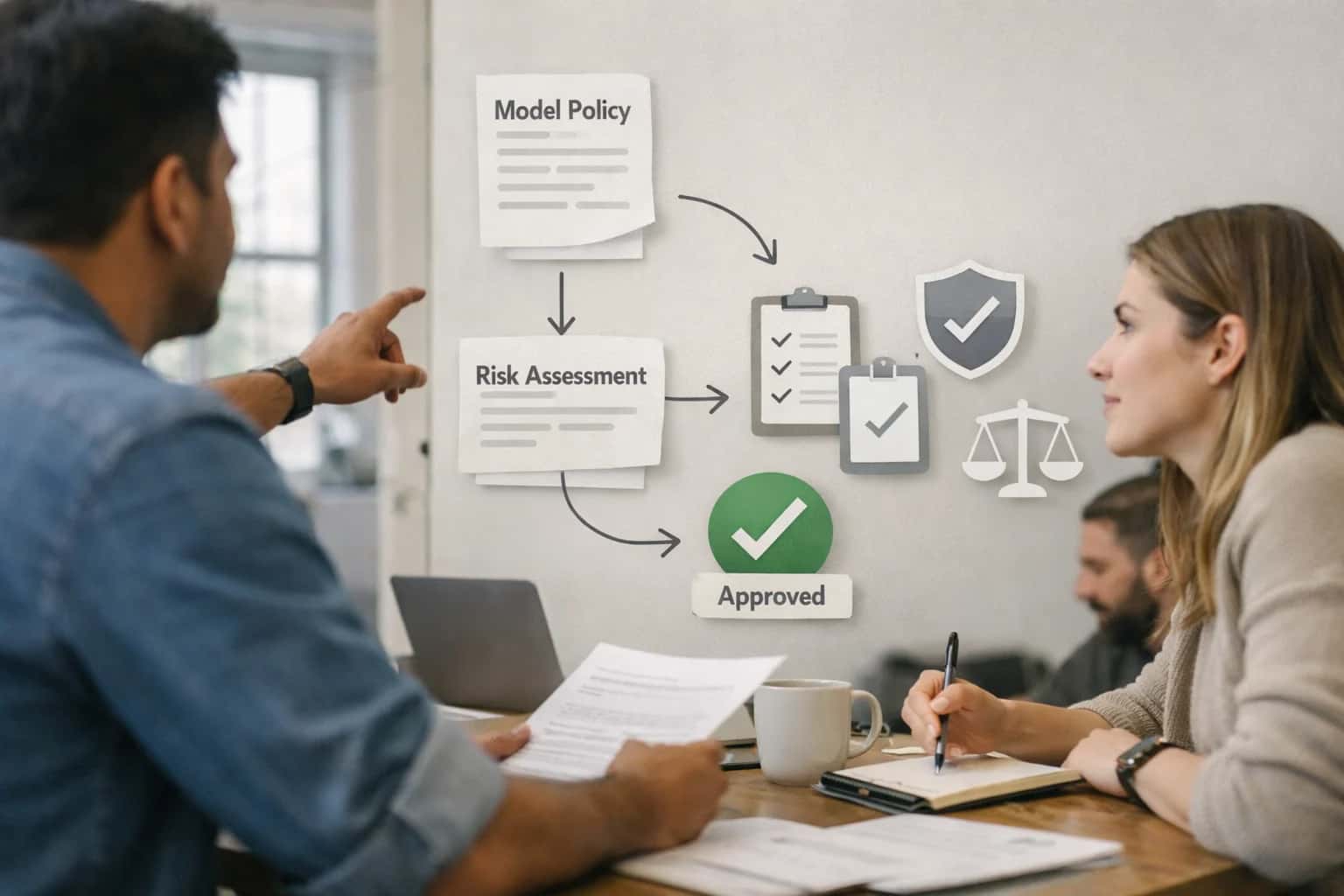
A technical comparison of the native AI governance modules within Salesforce and ServiceNow platforms. We evaluate their embedded controls for responsible AI, user permissioning, activity logging, and compliance with public sector mandates to help CTOs and engineering leads choose the right foundation for governed AI applications.
THE ANALYSIS
Introduction
A head-to-head comparison of how Salesforce and ServiceNow embed responsible AI controls directly into their enterprise application suites.
ServiceNow AI Governance takes a different approach by leveraging its strength as a system of record for enterprise workflows. Its strategy centers on audit trail generation and policy enforcement through automated ServiceNow workflows and ITSM integrations. This results in a trade-off where governance is less about fine-grained data access and more about creating a verifiable, process-oriented chain of custody for AI-driven decisions, such as those from Virtual Agent or Predictive Intelligence, within the Now Platform.
The key trade-off: If your priority is enforcing ethical AI usage through existing CRM user roles and data permissions, choose Salesforce Einstein Governance. Its controls are deeply integrated with the object and field security model familiar to Salesforce admins. If you prioritize automated compliance logging and integrating AI oversight into broader IT service management and operational workflows, choose ServiceNow AI Governance. Its strength lies in generating the audit-ready documentation required for public sector mandates. For a broader view of the governance landscape, see our comparisons of OneTrust vs IBM watsonx.governance and Microsoft Purview vs Google Vertex AI Governance.
HEAD-TO-HEAD COMPARISON
Salesforce Einstein Governance vs ServiceNow AI Governance
Direct comparison of native AI governance modules for CRM and workflow automation platforms, focusing on compliance with public sector mandates.
| Metric | Salesforce Einstein Governance | ServiceNow AI Governance |
|---|---|---|
AI Activity Audit Trail Retention | 10 years | 7 years |
Automated Bias Detection for Custom Models | ||
Sovereign Data Residency Controls | ||
Native Integration with GRC Workflows | Salesforce GRC | ServiceNow GRC |
Real-time AI Decision Logging Latency | < 100 ms | < 250 ms |
Pre-built Compliance Frameworks | NIST AI RMF, ISO 42001 | NIST AI RMF, EU AI Act |
User Permission Granularity | Field-level | Record-level |
Salesforce Einstein vs ServiceNow AI Governance
TL;DR Summary
Key strengths and trade-offs at a glance for SaaS-native AI governance modules.
01
Salesforce Einstein: Native CRM Governance
Deep CRM integration: Governs AI features like Einstein Bots, Prediction Builder, and Next Best Action directly within the Salesforce data model. This matters for organizations where customer data privacy and sales/marketing automation are the primary AI use cases, ensuring governance is applied at the field and object level.
02
ServiceNow: Unified Workflow Governance
ITSM-centric control: Embeds governance into Now Platform workflows, Virtual Agent conversations, and Predictive Intelligence. This matters for public sector agencies using AI to automate IT service management, HR service delivery, and facilities operations, providing a single pane of glass for audit trails across business services.
03
Salesforce: User Permissioning & Data Masking
Leverages existing profiles and permission sets: Applies field-level security (FLS) and data masking policies automatically to AI model inputs and outputs. This matters for enforcing least-privilege access in shared tenant environments, a critical requirement for public trust in citizen-facing services.
04
ServiceNow: Granular Activity Logging
Comprehensive audit logs: Tracks every AI-driven decision, agent action, and data access within the Configuration Management Database (CMDB). This matters for compliance with sovereign AI mandates requiring detailed provenance for automated administrative decisions, such as benefit eligibility or permit approvals.
05
Salesforce: Einstein Trust Layer
Built-in safety and grounding: Offers zero-data retention with LLM partners, automatic toxicity filtering, and dynamic grounding with Salesforce Data Cloud. This matters for reducing hallucination risk in AI-generated content and ensuring ethical compliance without complex external tooling.
06
ServiceNow: AI Control Center
Centralized policy management: Provides a dedicated hub for enabling/disabling AI capabilities, setting risk thresholds, and reviewing agentic decisions. This matters for IT governance teams needing to operationalize Human-in-the-Loop (HITL) approvals for moderate-risk AI workflows in government operations.
CHOOSE YOUR PRIORITY
When to Choose: User Scenarios
Salesforce Einstein Governance for CRM
Verdict: The definitive choice for governing AI embedded within customer relationship workflows. Strengths: Native, granular controls over AI features like Einstein Bots, Prediction Builder, and Next Best Action within the Salesforce ecosystem. Governance is directly tied to Salesforce Object Permissions and Field-Level Security, ensuring AI-driven insights and automations respect existing user roles and data access policies. Activity logging feeds directly into Salesforce Shield for comprehensive audit trails. Ideal for public agencies using Salesforce for constituent services, where AI-powered case routing or sentiment analysis must comply with strict citizen data handling regulations. Considerations: Governance scope is largely confined to the Salesforce platform. Integrating governance for external AI models or custom ML pipelines requires additional configuration and may lack the depth of a standalone platform.
ServiceNow AI Governance for CRM
Verdict: A strong alternative when CRM is part of a broader service management and workflow automation landscape. Strengths: Excels at governing AI that orchestrates cross-departmental service delivery, such as AI agents for IT service management (ITSM) or HR service delivery. Governance policies are defined within the ServiceNow Governance, Risk, and Compliance (GRC) module, providing a unified framework for AI risk alongside other enterprise risks. Tracks AI decisions within the Configuration Management Database (CMDB) context, linking AI actions to specific services and assets. Best for government IT departments managing citizen and internal employee services through a single platform. Considerations: While it can govern AI in the ServiceNow Customer Service Management (CSM) module, its governance model is more process-oriented than data-object-oriented compared to Salesforce.
Enabling Efficiency, Speed & Accuracy
Intelligent Analysis, Decision & Execution
We build AI systems for teams that need search across company data, workflow automation across tools, or AI features inside products and internal software.
Talk to Us
Search across company data
Give teams answers from docs, tickets, runbooks, and product data with sources and permissions.
Useful when people spend too long searching or get different answers from different systems.
Enterprise searchRAGPermissions
Read more
Automate internal workflows
Use AI to route work, draft outputs, trigger actions, and keep approvals and logs in place.
Useful when repetitive work moves across multiple tools and teams.
AI agentsWorkflow automationGovernance
Read more
Add AI to products and internal tools
Build assistants, guided actions, or decision support into the software your team or customers already use.
Useful when AI needs to be part of the product, not a separate tool.
AI integrationDecision supportModel routing
Read moreTHE ANALYSIS
Verdict and Final Recommendation
A decisive comparison of two SaaS-native governance modules, helping you select the right platform based on your core operational environment and compliance priorities.
Salesforce Einstein Governance excels at embedding ethical controls directly within the customer relationship lifecycle. Its strength lies in governing AI-driven predictions for sales, marketing, and service, where decisions directly impact citizen or constituent interactions. For example, its Permission Sets and Field Audit Trail provide granular, real-time logging of AI feature usage, crucial for demonstrating transparency in public-facing services. This deep CRM integration makes it ideal for agencies where the primary AI use case is enhancing citizen engagement and service delivery within a known data model.
ServiceNow AI Governance takes a different approach by focusing on the orchestration layer of enterprise workflows. Its strategy is to govern AI agents and automations that execute tasks across IT, HR, and customer service operations. This results in a trade-off: while less specialized for predictive analytics, it offers superior cross-platform activity logging and risk assessment workflows for AI-powered process automation. Its integration with the Now Platform's CMDB and GRC modules provides a unified control plane for managing AI as part of broader IT service management and operational risk.
The key trade-off centers on your primary AI application and existing tech stack. If your priority is governing predictive AI within citizen-facing CRM processes and you are already a Salesforce shop, Einstein Governance provides the most seamless, context-aware controls. If you prioritize governing autonomous, agentic workflows across a heterogeneous IT environment and need to enforce compliance with ITIL or internal service-level agreements, ServiceNow's platform-native approach is more strategic. For a broader perspective on tools that monitor 'Agentic Decisions,' see our comparison of Fiddler AI Governance vs Arize Phoenix Governance.
Consider Salesforce Einstein Governance if your agency's AI mandate is tightly coupled with improving case management, personalized citizen communication, and predictive service delivery. Its governance is strongest when the AI model, the data, and the user interaction all reside within the Salesforce ecosystem, ensuring audit trails are intrinsically linked to business objects.
Choose ServiceNow AI Governance when you are deploying AI to automate internal service operations, IT workflows, or procurement, and you need a governance layer that sits above diverse AI tools. Its ability to log agent actions, manage approval gates, and integrate with enterprise risk frameworks makes it better suited for internal operational compliance and aligning with standards like ISO/IEC 42001. For evaluating comprehensive platforms that manage this full lifecycle, review our analysis of MLflow Model Registry Governance vs Kubeflow Pipelines Governance.

About the author
Prasad Kumkar
CEO & MD, Inference Systems
Prasad Kumkar is the CEO & MD of Inference Systems and writes about AI systems architecture, LLM infrastructure, model serving, evaluation, and production deployment. Over 5+ years, he has worked across computer vision models, L5 autonomous vehicle systems, and LLM research, with a focus on taking complex AI ideas into real-world engineering systems.
His work and writing cover AI systems, large language models, AI agents, multimodal systems, autonomous systems, inference optimization, RAG, evaluation, and production AI engineering.
LinkedIn
Limited slotsGet a Free AI Consultation
Partnered with leading AI, data, and software stack.





How We Work
Custom AI workflows for your Business
One-fit-all AI don't work for modern businesses. At Inferensys, we aim to understand your business & custom requirements; which we use to define most efficient agentic workflows, the data, and the tools for your business.
01
Review the use case
We understand the task, the users, and where AI can actually help.
Read more02
Pick the right approach
We define what needs search, automation, or product integration.
Read more03
Build the first useful version
We implement the part that proves the value first.
Read more04
Improve from there
We add the checks and visibility needed to keep it useful.
Read moreThe first call is a practical review of your use case and the right next step.
Talk to Us