
Inferensys

Service

5G/6G Network Edge AI Deployment

Integrate small language models with 5G/6G Multi-access Edge Computing (MEC) architectures. We deliver ultra-low-latency AI for smart cities, connected vehicles, and industrial IoT, reducing response times from seconds to milliseconds.
Engineer deploying small language model to edge device, IoT sensor visible on desk, technical hardware setup in bright workspace.

Deploy Small Language Models at the 5G/6G network edge to serve real-time AI for smart cities and connected vehicles.

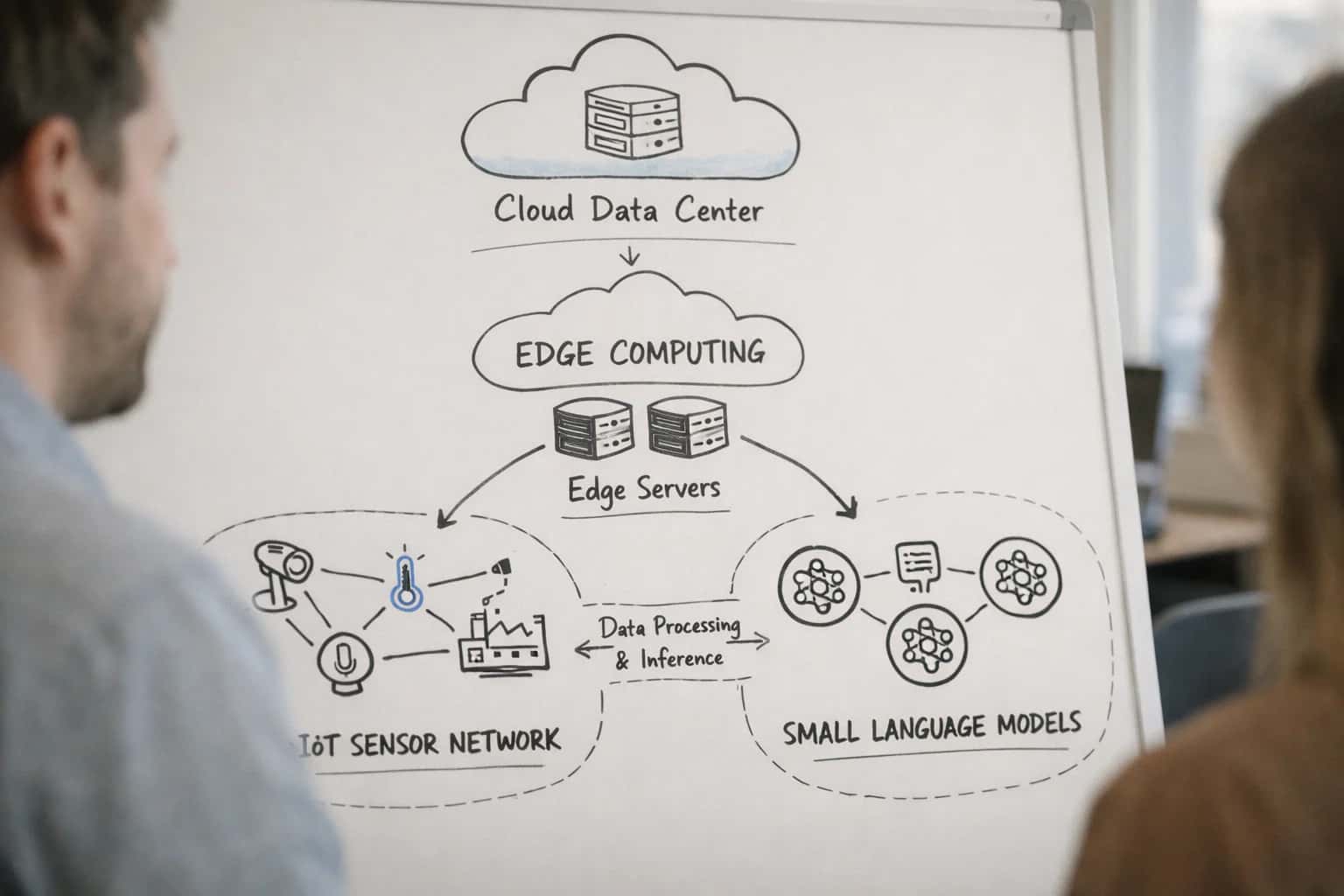
Next-generation networks promise ultra-low latency, but traditional cloud AI creates a critical bottleneck. We integrate Small Language Models (SLMs) directly with Multi-access Edge Computing (MEC) architectures, moving intelligence to the network edge where data is generated.

  • Sub-10ms Inference: Achieve deterministic latency for time-sensitive applications like autonomous vehicle coordination and real-time traffic management.
  • Bandwidth Optimization: Process data locally, reducing backhaul traffic by up to 70% and lowering operational costs.
  • Enhanced Privacy & Sovereignty: Keep sensitive data (e.g., vehicle telemetry, citizen interactions) within the local network edge, supporting compliance with regional data laws.


Deploying intelligence at the edge transforms network infrastructure from a passive pipe into an active, intelligent grid.

Our service delivers:

  • MEC-Integrated SLM Deployment: Seamless integration of optimized models like Phi-3.5 into standard ETSI MEC frameworks.
  • Use-Case Specific Pipelines: Pre-architected solutions for smart city command centers and V2X (Vehicle-to-Everything) communication.
  • End-to-End Lifecycle Management: From model optimization for edge hardware to over-the-air (OTA) updates and performance monitoring across your distributed fleet.

This approach is foundational for applications requiring real-time response, such as those detailed in our guide on Real-Time Edge Language Processing.

Technical Outcomes for Network Operators & OEMs:

  • Reduce AI inference latency by 60-90% compared to cloud-offloaded models.
  • Achieve 99.9% uptime SLA for critical edge AI services with redundant, localized inference.
  • Deploy a pilot edge AI node within 4 weeks, proving value before scaling across the network.

For enterprises building the underlying secure infrastructure, our work in Confidential Computing for AI Workloads ensures data remains protected even at the distributed edge.

MEASURABLE IMPACT

Business Outcomes of 5G/6G Edge AI Deployment

Deploying intelligence at the network edge with 5G/6G MEC architectures delivers concrete operational and financial advantages. Our integration of optimized Small Language Models (SLMs) with Multi-access Edge Computing transforms network latency into a competitive edge.

01

Ultra-Low Latency for Interactive Services

Deploy SLMs directly on 5G/6G Multi-access Edge Computing (MEC) servers to achieve sub-10ms inference latency. This enables real-time applications like autonomous vehicle coordination, interactive AR retail assistants, and live multilingual translation that are impossible with cloud-only architectures.

< 10ms
End-to-End Latency
99.99%
Local Availability
02

Dramatic Reduction in Backhaul Costs

Process data locally at the network edge, eliminating the need to transmit massive volumes of raw sensor and video data to centralized clouds. This reduces 5G core network congestion and can lower bandwidth and egress costs by over 60% for data-intensive applications.

> 60%
Bandwidth Savings
Local
Data Processing
From Proof of Concept to Full-Scale Production

Phased Deployment Timeline & Deliverables

Our structured, milestone-driven approach to deploying SLMs at the 5G/6G network edge ensures predictable outcomes, clear accountability, and rapid time-to-value for ultra-low-latency applications.

PhaseTimelineKey DeliverablesSuccess Metrics

Phase 1: Architecture & Feasibility

2-3 weeks

Network Edge Assessment Report, SLM Model Selection (e.g., Phi-3.5), Initial MEC Integration Design

Validated latency target (<50ms), Defined hardware & bandwidth requirements

Phase 2: Edge-Optimized Model Prep

3-4 weeks

Quantized & Pruned SLM (<500MB), Containerized Inference Engine, Initial Security Hardening

Model achieves target accuracy on edge benchmarks, Inference speed <100ms on target hardware

Phase 3: MEC Integration & Pilot

4-6 weeks

SLM Deployed on Live MEC Node, Pilot Application (e.g., smart traffic analysis), Monitoring Dashboard

Pilot application meets SLA, Latency & uptime validated in live 5G slice

Phase 4: Scaling & Orchestration

3-4 weeks

Multi-Node Deployment Blueprint, Automated CI/CD Pipeline, Centralized Model Management

Orchestration of SLM across 3+ edge nodes, Zero-touch OTA update capability

Phase 5: Production & Optimization

Ongoing

Full Production Deployment, 99.9% Uptime SLA, Performance Optimization Reports, 24/7 Support Handoff

System handles target transaction volume, Continuous cost/performance optimization

MEC-READY AI DEPLOYMENT

Core Technical Capabilities

Our engineering team delivers production-ready AI systems that leverage the ultra-low latency of 5G/6G Multi-access Edge Computing (MEC). We architect solutions that position intelligence at the network edge, enabling real-time applications for smart cities, connected vehicles, and industrial automation.

01

MEC Architecture Integration

We design and deploy AI inference pipelines directly within 5G/6G Multi-access Edge Computing (MEC) nodes. This reduces round-trip latency to <10ms, enabling real-time decision-making for autonomous vehicle coordination and smart city sensor grids. Our integration ensures seamless orchestration between cloud, edge, and on-device compute layers.

< 10ms
Inference Latency
Zero-trust
Network Security
02

Ultra-Low Latency Model Optimization

We specialize in optimizing Small Language Models (SLMs) like Microsoft Phi-3.5 and custom DSLMs for edge hardware within MEC environments. Using techniques such as INT8 quantization and layer pruning, we achieve sub-100ms inference times, which is critical for interactive voice AI and real-time telematics.

< 100ms
SLM Response
70% Smaller
Model Footprint
03

Network-Aware AI Orchestration

Our systems dynamically manage AI workloads across distributed edge nodes based on real-time network conditions, device availability, and data sovereignty requirements. This intelligent orchestration maximizes resource utilization and ensures compliance with data localization mandates, a key consideration for global deployments.

99.95%
Orchestration Uptime
Auto-Scaling
Workload Management
04

Secure Edge-to-Cloud Data Pipelines

We implement encrypted, zero-trust data pipelines for secure model updates, telemetry aggregation, and federated learning parameter exchange between edge nodes and central cloud governance. This architecture is foundational for maintaining data integrity and privacy in regulated industries like healthcare and defense.

E2E Encrypted
All Data Transfers
FIPS 140-2
Compliant Modules
05

Predictive Network Load Balancing

Our AI systems incorporate predictive analytics to forecast traffic spikes and pre-emptively distribute SLM inference loads across available MEC resources. This prevents congestion, maintains quality of service (QoS) for critical applications, and optimizes the total cost of ownership for your edge AI footprint.

40% Reduction
Peak Load Impact
Predictive
QoS Assurance
06

Standards-Compliant Deployment

Our deployment frameworks adhere to ETSI MEC standards and leverage partnerships with major telecom providers. We ensure your edge AI solution is interoperable, future-proof for 6G upgrades, and compliant with evolving regulations like the EU AI Act, reducing long-term integration risk.

ETSI MEC
Standards Based
Vendor Agnostic
Architecture
5G/6G EDGE AI DEPLOYMENT

Our Methodology: From MEC Integration to Fleet Management

A systematic approach to deploying ultra-low-latency AI at the network edge for smart cities and connected vehicles.

Deploy domain-specific intelligence within 2-4 weeks by integrating optimized SLMs directly into your Multi-access Edge Computing (MEC) architecture, bypassing cloud latency for mission-critical applications.

Our end-to-end methodology delivers sub-100ms inference latency for real-time decision-making:

  • Phase 1: MEC Integration & Optimization – We containerize and deploy your Phi-3.5 or custom edge-optimized DSLM onto telco-grade MEC servers, ensuring seamless integration with 5G Core network functions and UPF traffic routing.
  • Phase 2: Real-Time Pipeline Engineering – Build robust, low-latency data pipelines that process IoT sensor streams, live video, and V2X communications directly at the edge, feeding your SLM for instant analysis.
  • Phase 3: Fleet Management & Orchestration – Implement a centralized platform for over-the-air (OTA) updates, performance monitoring, and security patching across thousands of distributed edge nodes, ensuring 99.9% operational uptime.

This architecture is foundational for smart city traffic management and connected vehicle platooning, where cloud round-trip delay is unacceptable. For isolated environments, explore our disconnected edge AI deployment services.

Outcome: Achieve deterministic, <50ms edge-to-application response times, reduce bandwidth costs by 60-80%, and maintain full data sovereignty—critical for compliance with regional data regulations. Move from concept to scaled fleet in under 90 days.

5G/6G Network Integration

Frequently Asked Questions on Edge AI Deployment

Get specific answers on timelines, costs, and technical requirements for deploying Small Language Models (SLMs) at the 5G/6G network edge.

A standard deployment for a Small Language Model (SLM) on a Multi-access Edge Computing (MEC) platform takes 2-4 weeks from finalized architecture to production-ready inference. This includes hardware-aware model optimization, integration with the 5G core network, and initial load testing. Complex multi-site rollouts or custom hardware integration can extend to 6-8 weeks. We provide a detailed project plan during the discovery phase.

Prasad Kumkar

About the author

Prasad Kumkar

CEO & MD, Inference Systems

Prasad Kumkar is the CEO & MD of Inference Systems and writes about AI systems architecture, LLM infrastructure, model serving, evaluation, and production deployment. Over 5+ years, he has worked across computer vision models, L5 autonomous vehicle systems, and LLM research, with a focus on taking complex AI ideas into real-world engineering systems.

His work and writing cover AI systems, large language models, AI agents, multimodal systems, autonomous systems, inference optimization, RAG, evaluation, and production AI engineering.


