Ensure continuous intelligence and automation in offshore rigs, remote mining sites, or secure facilities where cloud access is impossible or prohibited.

Service
Disconnected Edge AI Deployment
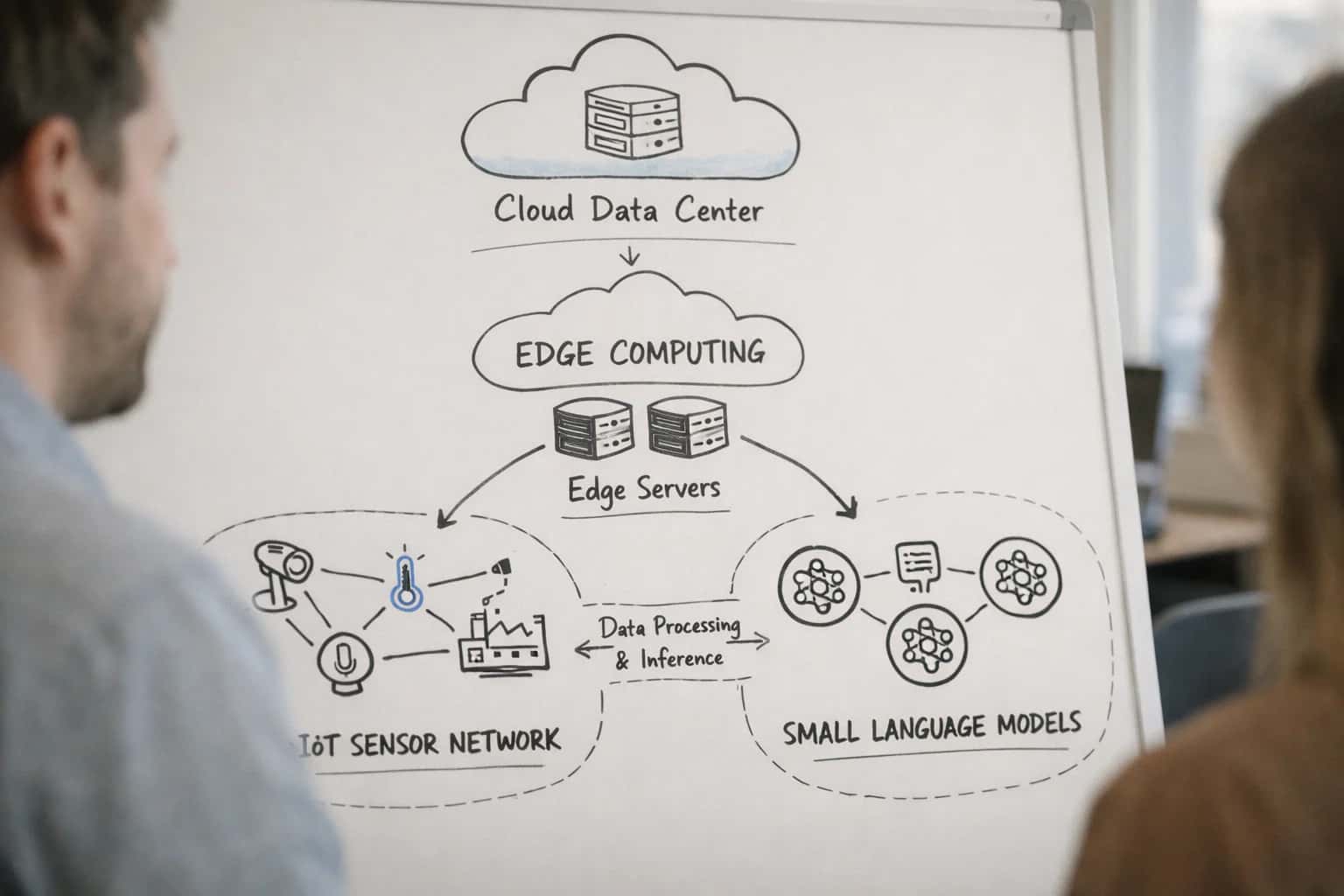
Architecture and deployment of SLM systems for environments with intermittent or no connectivity, including robust local inference, secure data caching, and sync strategies.
DISCONNECTED OPERATIONS
AI That Works Where the Network Doesn't
Deploy resilient, domain-specific AI that operates with zero connectivity in remote or secure environments.
Our disconnected edge AI deployment delivers:
- Local inference engines that run
Phi-3.5or custom Domain-Specific Language Models (DSLMs) directly on ruggedized hardware. - Secure data caching & sync strategies for intermittent connectivity, ensuring operational data integrity.
- 99.9% uptime SLAs for critical processes, eliminating dependency on unstable satellite or cellular links.
- Air-gapped security protocols aligned with defense and industrial standards, preventing data exfiltration.
Move beyond basic IoT to true operational autonomy. We architect systems for:
- Predictive maintenance on remote assets using local sensor telemetry and NLP on maintenance logs.
- Procedural guidance for field technicians via on-device voice assistants, accessing local knowledge bases.
- Real-time anomaly detection and alerting, processed entirely at the edge to enable immediate response.
This capability is a core component of our broader Small Language Model (SLM) Edge Deployment services, which also include on-device SLM integration and edge-optimized DSLM development. For environments requiring absolute data sovereignty, explore our Sovereign AI Infrastructure Development pillar.
OPERATIONAL RESILIENCE
Business Outcomes of Deploying Offline AI
Deploying AI models that operate independently of cloud connectivity delivers tangible, measurable advantages. These outcomes directly impact operational continuity, cost efficiency, and security for enterprises in remote, mobile, or sensitive environments.
01
Guaranteed Operational Continuity
Eliminate downtime due to network outages or latency. Our disconnected edge AI systems provide deterministic, sub-100ms inference locally, ensuring critical processes in remote industrial sites, maritime operations, or defense applications continue uninterrupted. This architecture is a core component of our Sovereign AI Infrastructure Development services for air-gapped environments.
100%
Local Availability
< 100ms
Inference Latency
02
Drastically Reduced Data Egress Costs
Process terabytes of sensor, image, and log data directly at the source. By avoiding continuous cloud data transfer, you eliminate unpredictable egress fees and bandwidth bottlenecks, achieving predictable operational expenditure. This cost optimization principle is also applied in our AI Supercomputing and Hybrid Cloud Architecture services.
90%+
Bandwidth Reduction
$0
Cloud Egress
03
Enhanced Data Privacy & Sovereignty
Keep sensitive data—patient records, proprietary designs, geospatial intelligence—physically contained within your controlled environment. Local inference ensures raw data never leaves the device or premise, aligning with stringent regulations like the EU AI Act. For the highest security tier, explore our Confidential Computing for AI Workloads offerings.
Zero
Data Transmission
On-Prem
Data Processing
04
Predictable, Scalable Total Cost of Ownership
Move from variable, usage-based cloud AI costs to a fixed, scalable capex model. Deploy optimized models like Phi-3.5 on standardized edge hardware, enabling you to scale intelligence by adding units with linear, predictable costs, avoiding cloud vendor lock-in.
60-80%
vs. Cloud TCO
Linear
Scaling Cost
05
Real-Time Decision Autonomy
Enable autonomous systems—robotics, drones, vehicles—to make intelligent decisions in real-time without round-trip cloud dependency. This is critical for applications requiring immediate response, such as obstacle avoidance or real-time quality inspection, a capability extended in our Physical AI and Industrial Robotics Integration work.
Real-Time
Decision Loop
No Network
Dependency
06
Simplified Compliance & Audit Trail
Maintain a clear, verifiable chain of custody for data and AI decisions. With processing confined to specific hardware in defined jurisdictions, demonstrating compliance with regional data laws (e.g., GDPR, China's DSL) becomes straightforward, reducing legal and audit overhead.
Localized
Data Jurisdiction
Hardened
Audit Trail
From Architecture to Operational Handoff
Typical Deployment Timeline and Deliverables
A clear breakdown of the phased engagement for a disconnected edge AI deployment, outlining key activities, responsibilities, and deliverables at each stage to ensure a predictable, low-risk implementation.
| Phase & Timeline | Key Activities | Inference Systems Deliverables | Client Responsibilities |
|---|---|---|---|
Phase 1: Discovery & Architecture (1-2 Weeks) | Requirements analysis, connectivity assessment, hardware evaluation, security review. | Technical architecture document, hardware specification list, risk mitigation plan. | Provide access to subject matter experts, existing system documentation, and target environment details. |
Phase 2: Model Optimization & Prototyping (2-3 Weeks) | SLM selection/adaptation, model quantization & compression, local inference pipeline development, initial sync logic. | Optimized, containerized model artifact, prototype application with core inference, initial performance benchmarks. | Supply domain-specific data for fine-tuning (if applicable), validate prototype functionality against core use cases. |
Phase 3: Core System Development (3-4 Weeks) | Robust local inference engine, secure data caching layer, encrypted sync agent, deployment automation scripts. | Deployment-ready software package, comprehensive system documentation, integration test suite. | Provide staging environment (if available), begin internal security review of code and architecture. |
Phase 4: Pilot Deployment & Validation (2-3 Weeks) | Deploy to pilot devices, conduct field testing, monitor stability and performance, validate sync under simulated disconnect. | Pilot deployment report with metrics (latency, accuracy, battery impact), updated configuration guides, issue log. | Manage pilot device logistics, assign operational testers, provide feedback on user experience and edge cases. |
Phase 5: Production Rollout & Handoff (1-2 Weeks) | Finalize deployment packages, conduct knowledge transfer sessions, establish monitoring dashboards. | Final production artifacts, operational runbooks, monitoring dashboard access, 30-day post-launch support period. | Execute full-scale deployment to edge fleet, train internal ops team, assume ownership of ongoing monitoring. |
Total Project Timeline | 9-14 Weeks | ||
Ongoing Support Options | Available as SLA: Monitoring, OTA Updates, Incident Response | Optional retainers for model updates, fleet expansion, or performance tuning. |
PROVEN DEPLOYMENTS
Industries and Applications We Serve
Our disconnected edge AI deployment architecture delivers resilient, low-latency intelligence for mission-critical operations where connectivity is unreliable or prohibited. We engineer systems that operate autonomously, ensuring continuous functionality and data sovereignty.
01
Remote Industrial & Mining Operations
Deploy SLMs on ruggedized edge hardware for real-time equipment diagnostics, safety protocol validation, and procedural guidance from PDF manuals—all without cloud dependency. Secures proprietary operational data on-site.
Learn more about our approach to Industrial IoT NLP.
< 100ms
Local Inference
Zero egress
Data Sovereignty
02
Defense & Field Intelligence
Architect air-gapped, tamper-proof SLM systems for secure communications, document analysis, and situational awareness in contested environments. Implements hardware-based secure boot and encrypted model storage.
Our security methodology extends to Confidential Computing for AI Workloads.
Air-gapped
Deployment
FIPS 140-2
Compliance
03
Maritime & Offshore Logistics
Enable autonomous vessel monitoring, cargo manifest processing, and crew assistance via offline-capable SLMs deployed on shipboard servers. Systems feature robust data caching and sync strategies for port visits.
30+ days
Offline Operation
Local RAG
Knowledge Base
04
Agriculture & Smart Farming
Integrate SLMs into field gateways and autonomous machinery for real-time pest identification, yield prediction from local sensor data, and offline access to agronomic research, overcoming rural connectivity challenges.
Explore our broader Agri-Tech AI Development capabilities.
On-device
Vision Models
Local Sync
Data Aggregation
05
Retail & In-Store Automation
Power mobile-first, offline SLMs for associates providing personalized product recommendations, inventory lookup, and complex policy guidance without relying on store Wi-Fi, ensuring uninterrupted customer service.
< 2 sec
Query Response
On-device
Customer Data
06
Healthcare in Low-Connectivity Regions
Deploy medically-tuned DSLMs on portable diagnostic devices and clinic servers for patient triage support, medical literature retrieval, and administrative documentation where internet access is intermittent or insecure.
HIPAA-compliant
Local Data
Phi-3.5 Mini
Optimized Model
Enabling Efficiency, Speed & Accuracy
Intelligent Analysis, Decision & Execution
We build AI systems for teams that need search across company data, workflow automation across tools, or AI features inside products and internal software.
Talk to Us
Search across company data
Give teams answers from docs, tickets, runbooks, and product data with sources and permissions.
Useful when people spend too long searching or get different answers from different systems.
Enterprise searchRAGPermissions
Read more
Automate internal workflows
Use AI to route work, draft outputs, trigger actions, and keep approvals and logs in place.
Useful when repetitive work moves across multiple tools and teams.
AI agentsWorkflow automationGovernance
Read more
Add AI to products and internal tools
Build assistants, guided actions, or decision support into the software your team or customers already use.
Useful when AI needs to be part of the product, not a separate tool.
AI integrationDecision supportModel routing
Read moreTechnical Implementation
Disconnected Edge AI Deployment FAQs
Common questions about deploying and managing small language models in environments with limited or no internet connectivity.
A standard deployment, from architecture design to field deployment, typically takes 2-4 weeks. This includes hardware assessment, model optimization for the target environment, and integration with local data caching systems. Complex multi-site rollouts or custom hardware integration can extend to 6-8 weeks. We provide a detailed project plan within the first week of engagement.

About the author
Prasad Kumkar
CEO & MD, Inference Systems
Prasad Kumkar is the CEO & MD of Inference Systems and writes about AI systems architecture, LLM infrastructure, model serving, evaluation, and production deployment. Over 5+ years, he has worked across computer vision models, L5 autonomous vehicle systems, and LLM research, with a focus on taking complex AI ideas into real-world engineering systems.
His work and writing cover AI systems, large language models, AI agents, multimodal systems, autonomous systems, inference optimization, RAG, evaluation, and production AI engineering.
LinkedIn
Limited slotsGet a Free AI Consultation
Partnered with leading AI, data, and software stack.





How We Work
Custom AI workflows for your Business
One-fit-all AI don't work for modern businesses. At Inferensys, we aim to understand your business & custom requirements; which we use to define most efficient agentic workflows, the data, and the tools for your business.
01
Review the use case
We understand the task, the users, and where AI can actually help.
Read more02
Pick the right approach
We define what needs search, automation, or product integration.
Read more03
Build the first useful version
We implement the part that proves the value first.
Read more04
Improve from there
We add the checks and visibility needed to keep it useful.
Read moreThe first call is a practical review of your use case and the right next step.
Talk to Us