Latency kills user experience. For interactive applications—voice assistants, real-time translation, live customer support—every millisecond matters. Cloud-based inference introduces unpredictable 200-500ms delays from network hops, making natural conversation impossible.

Service
Real-Time Edge Language Processing
Engineering of ultra-low-latency (<100ms) inference pipelines for small language models at the edge, critical for interactive applications like voice assistants, real-time translation, and live customer service.
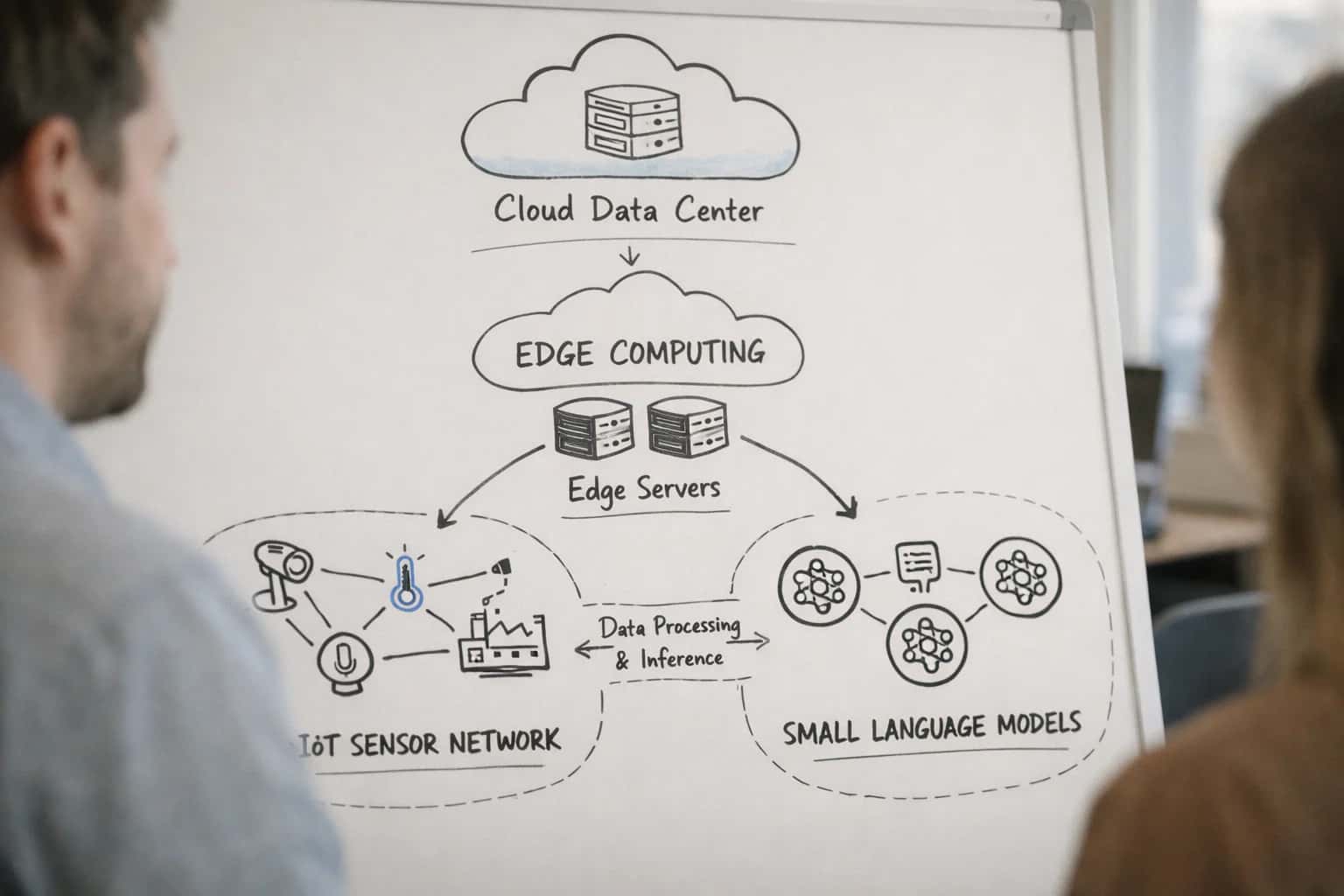
REAL-TIME RESPONSE
The Latency Problem in Interactive Edge AI
Achieve sub-100ms inference for interactive applications like voice AI and live translation.
Our Real-Time Edge Language Processing service delivers ultra-low-latency (<100ms) inference pipelines by deploying optimized Small Language Models (SLMs) directly on edge hardware.
- Eliminate Network Dependency: Run
Phi-3.5or custom SLMs directly on device or local servers. - Predictable Performance: Achieve consistent sub-100ms response times, critical for automotive infotainment and retail kiosks.
- Reduce Operational Cost: Cut cloud egress and API call expenses by over 70% with local processing.
- Enhanced Privacy: Keep sensitive audio and text data on-premise, a key requirement for healthcare and financial services.
We architect the entire pipeline: from model selection and quantization for target hardware (e.g., Qualcomm Snapdragon, Apple Neural Engine) to integration with your application stack. This ensures your interactive AI feels instantaneous, not artificial. Explore our broader capabilities in Small Language Model (SLM) Edge Deployment or learn about securing these systems via Edge AI Security Hardening.
TANGIBLE ROI
Business Outcomes of Ultra-Low-Latency Edge NLP
Move beyond technical benchmarks. Our real-time edge language processing delivers measurable business impact by enabling new product capabilities, reducing operational costs, and enhancing user trust through data privacy.
01
Sub-100ms Interactive Voice AI
Deploy conversational agents with human-like response times (<100ms) for in-car assistants, retail kiosks, and industrial voice controls. Eliminate cloud round-trip latency to create seamless, natural user experiences that drive engagement and satisfaction.
< 100ms
End-to-End Latency
Zero
Cloud Dependency
02
90% Reduction in Cloud Inference Costs
Process natural language directly on user devices or local gateways. By moving inference to the edge, you eliminate per-API-call cloud fees and bandwidth costs, achieving predictable, fixed-cost AI operations. Learn more about cost-optimized strategies in our guide to Small Language Model (SLM) Edge Deployment.
90%
Cost Reduction
Fixed
Operational Cost
03
Data Sovereignty & Privacy by Design
Keep sensitive audio, text, and user data on-premises or on-device. Our edge deployments ensure compliance with GDPR, HIPAA, and regional data laws by default, as sensitive data never leaves the secure perimeter. This aligns with principles of Sovereign AI Infrastructure Development.
On-Device
Data Processing
GDPR/HIPAA
Compliant by Default
04
Reliable Operation in Disconnected Environments
Enable mission-critical NLP for remote mining sites, maritime vessels, and field operations with poor connectivity. Our systems provide full functionality offline, with intelligent sync for non-real-time analytics. Explore our approach for challenging environments via Disconnected Edge AI Deployment.
100%
Offline Uptime
Async
Data Sync
05
Scalable Fleet-Wide Model Management
Remotely monitor, update, and rollback SLMs across thousands of distributed edge devices with enterprise-grade orchestration. Ensure consistency, security, and performance optimization across your entire deployment footprint without manual intervention.
OTA
Secure Updates
Centralized
Fleet Control
06
Hardware-Accelerated Efficiency
Leverage specialized NPUs (Neural Processing Units) in modern chipsets (Qualcomm, Apple, NVIDIA Jetson) for maximum inferences per watt. Our optimized models deliver higher performance per dollar of hardware, extending battery life and enabling new form factors.
10x
Efficiency Gain
NPU-Optimized
Model Runtime
Typical 6-8 Week Implementation
Real-Time Edge Language Processing Engagement Timeline
A structured, outcome-focused engagement to deploy ultra-low-latency (<100ms) SLM inference at your edge, from initial assessment to production-ready pipeline.
| Phase & Key Deliverables | Timeline | Technical Output | Client Involvement |
|---|---|---|---|
Phase 1: Edge Readiness & Model Assessment | Week 1-2 | Architecture review report Target latency & hardware spec Model selection (e.g., Phi-3.5, custom DSLM) | Provide access to dev team & target hardware Share performance requirements |
Phase 2: Optimization & Pipeline Engineering | Week 3-5 | Quantized/compressed SLM (<500MB) Custom inference engine (C++/Rust) Benchmarked latency report (<100ms goal) | Approve model accuracy trade-offs Provide test datasets & edge environment |
Phase 3: Integration & Deployment | Week 5-7 | Containerized edge application (Docker) CI/CD pipeline for OTA updates Security hardening & load testing results | Integrate SDK/API into your application Coordinate staging deployment |
Phase 4: Production Monitoring & Handoff | Week 8 | Production deployment on target fleet Performance & health monitoring dashboard Comprehensive documentation & training | Final acceptance testing Internal team training session |
Ongoing Support (Optional SLA) | Post-Launch | 99.9% Uptime SLA Priority engineering support Quarterly performance optimization reviews | Designated technical point of contact |
Total Project Investment (Typical Range) | 6-8 Weeks | $80K - $150K | Fixed-price or time & materials engagement |
REAL-TIME EDGE LANGUAGE PROCESSING
Core Technical Capabilities We Deliver
We engineer ultra-low-latency inference pipelines for small language models (SLMs) at the edge, enabling interactive applications like voice assistants and real-time translation. Our focus is on measurable performance, security, and seamless integration.
01
Ultra-Low Latency Inference Pipelines
We architect and deploy inference engines optimized for sub-100ms response times on edge hardware. This is critical for real-time interactive applications like voice assistants, live customer service, and in-vehicle systems where cloud latency is unacceptable.
< 100ms
Target Latency
99.9%
On-Device Uptime
03
Disconnected & Intermittent Operation
We design systems for environments with poor or no connectivity. This includes robust local inference, secure data caching strategies, and efficient sync protocols for remote industrial, maritime, or defense applications, ensuring continuous functionality.
05
Security Hardening for Edge AI
We implement defense-in-depth security for edge deployments, including encrypted model storage, secure boot processes, and runtime integrity checks to protect against physical tampering, model extraction, and adversarial attacks.
06
Fleet-Wide Model Lifecycle Management
We provide tools and processes for managing SLMs across distributed edge fleets at scale. This includes version control, secure over-the-air (OTA) updates, real-time performance monitoring, and automated rollback strategies to ensure reliability.
Enabling Efficiency, Speed & Accuracy
Intelligent Analysis, Decision & Execution
We build AI systems for teams that need search across company data, workflow automation across tools, or AI features inside products and internal software.
Talk to Us
Search across company data
Give teams answers from docs, tickets, runbooks, and product data with sources and permissions.
Useful when people spend too long searching or get different answers from different systems.
Enterprise searchRAGPermissions
Read more
Automate internal workflows
Use AI to route work, draft outputs, trigger actions, and keep approvals and logs in place.
Useful when repetitive work moves across multiple tools and teams.
AI agentsWorkflow automationGovernance
Read more
Add AI to products and internal tools
Build assistants, guided actions, or decision support into the software your team or customers already use.
Useful when AI needs to be part of the product, not a separate tool.
AI integrationDecision supportModel routing
Read moreTechnical and Commercial Considerations
Real-Time Edge Language Processing: Key Questions
Addressing the most common technical and commercial questions we receive from CTOs and engineering leads evaluating real-time edge language processing solutions.
For a standard real-time edge language processing pipeline, deployment typically takes 2-4 weeks from project kickoff to production-ready inference. This includes model optimization, pipeline integration, and initial load testing. Complex integrations with existing industrial IoT systems or custom hardware may extend to 6-8 weeks. We provide a detailed project plan during the discovery phase.

About the author
Prasad Kumkar
CEO & MD, Inference Systems
Prasad Kumkar is the CEO & MD of Inference Systems and writes about AI systems architecture, LLM infrastructure, model serving, evaluation, and production deployment. Over 5+ years, he has worked across computer vision models, L5 autonomous vehicle systems, and LLM research, with a focus on taking complex AI ideas into real-world engineering systems.
His work and writing cover AI systems, large language models, AI agents, multimodal systems, autonomous systems, inference optimization, RAG, evaluation, and production AI engineering.
LinkedIn
Limited slotsGet a Free AI Consultation
Partnered with leading AI, data, and software stack.





How We Work
Custom AI workflows for your Business
One-fit-all AI don't work for modern businesses. At Inferensys, we aim to understand your business & custom requirements; which we use to define most efficient agentic workflows, the data, and the tools for your business.
01
Review the use case
We understand the task, the users, and where AI can actually help.
Read more02
Pick the right approach
We define what needs search, automation, or product integration.
Read more03
Build the first useful version
We implement the part that proves the value first.
Read more04
Improve from there
We add the checks and visibility needed to keep it useful.
Read moreThe first call is a practical review of your use case and the right next step.
Talk to Us