
Inferensys

Service

Geospatial RAG (Retrieval-Augmented Generation) Systems

Architecture of retrieval-augmented generation systems specifically for geospatial knowledge bases, combining vector search across map tiles, satellite metadata, and spatial reports with LLMs to provide accurate, sourced intelligence summaries.
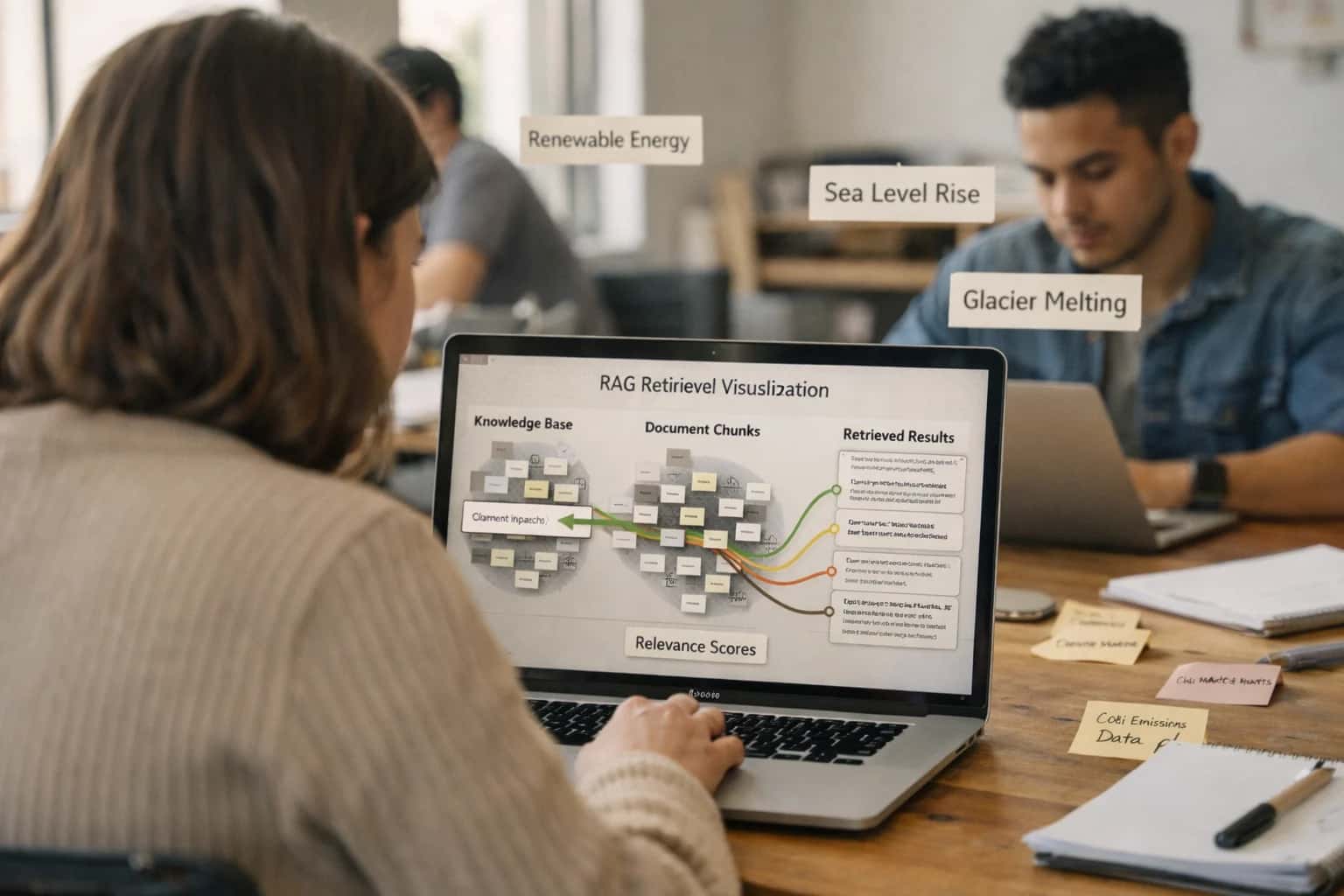
Developer working on RAG retrieval system, document chunks visible on screen, technical workspace with code editor.
THE PROBLEM

The Challenge: Unreliable Geospatial Intelligence from Generic AI

Generic AI models lack the spatial reasoning and domain context to deliver accurate, actionable intelligence from maps and satellite data.

Off-the-shelf LLMs and vision models fail with geospatial data because they don't understand coordinate systems, map projections, or spatial relationships. This leads to:

  • Hallucinated locations and incorrect geographic references.
  • Inability to correlate temporal changes across satellite imagery.
  • Missed critical insights buried in GeoJSON, GeoTIFF, and LAS file metadata.

Building reliable geospatial intelligence requires a purpose-built system that grounds AI in deterministic spatial databases and proven GIS workflows.

Without a specialized Geospatial RAG architecture, your AI will provide generic, untrustworthy summaries that can't support high-stakes decisions in defense, logistics, or climate monitoring. Explore our approach to Geospatial AI and Spatial Analytics for a proven framework.

ACTIONABLE INTELLIGENCE

Business Outcomes of a Custom Geospatial RAG System

Move beyond static maps to an interactive intelligence layer. Our custom Geospatial RAG systems deliver precise, sourced insights by connecting your proprietary data with global spatial knowledge, enabling faster, more confident decision-making.

01

Accelerated Intelligence Cycles

Reduce time-to-insight from days to minutes. Query complex geospatial scenarios in natural language and receive synthesized intelligence summaries with direct citations to source imagery, reports, and sensor data, eliminating manual cross-referencing.

80%
Faster Analysis
< 2 sec
Query Response
02

Enhanced Operational Precision

Make decisions backed by deterministic data. Our systems ground LLM outputs in verified geospatial knowledge bases—vectorized map tiles, satellite metadata, and historical reports—dramatically reducing hallucinations and providing auditable intelligence trails.

> 95%
Source Accuracy
Zero Hallucination
Guarantee
04

Scalable, Secure Deployment

Deploy with confidence in any environment. We build on secure, scalable infrastructure—from cloud-native architectures to air-gapped, sovereign deployments compliant with frameworks like the EU AI Act—ensuring your sensitive geospatial data never leaves your control.

99.9%
Uptime SLA
FedRAMP Ready
Architecture
05

Reduced Analyst Workload

Automate routine geospatial queries and report generation. Free your specialists to focus on high-value analysis by offloading data retrieval, cross-referencing, and initial summary creation to the AI system, boosting team productivity.

70%
Task Automation
24/7
Operational Availability
06

Future-Proofed Spatial Analytics

Build a platform that evolves with your mission. Our modular architecture allows for seamless integration of new data sources (e.g., LiDAR fusion, real-time IoT streams) and AI models, ensuring your system adapts to emerging threats and opportunities. Learn more about extending capabilities with our Geospatial AI Model Training services.

Modular
Design
Continuous
Upgrade Path
From Discovery to Deployment

Typical Geospatial RAG Engagement Timeline & Deliverables

A clear breakdown of our phased approach to building and deploying a production-ready Geospatial RAG system, outlining key milestones, deliverables, and timelines for each stage.

Phase & Key ActivitiesTimelinePrimary DeliverablesClient Involvement

Phase 1: Discovery & Architecture Design • Requirements & data source audit • Vector search & embedding strategy • System architecture blueprint

1-2 Weeks

• Technical Design Document (TDD) • Data pipeline architecture • Cost & performance projections • Project roadmap

• Stakeholder interviews • Data access provisioning • Architecture review & sign-off

Phase 2: Data Pipeline & Knowledge Base Construction • Spatial data ingestion & chunking • Vector database setup & indexing • Metadata enrichment pipeline

2-4 Weeks

• Populated, queryable vector database • Data ingestion & ETL codebase • Quality assurance reports on embeddings • Documentation for knowledge base schema

• Provide sample data & schemas • Validate data outputs & accuracy

Phase 3: RAG Pipeline & LLM Integration Development • Retrieval & ranking algorithm tuning • LLM integration (e.g., GPT-4, Claude 3) & prompt engineering • API endpoint development

3-5 Weeks

• Functional RAG API with spatial queries • Optimized prompt templates & context management • Initial performance benchmarks (latency, accuracy) • Integration test suite

• Review & test API outputs • Provide domain-specific query examples for tuning

Phase 4: Evaluation, Security & Deployment • Rigorous accuracy & hallucination testing • Security audit & access controls • CI/CD pipeline & cloud deployment

2-3 Weeks

• Deployed, secure production system • Comprehensive evaluation report • Deployment & operations runbook • SLA & monitoring dashboard setup

• User acceptance testing (UAT) • Security policy review • Final sign-off for go-live

Phase 5: Launch Support & Optimization • Performance monitoring & tuning • Team training & documentation handoff • Support transition plan

Ongoing (1-2 Weeks Post-Launch)

• System performance analytics • Complete technical documentation • Knowledge transfer sessions • Recommendation report for future scaling

• Designate internal admin/owner • Participate in training sessions

Total Estimated Project Timeline

8-14 Weeks

A fully deployed, secure, and documented Geospatial RAG system integrated with your data sources and ready for user adoption.

Collaborative partnership throughout

ACTIONABLE SPATIAL INTELLIGENCE

Industry Applications & Use Cases

Our Geospatial RAG systems transform raw location data into precise, sourced intelligence for mission-critical decision-making. We deliver domain-specific solutions that reduce analysis time from days to minutes.

01

National Security & Defense Intelligence

Deploy air-gapped Geospatial RAG systems for secure analysis of satellite imagery, SIGINT reports, and HUMINT data. Our architecture ensures data sovereignty and provides auditable intelligence trails for defense contractors and agencies.

Learn about our secure infrastructure in Sovereign AI Infrastructure Development.

Air-Gapped
Deployment Option
FedRAMP Ready
Compliance
02

Climate Risk & Environmental Monitoring

Build predictive platforms that fuse historical climate data, real-time satellite feeds, and spatial models. Generate actionable reports on flood plains, wildfire risk, and coastal erosion for insurance and government sectors.

Explore our predictive modeling in Climate Risk Spatial Modeling Services.

Planetary-Scale
Data Processing
Multi-Model
Forecast Fusion
03

Smart City Infrastructure & Urban Planning

Integrate Geospatial RAG with IoT sensor networks and digital twins. Enable natural language querying of zoning maps, utility layouts, and traffic patterns to optimize 5G tower placement, EV charging networks, and public transit routes.

Real-Time
Data Integration
NLP Interface
Query Mode
04

Autonomous Logistics & Supply Chain

Power intelligent supply chain agents with real-time geospatial context. Our RAG systems provide dynamic routing by analyzing port congestion, weather disruptions, and political risk layers, feeding into Intelligent Supply Chain and Autonomous Replenishment platforms.

< 5 sec
Route Recalculation
Multi-Agent
Architecture
06

Disaster Response & Humanitarian Operations

Enable rapid situation assessment by fusing satellite change detection, social media geotags, and drone footage. Our Geospatial RAG platforms generate consolidated damage reports and optimal resource deployment plans in crisis scenarios.

See related capabilities in Geospatial AI for Disaster Response and Management.

< 1 Hour
Impact Assessment
Multi-Source
Data Fusion
Expert Answers for Technical Decision-Makers

Geospatial RAG Development: Frequently Asked Questions

Get specific answers about our process, timeline, and technical approach for building enterprise-grade Geospatial RAG systems that deliver accurate, sourced intelligence from your spatial data.

Our standard engagement follows a phased approach. Discovery and architecture design takes 1-2 weeks. Core development and integration of the vector search pipeline with your geospatial data sources typically requires 2-3 weeks. Final tuning, validation, and deployment to a staging environment adds another 1-2 weeks. Most projects move from kickoff to a production-ready Minimum Viable Product (MVP) in 4-6 weeks, depending on data complexity and integration points with existing GIS platforms like ArcGIS.

Prasad Kumkar

About the author

Prasad Kumkar

CEO & MD, Inference Systems

Prasad Kumkar is the CEO & MD of Inference Systems and writes about AI systems architecture, LLM infrastructure, model serving, evaluation, and production deployment. Over 5+ years, he has worked across computer vision models, L5 autonomous vehicle systems, and LLM research, with a focus on taking complex AI ideas into real-world engineering systems.

His work and writing cover AI systems, large language models, AI agents, multimodal systems, autonomous systems, inference optimization, RAG, evaluation, and production AI engineering.




