Box webhooks (POST /webhooks) let you subscribe to events like FILE.UPLOADED, FILE.PREVIEWED, or FILE.DOWNLOADED. When a file lands in a monitored folder, Box sends a payload with the file_id, event_type, and source. Your integration service catches this event, uses the file_id to fetch metadata and content via the Box API (GET /files/{id}/content), and passes it to an AI pipeline. This pattern turns Box from a passive repository into an active intelligence layer, where content is analyzed the moment it arrives.

Integration
AI Integration for Box Webhooks
Architect event-driven AI processing for Box using webhooks to trigger real-time content analysis, translation, or compliance checks on upload or update.
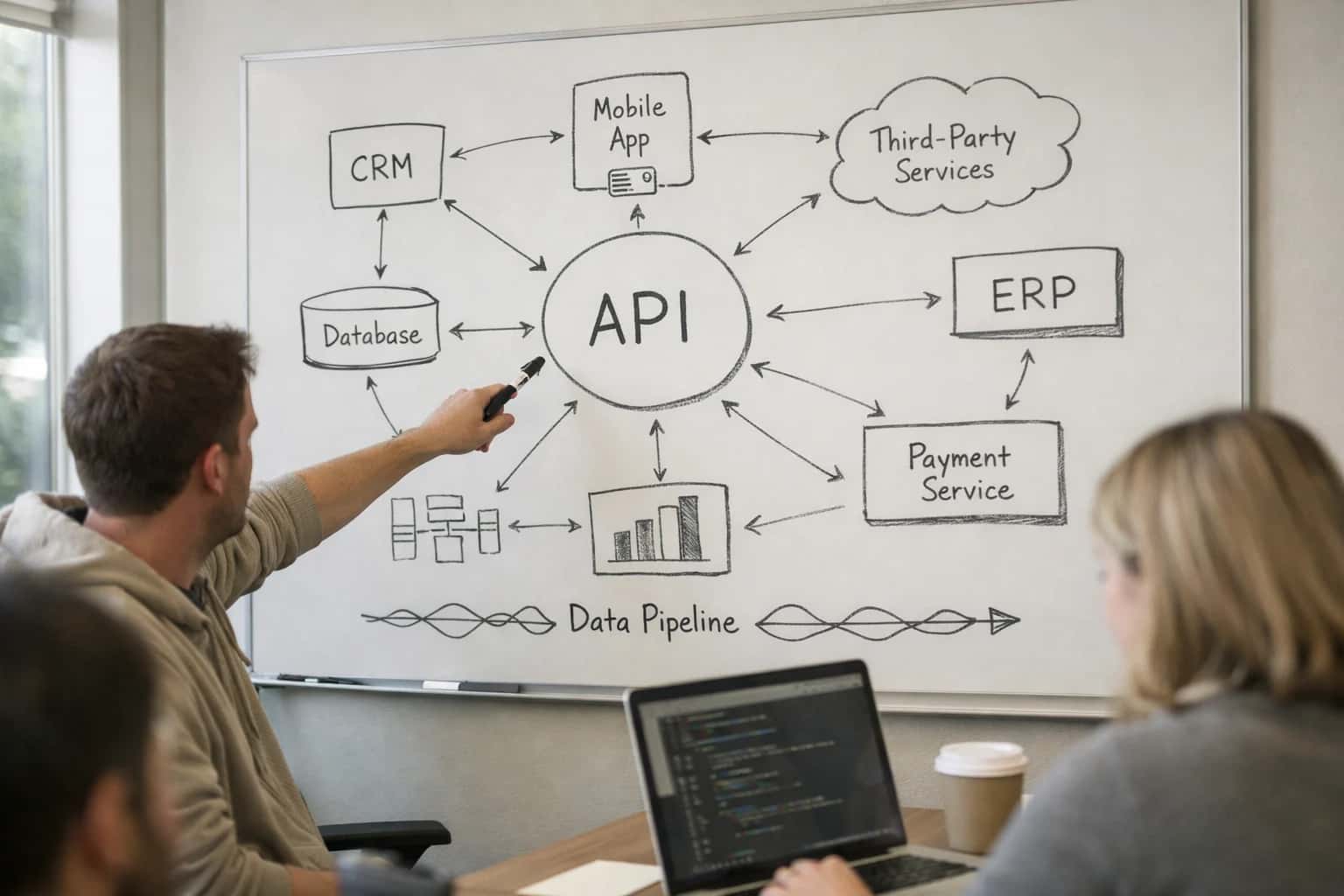
ARCHITECTURE PATTERN
Event-Driven AI for Box Content
Build real-time AI processing into Box using webhooks to trigger content analysis, translation, and compliance checks on upload or update.
High-value workflows include: Automated classification and tagging using an LLM to read the document and apply Box metadata templates for project, department, or document type. Real-time compliance scanning for PII, PCI, or PHI using a dedicated model, triggering a Box Governance policy to apply retention or encryption. On-demand translation for global teams, where a FILE.PREVIEWED event in a regional folder kicks off translation and stores a new version. Contract clause extraction for legal teams, where uploaded agreements are parsed, key obligations are pulled into a structured database, and a summary is appended to the file's description.
Rollout requires a resilient middleware layer. Your service must handle Box's webhook verification, manage API rate limits, and implement idempotency (using the event_id) to avoid duplicate processing. For sensitive data, process files through a secure, VPC-isolated inference endpoint—never stream raw content to public AI APIs. Start with a pilot folder and a single event type, using Box's Event Logs and your own audit trail to monitor accuracy and latency before scaling. This architecture keeps Box as the system of record while adding an event-driven AI cortex that works without manual intervention.
ARCHITECTURE SURFACES
Where AI Connects to Box Webhooks
Core Ingestion Triggers
Box webhooks for FILE.UPLOADED, FILE.PREVIEWED, and FILE.UPDATED are the primary triggers for real-time AI processing. This is where you inject intelligence at the moment of content creation or modification.
Key Integration Points:
- New Contract Uploads: Trigger AI for immediate clause extraction, risk scoring, and metadata tagging before the document enters a review workflow.
- Updated Marketing Assets: When a finalized brochure PDF is replaced, fire an AI job to generate an accessibility summary or extract key messaging for a DAM.
- Supporting Document Updates: In a project folder, an updated
specification.docxcan trigger an AI agent to compare versions, summarize changes, and notify relevant team members via Slack.
Architecturally, your webhook handler should validate the event, fetch the file via the Box API (using a service account with appropriate permissions), and dispatch it to your AI processing queue. Ensure idempotency to handle duplicate webhook deliveries.
EVENT-DRIVEN CONTENT INTELLIGENCE
High-Value AI Use Cases for Box Webhooks
Transform Box from a static file repository into an intelligent, event-driven content hub. Use webhooks to trigger real-time AI processing on upload, update, or download, automating compliance, discovery, and operational workflows.
01
Real-Time Compliance & PII Scanning
Trigger an AI scan on every file upload or update to detect sensitive data (PII, PHI, PCI). Automatically apply classification labels, trigger encryption via Box KeySafe, or move files to a secure folder. Workflow: File Upload → Webhook → AI Model Scan → Apply Box Metadata/Policy → Alert if Violation.
Batch -> Real-time
Policy enforcement
02
Automated Metadata Tagging & Taxonomy
Eliminate manual tagging. Use webhooks to send new documents to an AI service that analyzes content and returns rich, consistent metadata. Automatically populate Box's custom metadata fields and apply terms from your enterprise taxonomy, making search and governance effortless.
1 sprint
To deploy
03
Contract & Agreement Analysis on Sign
Integrate with Box Sign. When an agreement is signed, a webhook triggers AI to extract key clauses, dates, parties, and obligations. The analysis is saved as metadata or a summary note, and obligations can be pushed to a task system like Asana or Salesforce for tracking.
Hours -> Minutes
Obligation discovery
04
Intelligent Workflow Routing in Box Relay
Enhance Box Relay approvals. When a file enters a workflow, AI analyzes its content to intelligently assign tasks, predict bottlenecks, or dynamically adjust the approval path based on extracted values (e.g., invoice amount, contract type).
Same day
Routing accuracy
05
Multilingual Translation & Summarization
Automate global collaboration. On file upload, detect the language and trigger real-time translation to a target language, saving a new version. For large reports, generate a concise executive summary stored as a Box Note, making content immediately accessible.
Batch -> Real-time
Content readiness
06
Custom AI Skills for Media Files
Build domain-specific Box Skills kits. Use webhooks to process video, image, or audio files with custom AI models for transcription, object detection, or sentiment analysis. Results are written back as searchable metadata, turning media libraries into queryable data assets.
Hours -> Minutes
Media indexing
EVENT-DRIVEN PROCESSING PATTERNS
Example AI Workflows Triggered by Box Webhooks
Box webhooks enable real-time AI processing by triggering serverless functions or agents when files are uploaded, updated, or moved. Below are concrete workflows that combine Box events with AI models to automate content intelligence.
Trigger: A .pdf file is uploaded to the /Contracts/Inbound folder.
Context Pulled: The webhook payload provides the file ID. The integration uses the Box API with a service account to:
- Download the file content.
- Fetch existing metadata (like
contract_typecustom field).
AI Action: The file is sent to a configured LLM (e.g., GPT-4, Claude 3) with a system prompt for contract analysis. The model extracts:
- Parties, effective date, termination clauses.
- Key obligations and deadlines.
- A risk score based on non-standard language.
System Update: The extracted data is written back to Box as:
- Structured metadata in the file's custom fields.
- A summary
.txtfile placed in a/Contracts/Summariesfolder. - An entry in a separate compliance tracking system via its API.
Human Review Point: Contracts with a risk score above a defined threshold are automatically moved to a /Contracts/Needs_Review folder and a task is created in the legal team's project management tool.
EVENT-DRIVEN AI FOR BOX
Implementation Architecture: From Webhook to AI and Back
A production-ready blueprint for connecting Box webhooks to AI services for real-time document processing.
A robust integration starts with Box's webhooks API, which sends a JSON payload to your endpoint when a defined event occurs—like FILE.UPLOADED, FILE.PREVIEWED, or FILE.DOWNLOADED. Your architecture needs a secure, scalable webhook receiver (often a serverless function in AWS Lambda, Azure Functions, or Google Cloud Run) that validates the Box signature, parses the event, and initiates an asynchronous job. The payload contains the file_id, event_type, and user context, which your system uses to fetch the file via the Box API (with appropriate service account permissions) for processing.
Once the file is retrieved, the AI processing layer takes over. For a use case like real-time compliance scanning, you might send the document text to a model like GPT-4 or a specialized classifier to check for PII, sensitive keywords, or policy violations. For automatic translation, the content is routed to a translation service, and the output is saved as a new file in a designated Box folder, linked via metadata. The key is designing this layer as a series of idempotent, stateless workers that can be scaled independently. Results—whether extracted metadata, a classification tag, or a generated summary—are written back to the Box file using the metadata or tasks API, or can trigger a downstream Box Relay workflow for human review.
Governance and observability are critical. Each webhook invocation and AI operation should be logged with a correlation ID to an immutable audit trail. Implement circuit breakers and dead-letter queues to handle model API failures or Box API rate limits. For rollout, start with a pilot folder or co-marked user group, using Box's Metadata Templates to structure AI outputs. This event-driven pattern keeps Box as the system of record while injecting intelligence at the moment of action, turning static storage into an active, automated content pipeline. For a deeper look at structuring these serverless functions, see our guide on /integrations/enterprise-content-management-platforms/ai-integration-for-box-api.
ARCHITECTING EVENT-DRIVEN AI WORKFLOWS
Code and Payload Examples
Python Flask Webhook Endpoint
This example shows a secure webhook listener that validates Box signatures, parses events, and routes them to appropriate AI processing queues. It's the foundational entry point for any event-driven architecture.
pythonfrom flask import Flask, request, jsonify import hmac import hashlib import json import os from typing import Dict app = Flask(__name__) BOX_WEBHOOK_PRIMARY_KEY = os.getenv('BOX_WEBHOOK_PRIMARY_KEY') BOX_WEBHOOK_SECONDARY_KEY = os.getenv('BOX_WEBHOOK_SECONDARY_KEY') # Validate Box webhook signature def verify_signature(payload_body: bytes, signature_header: str, key: str) -> bool: digest = hmac.new(key.encode(), payload_body, hashlib.sha256).hexdigest() return hmac.compare_digest(digest, signature_header) @app.route('/webhooks/box', methods=['POST']) def handle_box_webhook(): signature = request.headers.get('BOX-SIGNATURE-PRIMARY', '') secondary_sig = request.headers.get('BOX-SIGNATURE-SECONDARY', '') # Validate with primary key, fallback to secondary if not (verify_signature(request.data, signature, BOX_WEBHOOK_PRIMARY_KEY) or verify_signature(request.data, secondary_sig, BOX_WEBHOOK_SECONDARY_KEY)): return jsonify({'error': 'Invalid signature'}), 401 event = request.json event_type = event.get('trigger') source = event.get('source', {}) # Route based on event type if event_type == 'FILE.UPLOADED': # Send to document processing queue route_to_queue('document_processing', { 'file_id': source.get('id'), 'file_name': source.get('name'), 'event': 'UPLOAD' }) elif event_type == 'FILE.PREVIEWED': # Send to real-time analysis queue route_to_queue('realtime_analysis', { 'file_id': source.get('id'), 'user_id': event.get('created_by', {}).get('id'), 'event': 'PREVIEW' }) return jsonify({'status': 'processed'}), 200 # Helper to route to message queue (e.g., RabbitMQ, SQS) def route_to_queue(queue_name: str, payload: Dict): # Implementation for your message broker print(f"Routing to {queue_name}: {payload}") if __name__ == '__main__': app.run(port=5000)
AI-PROCESSING FOR BOX WEBHOOKS
Realistic Time Savings and Operational Impact
How event-driven AI transforms document workflows triggered by Box uploads and updates, moving from manual oversight to automated, intelligent action.
| Workflow Stage | Before AI (Manual) | After AI (Automated) | Implementation Notes |
|---|---|---|---|
Document Intake & Classification | Manual folder placement or rule-based tagging | AI auto-classifies by type, project, and sensitivity | Uses file content, not just name/extension; human review for edge cases |
Compliance & PII Scan | Scheduled batch scans or manual spot checks | Real-time scan on upload; immediate policy flag | Triggers automated quarantine or alerts; reduces audit prep from days to hours |
Contract/Invoice Data Extraction | Manual data entry or template-based OCR | AI extracts key fields (dates, amounts, parties) on upload | Data validated and pushed to downstream systems (ERP, CRM); 80%+ straight-through rate |
Multilingual Content Handling | Manual identification and routing for translation | AI detects language, auto-translates summaries or full text | Enables global team access; translation workflows shift from days to same-day |
Content Summarization | User reads entire document | AI generates executive summary on upload for quick review | Summary stored as metadata; accelerates triage and knowledge sharing |
Workflow Routing & Assignment | Based on uploader or simple folder rules | AI analyzes content to assign to correct team/queue | Reduces misrouted items; approval cycles shorten from next-day to same-day |
Retention Schedule Application | Manual records declaration or broad policy rules | AI analyzes content to auto-apply correct retention schedule | Ensures defensible disposition; compliance risk review shifts from quarterly to continuous |
ARCHITECTING FOR PRODUCTION
Governance, Security, and Phased Rollout
A secure, governed approach to deploying AI on Box webhooks ensures value without risk.
A production-ready integration for Box webhooks is built on three layers: event ingestion, AI processing, and result persistence. The ingestion layer uses Box's webhook service to push events (e.g., FILE.UPLOADED, FILE.PREVIEWED) to a secure, scalable endpoint. This endpoint should validate the Box signature, authenticate the request, and place the event—containing the file ID and metadata—into a durable queue like Amazon SQS or Azure Service Bus. This decouples the event receipt from processing, ensuring reliability during AI service spikes or outages.
The AI processing layer pulls events from the queue, uses the Box API with appropriate scoped OAuth 2.0 tokens to download file content, and routes it to the appropriate AI service. Critical governance controls here include: RBAC-enforced token usage to limit file access, prompt and model version management to ensure consistent outputs, and audit logging of all AI actions linked to the original Box event. For sensitive data, processing can be configured to use a virtual private cloud (VPC) endpoint for the AI service, ensuring data never traverses the public internet. Results—such as extracted entities, a summary, or a compliance flag—are then written back to Box as file metadata, a comment, or a task, using the same authenticated session.
A phased rollout is essential. Start with a non-critical, high-volume workflow like auto-tagging marketing assets in a specific Box folder. Implement a human-in-the-loop review step where AI suggestions are written to a custom metadata field for manager approval before being applied. This builds trust and provides labeled data for model tuning. Phase two expands to automated actions, like moving files flagged for legal review to a secure folder. Finally, scale to real-time, fully automated workflows like instant translation of support documents, with continuous monitoring for model drift and operational metrics (e.g., latency, error rates) tracked back to the Box webhook source.
This architecture ensures the integration is secure, observable, and adaptable. By using Box's native webhook and API security model, processing in a controlled environment, and rolling out with graduated automation, teams can deploy AI that enhances Box without compromising governance. For related implementation patterns, see our guides on AI Integration for Box Content Classification and AI Integration for Box Governance Automation.
Enabling Efficiency, Speed & Accuracy
Intelligent Analysis, Decision & Execution
We build AI systems for teams that need search across company data, workflow automation across tools, or AI features inside products and internal software.
Talk to Us
Search across company data
Give teams answers from docs, tickets, runbooks, and product data with sources and permissions.
Useful when people spend too long searching or get different answers from different systems.
Enterprise searchRAGPermissions
Read more
Automate internal workflows
Use AI to route work, draft outputs, trigger actions, and keep approvals and logs in place.
Useful when repetitive work moves across multiple tools and teams.
AI agentsWorkflow automationGovernance
Read more
Add AI to products and internal tools
Build assistants, guided actions, or decision support into the software your team or customers already use.
Useful when AI needs to be part of the product, not a separate tool.
AI integrationDecision supportModel routing
Read moreAI INTEGRATION FOR BOX WEBHOOKS
Frequently Asked Questions
Practical questions and workflow examples for architects and developers implementing event-driven AI processing with Box.
A production-ready integration follows an event-driven, serverless pattern to ensure scalability and resilience:
- Event Trigger: A Box webhook is configured for events like
FILE.UPLOADED,FILE.PREVIEWED, orFILE.DOWNLOADED. - Secure Payload Receipt: An HTTPS endpoint (e.g., an Azure Function, AWS Lambda, or Google Cloud Run service) receives and validates the webhook payload using Box’s signature verification.
- Context Enrichment: The service uses the
source.idfrom the payload to call the Box API (with appropriate service account or user impersonation tokens) to fetch the file metadata and content, respecting folder- and file-level permissions. - AI Processing: The file content is sent to an AI service. Common patterns include:
- Classification & Tagging: Using an LLM to analyze the document and apply Box metadata templates.
- Summarization/Translation: Processing the text and saving the result as a new Box comment or a related file.
- Compliance Scan: Checking for PII/PHI and updating the file's classification or triggering a workflow.
- System Update: The results are written back to Box via its API—updating metadata, adding tasks, creating annotations, or moving the file to a governed folder.
- Governance & Observability: All actions are logged, and sensitive operations (e.g., moving a file) can be routed through a human-in-the-loop approval step using a queue like Azure Service Bus or Amazon SQS.

About the author
Prasad Kumkar
CEO & MD, Inference Systems
Prasad Kumkar is the CEO & MD of Inference Systems and writes about AI systems architecture, LLM infrastructure, model serving, evaluation, and production deployment. Over 5+ years, he has worked across computer vision models, L5 autonomous vehicle systems, and LLM research, with a focus on taking complex AI ideas into real-world engineering systems.
His work and writing cover AI systems, large language models, AI agents, multimodal systems, autonomous systems, inference optimization, RAG, evaluation, and production AI engineering.
LinkedIn
Limited slotsGet a Free AI Consultation
Partnered with leading AI, data, and software stack.





How We Work
Custom AI workflows for your Business
One-fit-all AI don't work for modern businesses. At Inferensys, we aim to understand your business & custom requirements; which we use to define most efficient agentic workflows, the data, and the tools for your business.
01
Review the use case
We understand the task, the users, and where AI can actually help.
Read more02
Pick the right approach
We define what needs search, automation, or product integration.
Read more03
Build the first useful version
We implement the part that proves the value first.
Read more04
Improve from there
We add the checks and visibility needed to keep it useful.
Read moreThe first call is a practical review of your use case and the right next step.
Talk to Us