AI integration connects at three primary layers within an ECM system: the ingestion pipeline, the metadata and object model, and the workflow engine. At ingestion, AI acts as a smart gatekeeper, using OCR and LLMs to classify incoming documents (e.g., invoices, contracts, forms) and extract key fields into the platform's native metadata schema—whether that's a SharePoint column, an OnBase keyword, or a Laserfiche index field. This transforms unstructured content into structured, queryable data immediately upon entry.

Integration
AI Integration for Intelligent Document Processing in ECM Platforms
A technical blueprint for building an LLM-powered Intelligent Document Processing (IDP) layer atop enterprise ECM platforms like OpenText, Hyland, Laserfiche, SharePoint, and Box to automate classification, data extraction, and validation.
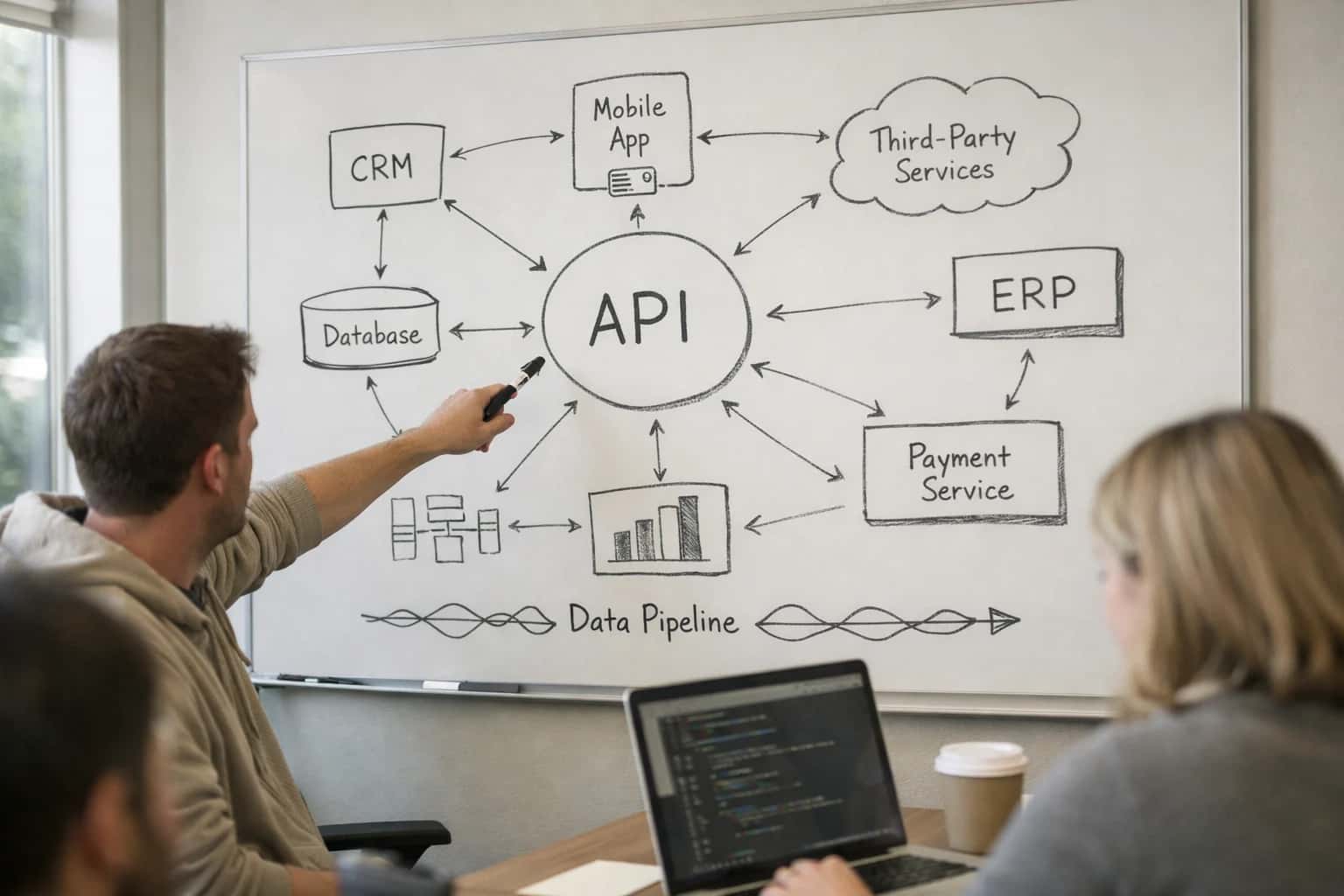
ARCHITECTURE & ROLLOUT
Where AI Fits in Your ECM Document Workflows
A practical blueprint for integrating AI into your Enterprise Content Management platform to automate classification, extraction, and routing.
The real operational impact comes from injecting AI decision points into the workflow engine. Instead of simple rule-based routing (e.g., 'if invoice, send to AP'), AI can read the document to determine urgency, validate extracted data against an ERP, flag exceptions, and assign the task to the correct queue or user. For example, an invoice workflow in OpenText AppWorks or Hyland OnBase can use an AI agent to check line items against a purchase order in SAP, automatically approve a match, or route a discrepancy to a specialist with a pre-populated analysis.
Rollout requires a phased, use-case-driven approach. Start with a high-volume, structured document type (like supplier invoices) to prove the model's accuracy and ROI. Implement a human-in-the-loop review step for low-confidence extractions, logging all AI decisions and corrections back to the ECM's audit trail for model tuning and compliance. Governance is critical: ensure your AI processing respects the ECM's existing security trim and records management policies, and architect the integration to be model-agnostic, allowing you to swap LLM providers or upgrade classifiers without disrupting core document workflows.
ARCHITECTURAL BLUEPOINTS
Integration Touchpoints Across Major ECM Platforms
AI at the Point of Entry
Integrate AI directly into document capture channels—scanners, email ingestion, upload portals, and mobile apps—to classify and pre-process content before it hits the repository. This layer acts as an intelligent gatekeeper.
Key Integration Points:
- Scanning/OCR Services: Augment traditional OCR with LLMs to handle poor-quality scans, handwritten notes, and complex layouts. Post-process OCR output for validation and enrichment.
- Email Ingestions: Use AI to parse email threads, separate attachments, and extract key metadata (sender, subject, intent) to auto-route to correct workflows or folders.
- Bulk Upload APIs: Intercept files via platform APIs (e.g., Box Upload API, SharePoint CSOM) to run immediate AI analysis, applying initial tags and triggering downstream workflows.
Example Workflow: An invoice arrives via email. AI extracts vendor, amount, and PO number, classifies it as Accounts Payable, and routes it to the Hyland OnBase AP workflow queue—all before a human sees it.
INTELLIGENT DOCUMENT PROCESSING
High-Value IDP Use Cases for ECM
Integrate LLMs with OpenText, Hyland, Laserfiche, SharePoint, and Box to automate classification, extraction, and validation, turning static document repositories into active, intelligent data sources.
01
Invoice Processing & AP Automation
Extract line items, vendor details, and totals from diverse invoice formats (PDF, scanned images, email attachments) for automatic GL coding, PO matching, and approval routing in accounts payable workflows. Integrates with ECM's workflow engine to handle exceptions and post validated data to ERP systems like SAP or NetSuite.
Days -> Hours
Processing time
02
Contract Lifecycle Intelligence
Analyze contracts upon ingestion to extract key clauses (termination, liability, SLA), identify parties and dates, and calculate risk scores. Automatically tag and route for legal review, populate a searchable obligation tracker, and trigger renewal workflows. Connects ECM repositories to CLM platforms like Ironclad.
Manual -> Automated
Clause review
03
Regulatory & Audit Document Compliance
Continuously scan document libraries for sensitive data (PII/PHI), required regulatory language, and completeness checks for audit submissions. Automatically apply retention schedules, flag non-compliant documents for review, and generate evidence packages. Ensures policy enforcement across Box, SharePoint, and OpenText archives.
Proactive Detection
Compliance risk
04
Customer Correspondence Triage
Classify and summarize inbound customer letters, emails, and forms stored in ECM case folders. Extract intent, sentiment, and key requests to auto-populate CRM cases (Salesforce, ServiceNow), suggest response templates, and route to the appropriate service queue. Reduces manual triage for front-office teams.
Hours -> Minutes
Case setup
05
Automated Metadata Tagging & Taxonomy Management
Apply AI to analyze document content and context upon ingestion, automatically assigning consistent, rich metadata and taxonomy terms. Reduces manual data entry, improves search precision, and enables dynamic content routing in Hyland OnBase or Laserfiche workflows. Continuously learns and suggests taxonomy improvements.
90%+ Accuracy
Auto-classification
06
Cognitive Search & RAG for Knowledge Repositories
Build a semantic search layer over ECM document libraries (SharePoint, Documentum) using RAG. Enables natural language Q&A, summarizing long manuals, and finding related content across disparate folders. Provides grounded, source-attributed answers to employee and customer queries, powered by a connected vector database.
Keyword -> Semantic
Search relevance
IMPLEMENTATION PATTERNS
Example AI-Powered Document Workflows
These concrete workflows illustrate how LLMs and AI agents connect to ECM platforms like OpenText, Hyland, and SharePoint to automate high-value, high-volume document processes.
Trigger: A new PDF or scanned image is uploaded to a designated 'Inbound Invoices' folder in the ECM system (e.g., OpenText Content Suite, Hyland OnBase).
Context/Data Pulled: The workflow retrieves the document binary and any existing metadata (vendor name from folder path, uploader).
Model/Agent Action: An AI agent processes the document through a multi-step pipeline:
- Classification: Confirms the document is an invoice (not a statement or contract).
- Extraction: Uses a specialized LLM or vision model to extract key fields: Vendor Name & Address, Invoice Number & Date, Line Items (Description, Quantity, Unit Price), Tax Amount, Total Due.
- Validation & Enrichment: Cross-references the vendor name against the ERP's vendor master (via API) to validate and fetch the correct GL coding. Matches line items against open Purchase Orders.
System Update/Next Step: The extracted and validated data is written back to the ECM document's metadata fields. The workflow then:
- Routes the invoice for manager approval if the total exceeds a threshold or if PO matching fails (creating a task in the ECM workflow engine).
- Posts the invoice data directly to the ERP (e.g., SAP, NetSuite) via integration connector for straight-through processing.
Human Review Point: Exceptions (poor scan quality, mismatched totals, new vendors) are flagged and routed to an AP clerk's queue within the ECM interface, with the AI's extracted data and confidence scores presented for easy correction.
A PRODUCTION BLUEPRINT
Implementation Architecture: Building the IDP Layer
A practical guide to architecting a secure, scalable Intelligent Document Processing (IDP) layer for enterprise content management platforms.
A production IDP layer is not a single model but a multi-stage pipeline integrated with your ECM's object model. For platforms like OpenText Content Suite or Hyland OnBase, this typically involves: an ingestion queue (listening to ECM events or scanning designated folders), a pre-processing service (for OCR, image cleanup, and document splitting), a classification engine (using an LLM to tag documents by type, e.g., invoice, contract, application), and an extraction service (using a mix of LLMs and specialized models to pull structured data into a JSON payload). This payload is then posted back to the ECM via its REST API to populate metadata fields, trigger workflows, or create related records.
The critical integration points are the ECM's event system and API layer. For example, in Laserfiche, you configure a Business Process to watch an entry folder and push documents to your IDP service via webhook. In SharePoint, you use Microsoft Graph change notifications to trigger processing. The extracted data must map precisely to the ECM's metadata schema (e.g., SharePoint columns, OnBase document types). Governance is enforced by designing the pipeline to log all decisions, maintain the original document, and route low-confidence extractions to a human-in-the-loop review queue within the ECM's native task management.
Rollout follows a phased, use-case-driven approach. Start with a single, high-volume document type (e.g., vendor invoices in Box or patient intake forms in Hyland Perceptive Content) to validate the architecture and ROI. Implement prompt management and model evaluation frameworks early to handle drift and regulatory changes. The final architecture should be a resilient, API-first service that treats the ECM as the system of record, enabling AI to augment—not replace—existing governance, security, and workflow investments. For a deeper look at connecting this pipeline to specific automation tools, see our guide on AI Integration with SharePoint Power Automate.
IMPLEMENTATION PATTERNS
Code & Payload Patterns
Webhook Handler for Ingested Documents
Most ECM platforms (Box, SharePoint, Laserfiche Cloud) emit webhook events for file uploads or updates. An AI service can subscribe to these events to process documents immediately upon ingestion.
A typical handler receives a JSON payload with file metadata, retrieves the document via the platform's API, processes it with an LLM for classification and extraction, and posts the results back as metadata or triggers a workflow.
Example Payload (Box Event):
json{ "trigger": "FILE.UPLOADED", "source": { "id": "123456789", "type": "file", "name": "invoice_2024_05.pdf", "parent": {"id": "987654321"} }, "webhook": {"id": "abcdef"} }
This pattern enables real-time classification, tagging, and routing, turning static storage into an intelligent processing pipeline.
INTELLIGENT DOCUMENT PROCESSING (IDP)
Realistic Time Savings and Operational Impact
Typical efficiency gains from integrating an AI-powered IDP layer with ECM platforms like OpenText, Hyland, and Laserfiche for classification, extraction, and validation workflows.
| Process | Before AI | After AI | Key Notes |
|---|---|---|---|
Invoice Data Entry | 15-30 minutes per invoice | 2-5 minutes with review | AI extracts line items, PO numbers, and totals; human validates exceptions |
Contract Clause Review | Manual search across documents | Semantic search in seconds | RAG over contract repository finds relevant clauses and obligations |
New Document Classification | Manual folder assignment | Auto-tagged on ingestion | AI applies metadata and triggers correct workflow based on content |
Customer Correspondence Triage | Read and route each email | Priority and topic auto-assigned | Summarizes intent and routes to correct queue or agent |
Regulatory Document Audit Prep | Weeks of manual collection | Days with automated evidence gathering | AI scans repositories for compliance artifacts and generates reports |
Records Retention Application | Periodic manual review | Continuous, risk-based scoring | AI analyzes content and context to apply and trigger retention schedules |
Forms Processing (Variable Layouts) | Manual template setup per form | Handles new layouts without templates | LLMs extract data from semi-structured and handwritten forms |
ARCHITECTING CONTROLLED AI OPERATIONS
Governance, Security, and Phased Rollout
A practical guide to deploying AI for Intelligent Document Processing (IDP) in regulated ECM environments with security, compliance, and iterative risk management.
Production AI integration for ECM platforms like OpenText Content Suite, Hyland OnBase, or SharePoint requires a security-first architecture. This typically involves a middleware layer (e.g., an API gateway or secure queue) that sits between the ECM's REST APIs and the AI service. Ingested documents are processed in a transient, encrypted workspace—never stored in the AI provider's environment—with results (extracted data, classifications) written back as metadata or to a separate audit log. Key controls include role-based access scoped to ECM security trim, payload logging for compliance audits, and prompt injection defenses to maintain data integrity. For on-premises ECMs like Laserfiche or OpenText Documentum, this architecture can be deployed within the corporate network, using private endpoints for cloud AI models or fully local LLMs.
A phased rollout is critical for managing risk and proving value. Start with a contained pilot on a single, high-volume, low-risk document type—such as vendor invoices in an AP workflow or standardized intake forms. Use this phase to validate extraction accuracy, tune prompts for your specific document schemas, and establish a human-in-the-loop review process within the ECM's native workflow engine (e.g., Laserfiche Workflow or Hyland Perceptive Process. Success metrics should be operational: reduction in manual keying hours, faster routing cycle time, or improved first-pass match rate for PO-backed invoices. Subsequent phases can expand to more complex document sets (contracts, clinical notes) and integrate with downstream systems like ERP or CRM via the ECM's connector framework.
Governance is not a one-time setup but an operational practice. Establish a cross-functional AI steering committee with representatives from IT, compliance, legal, and the business process owners. This group should review model performance dashboards, approve expansions to new document classes, and oversee the regular re-evaluation of AI outputs against ground-truth samples to detect drift. For ECMs with strong records management capabilities, such as OpenText Extended ECM or Laserfiche Records Management, leverage their retention and legal hold functions to govern the AI-generated metadata itself, ensuring it is preserved or disposed of in accordance with policy. This layered approach—secure architecture, iterative rollout, and active governance—ensures AI augments your ECM investment without introducing unmanaged risk.
Enabling Efficiency, Speed & Accuracy
Intelligent Analysis, Decision & Execution
We build AI systems for teams that need search across company data, workflow automation across tools, or AI features inside products and internal software.
Talk to Us
Search across company data
Give teams answers from docs, tickets, runbooks, and product data with sources and permissions.
Useful when people spend too long searching or get different answers from different systems.
Enterprise searchRAGPermissions
Read more
Automate internal workflows
Use AI to route work, draft outputs, trigger actions, and keep approvals and logs in place.
Useful when repetitive work moves across multiple tools and teams.
AI agentsWorkflow automationGovernance
Read more
Add AI to products and internal tools
Build assistants, guided actions, or decision support into the software your team or customers already use.
Useful when AI needs to be part of the product, not a separate tool.
AI integrationDecision supportModel routing
Read moreIMPLEMENTATION BLUEPRINTS
Frequently Asked Questions
Practical questions and workflow walkthroughs for integrating AI into OpenText, Hyland, Laserfiche, SharePoint, and Box to automate document processing.
We architect a secure, event-driven integration layer that keeps sensitive documents within your environment.
Typical Pattern:
- Trigger: A document is uploaded or updated in the ECM (e.g., a new invoice arrives in an OpenText Content Server folder).
- Secure Data Handling: The integration uses the ECM's API (with service account RBAC) to fetch only the document's binary/text content. Metadata and permissions remain in the ECM.
- Processing: The content is sent to a dedicated, private Azure OpenAI endpoint or a containerized open-source model deployed in your cloud VNet or data center.
- Result Handling: The AI returns structured JSON (e.g., extracted fields, classification). This payload is posted back to the ECM via API to update metadata fields or is placed in a secure queue (like Azure Service Bus) for a workflow engine to consume.
- Audit: All API calls, document IDs, and processing results are logged to your SIEM. No customer data is retained by external LLM providers.
Key Consideration: For highly regulated data, we deploy models fully on-premises using NVIDIA NIM or Ollama, with no external calls.

About the author
Prasad Kumkar
CEO & MD, Inference Systems
Prasad Kumkar is the CEO & MD of Inference Systems and writes about AI systems architecture, LLM infrastructure, model serving, evaluation, and production deployment. Over 5+ years, he has worked across computer vision models, L5 autonomous vehicle systems, and LLM research, with a focus on taking complex AI ideas into real-world engineering systems.
His work and writing cover AI systems, large language models, AI agents, multimodal systems, autonomous systems, inference optimization, RAG, evaluation, and production AI engineering.
LinkedIn
Limited slotsGet a Free AI Consultation
Partnered with leading AI, data, and software stack.





How We Work
Custom AI workflows for your Business
One-fit-all AI don't work for modern businesses. At Inferensys, we aim to understand your business & custom requirements; which we use to define most efficient agentic workflows, the data, and the tools for your business.
01
Review the use case
We understand the task, the users, and where AI can actually help.
Read more02
Pick the right approach
We define what needs search, automation, or product integration.
Read more03
Build the first useful version
We implement the part that proves the value first.
Read more04
Improve from there
We add the checks and visibility needed to keep it useful.
Read moreThe first call is a practical review of your use case and the right next step.
Talk to Us