The integration connects at two primary surfaces: Procare's Billing Engine API and QuickBooks Online's Journal Entry and Bank Feed APIs. AI agents orchestrate the flow of validated financial events—like posted tuition invoices, processed subsidy payments, and recorded parent payments—from Procare's FamilyAccount, Invoice, and Payment objects into QBO as categorized journal entries. This automation targets the manual, error-prone steps of mapping Procare revenue accounts to QBO classes, splitting multi-child family invoices, and handling complex adjustments for late fees or discounts.

Integration
AI Integration for Procare and QuickBooks Online AI
A technical blueprint for augmenting the Procare-to-QuickBooks Online sync with AI to automate journal entries, reconcile payments, detect anomalies, and generate financial reports, reducing manual bookkeeping by 70-80%.
ARCHITECTURE AND ROLLOUT
Where AI Fits in the Procare-to-QBO Financial Pipeline
A practical blueprint for automating journal entries, payment reconciliation, and financial reporting between Procare and QuickBooks Online.
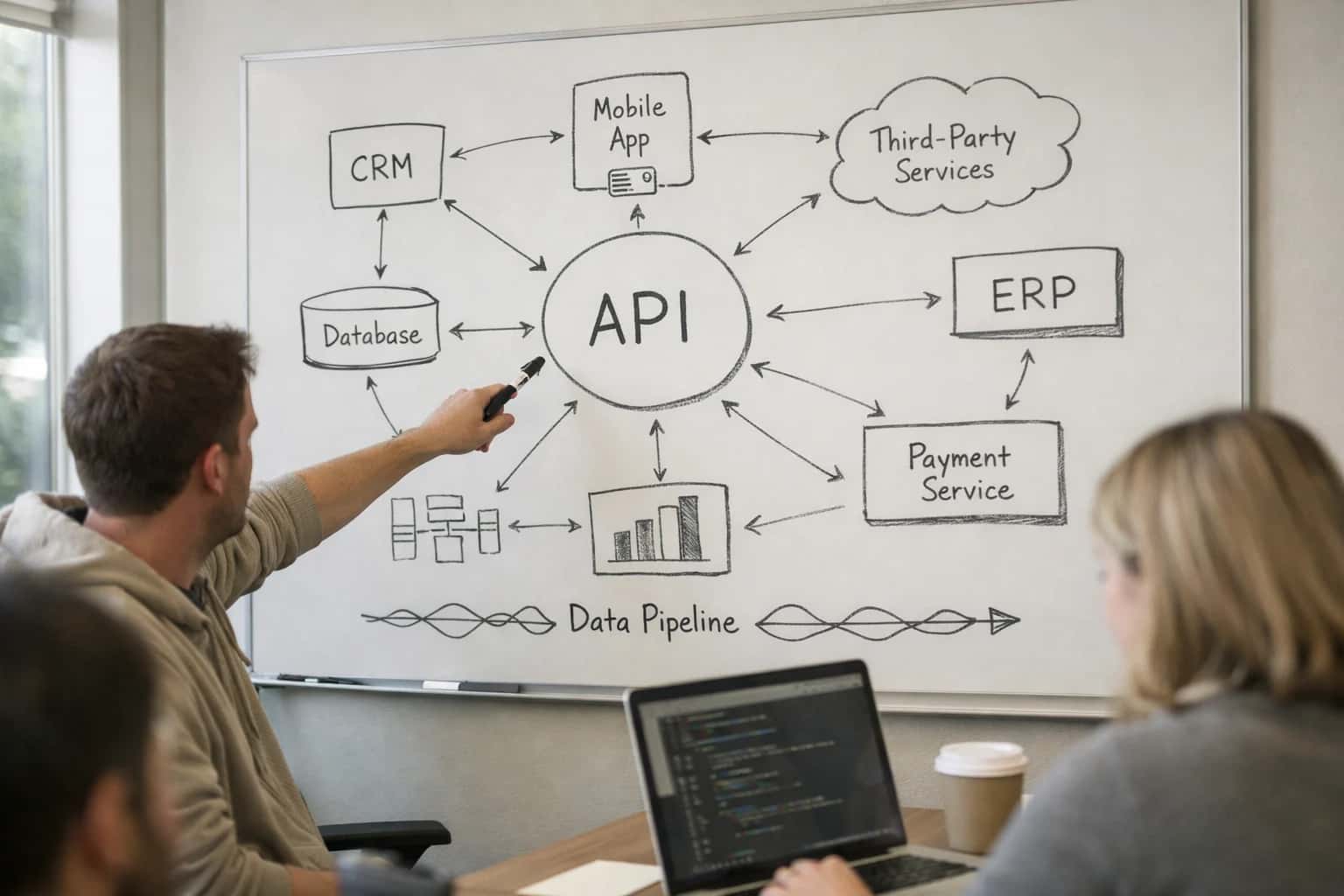
A production implementation uses a queue-based architecture to ensure reliability. Events from Procare webhooks land in a processing queue. An AI agent, with access to both systems' data models and your chart of accounts rules, examines each transaction. It performs tasks like:
- Anomaly Detection: Flagging invoices where the sum of line items doesn't match the total, or payments that don't correspond to an open invoice.
- Intelligent Categorization: Determining the correct QBO account (e.g.,
Tuition Income,Late Fee Income,State Subsidy Receivable) based on Procare's item descriptions and your configured rules. - Context-Aware Reconciliation: Matching bank-deposited amounts from QBO's bank feed to batched Procare payment records, highlighting discrepancies for human review before posting. The result is a reconciled general ledger in QBO, with audit trails back to the source Procare transaction ID, ready for month-end close in hours instead of days.
Rollout should be phased, starting with a single location or a subset of transaction types (e.g., standard tuition invoices). Governance is critical: all AI-proposed journal entries should route through an approval workflow in a tool like n8n or via a dedicated dashboard for the center's bookkeeper before final posting to QBO. This creates a human-in-the-loop control point. Post-implementation, the AI system can be tuned to learn from correction patterns, reducing the need for manual overrides over time. For centers using this integration, we provide the underlying orchestration platform and managed prompts, ensuring the logic adapts to your specific billing policies and state subsidy requirements without requiring internal AI expertise.
AI-AUGMENTED FINANCIAL AUTOMATION
Key Integration Surfaces in Procare and QuickBooks Online
Procare's Billing Module to QBO Invoices
The core integration surface is Procare's billing engine, which calculates tuition, fees, and subsidies based on attendance, schedules, and family agreements. AI augments this by:
- Automating Invoice Generation: Triggering invoice creation in QBO via the QBO API when Procare billing runs are finalized, ensuring GL account mapping is consistent.
- Handling Exceptions: Using AI to flag anomalies like unusual fee adjustments, missing subsidy codes, or invoice amounts that deviate from historical patterns before sync.
- Dynamic Payment Terms: Applying personalized payment terms or installment plans in QBO based on family payment history analyzed by AI.
This creates a closed-loop where Procare is the system of record for childcare charges, and QBO becomes the system of record for the resulting Accounts Receivable, with AI ensuring accuracy and reducing manual review.
AUTOMATED FINANCIAL OPERATIONS
High-Value AI Use Cases for Procare & QBO
Integrating AI between Procare and QuickBooks Online automates the most manual, error-prone financial workflows in childcare management. These use cases focus on turning batch processes into real-time, intelligent operations.
01
Automated Journal Entry Creation
AI monitors Procare's billing engine for posted tuition, fees, and payments. It automatically generates and posts corresponding journal entries to the correct QBO accounts (e.g., Accounts Receivable, Tuition Income, Late Fee Revenue), eliminating manual data entry and reducing month-end close time.
Hours -> Minutes
Close acceleration
02
Intelligent Payment Reconciliation
AI matches incoming bank deposits (from Stripe, ACH, etc.) to open Procare family invoices in QBO. It handles partial payments, applies late fees correctly, and flags mismatches for human review. This turns a daily manual task into an automated, exception-based workflow.
Batch -> Real-time
Reconciliation speed
03
Anomaly Detection in Financial Data
AI continuously analyzes the sync between Procare and QBO, flagging discrepancies like invoice totals that don't match journal amounts, duplicate payments, or unusual subsidy adjustments. This provides proactive audit control and prevents downstream accounting errors.
Proactive Audit
Risk reduction
04
Subsidy & Grant Reporting Automation
For centers managing state subsidies or grants, AI extracts eligible attendance and fee data from Procare, structures it per funder requirements, and generates draft reports or journal allocations in QBO. This ensures compliance and maximizes reimbursement accuracy.
1 Sprint
Report preparation
05
Dynamic AR Collections Support
AI analyzes family payment history and aging reports from the Procare-QBO sync. It triggers personalized, context-aware payment reminders via Procare's messaging APIs and can suggest payment plans for at-risk accounts, improving cash flow without damaging family relationships.
Same day
Collections action
06
Real-Time Financial Dashboard Sync
AI powers a unified financial view by streaming key metrics—daily revenue, outstanding AR, subsidy receivables—from the integrated Procare and QBO data layer to a dashboard like Power BI or Google Looker. This gives directors and owners instant, accurate financial visibility.
Real-time KPIs
Decision support
PRODUCTION-READY AUTOMATIONS
Example AI-Augmented Workflows
These workflows demonstrate how AI agents can automate the most complex and error-prone financial tasks between Procare and QuickBooks Online, moving data from childcare operations to the general ledger with high accuracy and minimal manual intervention.
Trigger: A Procare billing cycle closes, generating finalized tuition, fee, and payment data for a specific period.
Context/Data Pulled: An AI agent is triggered via a Procare webhook or scheduled job. It calls the Procare API to retrieve:
- Aggregated tuition charges by family and classroom.
- Itemized fee data (late pick-up, supply fees, registration).
- Payment records, including method (credit card, ACH, cash, subsidy) and status.
- Family and child data for proper GL coding (e.g., different accounts for infant vs. preschool tuition).
Model or Agent Action: The agent uses a configured rules engine (augmented by an LLM for exception handling) to:
- Map Procare line items to the correct QuickBooks Online accounts (Income, Accounts Receivable, Liability accounts for prepayments).
- Validate totals and identify discrepancies (e.g., payments not summing to charges).
- Generate a structured journal entry payload. For complex cases (e.g., a partial subsidy payment covering multiple children), the LLM reviews the rules and data to propose the correct split.
- Post the journal entry via the QuickBooks Online API.
System Update: The journal is created in QBO with a clear memo referencing the Procare period. The agent logs the transaction ID back to a Procare custom field or an external audit log.
Human Review Point: The system flags any transaction where confidence scores from validation are below a threshold (e.g., a new fee type without a mapping rule) and routes it to the finance manager's dashboard for review before posting.
PRODUCTION-READY INTEGRATION
Implementation Architecture: Data Flow & Guardrails
A secure, auditable architecture for automating financial workflows between Procare and QuickBooks Online.
The integration is built on a synchronization engine that listens for key events in Procare—such as invoice finalization, payment posting, or fee adjustment—via its REST API and webhooks. This engine transforms Procare's billing data (tuition, late fees, subsidies) into standardized journal entry payloads for QuickBooks Online, mapping Procare Family and Child records to QBO Customer and Class tracking categories. Critical financial objects like Invoice, Payment, and Credit Memo are mirrored bidirectionally, with the AI layer acting on the sync queue to classify, reconcile, and flag exceptions before data commits to either system.
AI guardrails are implemented at three control points: 1) Anomaly Detection on invoice amounts or payment matches using historical patterns, 2) Automated Reconciliation for complex scenarios like partial payments or split subsidies, and 3) Human-in-the-Loop Escalation for exceptions exceeding a confidence threshold, routed via Slack or email for review. All data flows are logged with full audit trails, linking Procare transaction IDs to QBO journal entries, ensuring compliance and simplifying month-end close. The system uses a idempotent, retry-with-backoff design to handle API rate limits and temporary outages without creating duplicate records.
Rollout follows a phased approach: starting with a read-only sync for data validation, moving to automated journal entries for cleared payments, and finally enabling predictive actions like dunning communication or late fee waivers. Governance is managed through a central dashboard where finance leads can adjust confidence thresholds, review AI-suggested entries, and monitor sync health. This architecture ensures the financial integrity of both systems while automating a high-volume, error-prone process, turning a manual reconciliation task that takes hours into a monitored, exception-driven workflow.
AI-AUGMENTED FINANCIAL SYNC
Code & Payload Examples
Handling Procare Invoice Events
When a new invoice is created or updated in Procare, a webhook payload is sent to your AI orchestration layer. This handler validates the event, extracts key financial data, and prepares it for AI review and transformation before syncing to QuickBooks Online (QBO).
python# Example: Flask webhook endpoint for Procare invoice events from flask import request, jsonify import logging @app.route('/webhooks/procare/invoice', methods=['POST']) def handle_procare_invoice(): payload = request.json event_type = payload.get('event') invoice_data = payload.get('data', {}) # Validate webhook signature (omitted for brevity) # Extract core fields for AI processing invoice_context = { "invoice_id": invoice_data.get('id'), "family_id": invoice_data.get('familyId'), "child_name": invoice_data.get('childName'), "amount_due": invoice_data.get('amountDue'), "due_date": invoice_data.get('dueDate'), "line_items": invoice_data.get('lineItems', []), # Tuition, fees, late charges "payment_terms": invoice_data.get('paymentTerms') } # Queue for AI review (e.g., anomaly detection, subsidy validation) queue_ai_review_task(invoice_context, event_type) return jsonify({"status": "processing"}), 202
This pattern ensures all financial events are captured for intelligent processing, enabling automated validation and enrichment before the QBO journal entry is created.
PROCARE TO QUICKBOOKS ONLINE FINANCIAL AUTOMATION
Realistic Time Savings and Operational Impact
This table illustrates the tangible operational improvements when AI automates the financial sync between Procare and QuickBooks Online, focusing on accuracy, speed, and staff capacity.
| Financial Workflow | Before AI | After AI | Key Notes |
|---|---|---|---|
Journal Entry Creation | Manual data export, review, and manual QBO entry (30-60 min/day) | Automated, validated entries posted in <5 min | Eliminates transposition errors, ensures daily close |
Payment Reconciliation | Cross-referencing bank feeds with Procare reports (2-3 hrs/week) | AI matches transactions, flags exceptions (20 min/week) | Focus shifts to resolving 5-10% of exceptions vs. 100% manual review |
Subsidy & Discount Application | Manual calculation and separate GL account tracking | AI applies rules from Procare, creates accurate audit trail | Ensures compliance for state/funding reports |
Late Fee Assessment & Invoicing | Manual review of aging reports, individual family adjustments | AI evaluates policy, payment history, auto-generates invoices | Consistent policy application, reduces family disputes |
Month-End Financial Close | Week-long process of aggregation, verification, adjustment | Pre-validated data enables 1-2 day close | Directors gain real-time P&L visibility mid-month |
Audit & Compliance Documentation | Manual compilation of transaction logs and supporting docs | AI auto-generates reconciliation reports and audit trails | Documentation is always current and searchable |
Staff Capacity Reallocation | Office manager/owner tied to repetitive bookkeeping tasks | Staff focus on family financial consultations & strategic planning | Shifts role from data entry to financial advisory |
PRODUCTION-READY FINANCIAL AUTOMATION
Governance, Security, and Phased Rollout
A secure, controlled implementation of AI between Procare and QuickBooks Online demands clear data governance, auditability, and a phased approach to minimize risk.
The integration operates on a zero-trust data principle. AI agents are granted explicit, read-only access to specific Procare objects—Child, Family, Invoice, Payment—and write access only to designated QuickBooks Online entities like JournalEntry and Customer. All API calls are logged with user/service context, and sensitive fields (e.g., full payment card numbers) are masked or excluded from AI processing. Data in transit is encrypted, and prompts are engineered to prevent the injection of raw PII into LLM contexts, using entity IDs and anonymized references instead.
A phased rollout is critical for financial workflows. Phase 1 typically automates the creation of straightforward, validated journal entries for standard tuition payments, running in a dry-run or approval-queue mode for 2-4 weeks. Phase 2 expands to handling payment reconciliations and exception flagging, where the AI suggests matches but requires a human-in-the-loop confirmation for discrepancies over a configurable threshold. Phase 3 introduces automated anomaly detection on billing data (e.g., duplicate invoices, unusual discount patterns) and generates summary financial reports. Each phase includes parallel validation against a sample of manually processed records to ensure accuracy before full automation.
Governance is enforced through role-based access controls (RBAC) in both systems. For instance, only users with the Procare Center Manager and QBO Accountant roles may approve the AI's proposed journal entries. All automated actions create an immutable audit trail in a dedicated log, referencing the source Procare transaction ID, the resulting QBO record ID, the prompting context, and the approving user. This ensures full traceability for month-end close and audit readiness. Regular reviews of the AI's logic and output are scheduled to catch drift and adjust for changes in state subsidy rules or center billing policies.
Enabling Efficiency, Speed & Accuracy
Intelligent Analysis, Decision & Execution
We build AI systems for teams that need search across company data, workflow automation across tools, or AI features inside products and internal software.
Talk to Us
Search across company data
Give teams answers from docs, tickets, runbooks, and product data with sources and permissions.
Useful when people spend too long searching or get different answers from different systems.
Enterprise searchRAGPermissions
Read more
Automate internal workflows
Use AI to route work, draft outputs, trigger actions, and keep approvals and logs in place.
Useful when repetitive work moves across multiple tools and teams.
AI agentsWorkflow automationGovernance
Read more
Add AI to products and internal tools
Build assistants, guided actions, or decision support into the software your team or customers already use.
Useful when AI needs to be part of the product, not a separate tool.
AI integrationDecision supportModel routing
Read moreAI INTEGRATION FOR PROCARE AND QUICKBOOKS ONLINE
FAQ: Technical and Commercial Questions
Practical answers to common technical and commercial questions about implementing an AI-augmented integration between Procare and QuickBooks Online for automated financial operations.
The AI agent acts as a dynamic mapping engine between Procare's billing data and your QuickBooks Online chart of accounts.
Typical workflow:
- Trigger: A batch of finalized invoices or payment receipts is posted in Procare.
- Context Pull: The agent retrieves the transaction details (family, child, fee type, amount, payment method, any subsidy flags) via Procare's Financial API.
- AI Action: Using a configured rules engine augmented with an LLM, the agent analyzes the transaction context to determine the correct QBO account mapping. For example:
Tuition FeeforChild A→ Debit:Accounts Receivable, Credit:Tuition IncomeLate PaymentwithState Subsidyportion → Debit:Cash, Credit:Accounts ReceivableandState Subsidy LiabilitySupply Feepaid via credit card → Debit:Undeposited Funds, Credit:Supply Income
- System Update: The agent constructs and posts a perfectly mapped Journal Entry via the QBO API. All mappings are logged for audit.
- Human Review Point: Transactions flagged with low confidence (e.g., a new, uncategorized fee type) are routed to a human-in-the-loop queue in a tool like Slack or via email for manual review before posting.

About the author
Prasad Kumkar
CEO & MD, Inference Systems
Prasad Kumkar is the CEO & MD of Inference Systems and writes about AI systems architecture, LLM infrastructure, model serving, evaluation, and production deployment. Over 5+ years, he has worked across computer vision models, L5 autonomous vehicle systems, and LLM research, with a focus on taking complex AI ideas into real-world engineering systems.
His work and writing cover AI systems, large language models, AI agents, multimodal systems, autonomous systems, inference optimization, RAG, evaluation, and production AI engineering.
LinkedIn
Limited slotsGet a Free AI Consultation
Partnered with leading AI, data, and software stack.





How We Work
Custom AI workflows for your Business
One-fit-all AI don't work for modern businesses. At Inferensys, we aim to understand your business & custom requirements; which we use to define most efficient agentic workflows, the data, and the tools for your business.
01
Review the use case
We understand the task, the users, and where AI can actually help.
Read more02
Pick the right approach
We define what needs search, automation, or product integration.
Read more03
Build the first useful version
We implement the part that proves the value first.
Read more04
Improve from there
We add the checks and visibility needed to keep it useful.
Read moreThe first call is a practical review of your use case and the right next step.
Talk to Us