A successful iCIMS implementation or consolidation hinges on the quality of imported candidate, job, and user data. Manual data scrubbing is a bottleneck, often consuming weeks of analyst time and introducing errors that corrupt downstream AI processes like candidate matching or analytics. This integration focuses on injecting AI agents into the migration pipeline to automate the validation of Candidate, Job, Requisition, and User records against your business rules and iCIMS's data model. Key targets include standardizing inconsistent fields (e.g., job titles, locations), deduplicating candidate profiles via entity resolution, flagging incomplete records for human review, and enriching sparse profiles with parsed skills from historical resume attachments.

Integration
AI Integration for iCIMS Data Migration
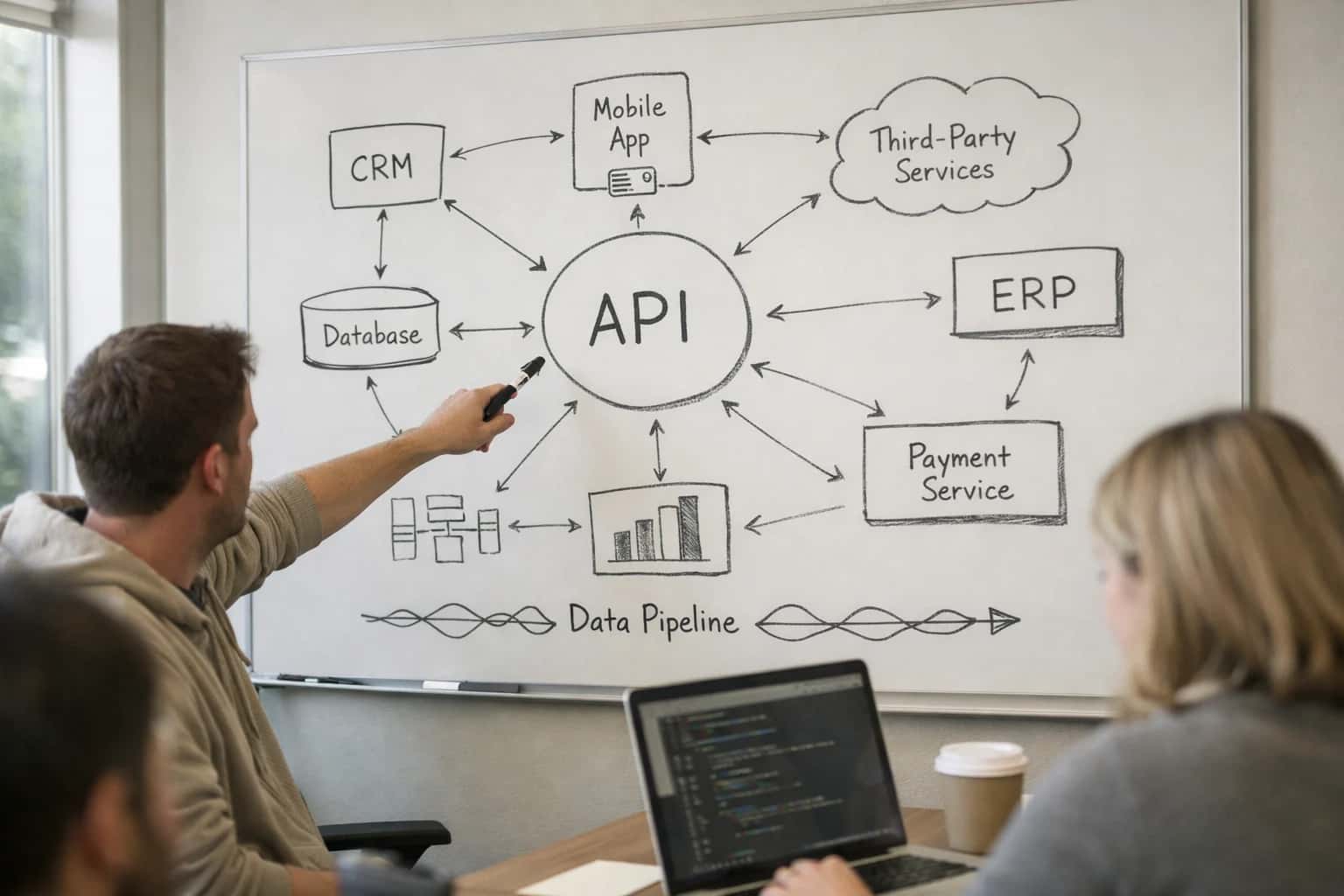
AI for iCIMS Data Migration: From Manual Scrub to Automated Quality
A technical blueprint for using AI to automate data cleansing, validation, and enrichment during iCIMS migration projects.
Implementation typically involves a staged, event-driven architecture. Source data is extracted into a secure staging area. An AI processing service, triggered by file arrival or API call, applies a sequence of validation and enrichment models. For example, a deduplication agent uses fuzzy matching on email, name, and phone to cluster duplicate Candidate records, suggesting a master profile. A standardization agent uses LLM classification to map hundreds of variant job titles to a clean, approved taxonomy, populating custom fields like Standardized_Job_Title. An enrichment agent parses resume files (PDF/DOCX) linked to candidate records to extract skills, certifications, and education, appending them to the candidate's Skills field. Each operation is logged with source, confidence score, and suggested change, creating a full audit trail. Cleaned records are then formatted for iCIMS's bulk import APIs or real-time POST/PUT endpoints.
Rollout requires a governance-first approach. Start with a pilot on a non-critical data domain, like Job records, to tune models and rules. Implement a human-in-the-loop approval queue for low-confidence transformations or critical fields. Use iCIMS's role-based access control (RBAC) to ensure only authorized users can approve AI-suggested merges or enrichments. Post-migration, these same AI agents can be repurposed for ongoing data quality monitoring, scanning new candidate submissions for completeness or flagging requisition data that deviates from hiring plans. By treating data migration not as a one-time project but as the foundation for AI-ready talent data, you turn a cost center into a strategic asset. For related architectural patterns, see our guide on [/integrations/applicant-tracking-platforms/ai-integration-for-icims](AI Integration for iCIMS) or our broader primer on [/integrations/applicant-tracking-platforms/ai-integration-for-applicant-tracking-platforms](AI Integration for Applicant Tracking Platforms).
Where AI Connects to the iCIMS Migration Pipeline
Pre-Migration Data Preparation
AI agents connect to the source data extract—often from legacy ATS, spreadsheets, or HRIS exports—to automate the most labor-intensive phase of migration: data cleansing. This involves:
- Entity Resolution: Using LLMs to deduplicate candidate records across multiple source files by matching on names, emails, and partial employment history, even when formats differ.
- Field Standardization: Parsing and normalizing inconsistent data (e.g.,
"Sr. Software Eng","Senior SW Engineer") into iCIMS-compliant picklist values forjob_title,department, orlocation. - Validation & Enrichment: Cross-referencing candidate profiles against public professional networks to fill missing key fields like
current_companyorskills, ensuring the migrated dataset is complete and AI-ready.
This layer operates on the raw extract files before load, creating a cleansed, validated staging dataset that dramatically reduces post-migration cleanup and manual rework.
High-Value AI Use Cases for iCIMS Data Migration
Migrating to iCIMS is a data-intensive project where AI can dramatically reduce manual effort, improve data quality, and ensure your new ATS is AI-ready from day one. These use cases focus on cleansing, transforming, and enriching candidate and job data before and during the migration.
Resume & Profile Data Standardization
AI parses and normalizes candidate data from legacy systems (PDFs, spreadsheets, old ATS exports) into iCIMS' structured candidate profile fields. It extracts and maps skills, titles, education, and experience, resolving inconsistencies and filling gaps to create clean, searchable records.
Duplicate Candidate Resolution
An AI agent performs entity resolution across source systems to identify and merge duplicate candidate records before migration. It uses fuzzy matching on names, emails, and profile data, presenting a unified 'golden record' for import into iCIMS, preventing data bloat.
Job Requisition Data Enrichment
Migrating historical job reqs? AI analyzes legacy job descriptions to auto-tag required skills, seniority levels, departments, and standardize titles. This enriches iCIMS job data for better reporting, future matching, and AI-driven candidate sourcing post-migration.
Migration Validation & Anomaly Detection
Post-migration, an AI workflow compares source and target data sets to flag discrepancies—missing records, field mismatches, or broken relationships. It generates an exception report for the migration team, turning a manual sampling audit into comprehensive data quality assurance.
Historical Note & Activity Summarization
Legacy systems often contain lengthy, unstructured candidate notes. AI summarizes key interactions, feedback, and status changes into concise, structured summaries attached to the new iCIMS candidate profile, preserving institutional knowledge without the noise.
Compliance Data Tagging & Redaction
For GDPR/CCPA readiness, AI scans source candidate data to identify and tag PII, sensitive data (e.g., SSN), or information requiring consent. It can also automate redaction workflows before migration, ensuring your iCIMS instance starts with compliant data practices. Learn more about our approach to secure, compliant AI integrations.
Example AI Migration Workflows for iCIMS
These workflows illustrate how AI agents can automate and accelerate data migration projects for iCIMS, focusing on cleansing, validation, and transformation tasks that are traditionally manual and error-prone.
Trigger: A batch of candidate records is extracted from a legacy ATS (e.g., Taleo, PeopleSoft) and staged in a migration landing zone.
AI Agent Actions:
- Parse & Extract: The agent ingests each raw record (often in CSV/JSON). It uses an LLM with a structured output schema to identify and extract key entities:
full_name,email,phone,skills,job_titles,companies,education. - Standardize Formats: It applies rules to normalize data:
- Phone numbers to E.164 format.
- Dates to ISO 8601.
- Skills to a controlled taxonomy (e.g., mapping "JS" to "JavaScript").
- Enrich & Deduplicate: For records with sparse data, the agent queries public profiles (via sanctioned APIs) to fill gaps. It performs fuzzy matching on
emailandname+companyto flag potential duplicates before iCIMS insertion.
System Update: The cleansed, enriched, and deduplicated records are formatted into iCIMS API payloads (POST /v1/candidates) and queued for insertion. A summary report logs changes, enrichment sources, and duplicate clusters for human review.
Human Review Point: A sample of enriched records and all flagged duplicates are sent to a migration dashboard for a project manager to approve or reject before the final bulk load.
Implementation Architecture: Building a Governed AI Migration Pipeline
A production-ready architecture for using AI to cleanse, structure, and validate data during an iCIMS migration, ensuring downstream AI processes start with high-quality inputs.
A governed AI migration pipeline for iCIMS typically connects at three key layers: the source data extraction point, a processing and validation engine, and the iCIMS API ingestion layer. The pipeline ingests legacy candidate profiles, job requisitions, and activity records from systems like Taleo, SAP SuccessFactors, or flat files. AI agents are then applied to specific data quality tasks: an entity resolution model deduplicates candidate records, a classification model maps legacy job codes to iCIMS' requisition structure, and a validation model checks for completeness (e.g., ensuring required fields for OFCCP compliance are populated) before any write operation occurs.
The core implementation pattern is a queue-based, human-in-the-loop workflow. Records move through stages like extracted, ai_processed, human_review, and ready_for_icims. For example, a candidate's unstructured work history from a legacy resume parse is sent to an LLM with a prompt to extract standardized company, title, and date fields conforming to iCIMS' candidate profile schema. The output, along with a confidence score, is placed in a review queue if confidence is below a set threshold (e.g., 85%). A migration operator approves or corrects the suggestion via a simple UI, creating an audit trail. Only approved records trigger calls to the iCIMS Candidate API (POST /v1/candidates) or the Job API for requisitions.
Governance is critical. The pipeline must log every AI-suggested change, the user who approved it, and the final payload sent to iCIMS. This creates a clear lineage for compliance audits. Rollout should be phased by data domain: start with job requisitions (lower volume, critical for structure), then candidate profiles, and finally historical activity data. This approach de-risks the migration and provides clean, structured data essential for downstream AI use cases in iCIMS, such as candidate scoring or talent pool management. The result is not just a data migration, but a transformation of legacy information into an AI-ready foundation.
Code and Payload Examples
Enriching Sparse Candidate Profiles
During migration from legacy systems, candidate records often arrive with incomplete or inconsistently formatted data. An AI enrichment service can parse raw text fields, extract structured entities, and populate iCIMS custom fields via API.
A typical workflow:
- A batch job retrieves candidate records flagged for enrichment from a migration staging table.
- The AI service processes the
resume_textornotesfield. - It extracts skills, years of experience, education degrees, and previous job titles using an LLM with a structured output schema.
- The service updates the iCIMS candidate record via PATCH, populating custom fields like
skills_json,total_years_experience, andlast_job_title.
This ensures migrated data is AI-ready for downstream processes like semantic search and candidate matching.
python# Example: Enrich a candidate record from migration payload import requests # Payload from legacy system (often unstructured) legacy_candidate = { "id": "mig_001", "name": "Jane Doe", "resume_text": "10+ years software engineering at TechCorp. Skills: Python, AWS, Kubernetes. MS Computer Science from State Univ.", "notes": "Strong communicator, led team of 5." } # Call AI enrichment service (pseudocode) enrichment_payload = { "text": f"{legacy_candidate['resume_text']} {legacy_candidate['notes']}", "extraction_schema": { "skills": "list", "years_experience": "integer", "highest_degree": "string", "last_title": "string" } } # Enriched data ready for iCIMS enriched_data = { "candidate": { "custom_field_skills": ["Python", "AWS", "Kubernetes"], "custom_field_years_exp": 10, "custom_field_degree": "MS Computer Science", "custom_field_last_title": "Software Engineer" } } # Update iCIMS via API icims_patch_url = f"https://api.icims.com/v1/candidates/{mapped_icims_id}" headers = {"Authorization": "Bearer {api_key}", "Content-Type": "application/json"} response = requests.patch(icims_patch_url, json=enriched_data, headers=headers)
Realistic Time Savings and Migration Impact
This table compares the manual effort of a typical iCIMS data migration project against an AI-assisted approach, focusing on time, quality, and operational impact for candidate and job data.
| Migration Phase | Manual Process | AI-Assisted Process | Impact & Notes |
|---|---|---|---|
Data Profiling & Mapping | 2-3 weeks for sample analysis | 3-5 days for automated schema discovery | AI identifies patterns, anomalies, and suggests field mappings from legacy systems. |
Candidate Record Cleansing | Hours per 1000 records for deduplication & formatting | Minutes per 1000 records with automated validation | AI standardizes formats, merges duplicates, and flags incomplete records for review. |
Resume Parsing & Skills Extraction | Manual review or basic parser requiring heavy QA | Automated parsing with contextual skill tagging | Extracts structured skills, certifications, and experience for future AI screening readiness. |
Job Requisition Data Harmonization | Manual reconciliation of inconsistent job codes & titles | Automated classification and taxonomy alignment | Ensures clean job architecture in iCIMS, critical for downstream reporting and matching. |
Validation & Error Reporting | Spot checks and reactive error discovery post-load | Continuous validation with real-time exception dashboards | Proactively surfaces data integrity issues (e.g., invalid dates, broken relationships) before go-live. |
Post-Migration Audit & Reconciliation | 1-2 weeks for sample-based auditing | Same-day automated audit with confidence scoring | Generates a reconciliation report highlighting records requiring human verification. |
Overall Project Timeline | 12-16 weeks for a medium-complexity migration | 8-10 weeks with compressed cleansing & validation phases | Reduces time-to-value for new iCIMS instance and accelerates readiness for AI hiring workflows. |
Governance, Security, and Phased Rollout
A controlled, audit-ready approach to integrating AI into iCIMS data migration projects.
A production AI integration for iCIMS data migration operates on a read-only, staging-first principle. Your AI agents should connect to a dedicated iCIMS sandbox or a replicated dataset, never the production instance during initial processing. This allows for validation of data cleansing logic—such as standardizing job titles, geocoding addresses, or merging duplicate candidate records—against known test cases before any write-back occurs. All AI-generated suggestions for data updates (e.g., a proposed normalized Candidate.Industry field) should be logged as metadata payloads, including the source record ID, the original value, the suggested change, and the confidence score from the LLM.
Security is enforced at the API layer and within the AI workflow itself. Use iCIMS' OAuth 2.0 for service accounts with scoped permissions, ensuring the integration only accesses the necessary objects like Candidate, Job, Application, and CustomField. For processing sensitive PII, implement a de-identification and re-identification pipeline: extract and hash direct identifiers, send anonymized content to the LLM for analysis, then re-associate the outputs within your secure processing environment before constructing the update payload for iCIMS. All data flows should be encrypted in transit and at rest, with audit logs capturing every API call, data batch processed, and AI-suggested modification.
Roll out in phased, measurable waves. Phase 1 might target non-critical, high-volume fields like Candidate.Skills normalization or Job.Location cleansing, providing immediate value while building trust in the system. Phase 2 can address more complex, cross-object scenarios, such as linking orphaned Application records to correct Candidate profiles. Each phase should include a human-in-the-loop review checkpoint, where a migration lead audits a sample of AI-suggested changes in a dashboard before approving bulk updates via iCIMS' import tools or API. This controlled approach de-risks the migration, provides clear ROI at each step, and creates the governance framework necessary for downstream AI processes like screening or analytics that depend on this cleansed data. For related architectural patterns, see our guide on AI Integration for Applicant Tracking Platforms.
Enabling Efficiency, Speed & Accuracy
Intelligent Analysis, Decision & Execution
We build AI systems for teams that need search across company data, workflow automation across tools, or AI features inside products and internal software.
Talk to Us
Search across company data
Give teams answers from docs, tickets, runbooks, and product data with sources and permissions.
Useful when people spend too long searching or get different answers from different systems.

Automate internal workflows
Use AI to route work, draft outputs, trigger actions, and keep approvals and logs in place.
Useful when repetitive work moves across multiple tools and teams.

Add AI to products and internal tools
Build assistants, guided actions, or decision support into the software your team or customers already use.
Useful when AI needs to be part of the product, not a separate tool.
FAQs: AI for iCIMS Data Migration
Practical answers for technical leaders planning AI-assisted data migration and cleansing projects for iCIMS implementations.
AI acts as a pre-processing and validation layer before data is loaded into iCIMS via its Candidate Import API or other bulk tools. The typical integration pattern is:
- Extract & Stage: Raw candidate, job, and user data is extracted from legacy systems (e.g., CSV, another ATS, HRIS) into a staging database or cloud storage.
- AI Processing Queue: A queue (e.g., SQS, RabbitMQ) feeds records to an AI service for cleansing and enrichment.
- AI Agent Actions: For each record, AI agents perform tasks like:
- Deduplication: Identifying duplicate candidate profiles across sources using fuzzy matching on names, emails, and phone numbers.
- Field Standardization: Parsing and normalizing inconsistent data (e.g.,
"Sr. Software Eng","Senior SW Engineer"→"Senior Software Engineer"). - Data Enrichment: Inferring missing fields (e.g., populating a
locationfield from a parsed address inresume_text). - Validation & Flagging: Identifying records with critical missing data (e.g., no email) or potential compliance issues for human review.
- Human-in-the-Loop Review: Flagged records or low-confidence transformations are routed to a review UI for a migration specialist to approve or correct.
- Load to iCIMS: Approved, cleansed records are formatted into iCIMS's expected JSON/XML schema and loaded via API, with detailed audit logs.

About the author
Prasad Kumkar
CEO & MD, Inference Systems
Prasad Kumkar is the CEO & MD of Inference Systems and writes about AI systems architecture, LLM infrastructure, model serving, evaluation, and production deployment. Over 5+ years, he has worked across computer vision models, L5 autonomous vehicle systems, and LLM research, with a focus on taking complex AI ideas into real-world engineering systems.
His work and writing cover AI systems, large language models, AI agents, multimodal systems, autonomous systems, inference optimization, RAG, evaluation, and production AI engineering.
Partnered with leading AI, data, and software stack.





How We Work
Custom AI workflows for your Business
One-fit-all AI don't work for modern businesses. At Inferensys, we aim to understand your business & custom requirements; which we use to define most efficient agentic workflows, the data, and the tools for your business.
01
Review the use case
We understand the task, the users, and where AI can actually help.
Read more02
Pick the right approach
We define what needs search, automation, or product integration.
Read more03
Build the first useful version
We implement the part that proves the value first.
Read more04
Improve from there
We add the checks and visibility needed to keep it useful.
Read moreThe first call is a practical review of your use case and the right next step.
Talk to Us