Integrating AI into Workable's candidate pipeline—touching Candidates, Jobs, Interviews, and Notes—requires a security-first architecture. This means processing Personally Identifiable Information (PII) like resumes, contact details, and feedback summaries within a controlled environment. A compliant integration uses Workable's REST API and webhooks to trigger AI workflows, but ensures data never leaves your governed cloud perimeter or is only sent to AI models via secure, zero-retention APIs. Key surfaces include automating resume screening, generating interview questions, or summarizing feedback, all while maintaining strict access logs.

Integration
AI Integration for Workable Security and Compliance
A technical blueprint for engineering teams to add AI-powered automation to Workable while maintaining strict data security, GDPR/CCPA compliance, and auditability for candidate PII.
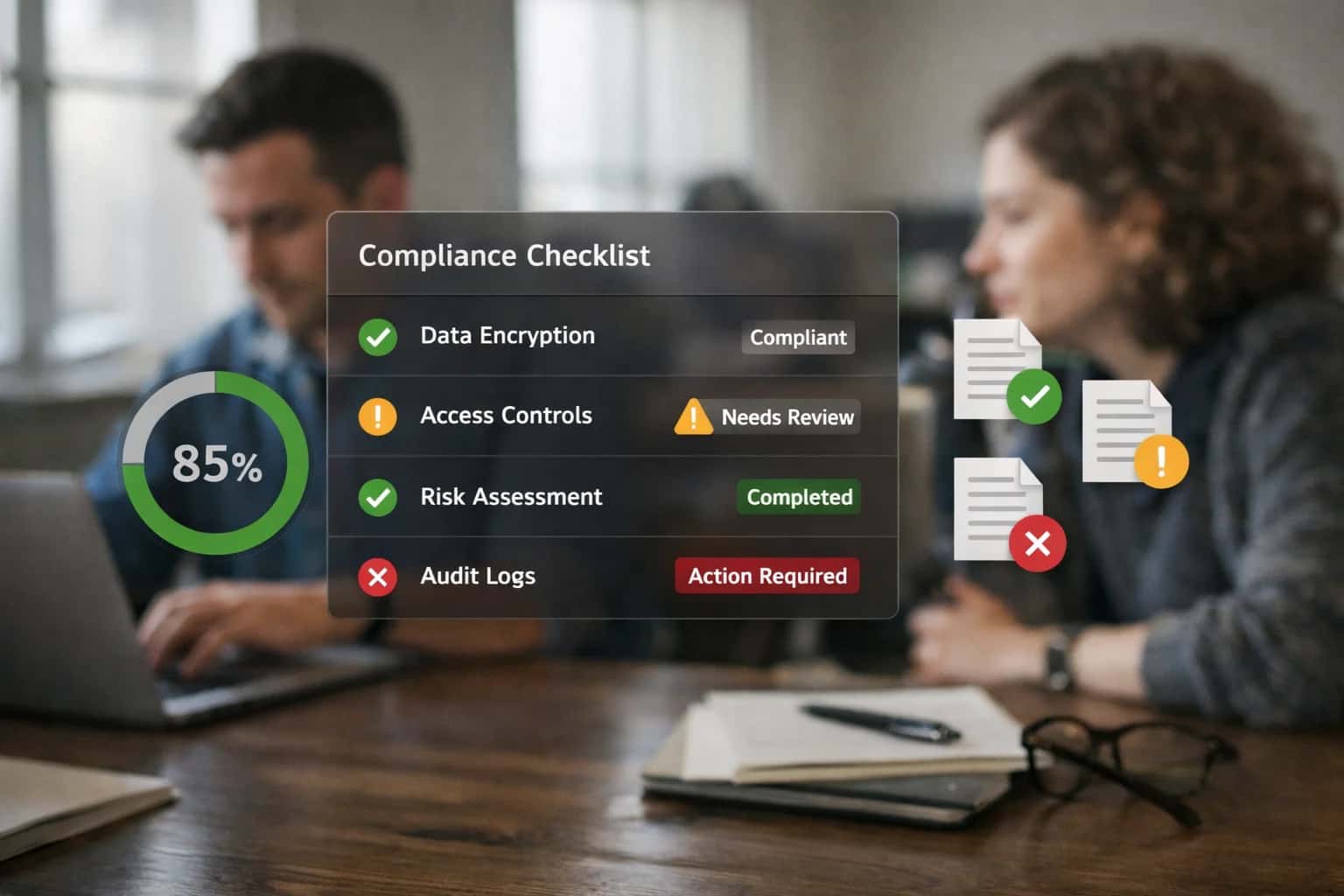
ARCHITECTURE & GOVERNANCE
Secure AI Integration for Workable: A Compliance-First Approach
A technical blueprint for implementing AI in Workable with built-in data security, privacy compliance, and audit controls.
Implementation requires a proxy layer between Workable and AI services. For example, a webhook for a new candidate.application event can route the candidate's resume PDF to an internal queue. An orchestration service then calls parsing and LLM services, which can be configured for in-region processing and prompt privacy (e.g., using Azure OpenAI with data governance). Results—like a match score or summarized notes—are written back to Workable via API into custom fields (e.g., AI_Assessment_Score) or private notes, with all PII stripped from AI system logs. This pattern supports GDPR/CCPA right-to-erasure requests by tying AI-processed data directly to the candidate record, which can be purged via Workable's API.
Rollout should start with a pilot Job or team, using Workable's permissions to limit AI-enhanced views. Governance checkpoints include: regular audits of AI-generated field usage, human review of automated rejections, and clear disclosure to candidates. By designing the integration with compliance as a core constraint, you gain the productivity benefits of AI—reducing manual screening from hours to minutes—without introducing regulatory risk or breaching candidate trust. For related architectural patterns, see our guides on AI Integration for Applicant Tracking Platforms and AI Governance and LLMOps Platforms.
ARCHITECTURE FOR COMPLIANCE
Where AI Touches Workable: Secure Integration Points
Secure Processing of Candidate PII
AI integrations must treat candidate data as sensitive PII, subject to GDPR, CCPA, and internal data residency policies. The primary integration surface is the Candidate Object API, which provides access to profiles, resumes, and application data.
A secure architecture uses a zero-retention processing model: AI services fetch candidate records via API for immediate analysis (e.g., resume parsing, skills extraction) but do not persist raw PII in external vector stores unless explicitly encrypted and governed. Webhooks for candidate.created or candidate.stage_change can trigger analysis, but payloads should be minimal. Implement field-level masking within API calls to exclude sensitive identifiers like phone numbers or addresses from AI processing unless required.
All processing must be logged in an immutable audit trail, linking the candidate ID, the AI operation performed, the timestamp, and the user/system initiating the action. This is critical for compliance audits and data subject access requests (DSARs).
SECURE, AUDITABLE INTEGRATIONS
High-Value, Compliance-Critical AI Use Cases for Workable
For teams using Workable, adding AI requires a security-first architecture. These patterns show where to inject intelligence while maintaining strict data governance, GDPR/CCPA compliance, and full audit trails for all PII handling.
01
Anonymized Resume Screening & Bias Detection
Trigger AI analysis via Workable webhook on new application. The system redacts PII (name, location, photo) before parsing, extracts skills/experience, and scores against the job requisition. Scores and a bias audit report are posted back to a custom field, enabling blind review. All redaction logic and scoring prompts are logged for compliance audits.
Batch -> Real-time
Screening speed
02
Secure Interview Feedback Synthesis
Automate the collection and summarization of panel feedback. When interviewers submit scorecards in Workable, an AI agent ingests notes via API, strips any accidental PII, and generates a neutral, structured summary. The summary is attached to the candidate record, with a clear audit trail linking to the source feedback and the anonymization step. Human reviewers can always see the original notes.
1 sprint
Feedback consolidation
03
Compliant Candidate Rediscovery
Safely mine Workable's talent pool for past applicants. An offline AI job runs on a secure, isolated data snapshot of anonymized candidate profiles. It identifies matches for new roles based on skills and experience. Output is a list of candidate IDs (not profiles) for recruiter review. The entire process—data export, anonymization, matching, and result generation—is logged as a single compliance event.
04
GDPR-Aware Candidate Communication
Orchestrate personalized, bulk candidate updates while respecting consent preferences. The AI system checks Workable's candidate tags for communication consent status (GDPR Article 6/9) before drafting any message. It generates personalized status updates or outreach, which are queued for recruiter approval and sent via Workable's native email system, keeping all communication within the platform of record.
05
Auditable Data Handoff to HRIS
Intelligently prepare candidate data for onboarding handoff. When a candidate is hired in Workable, an AI agent validates and transforms the candidate record into the format required by the HRIS (e.g., BambooHR, Workday). It flags data gaps or inconsistencies for human review and generates a complete audit log of all data points transferred, fulfilling data subject access request (DSAR) requirements.
Hours -> Minutes
Handoff prep
06
Automated Right-to-Work & Document Verification
Streamline pre-employment checks within a secure workflow. Upon candidate progression to offer stage, the AI system triggers a secure document collection portal. It uses vision models to validate document authenticity and extract relevant data, flagging any discrepancies for HR review. All document images and extraction results are stored in Workable's secure document store with strict access controls, never in the AI provider's environment.
IMPLEMENTATION PATTERNS
Secure AI Workflow Examples for Workable
Concrete, production-ready workflows for adding AI to Workable with built-in security, compliance, and audit controls. Each pattern details the trigger, data handling, AI action, and system update.
Trigger: A new candidate applies to a job in Workable.
Context/Data Pulled: The integration securely fetches the candidate's resume (PDF/DOCX), application answers, and the job requisition details via the Workable API. PII fields (name, email, phone) are tokenized or pseudonymized before processing.
Model or Agent Action: An AI agent, using a retrieval-augmented generation (RAG) system grounded in your company's role definitions and success profiles:
- Parses the anonymized resume for skills, experience, and education.
- Scores the candidate against the job's required and preferred qualifications.
- Generates a structured summary highlighting top matches and potential gaps.
- All processing logs are written to an immutable audit trail, recording the model version, input hash, and timestamp.
System Update or Next Step: The agent posts the score (e.g., 0-100) and the structured summary back to Workable as private notes on the candidate profile, using a custom field for the numeric score. The original PII is never stored in the AI system's context.
Human Review Point: The recruiter reviews the score and summary. They can override the score, and this feedback is logged to improve future model performance.
SECURING CANDIDATE PII IN WORKABLE
Architecture for a Secure, Compliant AI Integration
A technical blueprint for implementing AI in Workable with enforceable data governance, audit trails, and privacy-by-design.
Integrating AI into Workable requires a security-first architecture that treats candidate Personally Identifiable Information (PII)—resumes, contact details, interview notes—as a governed asset. A production implementation typically uses a gateway pattern: AI service calls are routed through a secure middleware layer that performs critical functions before data reaches an LLM. This layer handles data redaction (masking names, emails, phone numbers), enforces role-based access control (RBAC) to limit which AI tools can access which candidate pools, and logs all interactions to a tamper-evident audit trail for GDPR/CCPA Subject Access Requests (SARs).
For high-compliance use cases like automated resume screening, the workflow is explicitly designed to minimize PII exposure. A common pattern is: 1) A new candidate application in Workable triggers a webhook. 2) The secure gateway fetches the anonymized resume text via Workable's API (stripping header PII). 3) The AI service processes the text for skills and role matching, returning a score and tags. 4) The gateway writes the results back to a custom field in the candidate's Workable profile. The candidate's core PII never leaves the trusted Workable environment, and the AI only operates on a sanitized data payload. This pattern is detailed further in our guide on AI Integration for Greenhouse Resume Screening, which shares similar architectural principles.
Rollout and governance are phased. Start with a pilot for a non-sensitive data flow, such as job description generation, which uses public role requirements. Implement human-in-the-loop approvals for any AI-generated candidate communication. Use Workable's webhook and API audit logs in conjunction with your gateway's logs to create a unified chain of custody. For enterprises, this architecture must integrate with existing Data Loss Prevention (DLP) and vendor risk management frameworks, treating the AI model as a third-party processor. Our approach ensures AI augments recruitment without compromising the trust and compliance foundational to modern hiring.
IMPLEMENTATION BLUEPRINTS
Code Patterns for Secure Workable AI Integrations
Isolating AI Calls from PII
Direct calls from Workable to external AI services risk exposing candidate PII. A secure pattern uses a dedicated API gateway as a privacy buffer.
Implementation Flow:
- Workable webhook fires on
candidate.stage_change. - Gateway receives payload, extracts only non-PII fields (e.g.,
job_id,stage_id). - Gateway calls Workable's API (using a scoped token) to fetch the full candidate record, logging this access for audit.
- Gateway redacts PII (names, emails, phone) from the record, creating a tokenized payload.
- Tokenized payload is sent to the AI service (e.g., for skills extraction).
- AI response is mapped back to the original candidate ID and posted to Workable via a custom field.
This pattern centralizes logging, enforces data minimization, and keeps PII within your controlled environment.
See our guide on Data Governance for AI Integrations for more on tokenization strategies.
IMPLEMENTATION PRIORITIZATION
Realistic Impact: Security vs. Speed Trade-offs
This table compares the operational impact of implementing AI in Workable with different security postures, helping teams prioritize their rollout and balance risk with recruiter velocity.
| Workflow | Standard Integration (Faster) | Compliance-First Integration (Secure) | Implementation Notes |
|---|---|---|---|
Resume Screening & Scoring | Real-time scoring via API | Batch processing after PII redaction | Compliance-first adds 2-4 hour latency for redaction service. |
Candidate Communication | AI drafts personalized outreach using full profile | AI drafts using role & skills only; human adds PII | Removing PII from generation context prevents accidental data exposure. |
Interview Feedback Summarization | AI summarizes all panel notes immediately | AI summarizes after manual redaction of sensitive comments | Human review gate ensures compliance with internal feedback policies. |
Audit Logging & Explainability | Logs contain candidate IDs and score changes | Logs use pseudonymous tokens; full explainability reports stored separately | Pseudonymization requires a secure lookup table but satisfies strict audit requirements. |
Data Retention & Purging | AI training data retained per model lifecycle | AI training data ephemeral; vectors purged with candidate record | Ephemeral processing eliminates long-term data sovereignty risk. |
Cross-Border Candidate Processing | Processed in primary cloud region | Processed in candidate's geographic region or isolated tenant | Multi-region deployment adds complexity but ensures GDPR/CCPA compliance. |
Integration Rollout Speed | Pilot: 2-3 weeks | Pilot: 4-6 weeks | Additional time for legal review, redaction pipelines, and access control configuration. |
SECURE AI INTEGRATION FOR WORKABLE
Governance, Permissions, and Phased Rollout
A practical guide to implementing AI in Workable with enterprise-grade security, compliance, and controlled adoption.
Integrating AI into Workable requires a security-first architecture that respects the platform's data model and access controls. Your implementation should authenticate via Workable's OAuth 2.0 API, scoping token permissions to the minimal required—typically read access to candidates, jobs, and stages, and write access only to custom fields or notes for AI-generated insights. All AI processing should occur in a secure, isolated environment where PII from candidate resumes, applications, and feedback is never persisted in the AI provider's systems by default. Use ephemeral processing and enforce data retention policies that align with GDPR/CCPA, ensuring candidate data is purged from AI caches after analysis. Audit logs must capture every API call, data access event, and AI-generated action (e.g., score updates, note creation) to maintain a clear lineage for compliance reviews.
A phased rollout is critical for managing risk and building user trust. Start with a pilot in a single department or for a specific, high-volume role (e.g., screening inbound applications for Software Engineer requisitions). Implement a human-in-the-loop (HITL) approval step where AI suggestions, like a candidate match score or interview question batch, are presented to a recruiter for review before any system writes are made. This can be managed through a separate dashboard or by writing AI outputs to a dedicated, hidden custom field in Workable that only pilot users can view. Use this phase to tune prompts, validate accuracy, and gather feedback. Gradually expand to automated actions, such as auto-tagging candidates or populating scorecards, but only after establishing confidence thresholds and exception handling for low-confidence AI outputs.
Governance extends to the AI models themselves. For use cases like resume screening or feedback summarization, establish a regular evaluation cycle to check for model drift or unintended bias, especially across diverse candidate pools. Define clear ownership: Recruiting Operations may own the workflow, IT secures the integration, and Legal/Compliance approves the data handling. Roll out training that emphasizes the AI's role as an assistant—not a decision-maker—and ensure all users understand how to override AI suggestions. Finally, integrate monitoring to track key operational metrics: reduction in manual screening time, candidate response rates to AI-drafted outreach, and user adoption rates within the Workable interface. This measured, governed approach ensures the AI integration enhances Workable securely and sustainably.
Enabling Efficiency, Speed & Accuracy
Intelligent Analysis, Decision & Execution
We build AI systems for teams that need search across company data, workflow automation across tools, or AI features inside products and internal software.
Talk to Us
Search across company data
Give teams answers from docs, tickets, runbooks, and product data with sources and permissions.
Useful when people spend too long searching or get different answers from different systems.
Enterprise searchRAGPermissions
Read more
Automate internal workflows
Use AI to route work, draft outputs, trigger actions, and keep approvals and logs in place.
Useful when repetitive work moves across multiple tools and teams.
AI agentsWorkflow automationGovernance
Read more
Add AI to products and internal tools
Build assistants, guided actions, or decision support into the software your team or customers already use.
Useful when AI needs to be part of the product, not a separate tool.
AI integrationDecision supportModel routing
Read moreIMPLEMENTATION QUESTIONS
FAQ: Security and Compliance for Workable AI
Technical and operational questions for teams integrating AI with Workable's ATS, focusing on data handling, access control, and regulatory compliance.
AI integrations with Workable must treat candidate data with the highest security standards, as it contains sensitive Personally Identifiable Information (PII).
Secure Data Flow:
- API Authentication: All calls to the Workable API must use secure, short-lived OAuth 2.0 tokens with minimal necessary scopes (e.g.,
read:candidates,write:feedback). - Data Minimization: The integration should request only the specific candidate fields required for the AI task (e.g.,
resume_text,job_title). Avoid pulling full profiles unless absolutely necessary. - In-Transit Encryption: All data is transmitted over TLS 1.2+.
- At-Rest Encryption: PII processed by AI models should be encrypted at rest within your cloud environment (e.g., using AWS KMS or Azure Key Vault).
- Ephemeral Processing: Where possible, candidate data should be held in memory only for the duration of the AI task and not persisted to long-term storage after processing.
Example Payload for Minimal Data Request:
jsonGET /v3/candidates/{id} Headers: {"Authorization": "Bearer <token>"} Query Params: {"fields": "id,name,resume_text,applications.job_title"}

About the author
Prasad Kumkar
CEO & MD, Inference Systems
Prasad Kumkar is the CEO & MD of Inference Systems and writes about AI systems architecture, LLM infrastructure, model serving, evaluation, and production deployment. Over 5+ years, he has worked across computer vision models, L5 autonomous vehicle systems, and LLM research, with a focus on taking complex AI ideas into real-world engineering systems.
His work and writing cover AI systems, large language models, AI agents, multimodal systems, autonomous systems, inference optimization, RAG, evaluation, and production AI engineering.
LinkedIn
Limited slotsGet a Free AI Consultation
Partnered with leading AI, data, and software stack.





How We Work
Custom AI workflows for your Business
One-fit-all AI don't work for modern businesses. At Inferensys, we aim to understand your business & custom requirements; which we use to define most efficient agentic workflows, the data, and the tools for your business.
01
Review the use case
We understand the task, the users, and where AI can actually help.
Read more02
Pick the right approach
We define what needs search, automation, or product integration.
Read more03
Build the first useful version
We implement the part that proves the value first.
Read more04
Improve from there
We add the checks and visibility needed to keep it useful.
Read moreThe first call is a practical review of your use case and the right next step.
Talk to Us