In retail, AI integration targets three critical surfaces within platforms like Coupa, SAP Ariba, or Jaggaer: the merchandise purchase order (PO) lifecycle, seasonal and promotional procurement workflows, and the supplier chargeback and compliance data layer. Instead of a generic overlay, AI agents are wired to specific objects: Purchase Requisitions for new product lines, Contracts with seasonal clauses and volume tiers, Invoices tied to delivery performance, and Supplier Scorecards fed by chargeback events from warehouse management systems. The goal is to inject intelligence at the point of decision—before a buyer commits to a seasonal order, while a vendor invoice is being matched against an advanced shipping notice (ASN), or when a compliance team must validate packaging against ESG mandates.

Integration
AI Integration for Spend Management Platforms in Retail
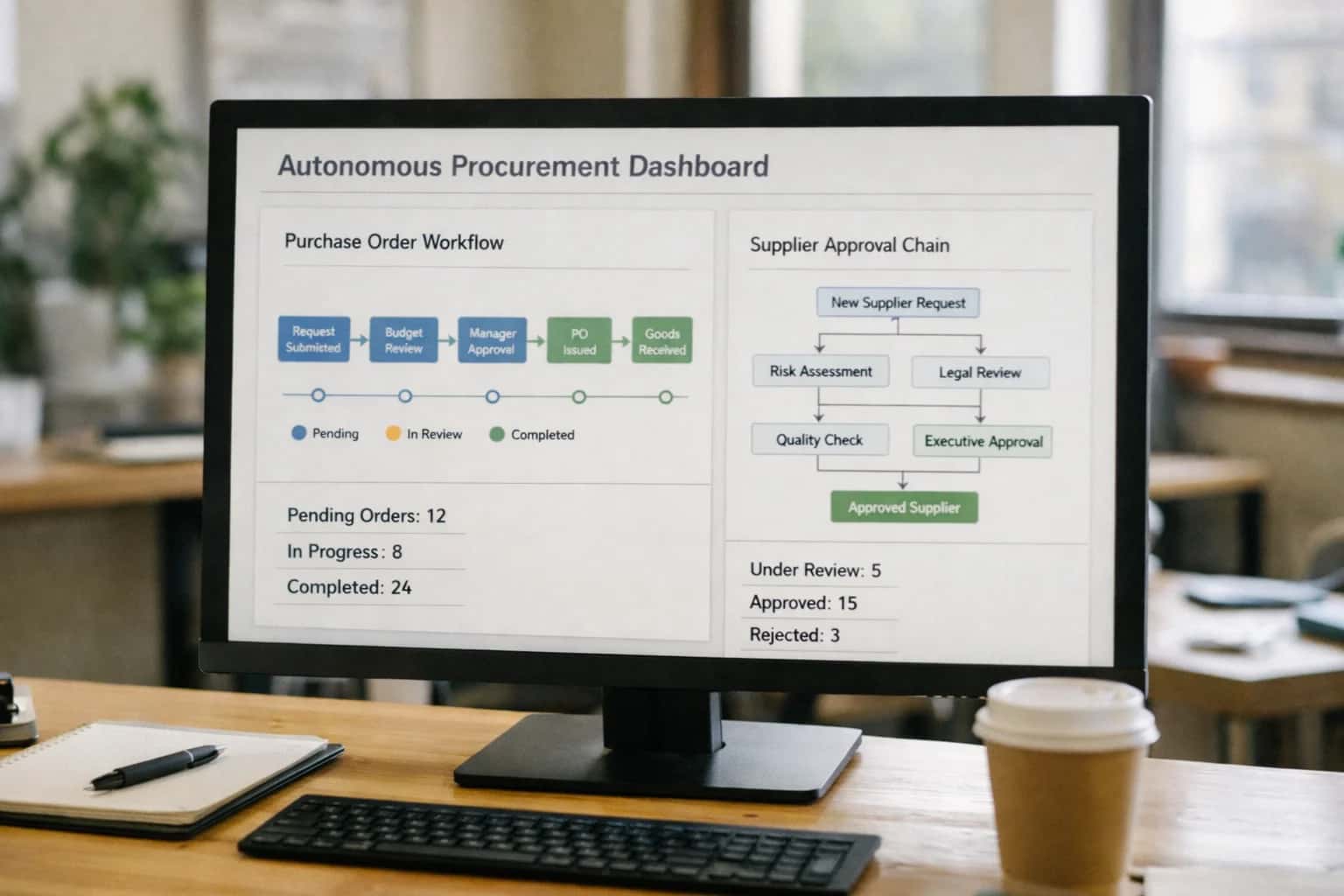
Where AI Fits in Retail Spend Management
A technical blueprint for embedding AI into retail-specific procurement workflows, connecting merchandise buying, seasonal planning, and supplier compliance to your core spend platform.
Implementation typically involves a middleware layer that subscribes to platform webhooks (e.g., purchase_order.created, invoice.received) and enriches transactions with retail-specific context. For example, an AI workflow can:
- Analyze historical sales data and current inventory levels to recommend order quantities on a new merchandise PO, considering lead times and predicted sell-through.
- Automate chargeback validation by comparing invoice details against ASN data and contract terms (e.g., late delivery, packaging errors), then creating a dispute case in the spend platform with supporting evidence.
- Classify spend for ESG reporting by extracting material details from invoices or POs (e.g.,
recycled_content_percentage,supplier_certification_id) and mapping them to your sustainability framework, populating custom fields in the supplier record for audit-ready reporting.
Rollout requires phased alignment with the retail calendar. Start with pre-season procurement support for a single category, using AI to analyze past season performance and supplier reliability during the buying cycle. Then, implement in-season chargeback automation to capture revenue leakage from vendor non-compliance. Governance is critical: all AI recommendations should be logged as audit_trail comments on the relevant record, and high-value actions (e.g., approving a six-figure PO) should remain gated by human-in-the-loop approvals. This ensures the integration augments—rather than disrupts—the existing buying and supplier management processes that keep retail operations running.
Key Integration Surfaces in Retail Spend Platforms
AI Integration for Seasonal and Assortment Planning
Retail merchandise procurement involves high-volume, time-sensitive workflows where AI can analyze historical sales, trend data, and supplier lead times to generate optimized purchase orders. Key integration surfaces include:
- Assortment Planning Modules: Inject AI recommendations for SKU-level quantities and timing based on predictive demand models, connecting to PLM or planning systems.
- Purchase Requisition & Order APIs: Automate the creation of POs in the spend platform by having AI agents validate item details, suggest alternate suppliers for out-of-stock items, and enforce buying calendar compliance.
- Supplier Capacity & Allocation Data: Integrate AI to monitor real-time supplier capacity feeds or EDI 856 (ASN) messages, predicting delays and automatically adjusting orders or routing to secondary vendors.
Implementation typically involves an orchestration layer that pulls data from demand forecasting tools, enriches it with market intelligence, and executes via the spend platform's REST APIs for order creation and amendment.
High-Value AI Use Cases for Retail Procurement
Retail procurement teams face unique pressures: seasonal buying cycles, complex supplier chargebacks, and stringent packaging sustainability goals. This guide details targeted AI integrations for spend management platforms that address these retail-specific challenges, turning procurement from a cost center into a strategic lever for margin protection and compliance.
Merchandise Buying & Seasonal Procurement
Automate the analysis of historical sales data, inventory turns, and supplier lead times to generate AI-powered purchase recommendations. Integrate with the platform's sourcing project and purchase order modules to adjust order quantities in real-time based on predicted demand shifts, reducing overstock and stockouts.
Supplier Chargeback & Deduction Management
Deploy an AI agent to ingest and classify chargeback documents (e.g., for late delivery, packaging non-compliance). The agent validates claims against contract terms stored in the CLM module and ASN/PO data, automatically populating dispute workflows with evidence, drastically reducing manual reconciliation.
Packaging & ESG Compliance Reporting
Connect AI to the platform's supplier information management (SIM) and item master to automate the collection and validation of supplier-submitted packaging data (materials, recyclability). The agent calculates Scope 3 emissions, flags non-compliant materials against internal policies, and generates audit-ready reports for sustainability teams.
Direct Import & Logistics Coordination
Build an AI workflow that monitors purchase orders for overseas vendors. It ingests shipping notices, port data, and carrier feeds to predict delays, automatically triggering alerts in the platform and suggesting alternative shipping modes or suppliers to protect in-store launch dates.
Private Label Supplier Onboarding & Qualification
Accelerate the onboarding of new private label manufacturers. An AI agent uses the platform's supplier portal APIs to guide vendors through data submission, then cross-references submissions against required certifications, factory audits, and quality documentation, scoring readiness and routing for expedited review.
Promotional & Marketing Spend Governance
Integrate AI with the invoice management and expense modules to audit marketing and promotional spend (e.g., co-op advertising, in-store displays). The agent matches invoices to approved promotional calendars and vendor agreements, flagging off-contract spend and ensuring accurate deduction capture before payment.
Example AI-Powered Retail Procurement Workflows
These concrete workflows illustrate how AI agents can be integrated into retail-specific modules of platforms like Coupa, SAP Ariba, and Jaggaer to automate high-volume, seasonal, and compliance-heavy procurement operations.
Trigger: A finalized merchandise forecast file is uploaded to a designated folder in the platform (e.g., Coupa's document management).
AI Agent Action:
- Extracts & Maps: The agent parses the forecast file (Excel/CSV), extracting SKUs, quantities, and requested delivery windows.
- Enrich & Validate: For each SKU, it queries the Item Master and Supplier Catalog to:
- Validate the preferred supplier and contract.
- Check current inventory levels and open POs against the forecast to prevent over-ordering.
- Flag any SKUs without an active contract for manual review.
- Generate & Route: The agent drafts a batch of POs in the system with pre-populated contract terms, pricing, and shipping instructions. It then routes them through the appropriate approval chain based on total spend and buyer role.
Human Review Point: The agent presents a summary dashboard for the buyer, highlighting any exceptions (e.g., items off-contract, suppliers at capacity) before final submission. The buyer can approve the batch or make adjustments.
Implementation Architecture: Data Flow & System Boundaries
A practical blueprint for connecting AI agents to retail-specific data flows within your spend management platform.
In a retail context, the AI integration primarily interfaces with three core data domains within platforms like Coupa, SAP Ariba, or Jaggaer: Merchandise Purchase Orders (POs), Supplier Chargeback & Deduction Records, and Supplier ESG Attributes. The architecture establishes a secure middleware layer that subscribes to platform webhooks (e.g., purchase_order.created, invoice.posted) and uses their REST APIs to fetch detailed records. This layer enriches transactional data with retail-specific context—such as season codes, product categories, and store allocation—before routing it to purpose-built AI agents for analysis and action.
For a typical workflow like seasonal procurement support, the system boundary is clear: The AI agent acts as a copilot within the requisition workflow. It ingests a new merchandise requisition, cross-references it against historical buying patterns, current inventory levels from the ERP, and supplier lead times. It then generates a recommendation for the buyer, which is posted back as a comment or a structured data payload to the P2P platform via API, keeping all decisioning auditable within the system of record. Similarly, for chargeback management, an agent monitors incoming supplier invoices, compares them against PO terms and delivery proofs from the WMS, and automatically flags discrepancies for review or initiates a debit memo, drastically reducing manual reconciliation.
Rollout and governance are critical. We recommend a phased approach, starting with a single high-volume category (e.g., packaging supplies) to validate data quality and agent accuracy. All AI-generated recommendations should be logged with a human-in-the-loop approval step initially, and all data flows must respect the platform's native RBAC—ensuring buyers only see data for their categories. This architecture ensures the AI augments, rather than bypasses, existing procurement controls and audit trails. For deeper technical patterns on connecting to specific platforms, see our guides on AI Integration for Coupa Spend Management and AI Integration with SAP Ariba.
Code & Payload Examples for Retail Integrations
Automating Seasonal Procurement Flows
In retail, purchase orders (POs) for seasonal merchandise must be matched against invoices and advanced shipping notices (ASNs) with high accuracy to avoid stockouts or overpayments. An AI agent can be integrated via the platform's webhook system to validate line items, quantities, and landed costs against the original PO and contract terms before routing for payment.
Example Webhook Payload for Invoice Validation:
json{ "event": "invoice.created", "platform_id": "coupa", "data": { "invoice_id": "INV-2024-78910", "po_number": "PO-RET-SPR24-5501", "supplier_id": "V-8842", "line_items": [ { "sku": "RT-SWTR-24-BL", "quantity": 500, "unit_price": 24.99, "extended_price": 12495.00 } ], "total_amount": 12495.00, "currency": "USD" } }
The agent calls the platform's PO API to retrieve the agreed SKU list and pricing, performs the match, and either auto-approves or flags discrepancies for the buying team.
Realistic Time Savings & Operational Impact
This table illustrates the measurable impact of integrating AI agents into retail-specific spend management workflows, focusing on seasonal buying, vendor chargebacks, and ESG compliance.
| Retail Procurement Workflow | Before AI Integration | After AI Integration | Notes & Implementation Scope |
|---|---|---|---|
Merchandise Purchase Order Creation | Manual item lookup, vendor selection, and cost validation | AI-assisted catalog search, vendor recommendation, and price benchmarking | Integrates with platform's guided buying or requisition module; human buyer approves final PO |
Seasonal Supplier Capacity & Risk Review | Quarterly manual report compilation from multiple sources | Weekly automated briefings on key supplier news, financials, and port delays | AI agent monitors external data feeds and enriches supplier master records; alerts category managers |
Vendor Chargeback & Deduction Management | AP team manually matches claims to shipment/POD data | AI pre-validates claims against ASN and delivery data, flags discrepancies | Triggers workflow in platform's dispute module; reduces manual research by ~70% |
Packaging & Private Label ESG Reporting | Manual collection of supplier-submitted documentation | AI extracts and validates material data, certifications from uploaded docs | Automates data aggregation for platform's sustainability module; supports Scope 3 reporting |
Tail Spend Consolidation Analysis | Ad-hoc quarterly analysis by procurement analysts | Continuous AI monitoring of non-catalog spend with supplier rationalization suggestions | Feeds into platform's spend analytics; identifies candidates for catalog inclusion or contract |
Invoice Exception Triage for DC Receipts | AP specialist manually researches mismatches between invoice and GRN | AI agent analyzes invoice, PO, and goods receipt note, suggests resolution | Routes to exception queue in platform's invoice management module with proposed action |
Markdown & Promotion Procurement Support | Buyer manually forecasts demand impact on supply needs | AI analyzes historical promotion data to suggest adjusted order quantities | Provides input within platform's demand planning or category management workspace |
Governance, Security & Phased Rollout
A secure, governed rollout is critical for AI integrations in retail spend management, where data sensitivity and seasonal volatility demand precision.
In retail, AI integrations with platforms like Coupa, SAP Ariba, or Jaggaer must enforce strict data governance from day one. This means implementing role-based access controls (RBAC) tied to existing procurement roles (e.g., Buyer, Category Manager, AP Clerk) and ensuring AI agents only access the vendor, invoice, and contract data necessary for their specific task—such as analyzing chargeback claims or validating packaging ESG scores. All AI-generated recommendations, like a suggested merchandise order quantity, should be logged as an auditable suggestion within the platform's native workflow, preserving a clear human-in-the-loop approval chain before any system-of-record update is made.
A phased rollout mitigates risk and aligns with retail's cyclical nature. A typical implementation starts in a pilot category with predictable, high-volume spend, such as store supplies or packaging materials. We deploy a single AI agent, like an invoice routing bot for DC freight invoices, operating in a "shadow mode" for 4-6 weeks where its suggestions are visible but not actionable. This validates accuracy against historical data and gathers user feedback. The next phase expands to seasonal procurement support for a key merchandise category, using AI to analyze historical buy data and current sales forecasts to generate draft POs for buyer review ahead of a major season, all while maintaining a secure API connection that never stores raw retail sales data in external AI systems.
Security is non-negotiable. Integrations are architected so that sensitive data—like supplier bank details, negotiated cost prices, or customer chargeback evidence—remains within the spend platform's environment. AI models are invoked via secure, tokenized API calls, with prompts carefully engineered to exclude PII. For a use case like supplier chargeback management, the AI agent receives only anonymized transaction IDs and chargeback codes from the platform, fetches the relevant documentation, performs analysis, and returns a disposition recommendation (e.g., 'uphold,' 'dispute') without ever persisting the supplier's full invoice image. This pattern keeps data sovereignty intact while automating a manual, error-prone process.
Enabling Efficiency, Speed & Accuracy
Intelligent Analysis, Decision & Execution
We build AI systems for teams that need search across company data, workflow automation across tools, or AI features inside products and internal software.
Talk to Us
Search across company data
Give teams answers from docs, tickets, runbooks, and product data with sources and permissions.
Useful when people spend too long searching or get different answers from different systems.

Automate internal workflows
Use AI to route work, draft outputs, trigger actions, and keep approvals and logs in place.
Useful when repetitive work moves across multiple tools and teams.

Add AI to products and internal tools
Build assistants, guided actions, or decision support into the software your team or customers already use.
Useful when AI needs to be part of the product, not a separate tool.
FAQ: AI for Retail Spend Management
Practical questions for retail procurement, merchandise, and operations teams evaluating AI integration with Coupa, SAP Ariba, Jaggaer, or Ivalua.
AI agents integrate with your spend platform's PO and contract modules to analyze historical buy data, current inventory positions, and forward-looking demand signals (e.g., from your merchandising system).
Typical workflow:
- Trigger: A new seasonal buy plan is created in the spend platform or linked ERP.
- Context Pulled: The agent retrieves last season's PO history, supplier performance on delivery and quality, current contracted costs, and open inventory reports.
- Agent Action: An LLM synthesizes this data to generate a draft allocation recommendation, flagging suppliers with past delivery issues for high-priority SKUs and suggesting order phasing based on lead times.
- System Update: Recommendations are posted as comments on the relevant POs or sourcing project in the spend platform (e.g., via Coupa's Purchase Order API).
- Human Review: The buying manager reviews the AI-generated notes before releasing orders, ensuring strategic overrides where needed.

About the author
Prasad Kumkar
CEO & MD, Inference Systems
Prasad Kumkar is the CEO & MD of Inference Systems and writes about AI systems architecture, LLM infrastructure, model serving, evaluation, and production deployment. Over 5+ years, he has worked across computer vision models, L5 autonomous vehicle systems, and LLM research, with a focus on taking complex AI ideas into real-world engineering systems.
His work and writing cover AI systems, large language models, AI agents, multimodal systems, autonomous systems, inference optimization, RAG, evaluation, and production AI engineering.
Partnered with leading AI, data, and software stack.





How We Work
Custom AI workflows for your Business
One-fit-all AI don't work for modern businesses. At Inferensys, we aim to understand your business & custom requirements; which we use to define most efficient agentic workflows, the data, and the tools for your business.
01
Review the use case
We understand the task, the users, and where AI can actually help.
Read more02
Pick the right approach
We define what needs search, automation, or product integration.
Read more03
Build the first useful version
We implement the part that proves the value first.
Read more04
Improve from there
We add the checks and visibility needed to keep it useful.
Read moreThe first call is a practical review of your use case and the right next step.
Talk to Us