
Inferensys

Integration

AI Integration for Monday.com Project Tracking

A technical blueprint for connecting AI to Monday.com's boards, columns, and automations to create intelligent project tracking systems that provide real-time health scores, predictive forecasts, and automated status reporting.
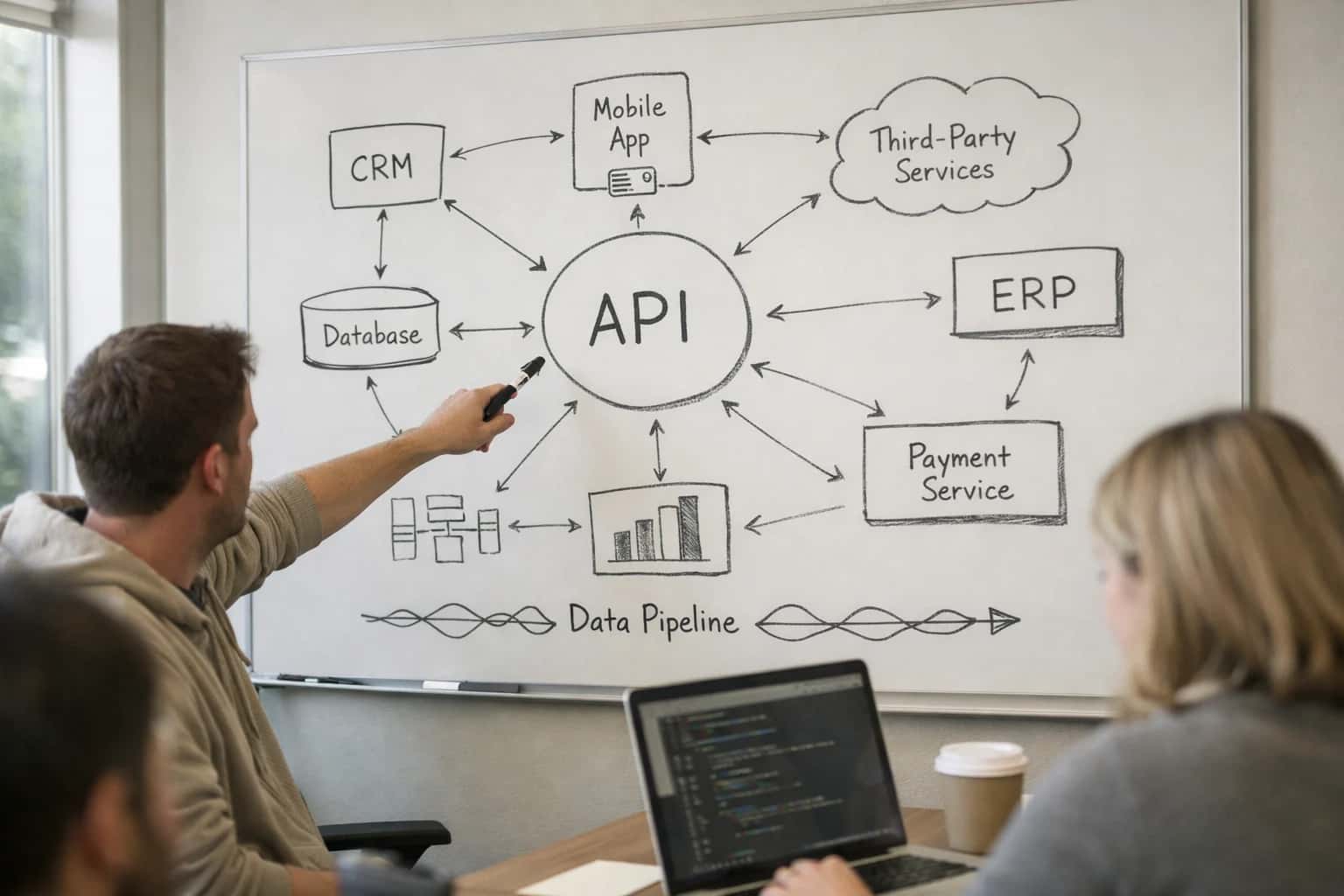
Enterprise integration architect reviewing API connections on laptop, diagram showing systems connecting, modern office setup.
ARCHITECTURE AND ROLLOUT

Where AI Fits into Monday.com Project Tracking

A practical guide to embedding AI agents and workflows into Monday.com's boards, automations, and dashboards for intelligent project management.

AI integrates with Monday.com by connecting to its GraphQL API and webhook ecosystem, treating boards as structured data sources and automations as execution surfaces. The primary integration points are:

  • Board Columns: Use status, timeline, number, and text columns as inputs for AI analysis (e.g., for health scoring) and outputs for AI-generated updates.
  • Automation Center: Embed AI decision nodes within "if-this-then-that" recipes to trigger intelligent actions, like reassigning a task based on sentiment analysis of an update.
  • Dashboard Widgets: Power widgets with live AI-generated insights, pulling aggregated data from multiple boards to show predictive metrics and trends.
  • Updates & Docs: Inject AI agents into comment threads and documents to summarize discussions, extract action items, or retrieve knowledge from connected items.


For a production rollout, start with a single high-value workflow, such as automated weekly status reporting. An AI agent can be scheduled to query the API for all items changed in the last week, analyze timeline shifts and status column updates, and then post a concise summary to a dedicated dashboard or send it via email. This moves reporting from a manual, hours-long process to a near-instantaneous one. Another common pattern is a risk detection copilot that monitors timeline and dependency columns, using a simple model to flag items where the planned end date is approaching but status hasn't progressed, and automatically creates a "Risk" subitem or tags the project manager.

Governance is managed through Monday.com's existing permissions and audit logs. AI actions should be performed by a dedicated integration service account, and all mutations (like updating a status or posting a comment) are logged in the board's activity stream. For sensitive data, implement a human-in-the-loop step where the AI suggests an action (e.g., "Recommend pushing deadline by 2 days") but requires a user to approve it via a button in an update. Roll out incrementally: first to a pilot team's board, use the feedback to refine prompts and data sources, then scale via Monday.com's tags and groups to manage which boards and users are in scope. For related architectural patterns, see our guides on /integrations/project-and-portfolio-management-platforms/ai-integration-for-mondaycom-api and /integrations/project-and-portfolio-management-platforms/ai-integration-for-mondaycom-dashboards.

ARCHITECTURAL BLUEPRINT

Key Integration Surfaces in Monday.com

Boards & Columns: The Primary Data Layer

Monday.com boards are the central data model for AI integration. Each column type represents a structured field for AI input and output.

Key Integration Points:

  • Text, Long Text, and Note Columns: Serve as the primary surface for AI-generated content like status summaries, risk descriptions, and action items. Use webhooks to trigger AI analysis when these fields are updated.
  • Status, Dropdown, and Tags Columns: Ideal for AI to set categorical outputs like project health scores (On Track, At Risk, Delayed), priority levels, or risk categories based on analysis of other board data.
  • Timeline, Date, and Numbers Columns: Enable AI to read project schedules and metrics, then write back forecasted dates, adjusted estimates, or calculated confidence scores.

Implementation Pattern: Configure Monday.com automations to send item updates (via webhook) to your AI service when key columns change. The AI processes the board's context and writes back insights into designated output columns.

MONDAY.COM INTEGRATION PATTERNS

High-Value AI Use Cases for Project Tracking

Connect AI directly to Monday.com's boards, automations, and dashboards to transform static project tracking into an intelligent, predictive system. These patterns use the GraphQL API, webhooks, and custom columns to embed AI into core workflows.

01

Automated Status Reporting & Health Scoring

AI analyzes timeline columns, status indicators, and weekly updates across linked boards to generate consolidated health scores and narrative summaries. It posts insights to a dedicated dashboard board and tags at-risk items.

Hours -> Minutes
Report generation
02

Intelligent Request Triage & Board Creation

Connect AI to Monday.com forms. When a request is submitted, AI classifies the project type, estimates effort based on historical data, and automatically creates a new board with pre-populated groups, columns, and assigned owners based on capacity.

Batch -> Real-time
Intake workflow
03

Predictive Timeline & Dependency Management

An AI agent monitors dependency columns and timeline changes. It predicts cascade effects of delays, identifies new critical path tasks, and sends proactive alerts via updates or automations to suggest resequencing.

1 sprint
Lead time on delays
04

AI-Powered Retrospective & Process Insights

At the end of a sprint or project phase, AI analyzes completed item data, cycle times, and comment threads from the board. It generates retrospective summaries highlighting bottlenecks and suggesting process improvements for the next phase.

Same day
Insight delivery
05

Capacity Forecasting & Workload Balancing

By reading person columns and timeline data across multiple boards, an AI model forecasts team capacity, identifies overallocation weeks in advance, and recommends task redistribution or start date adjustments via board updates.

06

Document Intelligence for Task Creation

AI integrates with files attached to Monday.com items. It summarizes project briefs, SOWs, or meeting notes attached to a board, then automatically creates subtasks, populates description fields, and sets deadlines based on the extracted content.

Hours -> Minutes
Document processing
IMPLEMENTATION PATTERNS

Example AI-Powered Tracking Workflows

These concrete workflows illustrate how to connect AI agents to Monday.com's boards, automations, and API to automate project tracking, generate insights, and reduce manual oversight. Each pattern includes the trigger, data flow, AI action, and system update.

Trigger: A scheduled daily automation or a change in a key timeline column (e.g., "Due Date").

Context/Data Pulled: The AI agent queries the Monday.com GraphQL API for a specific board, retrieving:

  • Status column values for all items.
  • Timeline/Date column values.
  • Numeric columns like "Budget vs. Actual."
  • Recent update comments from the "Updates" section.

Model/Agent Action: A lightweight LLM call (e.g., GPT-4) analyzes the data against predefined criteria to generate a health score (e.g., Red/Yellow/Green) and a brief rationale.

System Update/Next Step: The agent writes back to the board via API:

  1. Updates a "Health Score" status column with the color.
  2. Posts a summary comment in the item's updates.
  3. If the score is "Red," it triggers a Monday.com automation to:
    • Send an email alert to the project lead.
    • Create a follow-up task in a "Critical Issues" board.

Human Review Point: The project lead reviews the AI-generated rationale and alert, confirming or overriding the assessment.

BUILDING A PRODUCTION-READY AI LAYER

Implementation Architecture: Data Flow & System Design

A practical blueprint for connecting AI models to Monday.com's work OS to automate project tracking, health scoring, and forecasting.

A robust integration connects Monday.com's GraphQL API and webhooks to an external AI service layer. The core data flow begins with the AI service subscribing to webhooks for key events like item_created, column_value_changed, and update_created on relevant boards. When triggered, the service fetches the full item context—including timeline columns, status indicators, dependencies, and recent updates—via optimized GraphQL queries. This structured project data is then packaged into a prompt context for an LLM, which is tasked with generating a real-time health score, a confidence-adjusted forecast, and a narrative summary of risks and blockers.

The AI service writes its analysis back into Monday.com using mutations to update specific columns designed as integration surfaces. A typical implementation uses these column types:

  • A "Health Score" number column for a 1-100 score.
  • A "Forecast Status" status column with values like On Track, At Risk, Delayed.
  • A "AI Insights" long text column for the narrative summary and recommended actions. These updates can then trigger native Monday.com automations—like notifying the project lead or moving an item to a "Review" group—creating a closed-loop intelligent workflow. For governance, all AI-generated content should be logged with traceability back to the source item and user, and a human-in-the-loop approval step can be configured for critical status changes before they are committed.

Rollout follows a phased approach: start with a single pilot board, using a dedicated "AI Agent" user account for all mutations to maintain a clear audit trail. Monitor the accuracy of forecasts and health scores, refining the prompt logic and data points used. Once validated, the integration can be scaled using Monday.com's workspace-level webhooks and board templates to deploy the AI-enhanced tracking columns and automations across multiple teams. The final architecture ensures AI acts as a copilot to the project manager, providing data-driven insights while leaving final decisions and updates in human hands.

AI INTEGRATION PATTERNS

Code & Payload Examples

Real-Time Project Health Scoring

This pattern uses Monday.com's GraphQL API to fetch board data—timeline columns, status indicators, and updates—and passes it to an AI model for analysis. The model returns a health score and narrative summary, which is written back to a custom column.

Key Integration Points:

  • GraphQL Query: Fetch items with specific column values (dates, status, numbers).
  • Webhook Listener: Trigger analysis on column value changes or item updates.
  • Custom Column: Store the AI-generated health score (e.g., "AI Health") and summary text.

Example Payload to AI Model:

json
{
  "board_id": "1234567890",
  "items": [
    {
      "name": "Q3 Launch Campaign",
      "status": "Working on it",
      "timeline_start": "2024-07-01",
      "timeline_end": "2024-09-15",
      "percent_complete": 65,
      "last_updated": "2024-08-20T14:30:00Z",
      "updates_last_7_days": 12
    }
  ],
  "analysis_request": "Calculate overall project health score (0-100) and a one-line risk summary."
}

The AI response is then used to update the board via a change_column_value mutation.

AI-POWERED PROJECT TRACKING

Realistic Time Savings & Operational Impact

This table illustrates the tangible efficiency gains and operational improvements achievable by integrating AI agents with Monday.com's boards, automations, and reporting surfaces.

Workflow / MetricBefore AI IntegrationAfter AI IntegrationImplementation Notes

Weekly Status Report Generation

Manual compilation across 5-10 boards (2-4 hours)

Automated synthesis & narrative drafting (15-20 minutes)

AI agent queries Monday.com API, analyzes updates & timeline changes, posts to doc column

Project Health Scoring

Subjective review by PM; updated sporadically

Automated scoring based on column logic & timeline analysis

AI evaluates status, due dates, dependency columns; updates a 'Health Score' number column

Risk & Delay Detection

Reactive discovery in weekly syncs

Proactive alerts on timeline slippage & blocked tasks

AI monitors date columns & dependency changes; posts alerts to update or via integration (Slack/Email)

Stakeholder Briefing Prep

Manual data pull and slide creation (3-5 hours)

AI-generated executive summary with key metrics (30 minutes)

Agent aggregates data from portfolio boards, highlights trends, drafts narrative for review

Backlog Prioritization

Manual scoring and ranking in planning sessions

AI-assisted scoring based on custom field inputs

AI analyzes 'Impact', 'Effort', and 'Strategic Alignment' columns to suggest a ranked order

Automated Meeting Follow-ups

Manual note-taking and task creation

Action item extraction & Monday.com task creation

AI processes meeting transcripts/notes, creates tasks with owners & due dates in relevant boards

Resource Allocation Checks

Manual review of Workload view or spreadsheets

AI flagging of potential over/under-utilization

Analyzes 'Assignee' and 'Timeline' columns across boards to suggest balancing adjustments

ARCHITECTING CONTROLLED DEPLOYMENT

Governance, Security, and Phased Rollout

A practical framework for implementing, securing, and scaling AI within Monday.com without disrupting existing workflows.

A production-grade integration treats Monday.com as a system of record, not a sandbox. Governance starts with defining which boards, columns, and automations are in scope. Use Monday.com's item, update, and board-level permissions to create a dedicated service account for the AI agent, limiting its access to specific workspaces. All AI-initiated changes—like updating a status column, adding a timeline comment, or modifying a custom number field—should be performed via this authenticated service account, creating a clear audit trail in Monday.com's activity log. For data leaving the platform, implement a secure middleware layer that handles API calls, manages rate limits, and logs all prompts and responses before any data is sent to an LLM like OpenAI or Anthropic.

A phased rollout mitigates risk and builds confidence. Start with a read-only analysis phase in a single pilot board. Here, the AI system consumes data from columns like Timeline, Status, and Numbers to generate health scores and forecast summaries, posting them as comments or updates for manual review. Next, move to a controlled write-back phase in a non-critical project. Configure Monday.com automations to trigger AI analysis via webhook when specific conditions are met (e.g., a status changes to 'At Risk'). The AI can then calculate a new forecast date and write it to a dedicated 'AI Forecast' column, but require a manual approval step or a manager's review column to be checked before any timeline is automatically adjusted. Finally, scale to autonomous, multi-board operations for trusted workflows, such as auto-generating weekly status reports that synthesize updates from linked boards and post them to a dedicated dashboard.

Security extends to the data payload. Never send sensitive PII or financial data from custom fields directly to a public LLM. Use the middleware to strip or pseudonymize sensitive text from item names and updates before processing. For compliance, maintain a separate vector store of historical project data (like past delays and resolutions) to enable grounded, context-aware RAG that keeps proprietary reasoning in-house. Rollout success is measured by reduced manual reporting time and earlier risk detection, not by full automation. Plan for a human-in-the-loop checkpoint to remain, where major timeline shifts or priority changes suggested by the AI are presented to the board owner via a Monday.com notification for a final 'Approve' click.

IMPLEMENTATION DETAILS

Frequently Asked Questions

Practical answers to common technical and operational questions about integrating AI agents and workflows into Monday.com for intelligent project tracking.

The integration uses Monday.com's OAuth 2.0 authentication and operates under a dedicated service account with scoped API permissions. Security is enforced through:

  • Principle of Least Privilege: The AI agent's token is granted only the specific boards:read, boards:write, and updates:write scopes needed for its workflows.
  • API Key Management: Credentials are never hard-coded; they are managed in a secure secrets vault (e.g., AWS Secrets Manager, Azure Key Vault).
  • Audit Trail: All AI-generated updates, column changes, or item creations are tagged with a source: ai_agent custom field or noted in the update text, creating a clear audit log.
  • Data Residency: Your Monday.com data is not used to train public models. The AI processes data in-memory within your cloud environment (e.g., AWS, GCP, Azure) and only sends necessary context to the LLM API.

For a deeper look at secure API patterns, see our guide on AI Integration for Monday.com API.

Prasad Kumkar

About the author

Prasad Kumkar

CEO & MD, Inference Systems

Prasad Kumkar is the CEO & MD of Inference Systems and writes about AI systems architecture, LLM infrastructure, model serving, evaluation, and production deployment. Over 5+ years, he has worked across computer vision models, L5 autonomous vehicle systems, and LLM research, with a focus on taking complex AI ideas into real-world engineering systems.

His work and writing cover AI systems, large language models, AI agents, multimodal systems, autonomous systems, inference optimization, RAG, evaluation, and production AI engineering.


