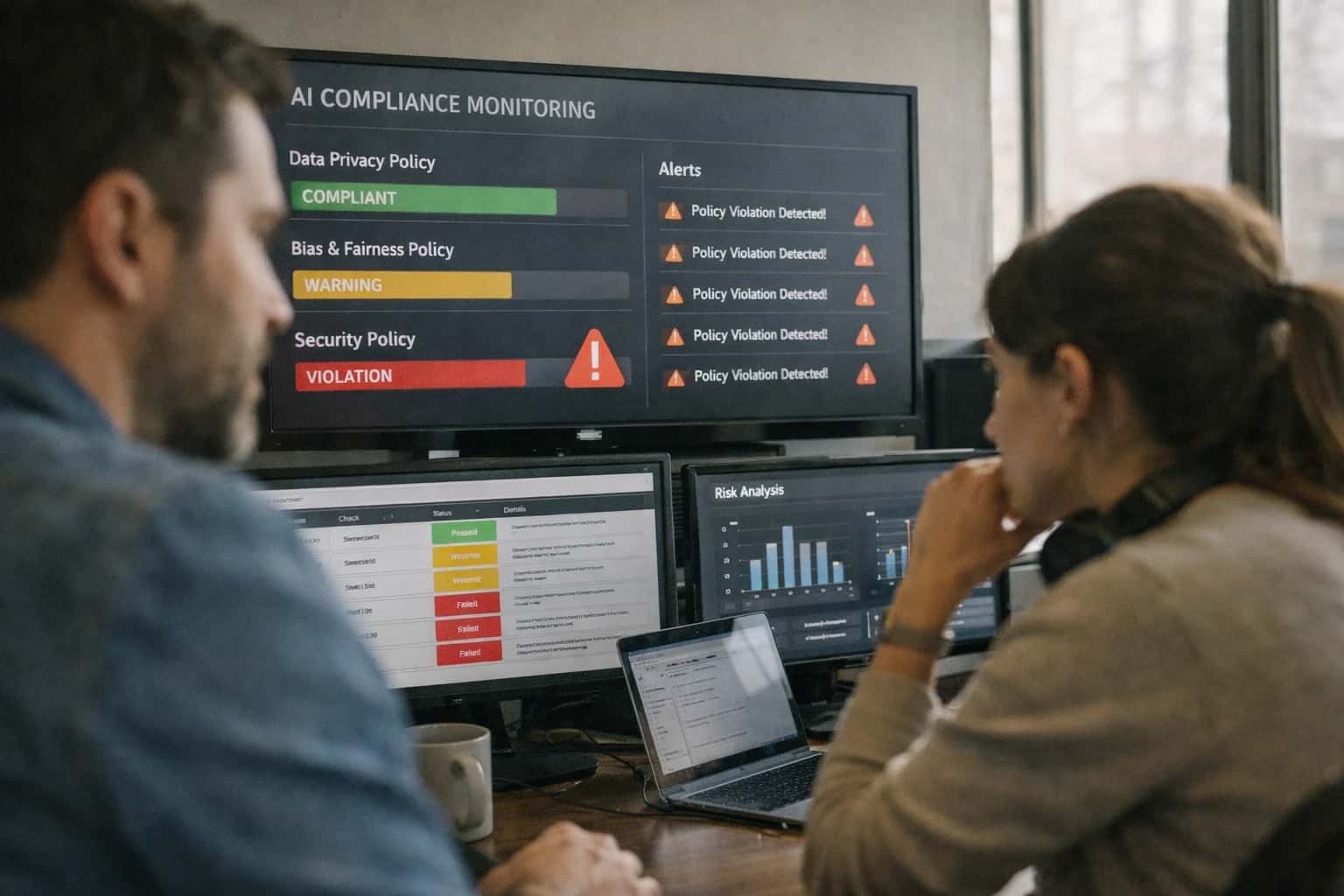
AI integration targets specific surfaces within SAP DM's compliance architecture: the Electronic Batch Record (EBR), electronic signatures (eSignatures), audit trails for data changes, and the change control management workflows. By connecting to SAP DM's OData APIs and event-driven services, AI models can be triggered to analyze records in real-time. For example, an AI agent can continuously monitor the sf_compliance_log table for anomalies in user actions or data modifications, flagging sequences that deviate from standard operating procedures (SOPs) for immediate review by quality assurance.

Integration
AI Integration for SAP Digital Manufacturing for Compliance
Add AI to SAP DM's compliance workflows to automate audit trail monitoring, validate electronic signatures, assess change control impacts, and reduce manual review cycles from days to hours.
ARCHITECTURE & GOVERNANCE
Where AI Fits into SAP DM's Compliance Workflows
Integrating AI into SAP Digital Manufacturing's compliance layer automates audit trail monitoring, signature validation, and change control, reducing manual oversight and accelerating regulated production.
Implementation focuses on augmenting, not replacing, existing validation steps. A common pattern is to deploy a lightweight AI service that subscribes to SAP DM's Business Logic Services (BLS) or Cloud Integration events. When a batch record is completed or a change request is submitted, the service receives a payload containing the relevant IDs. It then retrieves the full context—such as the ProductionOrder, MaterialDocument, and linked QualityInfoRecords—and uses a rules-based or LLM-powered model to assess compliance risk. High-value use cases include:
- Automated Audit Trail Review: Scanning thousands of log entries post-production to identify unsigned actions or out-of-sequence operations.
- eSignature Workflow Validation: Cross-referencing signatories against current training certifications and approval matrices stored in SAP SuccessFactors or SAP S/4HANA.
- Change Control Impact Assessment: Analyzing the proposed change against historical non-conformances and current work-in-process to predict disruption risk.
Governance and rollout require a phased approach. Start with a read-only AI analysis that generates alerts in a separate dashboard or via SAP Fiori notifications, allowing QA teams to build trust in the AI's findings. For production use, integrate the AI's output back into SAP DM's workflow engine—for instance, automatically escalating a flagged batch to a HOLD status in the QualityManagement module. Critical to success is maintaining a human-in-the-loop for final decisions and ensuring all AI actions are themselves logged in a dedicated audit trail. This creates a closed-loop system where the AI's performance can be monitored and refined, ensuring it aligns with evolving regulatory standards like FDA 21 CFR Part 11 or EU Annex 11.
AUTOMATED AUDIT, SIGNATURE, AND CHANGE CONTROL
Key SAP DM Compliance Surfaces for AI Integration
Continuous Audit Trail Analysis
SAP Digital Manufacturing's audit trail captures every user action, data change, and system event—a critical but voluminous record for regulated environments. AI integration focuses on this log to automate compliance oversight.
Key integration surfaces include the Audit Log Service API and the underlying change document tables (e.g., CDHDR, CDPOS equivalents). AI models are applied to:
- Anomaly Detection: Identify unusual patterns of access or data modification outside of standard workflows, such as mass deletions or parameter changes outside approved windows.
- Trend Analysis: Correlate audit events with production outcomes (e.g., a spike in parameter adjustments preceding a quality deviation).
- Automated Reporting: Generate narrative summaries of audit activity for periodic reviews, highlighting exceptions and user compliance rates.
Implementation typically involves a streaming pipeline that ingests audit events, enriches them with user role and context data, and runs inference to flag items for human review. This shifts compliance from a periodic manual audit to a continuous, automated control.
SAP DIGITAL MANUFACTURING
High-Value AI Use Cases for Compliance
Integrate AI directly into SAP Digital Manufacturing's compliance workflows to automate audit trail monitoring, validate electronic signatures, assess change control impacts, and accelerate regulatory reporting.
01
Automated Audit Trail Monitoring
Continuously analyze SAP DM's electronic audit trails for anomalies, unauthorized changes, or procedural gaps. AI models flag deviations from standard operating procedures (SOPs) in real-time, such as out-of-sequence operations or missing data entries, triggering immediate review workflows. This shifts compliance from periodic manual audits to continuous, automated surveillance.
Continuous → Periodic
Monitoring cadence
02
Electronic Signature & Identity Validation
Augment SAP DM's electronic signature workflows with AI-driven anomaly detection. Analyze signature timestamps, geolocation (if available), and user role patterns to flag potentially fraudulent or mistaken sign-offs on critical records like batch releases, equipment clearances, or deviation approvals. Integrates with IAM systems for enhanced identity confidence.
Same day
Anomaly detection
03
Change Control Impact Assessment
Automate the initial impact assessment for Engineering Change Orders (ECOs) and manufacturing procedure updates. AI analyzes the change against historical production data, active work orders, and inventory levels within SAP DM to predict effects on yield, compliance status, and equipment readiness. Generates a risk-scored report for the change control board.
Hours -> Minutes
Assessment time
04
Automated Regulatory Report Drafting
Generate first drafts of compliance reports (e.g., FDA 483 responses, annual product reviews) by extracting and synthesizing data from SAP DM's production records, quality events, and corrective actions. AI structures narrative summaries of deviations, CAPA effectiveness, and process performance trends, reducing manual data compilation from weeks to days.
Weeks -> Days
Report preparation
05
Dynamic Sampling Plan Optimization
Integrate AI with SAP DM's inspection planning to dynamically adjust sampling frequencies and sizes based on real-time process capability (Cp/Cpk) and supplier performance data. Moves quality checks from fixed, resource-intensive schedules to risk-based, adaptive plans that maintain compliance while reducing inspection labor.
Batch -> Real-time
Plan adjustment
06
Deviation Triage & Root Cause Suggestion
When a nonconformance is logged in SAP DM, AI immediately analyzes similar historical deviations, correlating them with process parameters, material lots, and equipment states from the time of the event. Suggests the most probable root cause categories and relevant corrective actions, accelerating the initial investigation phase of the quality workflow.
1 sprint
Investigation acceleration
SAP DIGITAL MANUFACTURING
Example AI-Augmented Compliance Workflows
These workflows illustrate how AI agents can be embedded into SAP Digital Manufacturing's compliance and regulatory processes, automating audit trail monitoring, electronic signature validation, and change control impact assessment.
Trigger: A user action (e.g., data change, production order confirmation, parameter adjustment) is logged to the SAP DM audit trail.
Context/Data Pulled: The AI agent subscribes to audit trail events via SAP DM's OData APIs or event-driven architecture. It pulls the last 72 hours of audit entries for the same object type, user role, and shift pattern for contextual comparison.
Model or Agent Action: A lightweight anomaly detection model analyzes the new entry against historical patterns, flagging unusual sequences (e.g., a quality inspector approving a batch outside normal hours, a parameter change exceeding typical delta, back-to-back sign-offs by the same user in rapid succession).
System Update or Next Step: High-confidence anomalies are automatically routed as notifications to the Compliance Manager's Fiori inbox with a pre-populated investigation link. The audit trail entry is tagged with a AI_Flagged_For_Review status.
Human Review Point: The Compliance Manager reviews the flagged entry and either clears the flag or escalates it to a formal deviation record in SAP DM's Nonconformance Management module, initiating a CAPA workflow.
AUDIT TRAIL MONITORING & CHANGE CONTROL
Implementation Architecture: Data Flow & Integration Patterns
A production-ready AI integration for SAP Digital Manufacturing connects to its event-driven data fabric to automate compliance workflows.
The integration architecture centers on SAP Digital Manufacturing's OData APIs and its native event publishing framework. Key data objects for compliance include ProductionOrder, ProcessOrder, QualityInspectionResult, EquipmentEvent, and the AuditLog itself. AI models are deployed as a microservice layer that subscribes to these real-time events—such as a user override, a parameter change, or a batch completion—to perform continuous audit trail monitoring. For electronic signature validation, the service validates the ElectronicSignature object against configured approval matrices and user roles, flagging any sequence breaks or missing authorizations in real-time before the transaction is committed.
For change control impact assessment, the AI service taps into the BillOfMaterial, Routing, and ChangeDocument APIs. When an engineering change order (ECO) is released from an integrated PLM system, the AI analyzes the delta against active production orders and work-in-process (WIP) to predict potential compliance risks, material obsolescence, or rework requirements. This analysis is then formatted into a structured impact report and posted back to SAP DM as a Notification or Task, triggering a governed review workflow. The system uses a vector database to retrieve similar past changes and their outcomes, grounding the AI's recommendations in historical plant data.
Governance is enforced through a dedicated middleware layer that manages API rate limits, handles authentication via SAP's identity services, and maintains a full audit trail of all AI inferences and actions. All AI-generated flags or suggested actions are routed through a human-in-the-loop approval step within the SAP Fiori interface before any system record is modified. This ensures the integration augments—rather than bypasses—existing quality gates and electronic signature requirements, maintaining full 21 CFR Part 11 and GMP compliance. Rollout typically begins with a single high-risk workflow, such as automated audit trail anomaly detection for sterility processes, before expanding to full change control impact assessment.
AI-ENHANCED COMPLIANCE WORKFLOWS
Code & Payload Examples
Real-Time Audit Log Analysis
SAP Digital Manufacturing's OData APIs expose detailed audit trails for user actions, data changes, and system events. An AI agent can be configured to monitor these logs in real-time, identifying patterns that indicate compliance risks, such as unauthorized access attempts or deviations from standard operating procedures.
Example Workflow:
- A Python service polls the
AuditLogentity set via OData. - Log entries are streamed to an LLM with a prompt to classify the event's risk level and summarize the context.
- High-risk events trigger an automated notification in SAP DM or create a nonconformance record for investigation.
python# Example: Polling SAP DM OData for Audit Logs import requests # SAP DM OData endpoint for audit logs url = "https://<your-instance>.sapdm.com/sap/opu/odata/sap/API_AUDIT_LOG_SRV/AuditLog" headers = { "Authorization": "Bearer <access_token>", "Accept": "application/json" } # Fetch recent logs with a filter for today params = { "$filter": "creationDate ge datetime'2024-01-15T00:00:00'" } response = requests.get(url, headers=headers, params=params) logs = response.json().get('d', {}).get('results', []) # Send log batch to LLM for analysis for log in logs: # Construct a prompt with log details prompt = f"""Analyze this manufacturing audit log for compliance risk: User: {log.get('userName')} Action: {log.get('action')} Object: {log.get('objectType')} Timestamp: {log.get('creationDate')} Details: {log.get('changeDescription')} Return a JSON with 'risk_level' (HIGH, MEDIUM, LOW) and 'summary'.""" # Call LLM API (e.g., OpenAI, Anthropic) # ... LLM processing logic ...
SAP DIGITAL MANUFACTURING FOR COMPLIANCE
Realistic Time Savings & Operational Impact
This table illustrates the tangible workflow improvements and risk reduction achievable by integrating AI into SAP Digital Manufacturing's compliance modules. Impact is measured in time saved, manual effort reduced, and audit readiness improved.
| Compliance Workflow | Before AI | After AI | Key Impact & Notes |
|---|---|---|---|
Electronic Batch Record (EBR) Review | Manual, line-by-line verification by QA | AI-assisted anomaly flagging & summarization | Review time: 4-8 hours → 1-2 hours. Human reviewer focuses on flagged exceptions only. |
Audit Trail Monitoring | Periodic sampling or reactive investigation | Continuous AI monitoring for anomalous user actions | Detection: Next audit cycle → Real-time alerts. Proactive risk mitigation for 21 CFR Part 11 compliance. |
Change Control Impact Assessment | Manual cross-referencing of affected documents & processes | AI-driven impact analysis across BOMs, routings, and specs | Assessment: 1-2 days → 2-4 hours. Reduces risk of missing downstream dependencies. |
Electronic Signature Validation | Checklist-based manual verification post-process | Automated validation against user roles & record state | Verification: Per batch → Continuous. Ensures ALCOA+ principles are enforced in real-time. |
Deviation & CAPA Triage | Manual classification and routing based on keyword search | AI-powered initial classification & similarity matching to past events | Triage time: 30-60 mins → 5-10 mins. Accelerates containment and routes to correct SME. |
Regulatory Submission Data Pull | Manual extraction and formatting from multiple MES reports | AI-automated data aggregation and narrative drafting | Preparation: Days → Hours. Creates audit-ready data packages for FDA, EMA, etc. |
Environmental Monitoring Alert Review | Manual trend spotting across sensor data logs | AI-driven pattern recognition for excursions and drift | Analysis: Daily review → Exception-based. Predicts potential excursions before they breach limits. |
ENSURING CONTROLLED, AUDITABLE AI FOR REGULATED MANUFACTURING
Governance, Security & Phased Rollout
Integrating AI into SAP Digital Manufacturing for compliance requires a deliberate architecture that prioritizes data integrity, auditability, and controlled user access.
Implementation begins by mapping the AI's data access and write permissions to SAP DM's existing authorization objects (e.g., MES_PROC_ORD, MES_QUAL_INSP) and user roles (Operator, Quality Engineer, Supervisor). AI agents are configured as a dedicated technical user with a traceable audit log, ensuring every automated review, signature validation, or change assessment is recorded in the system's electronic audit trail (CDHDR/CDPOS). For workflows like automated audit trail monitoring, the AI operates in a read-only "observer" mode initially, flagging anomalies for human review before any corrective actions are suggested or taken.
A phased rollout is critical for user adoption and risk management. Phase 1 typically focuses on assistive intelligence—such as using AI to pre-populate audit checklists or highlight potential deviations in electronic batch records for a quality engineer's final approval. Phase 2 introduces controlled automation for low-risk, repetitive tasks like validating that all required electronic signatures on a device history record (DHR) are present and in sequence. Phase 3, after establishing trust and refining guardrails, enables prescriptive actions, such as the AI automatically creating a minor deviation record in SAP DM when it detects a procedural anomaly in the audit trail that matches a pre-approved pattern.
Security is enforced at multiple layers. Sensitive data (e.g., personnel information in signatures) is masked or pseudonymized before being sent to the AI model for processing. All prompts, model inferences, and user feedback are logged in a separate AI governance platform (linked to the SAP DM audit log by transaction ID) for performance monitoring, drift detection, and regulatory scrutiny. This creates a closed-loop system where the AI's impact on compliance workflows is itself fully compliant, traceable, and reversible.
Enabling Efficiency, Speed & Accuracy
Intelligent Analysis, Decision & Execution
We build AI systems for teams that need search across company data, workflow automation across tools, or AI features inside products and internal software.
Talk to Us
Search across company data
Give teams answers from docs, tickets, runbooks, and product data with sources and permissions.
Useful when people spend too long searching or get different answers from different systems.
Enterprise searchRAGPermissions
Read more
Automate internal workflows
Use AI to route work, draft outputs, trigger actions, and keep approvals and logs in place.
Useful when repetitive work moves across multiple tools and teams.
AI agentsWorkflow automationGovernance
Read more
Add AI to products and internal tools
Build assistants, guided actions, or decision support into the software your team or customers already use.
Useful when AI needs to be part of the product, not a separate tool.
AI integrationDecision supportModel routing
Read moreIMPLEMENTATION AND WORKFLOW DETAILS
Frequently Asked Questions
Common technical and operational questions about integrating AI into SAP Digital Manufacturing for compliance, audit, and regulatory workflows.
This workflow continuously analyzes the SAP DM audit log (table AUDIT_LOG_*) for suspicious patterns that indicate potential compliance risks.
Typical Flow:
- Trigger: A scheduled job (e.g., every 15 minutes) or a CDC stream from the audit log database.
- Context Pulled: The AI agent retrieves the latest audit entries, focusing on key objects:
ProductionOrder,Resource,MaterialDocument,InspectionLot, andNonConformance. It enriches this with user role data fromUSR02. - Agent Action: A pre-trained model (or rules engine) evaluates entries against patterns:
- After-hours modifications to master data like recipes or inspection plans.
- Sequence breaks in electronic signatures (e.g., an approval before a verification).
- High-frequency access to sensitive transactions by a single user.
- Deletion or reversal of critical process data post-confirmation.
- System Update: The agent creates a
ComplianceAlertrecord in a custom Z-table, classifying the risk (High/Medium/Low) and linking to the original audit entries. - Human Review Point: Alerts are routed via workflow to the Quality Assurance or IT security team within SAP Fiori. The agent can suggest initial containment steps, such as temporarily suspending a user's
PFCGrole.

About the author
Prasad Kumkar
CEO & MD, Inference Systems
Prasad Kumkar is the CEO & MD of Inference Systems and writes about AI systems architecture, LLM infrastructure, model serving, evaluation, and production deployment. Over 5+ years, he has worked across computer vision models, L5 autonomous vehicle systems, and LLM research, with a focus on taking complex AI ideas into real-world engineering systems.
His work and writing cover AI systems, large language models, AI agents, multimodal systems, autonomous systems, inference optimization, RAG, evaluation, and production AI engineering.
LinkedIn
Limited slotsGet a Free AI Consultation
Partnered with leading AI, data, and software stack.





How We Work
Custom AI workflows for your Business
One-fit-all AI don't work for modern businesses. At Inferensys, we aim to understand your business & custom requirements; which we use to define most efficient agentic workflows, the data, and the tools for your business.
01
Review the use case
We understand the task, the users, and where AI can actually help.
Read more02
Pick the right approach
We define what needs search, automation, or product integration.
Read more03
Build the first useful version
We implement the part that proves the value first.
Read more04
Improve from there
We add the checks and visibility needed to keep it useful.
Read moreThe first call is a practical review of your use case and the right next step.
Talk to Us