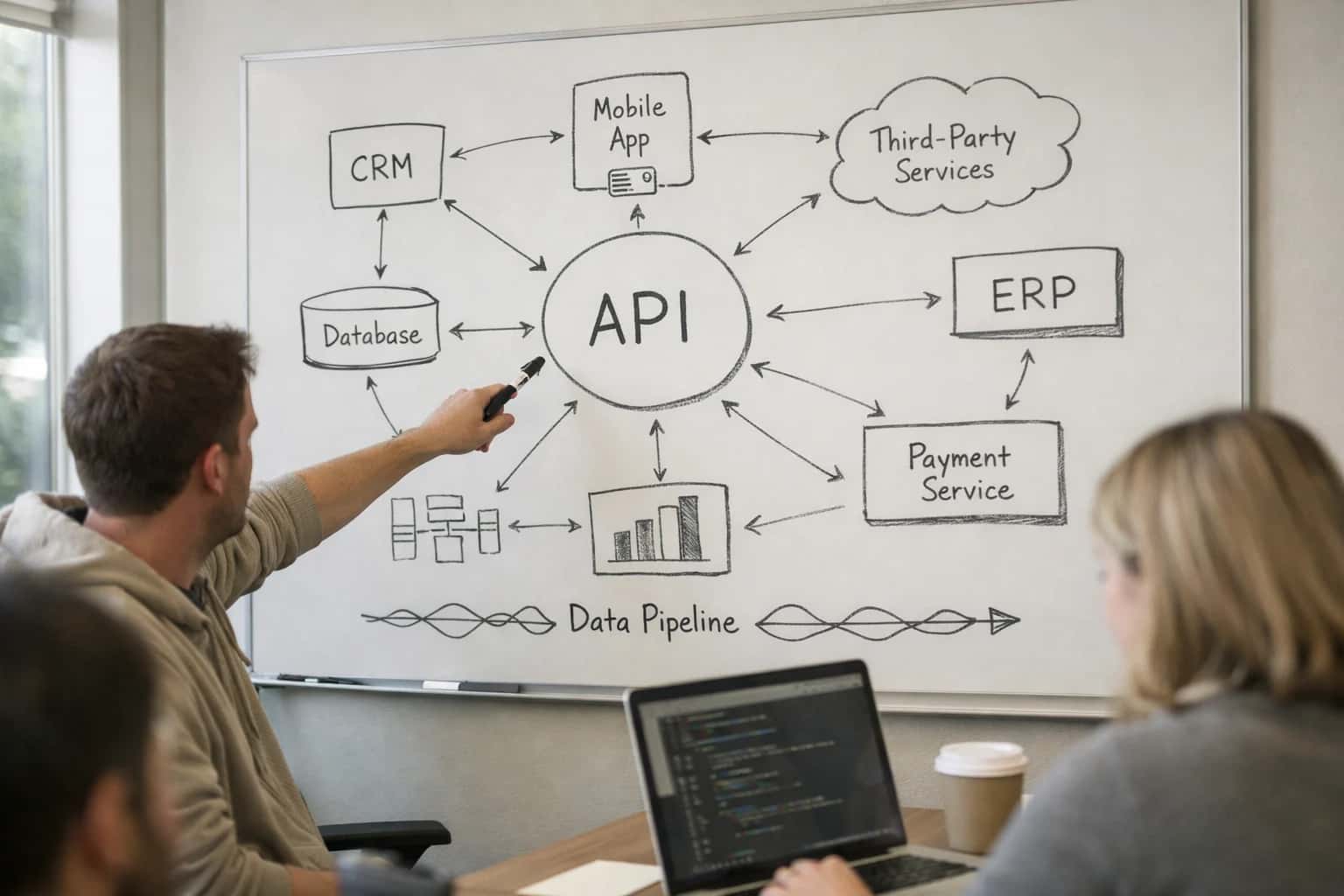
An effective AI-powered HR assistant is not a standalone chatbot; it's a secure orchestration layer that connects to your core HRIS—like Workday, UKG, or BambooHR—via APIs and webhooks. Its primary surfaces are the conversational interface for employees and a governance console for HR administrators. The assistant's intelligence is grounded in real-time access to HRIS objects: Employee, Job, Compensation, Benefit_Election, Time_Off_Request, and Onboarding_Checklist. It acts as a policy-aware agent, interpreting natural language queries, retrieving sanctioned data, and executing approved transactions like submitting a leave request or updating a personal detail, all while maintaining a full audit trail back to the HRIS.

Integration
AI Integration for AI-Powered HR Assistants
Architectural blueprint for building enterprise-grade HR assistants that securely integrate with core HRIS platforms to automate support, answer policy questions, and execute approved transactions.
ARCHITECTURAL BLUEPRINT
Where AI Fits into the HR Assistant Stack
A practical guide to building enterprise-grade AI-powered HR assistants that are secure, auditable, and integrated with core HRIS systems.
Implementation centers on three integration patterns: 1) Query & Retrieve, where the assistant uses the HRIS API to fetch answers to questions about pay, policy, or PTO balances. 2) Transaction & Update, where it initiates workflows like benefits changes by calling specific API endpoints, often triggering existing HRIS approval chains. 3) Proactive Notification, where the assistant monitors HRIS events (like a promotion effective date) and initiates a guided journey for the manager or employee. The technical stack typically involves a RAG pipeline for policy documents, a vector database for semantic search over HR knowledge, and strict role-based access control (RBAC) synced from the HRIS to ensure data privacy. For example, an assistant can reduce HR ticket volume by deflecting common inquiries, turning a 24-hour email wait into a 30-second resolution.
Rollout requires a phased, use-case-driven approach. Start with low-risk, high-volume queries like "How many vacation hours do I have?" to build trust and validate the integration. Then, layer in guided transactional support for open enrollment or onboarding tasks. Governance is critical: every assistant interaction should log the user, timestamp, query, data retrieved, and any transaction ID from the HRIS for compliance. Implement a human-in-the-loop review for sensitive actions before progressing to full automation. This architecture ensures the assistant is a controlled extension of your HRIS, not a shadow IT system. For deeper patterns on connecting agents to specific platforms, see our guides on AI Integration for Workday and AI Integration for Employee Support Agents in HRIS.
ARCHITECTURAL BLUEPRINT
HRIS Integration Touchpoints for AI Assistants
Foundational Data Access
The primary integration surface for an AI assistant is the HRIS API layer. This provides secure, governed access to the core employee data model.
Key API Objects to Map:
- Worker/Employee: The central record for personal details, employment status, and manager hierarchy.
- Job & Position: Role, title, department, and cost center data for context-aware responses.
- Compensation: Pay structure, salary, and bonus information for manager guidance (with appropriate RBAC).
- Benefits Elections: Current enrollments for answering coverage questions during open enrollment.
- Time Off: Balances and requests to handle leave inquiries and automate approvals.
A well-architected assistant uses these APIs in a read-first, write-secondary pattern, executing transactions like submitting a time-off request only after explicit user confirmation and within strict policy guardrails.
ENTERPRISE-GRADE PATTERNS
High-Value Use Cases for Integrated HR Assistants
These integration patterns connect AI directly to core HRIS APIs and data models, enabling secure, transactional support and automation that scales with your workforce.
01
Employee Self-Service Agent
A conversational agent integrated via HRIS APIs (Workday Extend, BambooHR API) that answers policy questions, retrieves personal paystubs or PTO balances, and submits approved data changes like address updates. Reduces HR ticket volume by handling common, repetitive inquiries.
Hours -> Minutes
Inquiry resolution
02
Intelligent Onboarding Orchestrator
An AI workflow triggered from the HRIS upon hire that personalizes onboarding checklists, generates IT provisioning tickets, sends welcome communications, and answers new-hire questions. Integrates with IT service management and facilities systems for cross-departmental automation.
Batch -> Real-time
Task coordination
03
Manager Copilot for People Operations
An AI assistant embedded in manager dashboards that helps write performance feedback, guides compensation decisions using internal equity data, and explains team turnover risk scores sourced from HRIS analytics. Provides guardrails and consistency for people management.
1 sprint
Review cycle prep
04
Automated HR Case Triage & Routing
AI analyzes incoming HR service desk tickets (via email or portal), classifies them using HRIS data context (employee role, location), suggests knowledge base articles, and routes complex cases to the correct specialist. Improves first-response time and agent efficiency.
Same day
Initial routing
05
Compliance Monitoring & Alerting
Continuously scans HRIS records (UKG, ADP) for compliance risks: expired certifications, missing I-9 documents, or potential overtime violations. AI agents create cases, alert managers, and track remediation. Proactively manages regulatory exposure.
06
Personalized Learning & Skills Advisor
Connects AI to HRIS skills data (Workday Skills Cloud) and the corporate LMS. Recommends courses to close skill gaps for career paths, suggests mentors, and generates personalized development plans. Ties learning directly to internal mobility and retention.
HRIS INTEGRATION PATTERNS
Example AI Assistant Workflows
These concrete workflows illustrate how AI assistants connect to HRIS platforms like Workday, UKG, or BambooHR to automate tasks, answer questions, and trigger system updates. Each pattern follows a secure, auditable architecture suitable for enterprise deployment.
Trigger: An employee asks a question via a chat interface (e.g., Teams, Slack, HR portal) like "What's my remaining PTO?" or "How do I update my tax withholding?"
Context/Data Pulled: The AI assistant authenticates the user, then calls the HRIS API (e.g., Workday Get_Workers, UKG /personnel/v1/employees) to retrieve the employee's record, accrual balances, and relevant policy documents.
Model/Agent Action: A reasoning agent interprets the query, retrieves the specific data, and formulates a natural language answer grounded in the employee's data and company policy. For transactional requests (e.g., "submit a W-4 change"), the agent confirms intent and prepares the API call.
System Update/Next Step: For informational queries, the answer is displayed to the employee. For transactions, the agent executes a secure API call (e.g., Workday Submit_Change_Work_Contact_Information) to update the HRIS, returns a confirmation ticket number, and logs the transaction.
Human Review Point: Transactions exceeding a pre-defined risk threshold (e.g., direct deposit changes) are routed to an HR analyst for approval before the API call is executed, with the agent providing context for the reviewer.
SECURE, AUDITABLE, AND INTEGRATED
Implementation Architecture & Data Flow
A production-ready HR assistant is not a standalone chatbot; it's a governed system integrated with your core HRIS for data, workflows, and security.
The architecture is built around a central orchestration layer that sits between the conversational interface (e.g., Teams, Slack, web portal) and your HRIS (Workday, UKG, BambooHR, ADP). This layer handles intent recognition, manages conversation state, and executes approved actions. For data retrieval, it calls the HRIS's REST APIs (like Workday's workers, staffing, or benefits APIs) using service accounts with role-based access control (RBAC). For transactional workflows—such as submitting a time-off request or updating a home address—the agent constructs the correct API payload or triggers an existing Workday Business Process or UKG Pro workflow via webhook. All data flows are encrypted in transit, and the assistant only accesses the minimum employee data required for the task, adhering to the principle of least privilege.
A critical component is the retrieval-augmented generation (RAG) pipeline for policy and knowledge questions. This system ingests documents from your HR knowledge base, policy PDFs, and intranet pages into a vector database (like Pinecone or Weaviate). When an employee asks "What is our parental leave policy?", the query first searches this vector store for the most relevant, up-to-date text chunks. The LLM (e.g., GPT-4, Claude) is then grounded with these official sources to generate an accurate, cited answer, preventing hallucinations. This pipeline is kept in sync with your HRIS's document management module or CMS via scheduled syncs or change-event webhooks.
Governance and rollout are managed through a phased approach. Start with a read-only pilot focused on FAQ deflection and data lookup (e.g., "What are my remaining PTO hours?") to build trust and validate accuracy. All interactions are logged with a full audit trail—user ID, query, data accessed, response, and system actions—for compliance and continuous improvement. For the next phase, introduce controlled write-backs, such as initiating a benefits change during open enrollment, which should route through existing HRIS approval workflows. A human-in-the-loop review step can be configured for sensitive transactions before final submission, ensuring the AI agent acts as a copilot, not an autonomous actor.
HRIS INTEGRATION PATTERNS
Code & Payload Examples
Querying HRIS Data for Agent Responses
An AI assistant needs secure, real-time access to employee data to answer questions about policies, PTO balances, or org structure. This typically involves calling the HRIS API with the authenticated user's context to retrieve specific records.
Example: Fetching an Employee's Leave Balance via Workday REST API
pythonimport requests # Authenticate and obtain bearer token (OAuth 2.0 Client Credentials flow) auth_response = requests.post( 'https://wd2-impl-services1.workday.com/ccx/oauth2/tenant/token', data={'grant_type': 'client_credentials', 'client_id': CLIENT_ID, 'client_secret': CLIENT_SECRET} ) token = auth_response.json()['access_token'] # Construct query for the current user's leave balances headers = {'Authorization': f'Bearer {token}', 'Accept': 'application/json'} # The 'wd:worker' descriptor and 'Leave_of_Absence_Balance' data source are common Workday objects. query_response = requests.get( 'https://wd2-impl-services1.workday.com/api/v1/workers/{{workerID}}/leaveBalances', headers=headers, params={'as_of_date': '2024-05-01'} ) # Parse and format the balance for the AI agent's response balances = query_response.json() pto_balance = next((b for b in balances if b['leaveType'] == 'Paid Time Off'), {}) agent_response = f"Your current PTO balance is {pto_balance.get('availableBalance', 0)} hours."
This pattern ensures the AI agent provides accurate, personalized data without requiring the employee to navigate the HRIS UI.
AI-POWERED HR ASSISTANT INTEGRATION
Realistic Time Savings & Operational Impact
This table illustrates the operational impact of integrating an AI-powered assistant with your core HRIS (Workday, UKG, ADP, BambooHR). Metrics are based on typical enterprise HR operations before and after deploying a governed, API-connected agent.
| HR Workflow | Before AI Integration | After AI Integration | Implementation Notes |
|---|---|---|---|
Employee Policy & Pay Inquiry Resolution | 2-4 hours manual research by HR specialist | Instant, automated answer with source citation | Agent queries HRIS APIs and knowledge base; complex cases routed to human |
New Hire Onboarding Task Completion | 5-7 business days for full provisioning | 2-3 days with automated checklist and system triggers | AI orchestrates tasks across HRIS, IT, and facilities via pre-built connectors |
HR Case Triage & Routing | Manual review and assignment (15-30 mins per case) | Automated classification and routing (<1 min) | Uses ticket content and employee data from HRIS to route to correct queue |
Benefits Enrollment Support | 45-60 minute guidance sessions per employee | Personalized, self-guided AI assistant with plan comparison | Agent provides recommendations based on HRIS demographics and submits elections via API |
Payroll Anomaly Review | Manual audit of reports pre-payroll (4-8 hours monthly) | Continuous monitoring with weekly exception reports (1 hour review) | AI scans HRIS payroll data for outliers; flags for human review |
Manager Data Requests (Headcount, Turnover) | Ad-hoc report building by HR analyst (1-2 hours per request) | Natural language query answered in <30 seconds | AI uses HRIS reporting APIs or connected data warehouse; enforces data permissions |
Performance Review Feedback Drafting | Manager writes from scratch (60-90 mins per review) | AI-assisted drafting with examples and bias check (20-30 mins) | Integrates with HRIS performance module; suggests content based on goals and feedback |
ENTERPRISE-GRADE DEPLOYMENT
Governance, Security & Phased Rollout
A practical framework for deploying secure, governed AI assistants that integrate with your HRIS.
Production AI assistants must operate within the same security and compliance boundaries as your HRIS. This means integrating at the API layer with strict role-based access control (RBAC) enforced by your HRIS (e.g., Workday security groups, UKG roles). The AI agent should act as a proxy for the employee or manager, only accessing data and executing transactions the authenticated user is permitted to perform. All queries and actions must generate immutable audit logs that tie back to the original user session, and sensitive data flows should be encrypted in transit and at rest. For platforms like ADP or BambooHR, this often involves using OAuth 2.0 for secure authentication and scoping API calls to the minimum necessary data objects.
A successful rollout follows a phased, use-case-driven approach. Phase 1 typically starts with a read-only, high-volume use case like an employee policy Q&A agent that retrieves information from your HRIS knowledge base but executes no writes. This builds trust and isolates risk. Phase 2 introduces simple transactional support, such as automated paid time off (PTO) balance checks or benefits enrollment guidance, where the agent can trigger predefined, low-risk workflows via HRIS webhooks or APIs. Phase 3 expands to complex orchestration, like onboarding workflow automation that interacts with the HRIS, IT ticketing system, and facilities software, requiring robust error handling and human-in-the-loop approvals for exceptions.
Governance is continuous. Establish a cross-functional review board (HR, IT, Legal, Security) to approve new agent capabilities and prompts. Implement regular audits of the AI's interactions to check for drift, bias, or compliance issues. Use the HRIS's own change management workflows (like those in Workday Extend) to manage deployments. For sensitive actions—such as submitting a promotion recommendation or adjusting a compensation record—always require explicit user confirmation before the AI agent commits the transaction via the API. This layered approach ensures the AI augments your HR operations without introducing unmanaged risk or compromising data integrity.
Enabling Efficiency, Speed & Accuracy
Intelligent Analysis, Decision & Execution
We build AI systems for teams that need search across company data, workflow automation across tools, or AI features inside products and internal software.
Talk to Us
Search across company data
Give teams answers from docs, tickets, runbooks, and product data with sources and permissions.
Useful when people spend too long searching or get different answers from different systems.
Enterprise searchRAGPermissions
Read more
Automate internal workflows
Use AI to route work, draft outputs, trigger actions, and keep approvals and logs in place.
Useful when repetitive work moves across multiple tools and teams.
AI agentsWorkflow automationGovernance
Read more
Add AI to products and internal tools
Build assistants, guided actions, or decision support into the software your team or customers already use.
Useful when AI needs to be part of the product, not a separate tool.
AI integrationDecision supportModel routing
Read moreIMPLEMENTATION AND OPERATIONS
Frequently Asked Questions
Practical questions for technical leaders planning to deploy AI-powered HR assistants integrated with core HRIS platforms like Workday, UKG, BambooHR, and ADP.
Secure integration follows a principle of least privilege and API-first design.
- Authentication & Authorization: Use OAuth 2.0 or client credentials flow specific to your HRIS (e.g., Workday's 2-legged OAuth, UKG's API keys). Create a dedicated service account with scoped permissions, granting read/write access only to the necessary objects (e.g.,
Worker,Onboarding_Event,Time_Off_Request). - Data Flow Architecture: Implement a middleware layer (often a secure API gateway or orchestration service) between the AI agent and the HRIS. This layer handles authentication, request transformation, logging, and rate limiting. Never embed HRIS credentials directly in agent prompts or code.
- Context Management: For transactional queries (e.g., "What's my remaining PTO?"), the agent calls the HRIS API in real-time. For complex analytics, consider a scheduled sync to a secure vector database or data warehouse, ensuring PII is masked or tokenized.
- Audit Trail: Log all agent-initiated API calls, including the user query, the data fetched or action taken, and a unique session ID. This is critical for compliance and debugging.
Example payload for a secure API call to fetch worker data:
json{ "endpoint": "https://api.workday.com/workers/v1/workers/12345", "method": "GET", "headers": { "Authorization": "Bearer <SCOPED_TOKEN>", "Content-Type": "application/json" }, "params": { "fields": "personData,employmentData" } }

About the author
Prasad Kumkar
CEO & MD, Inference Systems
Prasad Kumkar is the CEO & MD of Inference Systems and writes about AI systems architecture, LLM infrastructure, model serving, evaluation, and production deployment. Over 5+ years, he has worked across computer vision models, L5 autonomous vehicle systems, and LLM research, with a focus on taking complex AI ideas into real-world engineering systems.
His work and writing cover AI systems, large language models, AI agents, multimodal systems, autonomous systems, inference optimization, RAG, evaluation, and production AI engineering.
LinkedIn
Limited slotsGet a Free AI Consultation
Partnered with leading AI, data, and software stack.





How We Work
Custom AI workflows for your Business
One-fit-all AI don't work for modern businesses. At Inferensys, we aim to understand your business & custom requirements; which we use to define most efficient agentic workflows, the data, and the tools for your business.
01
Review the use case
We understand the task, the users, and where AI can actually help.
Read more02
Pick the right approach
We define what needs search, automation, or product integration.
Read more03
Build the first useful version
We implement the part that proves the value first.
Read more04
Improve from there
We add the checks and visibility needed to keep it useful.
Read moreThe first call is a practical review of your use case and the right next step.
Talk to Us