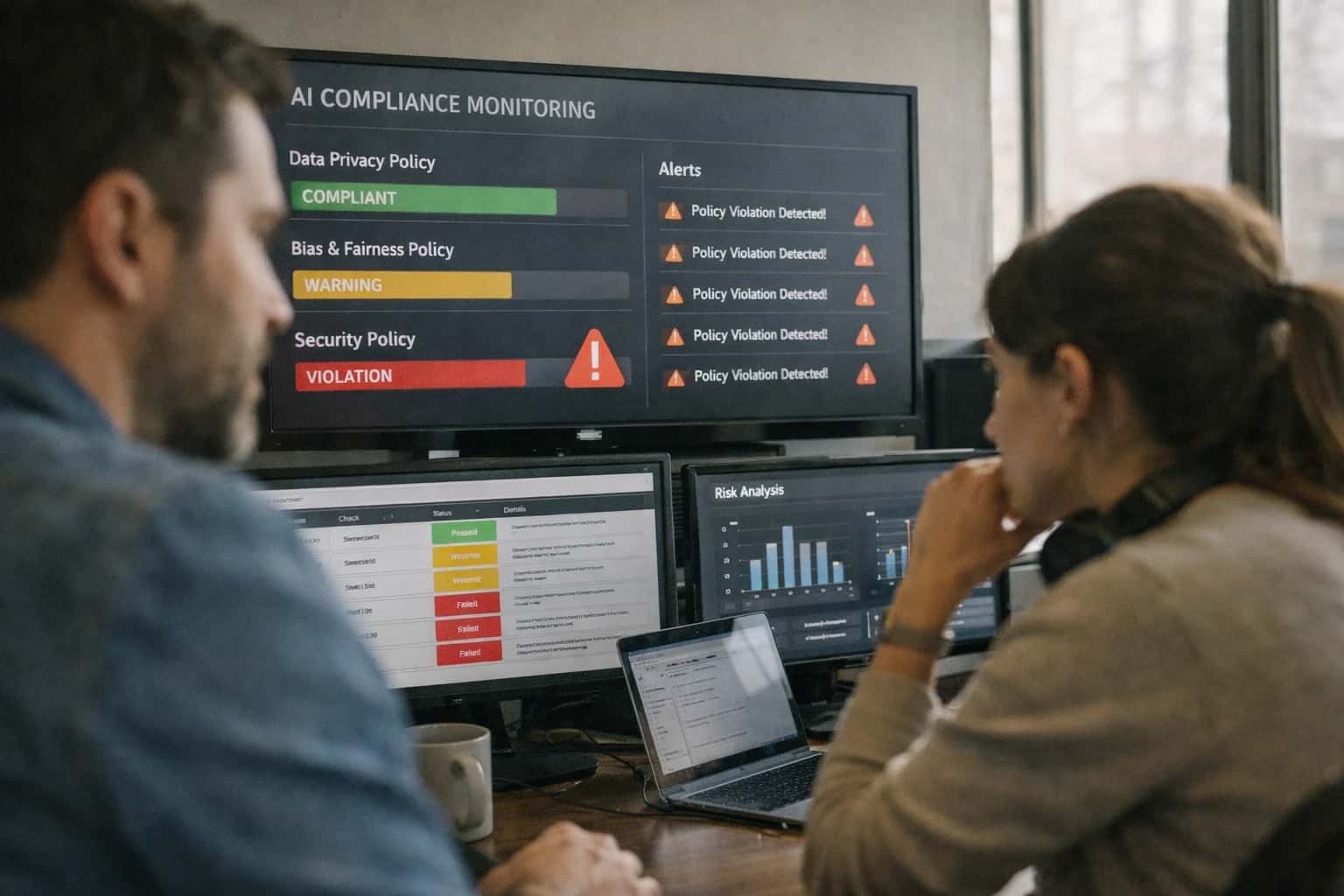
AI integration for Intelex safety compliance is not about replacing your core platform, but about adding an intelligent, real-time analysis layer on top of it. This layer continuously monitors the data flowing through key Intelex modules—Incident Management, Audit & Inspection, Risk Assessment, Corrective Actions (CAPA), and Document Control—against a dynamic model of your safety rules, procedures, and regulatory obligations. The goal is to shift from periodic, manual compliance checks to continuous, automated adherence monitoring.

Integration
AI Integration for Intelex Safety Compliance
Deploy AI agents to continuously monitor Intelex operational data against safety rules and procedures, providing real-time adherence alerts and automated compliance workflows for EHS teams.
ARCHITECTURE AND ROLLOUT
Where AI Fits into Intelex Safety Compliance
A practical blueprint for integrating AI as a continuous monitoring and advisory layer within your existing Intelex safety compliance workflows.
Implementation typically involves deploying secure AI agents that connect to Intelex via its REST API and webhook capabilities. These agents are configured to watch for specific triggers: a new incident report submission, an audit finding closure, a change to a controlled procedure document, or the creation of a new risk assessment. When triggered, the agent retrieves the relevant records and contextual data (e.g., past similar incidents, related permits, chemical inventories) and uses a governed LLM to analyze the content. It can then perform actions like: assigning a real-time compliance risk score to a new incident, auto-populating corrective action fields with suggested tasks based on root cause, or flagging a document revision that may have created a conflict with an existing permit condition. All AI-generated outputs are logged as system comments with a clear audit trail, and critical recommendations (like a high-severity gap) can be routed to a human-in-the-loop approval queue before any system updates are made.
A phased rollout is critical. Start with a single, high-value workflow—such as automated incident classification and severity scoring—within a pilot site or business unit. This allows you to tune the AI's prompts against your specific Intelex data model and internal taxonomy, establish governance protocols, and measure impact (e.g., reduction in manual triage time, consistency of severity assignments). Successive phases can expand to audit finding correlation (identifying systemic issues across multiple inspections) and predictive compliance calendars that analyze regulatory updates and internal change data to forecast and prioritize upcoming obligations. The architecture ensures AI augments your team, providing them with prioritized alerts and draft content, while maintaining Intelex as the single source of truth and preserving all existing approval and workflow controls.
ARCHITECTURE BLUEPRINT
Intelex Modules and Data Touchpoints for AI
Incident Management & Audit Management
These are the primary surfaces for AI-driven automation and insight. The Incident Management module contains the initial report, classification, witness statements, and investigation narratives. AI can act as a first responder, triaging severity from free-text descriptions and auto-populating OSHA recordable fields.
Within Audit Management, AI connects to the audit schedule, checklist items, and finding records. It can pre-populate checklists based on site risk profiles, analyze auditor notes in real-time to suggest additional lines of inquiry, and categorize findings against historical data to identify systemic issues. The key data objects are Incident, Audit, Finding, and Action Item. AI integration here reduces manual data entry by up to 70% for narrative fields and accelerates audit cycle times from weeks to days.
OPERATIONAL AUTOMATION
High-Value AI Use Cases for Intelex Safety Compliance
Integrate AI directly into Intelex workflows to automate compliance monitoring, accelerate incident response, and transform safety data into proactive intelligence.
01
Automated Incident Triage & Classification
AI analyzes free-text incident reports and witness statements upon submission, automatically assigning severity, category, and regulatory flags (e.g., OSHA recordable). Routes high-priority cases to investigators in minutes, not hours.
Hours -> Minutes
Initial review time
02
Real-Time Procedure Adherence Monitoring
Continuously scans work orders, permit-to-work forms, and inspection logs against approved safety procedures in Intelex. Flags deviations in real-time—like a missed LOTO step or an expired confined space permit—and alerts supervisors before work proceeds.
Batch -> Real-time
Compliance check
03
Predictive Audit Scheduling & Scoping
AI evaluates site risk scores, past audit findings, incident history, and regulatory change logs to dynamically generate the annual audit plan. Recommends which sites to audit, optimal timing, and high-risk areas to focus on, maximizing compliance coverage.
1 sprint
Planning cycle saved
04
AI-Assisted Root Cause Analysis
Guides investigators through structured RCA (e.g., 5 Whys, Fishbone) within Intelex. Suggests probable causes based on historical similar incidents and data correlations. Drafts the investigation narrative and auto-populates the corrective action (CAPA) form with linked findings.
Same day
Report draft ready
05
Automated Regulatory Report Generation
For reports like OSHA 300/301 or environmental permits, AI pulls validated data from across Intelex modules (Incidents, Training, Exposure Monitoring). Auto-fills forms, performs calculations, and generates narrative summaries, reducing manual consolidation from days to hours.
Days -> Hours
Report preparation
06
Intelligent Safety Observation Analysis
Processes thousands of free-text safety observations and near-miss reports. Uses NLP to categorize hazards, identify recurring themes, and assign risk scores. Automatically triggers follow-up workflows for high-risk observations, closing the feedback loop.
Batch -> Continuous
Hazard insight
INTELEX INTEGRATION PATTERNS
Example AI-Driven Compliance Workflows
These workflows illustrate how AI agents connect to Intelex's data model and automation layer to transform manual, reactive compliance tasks into proactive, automated processes. Each pattern is designed to be implemented via secure API calls, webhooks, and orchestration logic.
Trigger: A regulatory intelligence feed (e.g., RegScan, Enhesa) pushes a new or updated regulation via webhook.
Context/Data Pulled:
- The AI agent ingests the regulatory text and metadata (jurisdiction, industry, effective date).
- It queries Intelex for relevant records:
Compliance Obligationslinked to the jurisdiction/industry.Policies & Procedurestagged with related topics.Audit ProtocolsandInspection Checklists.- Past
Findingsfrom related audits.
Model/Agent Action:
- The LLM performs a semantic comparison between the new regulation and existing obligations/controls.
- It generates a structured impact assessment:
- Gap: New requirement with no existing control.
- Partial Gap: Existing control needs enhancement.
- Compliant: Existing control fully addresses it.
- For gaps, it drafts a new
Compliance Obligationrecord and suggests linkedAction Items.
System Update/Next Step:
- The agent creates or updates records in Intelex via the API:
- A new
Regulatory Changerecord with the impact summary. - Proposed
ObligationsandAction Itemsin a "Pending Review" status.
- A new
- An automated task is assigned to the Compliance Manager in Intelex for review and approval.
Human Review Point: The Compliance Manager reviews the AI-generated assessment, adjusts the priority and assignment of action items, and sets the effective dates before approving the records to become active.
FROM RULES TO REAL-TIME ADHERENCE
Implementation Architecture: Data Flow and Integration Points
A production-ready AI integration for Intelex connects safety rules to operational data flows, creating a continuous compliance monitoring system.
The integration architecture is built on three primary data flows into Intelex: 1) Operational Data Ingestion from connected systems (CMMS, IoT sensors, work order platforms, HRIS) via APIs or flat-file imports into custom objects or staging tables; 2) Rule and Procedure Context pulled from Intelex's Document Control and Compliance modules, including safety manuals, SOPs, and permit conditions; and 3) Human-Generated Input from incident reports, audit findings, and safety observations that provide ground truth for model tuning. The AI layer acts as a middleware service, subscribing to these data streams via Intelex's REST API or listening for webhook events on key objects like Incident, Audit, or Observation.
Core integration points within Intelex are the Action Tracking and Alert modules. When the AI model detects a potential deviation—such as a work order in the CMMS lacking a required JSA reference, or sensor data exceeding a threshold defined in a permit—it creates a prioritized action item with context and recommended steps. For high-severity or time-sensitive issues, it triggers an immediate alert to assigned safety officers or operations managers via Intelex's notification engine. The system logs all AI-generated insights and actions back to the relevant records, creating a full audit trail that links the predictive alert to the source data and the eventual resolution.
Rollout follows a phased, risk-based approach. Start with a single, high-impact rule set (e.g., confined space entry permit validation) and a pilot site. Governance is critical: all AI-generated actions should route through a human-in-the-loop approval step initially, with clear ownership defined in Intelex's role-based access controls. Performance is measured by tracking the mean time to detection for compliance gaps and the false positive rate of alerts, ensuring the system reduces burden rather than creating noise. This architecture turns Intelex from a system of record into a proactive system of assurance.
EHS COMPLIANCE AUTOMATION
Code and API Patterns for Intelex Integration
Automating Incident-to-CAPA Pipelines
Integrate AI directly into the Incident Management and Corrective Actions modules to automate the initial classification of reports and generate draft CAPA plans. Use Intelex's REST API to create and link records programmatically.
A typical pattern listens for new Incident records via webhook or scheduled sync. The AI service analyzes the free-text description, categorizes the event (e.g., Near Miss, Recordable Injury), assigns a preliminary severity score, and suggests potential root cause codes. It then creates a linked CorrectiveAction record with auto-populated fields like Description, Target Completion Date, and assigned Owner based on department.
python# Example: Create a CAPA from an analyzed incident import requests # Payload after AI analysis capa_payload = { "Title": "AI-Generated: Prevent Slip on Warehouse Floor A", "Description": "Generated from Incident INC-2024-789. Analysis suggests wet floor procedure not followed. Recommended action: Re-train team on spill response, install additional signage.", "RelatedIncidentId": "INC-2024-789", "AssignedToUserId": "user_456", # Derived from department mapping "Priority": "Medium", "TargetDate": "2024-06-15" } response = requests.post( f"{INTELEX_API_BASE}/api/v1/correctiveactions", json=capa_payload, headers={"Authorization": f"Bearer {api_token}"} )
This reduces the manual triage and CAPA drafting time from hours to minutes, ensuring faster closure loops.
AI-ENHANCED SAFETY COMPLIANCE WORKFLOWS
Realistic Time Savings and Operational Impact
This table illustrates the practical impact of integrating AI into core Intelex safety compliance workflows, focusing on time savings, process improvements, and risk reduction.
| Workflow / Metric | Before AI | After AI | Implementation Notes |
|---|---|---|---|
Regulatory Change Impact Analysis | Manual review of updates by specialist (4-8 hours per alert) | AI-powered filtering & gap analysis summary (30-60 minutes) | AI scans regulatory feeds, maps changes to existing controls, flags high-impact items for review |
Incident Report Triage & Classification | Supervisor manually codes type, severity, and body part (15-20 mins per report) | AI suggests codes from narrative, supervisor confirms (5 mins per report) | Ensures consistent OSHA recordability determination and reduces data entry errors |
Audit Finding Categorization & Assignment | Lead auditor manually tags findings and assigns actions post-audit (2-3 hours per audit) | AI auto-tags findings and suggests assignees during audit write-up (1 hour per audit) | Speeds up audit closure and links findings to systemic CAPA plans |
Safety Observation & Near-Miss Analysis | Monthly manual review of free-text reports to spot trends (1-2 days per month) | Weekly AI-generated trend reports on hazard types and locations (2-4 hours per month) | Uncovers hidden risks faster, enabling proactive interventions before incidents occur |
Corrective Action (CAPA) Plan Drafting | Investigator writes plan from scratch based on template (1-2 hours per finding) | AI drafts initial plan with tasks, owners, and deadlines from investigation notes (30 mins per finding) | Human investigator refines and approves; ensures all RCA elements are addressed |
Compliance Calendar & Deadline Management | Manual entry of dates from permits and regulations; reactive email reminders | AI parses documents to auto-populate calendar; predictive alerts for upcoming tasks | Shifts focus from administrative tracking to proactive compliance assurance |
Environmental / Safety Report Data Aggregation | Manual extraction from multiple modules and spreadsheets (1-2 days per report) | AI queries and consolidates required data sets (Half-day per report) | Reduces consolidation errors and frees specialists for data validation and analysis |
ENSURING CONTROLLED, AUDITABLE AI OPERATIONS
Governance, Security, and Phased Rollout
A production-ready AI integration for Intelex requires a structured approach to security, governance, and rollout to maintain compliance and user trust.
Governance starts with role-based access control (RBAC) aligned with Intelex's existing permission sets. AI-generated insights, such as real-time adherence alerts or compliance gap analyses, are treated as system-generated records. They are written back to designated custom objects or audit log tables within Intelex, creating a full audit trail. All AI actions—like flagging a potential procedure deviation—are logged with a timestamp, user/process ID, and the source data used, ensuring transparency for internal audits and regulatory inquiries.
Security is implemented through a zero-trust integration pattern. The AI service operates as a dedicated, non-human service account with strictly scoped API permissions to only the necessary Intelex modules (e.g., Incident Management, Document Control, Audit Management). Sensitive data, such as incident narratives or employee information, is never sent directly to a third-party LLM. Instead, a retrieval-augmented generation (RAG) architecture is used, where the AI queries a secure, internal vector store containing pre-processed and anonymized policy text, procedure summaries, and historical finding data. This keeps proprietary and PII data within your controlled environment while enabling the AI to reason over safe, context-rich information.
A phased rollout is critical for adoption and risk management. We recommend a three-phase approach:
- Phase 1: Pilot & Monitor. Deploy AI for a single, high-value workflow like automated safety observation categorization. Run the AI's output in parallel with human review for 4-6 weeks, measuring accuracy and refining prompts.
- Phase 2: Assisted Workflow. Integrate AI suggestions directly into the user interface as recommendations. For example, when a compliance officer reviews a regulatory change, the AI pre-populates a draft impact assessment in Intelex, requiring a human to review and approve.
- Phase 3: Controlled Automation. Activate fully automated workflows for low-risk, high-volume tasks, such as generating initial draft entries for routine inspection checklists. These automations include built-in human-in-the-loop (HITL) escalation gates for any low-confidence AI output or predefined high-risk scenarios, ensuring safety professionals retain oversight where it matters most.
Enabling Efficiency, Speed & Accuracy
Intelligent Analysis, Decision & Execution
We build AI systems for teams that need search across company data, workflow automation across tools, or AI features inside products and internal software.
Talk to Us
Search across company data
Give teams answers from docs, tickets, runbooks, and product data with sources and permissions.
Useful when people spend too long searching or get different answers from different systems.
Enterprise searchRAGPermissions
Read more
Automate internal workflows
Use AI to route work, draft outputs, trigger actions, and keep approvals and logs in place.
Useful when repetitive work moves across multiple tools and teams.
AI agentsWorkflow automationGovernance
Read more
Add AI to products and internal tools
Build assistants, guided actions, or decision support into the software your team or customers already use.
Useful when AI needs to be part of the product, not a separate tool.
AI integrationDecision supportModel routing
Read moreAI INTEGRATION FOR INTELEX
Frequently Asked Questions
Practical questions for technical and operational leaders evaluating AI to enhance Intelex safety compliance workflows.
AI integration typically connects at three key layers within Intelex:
- Event Ingestion via REST API/Webhooks: AI agents listen for webhook events (e.g.,
incident.created,observation.submitted,audit.scheduled) to trigger real-time analysis. - Data Retrieval via OData API: For context, the AI system queries Intelex's OData API to pull related records—such as past incidents for a specific location, active permits, or employee training records—before generating an analysis or recommendation.
- Record Creation/Update via REST API: AI-driven outputs, like a generated CAPA plan or a compliance gap summary, are written back to Intelex as new records (e.g.,
Actionitems) or updates to existing records (e.g., enriching anIncidentwith auto-categorized root causes).
Example Payload for Context Retrieval:
httpGET /api/v2/odata/Incidents? $filter=LocationId eq 'Site_123' and Status eq 'Closed'& $top=5& $select=Id,Title,Severity,RootCause
This allows the AI to be grounded in historical site-specific data, avoiding generic responses.

About the author
Prasad Kumkar
CEO & MD, Inference Systems
Prasad Kumkar is the CEO & MD of Inference Systems and writes about AI systems architecture, LLM infrastructure, model serving, evaluation, and production deployment. Over 5+ years, he has worked across computer vision models, L5 autonomous vehicle systems, and LLM research, with a focus on taking complex AI ideas into real-world engineering systems.
His work and writing cover AI systems, large language models, AI agents, multimodal systems, autonomous systems, inference optimization, RAG, evaluation, and production AI engineering.
LinkedIn
Limited slotsGet a Free AI Consultation
Partnered with leading AI, data, and software stack.





How We Work
Custom AI workflows for your Business
One-fit-all AI don't work for modern businesses. At Inferensys, we aim to understand your business & custom requirements; which we use to define most efficient agentic workflows, the data, and the tools for your business.
01
Review the use case
We understand the task, the users, and where AI can actually help.
Read more02
Pick the right approach
We define what needs search, automation, or product integration.
Read more03
Build the first useful version
We implement the part that proves the value first.
Read more04
Improve from there
We add the checks and visibility needed to keep it useful.
Read moreThe first call is a practical review of your use case and the right next step.
Talk to Us