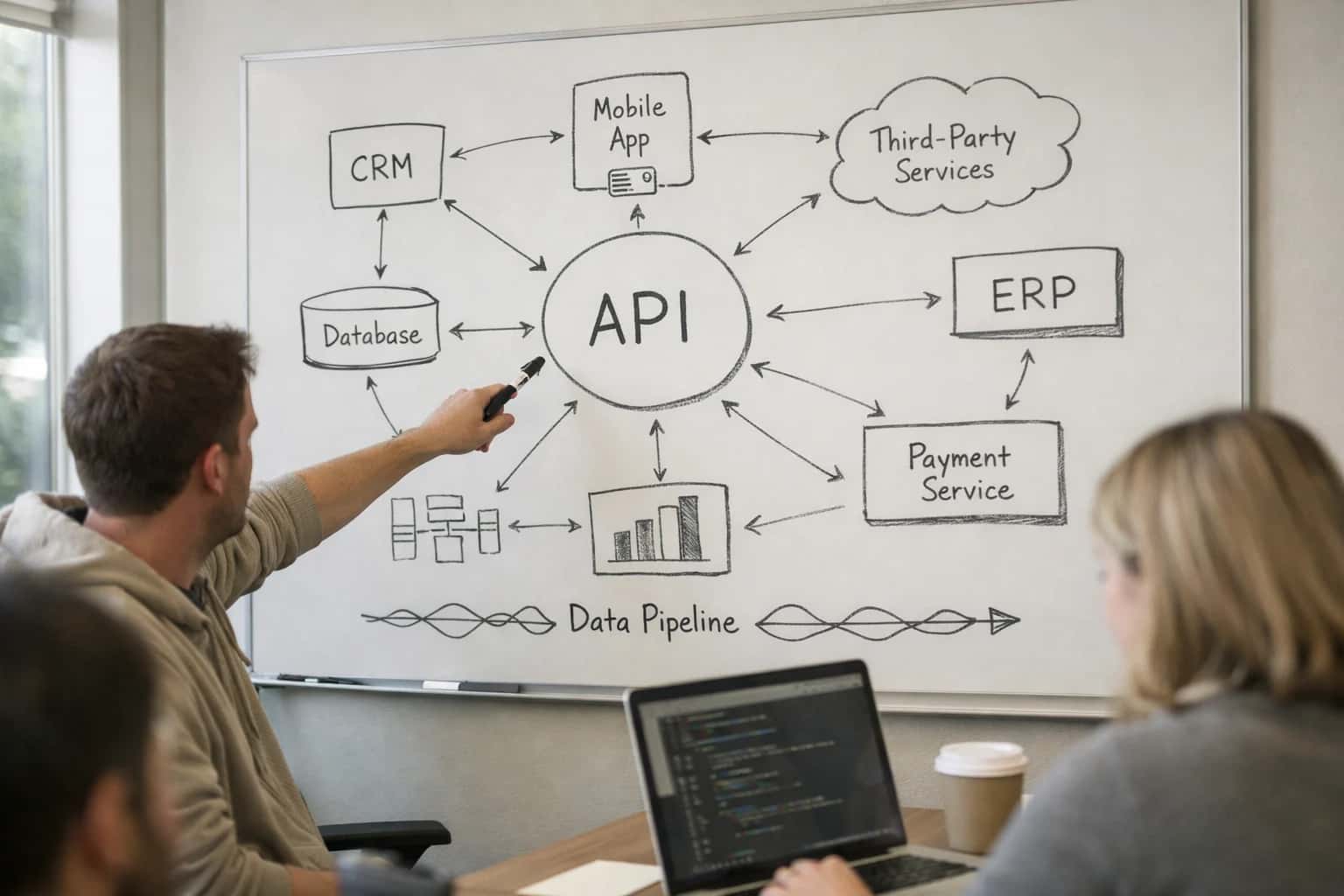
AI integration for customer correspondence management typically connects at three key points within an ECM platform's architecture: the ingestion/capture layer, the workflow engine, and the search/retrieval interface. At ingestion, AI can triage incoming correspondence—scanned letters, forwarded emails in PDF form—by urgency, topic, and required action, automatically classifying documents and populating metadata fields like Correspondence Type or Customer Sentiment. Within the workflow engine (e.g., OpenText BPM, Hyland OnBase Workflow, Laserfiche Workflow), AI acts as a decision agent, routing complex inquiries to specialized queues, drafting initial response summaries for agent review, or escalating items that match pre-defined risk patterns based on historical case data.

Integration
AI Integration for Customer Correspondence Management with AI
Where AI Fits in Customer Correspondence Workflows
A practical guide to integrating AI into inbound and outbound customer letter and email workflows managed within Enterprise Content Management (ECM) systems.
For implementation, this is often built as a microservice layer that subscribes to ECM events via webhooks or monitors designated intake folders. When a new correspondence document is created, the service extracts text via the platform's native OCR or text services, sends it to an LLM for analysis, and uses the ECM's REST API to update metadata, assign tasks, or kick off sub-processes. High-value use cases include reducing manual triage time from hours to minutes, ensuring regulatory disclosures are present in outbound replies, and summarizing lengthy customer histories for faster agent onboarding. Impact is measured in faster first response times, reduced handling time per item, and more consistent application of business rules.
Rollout should be phased, starting with a single correspondence stream (e.g., formal complaint letters) to refine prompts and validate accuracy before scaling. Governance is critical: all AI-generated drafts or summaries must be clearly flagged for human review before sending, and a feedback loop should be established where agent overrides or corrections are used to fine-tune the models. Access to the AI layer must respect the ECM's existing role-based permissions, ensuring agents only see AI suggestions for correspondence they are authorized to handle. For a deeper technical blueprint, see our guide on Intelligent Document Processing in ECM Platforms.
ECM Platform Touchpoints for AI Integration
Automating Intake and First-Touch Classification
AI integration begins at the point of entry. Configure your ECM platform to route inbound customer correspondence—whether from email gateways, scanned mail, fax servers, or web forms—through an AI processing layer before final storage.
Key Integration Surfaces:
- Email Connectors & Mailroom Scanners: Intercept inbound streams for real-time analysis.
- Capture/Import APIs: Use REST APIs (e.g., OpenText Content Server, Hyland OnBase, Laserfiche) to submit documents for AI processing before committing to the repository.
- Webhook Listeners: Trigger AI analysis when new files land in monitored folders (Box, SharePoint).
AI Actions at Ingest:
- Classify document type (complaint, inquiry, application, payment).
- Extract key entities: customer ID, account number, policy number, dates.
- Detect urgency and sentiment to prioritize routing.
- Apply initial metadata and tags for immediate workflow assignment.
High-Value AI Use Cases for Customer Correspondence
Integrate AI with platforms like OpenText, Hyland, Laserfiche, SharePoint, and Box to transform inbound customer letters and emails from static documents into actionable, intelligent workflows that connect to CRM and service systems.
Intelligent Triage & Routing
Use AI to read inbound correspondence and automatically classify its intent (e.g., complaint, inquiry, request) and urgency. Route it to the correct service queue, agent, or department within your ECM system, integrating with CRM platforms like Salesforce for a unified case view.
Automated Summarization & Case Enrichment
For lengthy letters or email threads, generate concise summaries that highlight key customer issues, requested actions, and sentiment. Attach this summary as metadata to the document in the ECM, populating related fields in linked CRM or service tickets for faster agent ramp-up.
AI-Assisted Draft Response
Provide agents with a context-aware draft response based on the analyzed correspondence, company knowledge base, and past similar cases. The draft is generated within the ECM interface, ensuring all source documents and compliance templates are referenced, ready for agent review and personalization.
Regulatory & Sensitive Data Redaction
Automatically scan inbound correspondence for PII, PHI, or sensitive financial data before it's stored or processed. Apply redactions directly within the ECM platform to ensure compliance with GDPR, HIPAA, or CCPA, and trigger secure handling workflows.
Sentiment Analysis for Escalation
Continuously monitor the tone and sentiment of customer correspondence. Flag highly negative or frustrated communications for immediate supervisor review or priority escalation within the ECM workflow, preventing potential churn or reputational risk.
Obligation Extraction for Follow-up
Analyze correspondence for specific promises, deadlines, or action items committed to by the company. Extract these obligations and create structured tasks or calendar events in connected systems (e.g., CRM, project management), ensuring nothing falls through the cracks.
Example AI-Powered Correspondence Workflows
These workflows illustrate how AI agents connect to Enterprise Content Management (ECM) systems like OpenText, Hyland, and Laserfiche to automate the triage, drafting, and management of inbound and outbound customer letters and emails.
Trigger: A new customer letter (PDF scan) or email is ingested into the ECM system's correspondence repository.
AI Agent Action:
- The agent is triggered via an ECM webhook or scheduled scan of a "New Inbound" folder.
- It retrieves the document text via the ECM's API and uses an LLM to:
- Classify the inquiry type (e.g., Billing Question, Product Complaint, Service Request).
- Extract key entities: Customer ID, Account Number, Invoice #, Product SKU.
- Assess urgency & sentiment from the language used.
- Generate a concise summary for the service team.
- System Update: The agent writes the extracted metadata (classification, entities, sentiment score, summary) back to the document's properties in the ECM. It then triggers an ECM workflow or updates a linked CRM (e.g., Salesforce) ticket, automatically routing it to the correct team queue with priority flags.
Human Review Point: Low-confidence classifications or ambiguous entities are flagged for manual review before routing, with the AI's reasoning provided to the agent.
Implementation Architecture: Data Flow & Integration Patterns
A practical blueprint for integrating AI into customer correspondence workflows within ECM platforms like OpenText, Hyland, and Laserfiche.
The integration architecture connects your ECM repository to an AI processing layer, typically via event-driven APIs or scheduled batch jobs. When a new customer letter or email PDF is ingested into a platform like Hyland OnBase or Laserfiche, a webhook or workflow step triggers an AI service. This service extracts the raw text, classifies the document (e.g., 'Complaint', 'Inquiry', 'Payment Question'), extracts key entities (customer ID, invoice number, dates), and generates a concise summary. The enriched metadata—classification, summary, entities—is then written back to the document's record in the ECM system using its native REST API, enabling immediate routing and search.
For response drafting, the architecture extends into your service platforms. The classified correspondence and its summary can be pushed via a secure connector to a CRM like Salesforce or a service desk like ServiceNow. An AI agent, with context from the customer's history and knowledge base articles, can then generate a draft response. This draft is typically inserted as a private note or a draft email within the service ticket, flagged for human review and approval before sending. This pattern keeps sensitive customer data within governed systems while automating the most time-consuming parts of triage and composition.
Governance is designed into the flow. All AI-generated metadata and drafts are logged with source document IDs and model versions for audit trails. A human-in-the-loop checkpoint is mandatory for outgoing communications. The system can be rolled out incrementally, starting with automatic triage and summarization for internal teams to build trust, followed by piloting draft generation for high-volume, low-risk inquiry types. This phased approach de-risks implementation while delivering quick wins in operational efficiency.
For a deeper technical dive on building this event-driven pattern, see our guide on AI Integration for Box Webhooks. To understand how to apply similar AI analysis to contracts within your ECM, review our blueprint for AI Integration for Contract Analysis in Enterprise Content Repositories.
Code & Payload Examples for Key Integration Steps
Automating Initial Classification & Routing
When a new customer letter or email arrives via scan, email-to-folder, or upload, an AI agent can analyze its content to determine urgency, category, and required action before a human sees it. This is typically triggered by a folder watcher or ECM event webhook.
The agent calls an LLM with the extracted text to classify the document (e.g., complaint, inquiry, payment_issue) and extract key entities (customer ID, reference numbers). The result is written back as metadata, which then triggers a pre-configured workflow in the ECM system (e.g., Laserfiche Workflow, OnBase Workflow) to route the document to the correct queue.
python# Example: Python webhook handler for new document event import json from inference_client import DocumentAgent def handle_new_document(event): """Process a new document added to the ECM system.""" doc_id = event['documentId'] text = ecmsdk.get_document_text(doc_id) # Call AI agent for classification and extraction result = DocumentAgent.analyze( text=text, instructions="Classify this customer correspondence and extract customer ID, account number, and urgency." ) # Write metadata back to ECM metadata = { 'category': result.classification, 'customerId': result.entities.customer_id, 'urgency': result.urgency_score, 'processedByAI': True } ecmsdk.update_metadata(doc_id, metadata) # Trigger workflow based on classification if result.classification == 'complaint': ecmsdk.start_workflow(doc_id, workflow_name='HighPriority_Complaint')
Realistic Time Savings & Operational Impact
How AI integration transforms manual, reactive correspondence handling into a proactive, assisted workflow within your ECM and CRM systems.
| Workflow Stage | Before AI | After AI | Notes |
|---|---|---|---|
Incoming Mail Triage & Classification | Manual review by staff (5-10 min per item) | AI auto-classifies by intent & urgency (<1 min) | Human review for complex/ambiguous items only |
Data Extraction from Attachments | Manual keying from scanned forms/letters (15-20 min) | AI extracts key fields (name, ID, request) automatically (2 min) | Focus shifts to validation, not data entry |
Case Summarization for Agent | Agent reads full thread (8-12 min) | AI provides concise summary with key facts (1 min) | Reduces agent cognitive load, speeds resolution |
Draft Response Generation | Agent writes from scratch (10-15 min) | AI suggests draft based on case type & history (2-3 min) | Agent edits and personalizes; ensures brand voice |
Routing & Assignment | Manual routing based on subject line or queue | AI recommends best agent/skill based on content & workload | Improves first-contact resolution, balances load |
Regulatory Flagging & Compliance Check | Periodic manual audits for sensitive topics | AI scans for PII, complaints, or regulated topics in real-time | Proactive compliance, reduces audit prep time |
Sentiment & Escalation Detection | Relies on agent to identify upset customers | AI scores sentiment, flags high-risk items for supervisor review | Enables proactive service recovery |
Knowledge Base Article Creation | Manual documentation of novel resolutions | AI suggests new KB articles from resolved cases | Turns individual solutions into organizational knowledge |
Governance, Security & Phased Rollout
Deploying AI for customer correspondence requires a secure, governed architecture that integrates with your ECM's existing security model and compliance workflows.
A production implementation typically connects to your ECM platform (e.g., OpenText Content Suite, Hyland OnBase) via its secure REST APIs and webhooks. AI processing should be triggered by document events—like a new email PDF saved to a 'Customer Inbox' folder—and run in a dedicated, isolated service layer. This ensures the AI never has direct database access; it only receives document content and metadata via controlled API calls. All extracted data, summaries, and suggested responses are written back as structured metadata or linked annotations, maintaining a full audit trail within the ECM's native version history and security trimming.
Governance is managed through a phased rollout, starting with assistive review. In this initial phase, the AI generates draft summaries and categorizations, but all outbound responses are queued for human agent approval within the connected CRM or service desk (like Salesforce Service Cloud or Zendesk). This allows for prompt tuning, accuracy validation, and building user trust. Subsequent phases can introduce automated triage for high-confidence, routine inquiries (e.g., password reset requests identified in letters) and agent copilot features that suggest full responses within the agent's existing console, reducing handle time without ceding final control.
Key security considerations include ensuring PII redaction before optional processing by external LLM APIs, leveraging the ECM's built-in permissions to enforce role-based access to AI-generated insights, and implementing strict data residency controls for cloud AI services if correspondence contains regulated data. A successful rollout maps AI actions to specific user roles—allowing only supervisors, for instance, to modify classification rules—and integrates with SIEM tools to log all AI-initiated activities for compliance audits.
Enabling Efficiency, Speed & Accuracy
Intelligent Analysis, Decision & Execution
We build AI systems for teams that need search across company data, workflow automation across tools, or AI features inside products and internal software.
Talk to Us
Search across company data
Give teams answers from docs, tickets, runbooks, and product data with sources and permissions.
Useful when people spend too long searching or get different answers from different systems.

Automate internal workflows
Use AI to route work, draft outputs, trigger actions, and keep approvals and logs in place.
Useful when repetitive work moves across multiple tools and teams.

Add AI to products and internal tools
Build assistants, guided actions, or decision support into the software your team or customers already use.
Useful when AI needs to be part of the product, not a separate tool.
Frequently Asked Questions (FAQ)
Practical questions for teams planning to integrate AI into customer correspondence workflows within ECM systems like OpenText, Hyland, Laserfiche, SharePoint, or Box.
The AI integration typically acts as a middleware layer between your ECM's ingestion points and your CRM or service desk. Common connection patterns include:
- Event-Driven (Preferred): Configure webhooks or event listeners in your ECM (e.g., Box webhooks, Laserfiche Cloud events) to trigger an AI processing service whenever a new customer letter or email PDF is added to a designated folder or case.
- Batch Processing: Schedule nightly jobs that query the ECM API for new correspondence documents from the last 24 hours, process them in bulk, and push results to the CRM.
- Real-Time API: Integrate the AI service directly into a CRM agent's console (e.g., a Salesforce Lightning component) to analyze correspondence on-demand during a customer interaction.
The AI service reads the document, classifies its intent (e.g., complaint, inquiry, request), extracts key entities (customer ID, policy number, dates), summarizes the content, and posts this structured data to the corresponding CRM case or contact record via API.

About the author
Prasad Kumkar
CEO & MD, Inference Systems
Prasad Kumkar is the CEO & MD of Inference Systems and writes about AI systems architecture, LLM infrastructure, model serving, evaluation, and production deployment. Over 5+ years, he has worked across computer vision models, L5 autonomous vehicle systems, and LLM research, with a focus on taking complex AI ideas into real-world engineering systems.
His work and writing cover AI systems, large language models, AI agents, multimodal systems, autonomous systems, inference optimization, RAG, evaluation, and production AI engineering.
Partnered with leading AI, data, and software stack.





How We Work
Custom AI workflows for your Business
One-fit-all AI don't work for modern businesses. At Inferensys, we aim to understand your business & custom requirements; which we use to define most efficient agentic workflows, the data, and the tools for your business.
01
Review the use case
We understand the task, the users, and where AI can actually help.
Read more02
Pick the right approach
We define what needs search, automation, or product integration.
Read more03
Build the first useful version
We implement the part that proves the value first.
Read more04
Improve from there
We add the checks and visibility needed to keep it useful.
Read moreThe first call is a practical review of your use case and the right next step.
Talk to Us