AI integration connects at three key layers of your ECM system: ingestion, repository, and workflow. At ingestion, AI classifies incoming contracts via email, scan, or upload—using tools like OpenText Document Intelligence, Hyland Brainware, or Laserfiche Quick Fields—and extracts metadata (counterparty, effective date, type). Within the repository, AI indexes full text and clauses into a vector store (like Pinecone or Weaviate) for semantic search and RAG, enabling natural language queries across thousands of contracts. For workflow, AI injects decision points into platforms like Laserfiche Workflow or SharePoint Power Automate, routing contracts for review based on risk scores or auto-populating clause libraries in systems like OpenText Contract Management.

Integration
AI Integration for Contract Analysis in Enterprise Content Repositories
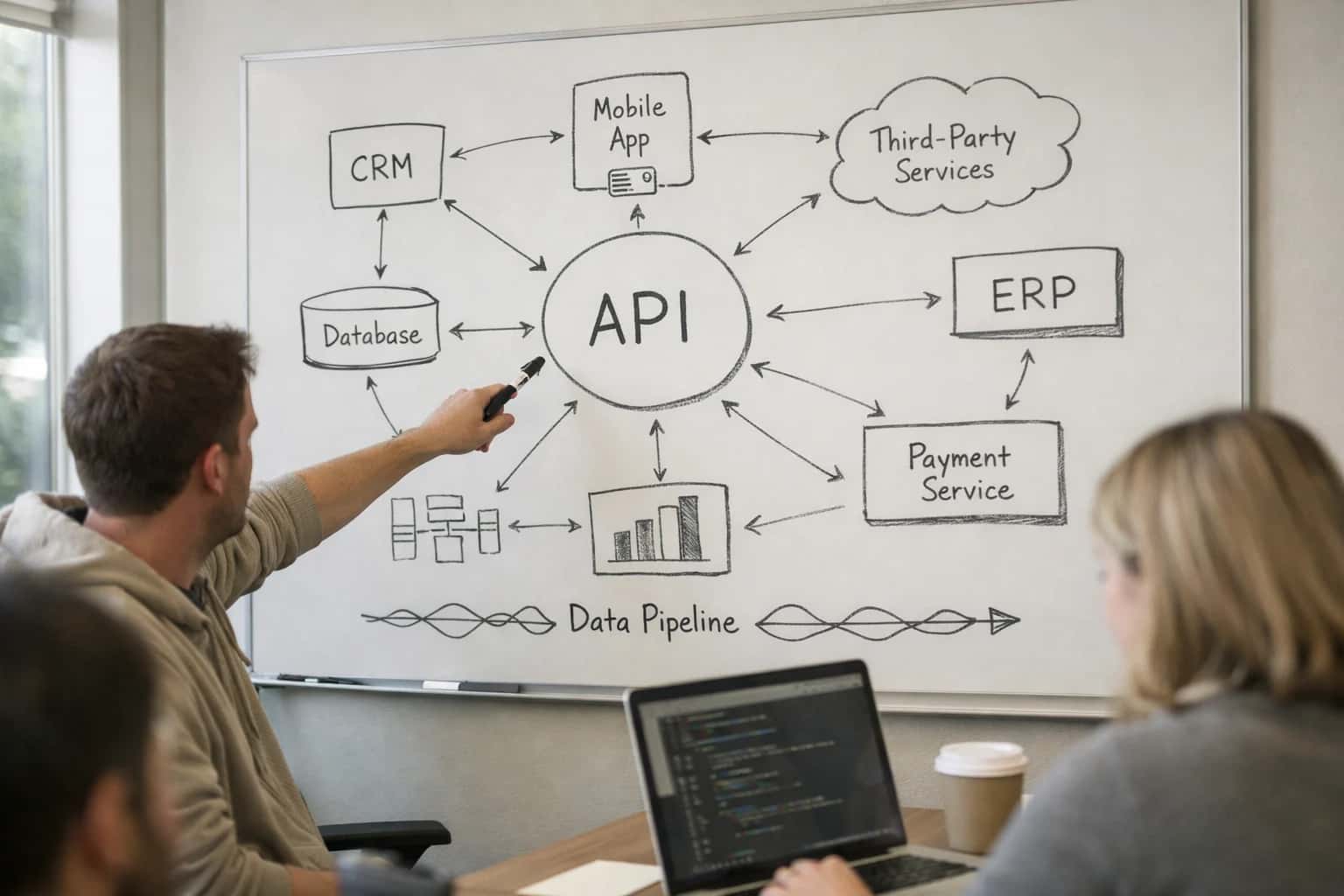
Where AI Fits into Your ECM Contract Repository
A practical blueprint for integrating AI into OpenText, Hyland, Laserfiche, SharePoint, and Box to transform contract portfolios from static files into active intelligence.
Implementation typically follows an event-driven pattern: a contract upload triggers a webhook to an AI service, which returns structured JSON with extracted entities, a summary, and a risk assessment. This payload is written back to the ECM’s metadata fields via its REST API (e.g., Box API, SharePoint Graph API). A separate process handles the vector embedding for search. High-value use cases include: obligation tracking (extracting key dates, deliverables, and renewal terms into a dashboard), risk assessment (flagging non-standard clauses against a playbook), and M&A due diligence (rapidly analyzing acquired contract portfolios). Impact is operational: reducing manual review from hours to minutes, surfacing auto-renewals 90 days out, and ensuring 100% of contracts are searchable by intent, not just filename.
Rollout requires a phased, governed approach. Start with a pilot repository of non-critical contracts (e.g., NDAs) to validate extraction accuracy and user trust. Implement a human-in-the-loop review step for high-risk documents, using the ECM’s tasking features. Governance is critical: audit trails must log AI-suggested metadata changes, and prompts must be version-controlled to avoid drift. For regulated industries, processing can be architected within Box Zones or SharePoint on-premises to maintain data residency. The goal isn’t full automation, but augmentation—giving legal, procurement, and sales ops teams a copilot that turns a document vault into a queryable system of insight. For a deeper technical dive on building this IDP layer, see our guide on Intelligent Document Processing in ECM Platforms.
Integration Touchpoints Across Major ECM Platforms
AI at the Point of Capture
Integrate AI models directly into the document ingestion pipelines of your ECM platform to perform initial contract triage and classification. This layer acts as a smart gatekeeper, ensuring contracts are processed correctly from the moment they enter the system.
Key Integration Points:
- Scanning/Upload Workflows: Inject AI into scanning stations or upload portals (e.g., Laserfiche Web Client, Hyland OnBase Unity Client) to classify documents as NDAs, MSAs, SOWs, or Amendments upon entry.
- Email Ingestion: Process contracts arriving via email to shared ECM mailboxes (common in OpenText RightFax or Box Relay). Use AI to extract key metadata like counterparty, effective date, and contract type for automatic filing.
- Bulk Import Tools: Augment bulk import utilities in SharePoint or OpenText Content Suite with AI to pre-populate metadata columns and tag documents for downstream workflows.
Implementation Pattern: A serverless function (e.g., Azure Function, AWS Lambda) is triggered by an ECM webhook on document creation. It calls an LLM via API for classification and writes the results back to the document's metadata profile.
High-Value Contract Intelligence Use Cases
Deploy AI agents that integrate directly with your enterprise content repository to read, analyze, and act on contract documents. These patterns connect LLMs to your ECM's object model, APIs, and workflow engines to automate high-volume, high-risk processes.
Automated Contract Ingestion & Risk Triage
AI agents monitor designated ECM folders or inboxes for new contracts. Upon upload, they perform an initial risk scan: extracting parties, dates, termination clauses, and indemnification language. High-risk clauses are flagged, and the contract is automatically routed via the ECM's workflow engine to the appropriate legal or commercial reviewer.
Obligation & Milestone Tracking
Post-signature, AI parses executed contracts stored in the ECM to extract all deliverables, reporting requirements, renewal dates, and payment milestones. These obligations are structured and pushed to a tracking database or project management platform. The system can generate alerts via the ECM or connected systems as deadlines approach.
Clause Library & Pre-Signature Analysis
During redlining, an AI copilot integrated into the ECM interface compares draft language against a governed clause library (stored in the ECM). It suggests preferred language, identifies deviations from standard terms, and provides a risk score for non-standard clauses, all within the reviewer's native document preview pane.
Portfolio-Wide Risk & Exposure Reporting
An AI batch process analyzes the entire contract repository. It answers questions like: "How many contracts have auto-renewal clauses in the next 6 months?" or "What is our total liability cap exposure across all supplier agreements?" Insights are surfaced through the ECM portal or a connected BI tool, turning static documents into a searchable risk database.
Intelligent Contract Search & RAG
Deploy a semantic search layer over the ECM's contract repository. Users ask natural language questions (e.g., "Show me all NDAs with non-solicit clauses") and receive precise answers with citations to source documents. The RAG system uses the ECM's security model to ensure users only see contracts they are authorized to access.
Automated Lease Abstracting for Real Estate
For ECMs managing real estate portfolios, AI extracts key financial and operational terms from leases: base rent, escalations, CAM charges, option periods, and tenant improvements. The structured data populates lease administration systems or financial models, eliminating manual data entry from hundreds of PDFs.
Example AI-Powered Contract Workflows
These workflows illustrate how to inject AI into the contract lifecycle by connecting to your ECM platform's APIs, webhooks, and object model. Each pattern is designed to be triggered by events in OpenText, Hyland, Laserfiche, SharePoint, or Box.
Trigger: A new contract document is uploaded or ingested into a designated ECM repository folder or via a capture workflow.
Context Pulled: The system retrieves the document binary and any available source metadata (e.g., vendor name from folder path, uploader).
AI Action: An AI agent processes the document to:
- Classify document type (e.g., NDA, MSA, SOW, Amendment).
- Extract key metadata: parties, effective/termination dates, notice periods, governing law, value.
- Summarize the core purpose and key obligations in 3-5 bullet points.
- Score Risk: Flag non-standard clauses against a pre-defined playbook (e.g., unlimited liability, unusual termination for convenience).
System Update: The extracted metadata is written back to the ECM document's properties/custom fields. A summary and risk score are stored in a linked comment or a sidecar JSON file. The document is automatically tagged and routed to a "For Legal Review" queue or a specific reviewer's folder based on risk score and contract type.
Human Review Point: The legal or procurement team reviews the AI-generated summary, metadata, and risk flags, correcting any errors before proceeding.
Implementation Architecture: Connecting AI to ECM
A practical blueprint for integrating LLMs with enterprise content repositories to automate contract analysis, risk assessment, and obligation tracking.
A production-ready contract intelligence system connects to your ECM platform—be it OpenText Content Suite, Hyland OnBase, Laserfiche, or SharePoint—via its REST API and event webhooks. The core integration surfaces are the document object model (for metadata and binary content), the workflow engine (for triggering AI analysis), and the search index (for enriching queries with extracted clauses). The AI layer typically sits as a middleware service, listening for new contract uploads to specific libraries or folders, fetching the document via secure API call, processing it through a pipeline of LLMs and validation rules, and writing structured insights back as custom metadata or linked JSON records.
The implementation detail lies in the processing pipeline and the feedback loop into business operations. A standard pipeline includes: 1) Document Classification & Splitting to identify contract type and separate exhibits; 2) Clause Extraction & Normalization using a RAG-augmented LLM against your clause library; 3) Risk & Obligation Tagging for terms like auto-renewal, liability caps, and termination notice; 4) Counterparty & Date Entity Recognition. The results are written back to the ECM's metadata schema (e.g., custom properties in SharePoint, indexed fields in OnBase) and can trigger downstream workflows—like alerting legal for high-risk clauses in Salesforce CPQ or populating a renewal dashboard in Power BI.
Rollout requires a phased, use-case-led approach. Start with post-signature analysis of archived contracts to build a searchable clause repository and assess portfolio risk. This non-disruptive phase validates the extraction accuracy and builds trust. Phase two integrates into active negotiation workflows, perhaps as a "Contract Review" button in your CLM or as an automated step when a draft is uploaded to a specific Box folder. Governance is critical: all extractions should have a human review queue for low-confidence items, and the system must maintain a full audit trail linking the source document, the AI model version, the extracted data, and any human overrides. The goal is not full automation, but reducing manual review from hours to minutes and ensuring no critical obligation is ever buried in a PDF again.
Code and Payload Examples for Key Operations
Triggering AI Analysis on Document Upload
When a contract is uploaded to your ECM repository (e.g., a specific Box folder or SharePoint library), an event webhook should trigger the AI pipeline. The first step is classifying the document type (e.g., NDA, MSA, SOW, Amendment) and extracting basic metadata for routing.
Example Webhook Payload to AI Service:
json{ "event": "file.uploaded", "source_system": "box", "document_id": "file_123456789", "file_name": "Acme_Corp_MSA_2025.pdf", "download_url": "https://api.box.com/files/123/content", "metadata": { "folder_path": "/Contracts/In-Review", "uploaded_by": "[email protected]", "file_size": 2456789 } }
The AI service responds with classification results and routes the document to the appropriate extraction workflow based on its type and priority.
Realistic Time Savings and Business Impact
How AI integration transforms manual contract review and management processes within ECM platforms like OpenText, Hyland, and Laserfiche.
| Process Step | Before AI | After AI | Key Impact |
|---|---|---|---|
Initial Contract Triage & Classification | Manual review by legal ops (15-30 min/contract) | Automated classification & routing (<1 min) | Legal team focuses on high-risk documents only |
Key Clause & Obligation Extraction | Manual highlight & spreadsheet entry (45-90 min) | AI extraction with human validation (5-10 min) | 90% faster data capture for obligation registers |
Risk & Compliance Flagging | Checklist review against internal policies (20-40 min) | Automated scoring against clause library (2 min) | Consistent risk assessment, reduced oversight variance |
Renewal & Date Monitoring | Calendar reminders & manual tracking | Automated alerts + summary of key terms 90 days out | Proactive management avoids auto-renewal surprises |
Contract Portfolio Query & Reporting | Manual search across repositories, compile in Excel (hours) | Natural language Q&A across entire portfolio (minutes) | Executives get instant answers on exposure, spend, terms |
Post-Signature Obligation Tracking | Periodic manual audits, email follow-ups | AI monitors deliverables, suggests follow-up tasks | Improves compliance, reduces missed milestones |
M&A Due Diligence (Sample Set) | Team of paralegals reviews 500 contracts over weeks | AI pre-screens, prioritizes high-risk contracts for review | Accelerates diligence timeline by 40-60% |
Governance, Security, and Phased Rollout
A production-grade contract intelligence system requires careful design to manage risk, ensure data sovereignty, and deliver incremental value.
A secure integration architecture treats the ECM platform (OpenText, Hyland, Laserfiche, etc.) as the system of record, with AI acting as a stateless processing layer. Documents are never permanently moved; they are streamed via secure APIs or webhooks to a processing pipeline. This pipeline typically includes: a queue for ingestion, an orchestrator to manage extraction jobs, a vector store for semantic search on clauses, and an audit log that records every AI action (document accessed, fields extracted, confidence scores). Access is controlled via the ECM's native RBAC, and all extracted data is written back as metadata or to a linked database for reporting, maintaining a clear lineage back to the source document.
Governance is enforced through human-in-the-loop (HITL) approvals and confidence scoring thresholds. For example, a high-risk clause like Limitation of Liability extracted with low confidence can be flagged for legal review within the ECM's workflow module before being committed. AI models can be configured to redact sensitive negotiation notes or PII automatically before analysis. A phased rollout mitigates risk: start with a pilot on a single repository (e.g., NDAs) to validate accuracy, then expand to sales contracts, and finally to complex M&A or procurement agreements. Each phase refines the extraction models and workflow rules based on user feedback and audit results.
Long-term success depends on continuous evaluation. Implement a feedback loop where legal and procurement teams can correct AI extractions, which are used to retrain or fine-tune models. Use the ECM's retention policies to manage the lifecycle of both the original contract and the AI-generated metadata. For global deployments, leverage ECM features like Box Zones or regional instances to ensure processing occurs within required data residency boundaries. This controlled approach transforms the ECM from a passive archive into an active, intelligent system of insight. For related architectural patterns, see our guide on AI Integration for Intelligent Document Processing in ECM Platforms.
Enabling Efficiency, Speed & Accuracy
Intelligent Analysis, Decision & Execution
We build AI systems for teams that need search across company data, workflow automation across tools, or AI features inside products and internal software.
Talk to Us
Search across company data
Give teams answers from docs, tickets, runbooks, and product data with sources and permissions.
Useful when people spend too long searching or get different answers from different systems.

Automate internal workflows
Use AI to route work, draft outputs, trigger actions, and keep approvals and logs in place.
Useful when repetitive work moves across multiple tools and teams.

Add AI to products and internal tools
Build assistants, guided actions, or decision support into the software your team or customers already use.
Useful when AI needs to be part of the product, not a separate tool.
Frequently Asked Questions on AI Contract Integration
Practical questions for architects and legal operations leaders planning to inject AI into contract repositories built on OpenText, Hyland, Laserfiche, SharePoint, or Box.
The connection pattern depends on your ECM platform and security posture. Common secure architectures include:
- API Gateway with Authentication: Deploy a secure API gateway (e.g., Kong, Apigee) in your DMZ or cloud. Your AI service calls this gateway, which handles authentication (OAuth, API keys) and forwards requests to the ECM's internal REST API (e.g., OpenText Content Server API, Laserfiche Cloud API).
- Event-Driven Processing: Use the ECM's native event system (e.g., SharePoint webhooks, Box Events API, Laserfiche Cloud Events). Configure events for new or updated contracts to trigger a secure serverless function (Azure Functions, AWS Lambda) that fetches the document, calls the AI model, and writes results back as metadata.
- Batch Processing Agent: For large legacy portfolios, deploy a lightweight agent inside your network. It polls a designated queue (e.g., RabbitMQ) for processing jobs, reads documents directly from the ECM's file store or database via secure channels, processes them, and posts results back via the internal API.
Key Security Controls:
- Never store raw contract text in the LLM provider's training data. Use API flags like
data_use: noneor choose providers with explicit data privacy commitments. - Implement strict RBAC. The AI service should inherit the user's permissions via a token or service account with least-privilege access.
- Encrypt data in transit (TLS 1.3) and consider client-side encryption for highly sensitive contracts before sending to a cloud-based model.

About the author
Prasad Kumkar
CEO & MD, Inference Systems
Prasad Kumkar is the CEO & MD of Inference Systems and writes about AI systems architecture, LLM infrastructure, model serving, evaluation, and production deployment. Over 5+ years, he has worked across computer vision models, L5 autonomous vehicle systems, and LLM research, with a focus on taking complex AI ideas into real-world engineering systems.
His work and writing cover AI systems, large language models, AI agents, multimodal systems, autonomous systems, inference optimization, RAG, evaluation, and production AI engineering.
Partnered with leading AI, data, and software stack.





How We Work
Custom AI workflows for your Business
One-fit-all AI don't work for modern businesses. At Inferensys, we aim to understand your business & custom requirements; which we use to define most efficient agentic workflows, the data, and the tools for your business.
01
Review the use case
We understand the task, the users, and where AI can actually help.
Read more02
Pick the right approach
We define what needs search, automation, or product integration.
Read more03
Build the first useful version
We implement the part that proves the value first.
Read more04
Improve from there
We add the checks and visibility needed to keep it useful.
Read moreThe first call is a practical review of your use case and the right next step.
Talk to Us