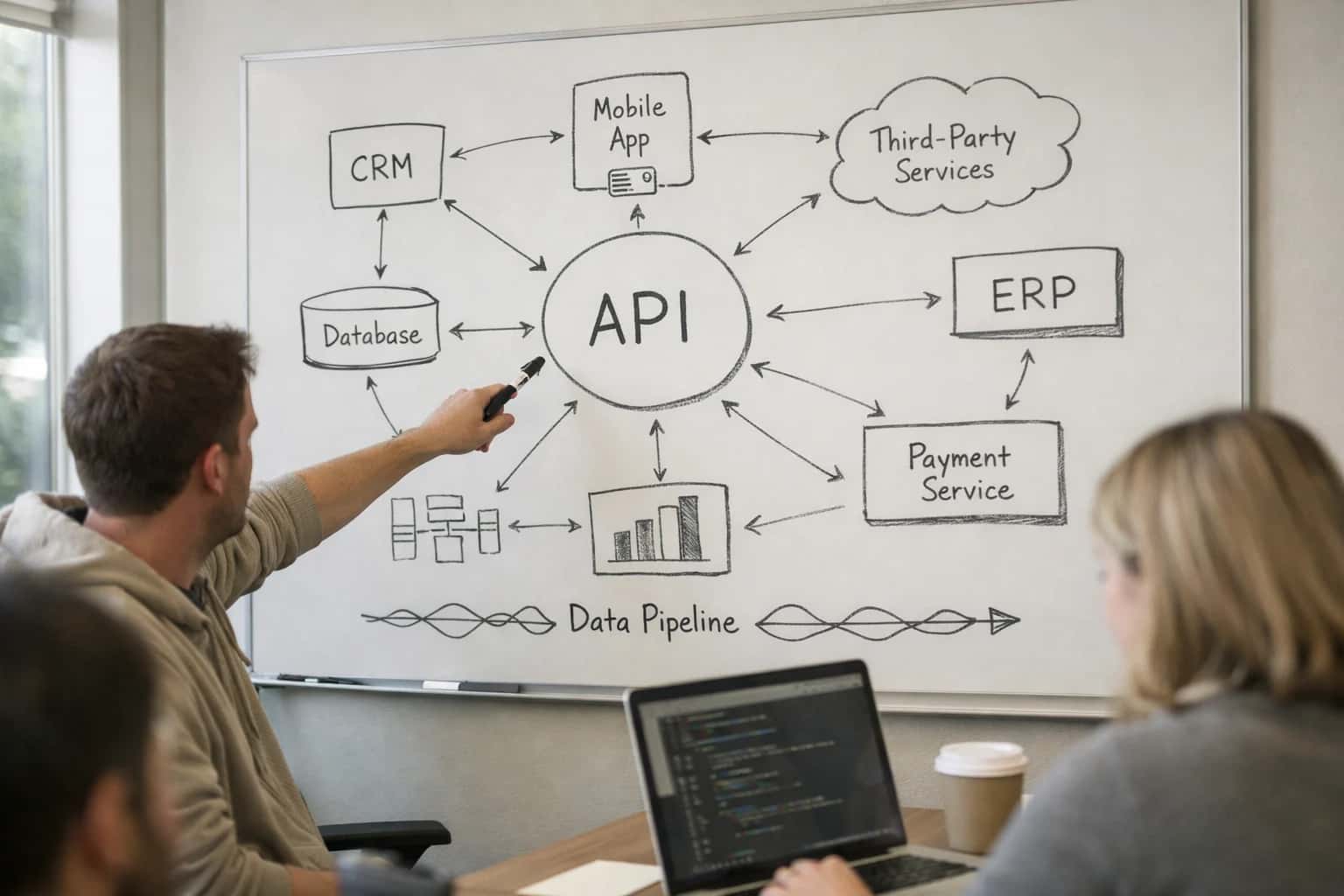
AI redaction integrates at the ingestion, review, and lifecycle stages of your ECM platform—whether it's OpenText Content Suite, Hyland OnBase, Laserfiche, or SharePoint. The typical architecture involves an event-driven pipeline: when a document is uploaded or flagged for review, a webhook triggers an AI service. This service uses pre-trained or fine-tuned models to scan for patterns of Personally Identifiable Information (PII), Protected Health Information (PHI), financial data, and custom confidential terms. Detected entities are returned with confidence scores and bounding coordinates, ready for application as redaction overlays or metadata tags within the native ECM interface.

Integration
AI Integration for AI-Driven Redaction in Sensitive Documents
Implement AI models to automatically identify and redact PII, PHI, and confidential information within documents stored in enterprise content management systems like OpenText, Hyland, Laserfiche, SharePoint, and Box.
ARCHITECTURE & IMPLEMENTATION
Where AI Fits into ECM Redaction Workflows
Integrating AI for redaction transforms a manual, error-prone compliance task into an automated, auditable process within your existing ECM system.
High-value use cases include automating redaction for inbound customer correspondence, legal discovery documents, employee records, and archived contracts. For example, in a healthcare setting, AI can pre-screen patient intake forms stored in OnBase, redacting Social Security Numbers and dates of birth before the record is routed for clinical review. In legal practice management, AI integrated with iManage or NetDocuments can automatically redact privileged party names from case files during e-discovery collection. The impact is operational: reducing manual review from hours per document to seconds, minimizing human oversight fatigue, and creating a consistent, defensible audit trail of what was redacted, when, and why.
Rollout requires a phased, governed approach. Start with a pilot in a controlled repository, using AI suggestions in a human-in-the-loop approval workflow before full automation. Governance is critical: you must define and test the redaction logic, manage model drift, and ensure the AI's decisions align with legal and regulatory requirements (e.g., GDPR's "right to be forgotten" vs. legal hold). The integration should log all actions—original text, redaction rationale, and user approval—back to the ECM's audit system. This creates a transparent chain of custody, essential for compliance audits and demonstrating due diligence in your redaction processes.
AI-DRIVEN REDACTION
Integration Touchpoints in Your ECM Platform
At the Point of Entry
Integrate AI redaction models directly into your ECM's capture channels to identify and mask sensitive data before documents are committed to the repository. This preemptive approach minimizes exposure and reduces downstream processing load.
Key Integration Points:
- Scanning/OCR Workflows: Intercept scanned image or OCR output in real-time, applying redaction before final PDF generation.
- Email Ingestion Services: Process attachments from mailroom automation tools (e.g., OpenText RightFax, Hyland Brainware) as they enter the system.
- Bulk Upload APIs: Hook into the
POST /documentsor similar upload endpoints of your ECM's REST API to apply serverless redaction functions. - Folder Watchers & Connectors: Use event-driven architectures where new files in a watched folder (like a network share or Box folder) trigger an immediate redaction job.
This layer ensures sensitive PII, PHI, or financial data is never stored in clear text, aligning with privacy-by-design principles.
ENTERPRISE CONTENT MANAGEMENT
High-Value Use Cases for AI-Powered Redaction
Integrate AI models directly into your ECM platform to automatically identify and redact sensitive data, ensuring compliance and protecting privacy without manual review bottlenecks.
01
Automated PII/PHI Redaction for Legal & Healthcare
Scan documents in OpenText Content Suite or Hyland OnBase for Personally Identifiable Information (PII) and Protected Health Information (PHI). AI models identify and redact social security numbers, medical record numbers, and addresses in batch or real-time, preparing documents for e-discovery or patient record release.
Batch -> Real-time
Processing speed
02
Contract & Agreement Sanitization for Sharing
Before sharing contracts from Box or SharePoint with external parties, use AI to redact confidential clauses, pricing, and party information. The integration analyzes document semantics, not just keywords, to protect intellectual property and sensitive commercial terms during due diligence or partner reviews.
Hours -> Minutes
Review time
03
Compliance-Driven Redaction in Records Management
Enforce GDPR, CCPA, and other privacy regulations by integrating AI with Laserfiche Records Management. Automatically apply redaction policies based on record type, retention schedule, and access requestor. AI identifies relevant data fields across varied document formats, ensuring consistent policy application at scale.
Manual -> Automated
Policy enforcement
04
Secure External-Facing Document Portals
Power self-service portals built on ECM platforms with on-the-fly redaction. When a citizen, customer, or partner requests a document via a Hyland Perceptive Content or SharePoint Online portal, AI dynamically redacts sensitive information based on the requester's role and entitlements before delivery.
Same day
Request fulfillment
05
Redaction as a Step in Automated Workflows
Inject an AI redaction step into Laserfiche Workflow or OpenText AppWorks processes. For example, in an invoice approval flow, automatically redact supplier bank details before routing for financial review. Or in a case management workflow, redact witness information from incident reports before sharing with legal counsel.
1 sprint
Integration timeline
06
Bulk Historical Data Remediation
Address compliance gaps by scanning legacy archives in OpenText InfoArchive or Box for sensitive data. AI processes millions of historical documents, identifies PII/PHI, and applies redactions or flags items for review, creating a cleansed, low-risk repository for long-term retention and future access.
Months -> Weeks
Project duration
IMPLEMENTATION PATTERNS
Example Redaction Workflows and Automations
These workflows demonstrate how AI-driven redaction integrates with enterprise content management (ECM) platforms like OpenText, Hyland, and Laserfiche. Each pattern connects to native APIs, triggers automated actions, and embeds governance checkpoints for production-ready compliance.
Trigger: A new document (e.g., scanned patient form, referral letter) is ingested into a healthcare ECM system like Hyland OnBase or OpenText Content Suite.
Workflow:
- Event Capture: The ECM's event system (e.g., OnBase workflow event, Laserfiche Cloud webhook) triggers an AI service via a secure API call, passing the document ID and metadata.
- Context Pull: The AI service retrieves the document binary via the ECM's REST API and extracts text using OCR if needed.
- Model Action: A specialized redaction model (e.g., tuned for HIPAA) scans the text and image layers for:
- Structured PII: Social Security Numbers, Dates of Birth, Medical Record Numbers.
- Unstructured PHI: Patient names, addresses, provider names, treatment details mentioned in narrative text.
- System Update: The service returns a redaction manifest (JSON list of bounding boxes/text spans) and a redacted PDF version.
- ECM Integration: The workflow engine:
- Stores the redacted PDF as a new version or linked document.
- Writes the redaction manifest as searchable metadata (e.g.,
Redaction_Applied: True,PII_Types_Found: SSN, DOB). - Routes the redacted document to the clinical workflow; the original is secured under a strict access policy.
Human Review Point: A sample of documents (e.g., 5%) is flagged for QA review in a dedicated queue. The manifest allows reviewers to quickly verify redaction accuracy.
SECURE, GOVERNED, AND AUDITABLE
Implementation Architecture: Data Flow and Guardrails
A production-ready architecture for AI-driven redaction integrates directly with your ECM's object model, ensuring sensitive data never leaves your controlled environment.
The core integration pattern connects an AI inference service to your ECM platform's event system (e.g., OpenText Content Server events, Laserfiche Workflow triggers, SharePoint event receivers). When a document is uploaded or flagged for review, a secure webhook passes only the document's unique identifier and metadata to a processing queue. The AI service, hosted within your VPC or Azure tenant, then uses the ECM's native REST API (like the OpenText Content Server OTDS API or Box API) to fetch the document binary directly, process it in-memory, and return a redacted version or a manifest of redaction coordinates—all without persisting the raw sensitive content externally. This keeps PII/PHI within your data boundary and leverages the ECM's existing authentication and authorization layer.
Critical guardrails are implemented at multiple layers:
- Pre-processing validation: Checks document type, size, and metadata to filter out non-text files or already-redacted documents.
- Model governance: Uses a curated ensemble of models—a high-recall model for sensitive pattern detection (e.g., for SSNs, credit card numbers) and a more nuanced LLM for contextual classification (e.g., distinguishing a patient's name from a doctor's reference in clinical notes). All models are benchmarked for false-positive/false-negative rates specific to your industry's document corpus.
- Human-in-the-loop (HITL) escalation: Low-confidence redactions or documents exceeding a complexity threshold are routed to a secure review queue within the ECM's native interface (like a Hyland OnBase workflow queue), where an authorized user can approve, reject, or modify the AI's suggestions. All actions are logged to the ECM's audit trail.
Rollout follows a phased, content-based approach. Start with a pilot on a low-risk, high-volume document set—such as internal meeting minutes or publicly available forms—to validate accuracy and performance. Then, progressively expand to more sensitive categories (e.g., HR records, patient intake forms), tuning confidence thresholds and review workflows for each. The final architecture includes continuous monitoring via dashboards that track redaction volume, model drift, HITL escalation rates, and processing latency, ensuring the system remains compliant and effective as document types evolve. For a deeper dive on integrating these guardrails with specific platforms, see our guide on [/integrations/enterprise-content-management-platforms/ai-integration-for-automated-retention-scheduling-in-ecm](AI-driven compliance workflows).
IMPLEMENTATION PATTERNS
Code and Payload Examples
Real-Time Processing on Document Upload
A common pattern is to trigger AI redaction via a webhook when a sensitive document is uploaded to the ECM platform. The ECM system (e.g., Box, SharePoint) sends a payload to your secure AI service, which processes the file and returns redacted versions or metadata for policy enforcement.
Example Payload from ECM Webhook:
json{ "event_id": "doc_upload_abc123", "event_type": "FILE.UPLOADED", "source": { "platform": "Box", "file_id": "1234567890", "file_name": "patient_discharge_summary.pdf", "file_path": "/Clinical/Patient Records/", "download_url": "https://api.box.com/files/1234567890/content", "uploaded_by": "[email protected]" }, "triggered_at": "2024-05-15T10:30:00Z" }
Your AI service uses this payload to fetch the document, run it through PII/PHI detection models, apply redaction masks, and post the secure version back to a designated folder, updating the record's metadata to reflect the compliance action.
AI-DRIVEN REDACTION
Realistic Time Savings and Operational Impact
How AI integration transforms manual, high-risk redaction workflows within Enterprise Content Management (ECM) platforms like OpenText, Hyland, and Laserfiche.
| Workflow Stage | Manual Process | With AI Integration | Operational Impact |
|---|---|---|---|
Document Triage & Classification | Manual review by analyst (5-15 min/doc) | AI auto-classifies by sensitivity (seconds) | Analyst effort shifts from classification to exception handling |
PII/PHI Detection | Keyword search & visual scan (10-30 min/doc) | AI models scan full text & context (1-2 min/doc) | Detection coverage expands from ~70% to >95% of sensitive fields |
Redaction Application | Manual blackout in PDF editor (5-20 min/doc) | AI proposes redaction boxes, human approves (1-3 min/doc) | Reduction in human error and missed redactions |
Quality Assurance Review | Second analyst reviews 100% of redacted docs | AI flags low-confidence areas; review focused on 10-20% | QA capacity reallocated to high-risk documents and process oversight |
Audit Trail & Reporting | Manual log entry in spreadsheet or ECM metadata | Automated audit log with reason codes, linked to ECM record | Compliance reporting time cut from days to hours |
Policy Exception Handling | Escalation to legal/compliance team (next-day turnaround) | AI routes exceptions with context to appropriate queue (same-day) | Faster resolution reduces legal hold and disclosure delays |
Process for New Document Types | Manual rule creation by IT (2-4 week cycle) | AI model fine-tuned with sample set (1-2 week cycle) | Agility to handle new regulations or business units rapidly |
ARCHITECTING FOR COMPLIANCE AND CONTROL
Governance, Security, and Phased Rollout
A secure, phased implementation is critical for AI-driven redaction in regulated content management environments.
A production redaction pipeline must be architected as a governed workflow, not a direct API call. For platforms like OpenText Content Suite, Hyland OnBase, or Laserfiche, this typically involves:
- Secure Data Handling: Documents are passed to a dedicated, isolated processing queue (e.g., via secure API or event from the ECM's workflow engine). The AI service should never have persistent access to the repository.
- Audit Trail Integration: Every redaction action—document submitted, PII/PHI categories identified, redaction applied, user who approved—must write back to the ECM's native audit log or a linked compliance system.
- Human-in-the-Loop Gates: Configure workflows to route low-confidence redactions or documents from high-risk matter folders for human review before the redacted version is committed.
Rollout follows a risk-based, phased approach:
- Pilot Non-Critical Content: Begin with internal, non-regulated documents (e.g., meeting minutes, internal reports) to validate accuracy and workflow integration.
- Expand by Document Type and Repository: Gradually enable redaction for specific, high-volume sensitive document classes (e.g.,
patient intake formsin a healthcare vertical,client contractsin legal). - Implement Role-Based Access Control (RBAC): Use the ECM's existing permission model to control who can configure, approve overrides, or view the original unredacted version.
- Continuous Validation: Establish a QA process where a sample of AI-redacted documents is manually reviewed to monitor model drift and update classification rules.
Security is paramount. The integration must ensure data never leaves the approved compliance boundary. For cloud ECMs like Box or SharePoint Online, this means using the vendor's built-in AI services (e.g., SharePoint Premium) or deploying a model in your own Azure/GCP/AWS tenant, connected via private endpoint. For on-premises systems like OpenText Documentum or SharePoint Server, the AI model should be deployed in the same data center, with all communication encrypted and firewalled. Inference Systems designs these integrations with a 'zero-trust' data plane, ensuring redaction is a transient, logged operation within a controlled pipeline.
Enabling Efficiency, Speed & Accuracy
Intelligent Analysis, Decision & Execution
We build AI systems for teams that need search across company data, workflow automation across tools, or AI features inside products and internal software.
Talk to Us
Search across company data
Give teams answers from docs, tickets, runbooks, and product data with sources and permissions.
Useful when people spend too long searching or get different answers from different systems.
Enterprise searchRAGPermissions
Read more
Automate internal workflows
Use AI to route work, draft outputs, trigger actions, and keep approvals and logs in place.
Useful when repetitive work moves across multiple tools and teams.
AI agentsWorkflow automationGovernance
Read more
Add AI to products and internal tools
Build assistants, guided actions, or decision support into the software your team or customers already use.
Useful when AI needs to be part of the product, not a separate tool.
AI integrationDecision supportModel routing
Read moreAI-DRIVEN REDACTION IMPLEMENTATION
Frequently Asked Questions
Key questions for architects and compliance leaders planning AI-powered redaction within OpenText, Hyland, Laserfiche, SharePoint, or Box.
AI redaction integrates as a processing layer, typically via the platform's APIs or event system. The standard pattern is:
- Trigger: A document upload, update, or a scheduled scan triggers a webhook or drops a file into a monitored folder.
- Processing: The file is sent securely to an AI service (on-premises or cloud-based) via API. The AI model scans the document text and metadata for patterns matching PII (SSNs, driver's licenses), PHI (diagnosis codes, patient names), and custom confidential terms.
- Action: The service returns coordinates (e.g., bounding boxes) and confidence scores for each detected entity.
- Update: Your ECM workflow applies native redaction stamps or creates a redacted copy, updating the document record with an audit log of what was redacted and why.
For example, in Box, you would use the Box Skills Kit framework or the Box API with webhooks. In SharePoint, you would use Microsoft Graph API and potentially Azure AI Document Intelligence.

About the author
Prasad Kumkar
CEO & MD, Inference Systems
Prasad Kumkar is the CEO & MD of Inference Systems and writes about AI systems architecture, LLM infrastructure, model serving, evaluation, and production deployment. Over 5+ years, he has worked across computer vision models, L5 autonomous vehicle systems, and LLM research, with a focus on taking complex AI ideas into real-world engineering systems.
His work and writing cover AI systems, large language models, AI agents, multimodal systems, autonomous systems, inference optimization, RAG, evaluation, and production AI engineering.
LinkedIn
Limited slotsGet a Free AI Consultation
Partnered with leading AI, data, and software stack.





How We Work
Custom AI workflows for your Business
One-fit-all AI don't work for modern businesses. At Inferensys, we aim to understand your business & custom requirements; which we use to define most efficient agentic workflows, the data, and the tools for your business.
01
Review the use case
We understand the task, the users, and where AI can actually help.
Read more02
Pick the right approach
We define what needs search, automation, or product integration.
Read more03
Build the first useful version
We implement the part that proves the value first.
Read more04
Improve from there
We add the checks and visibility needed to keep it useful.
Read moreThe first call is a practical review of your use case and the right next step.
Talk to Us