AI integration targets specific, high-volume contract types where manual review creates bottlenecks and compliance risk. Key surfaces include Business Associate Agreements (BAAs), provider network contracts, vendor service agreements, and clinical trial agreements. The integration connects to the CLM platform's API layer (e.g., Ironclad Workflow Engine, Icertis AI Studio, Agiloft's configurable objects) to trigger AI analysis upon document upload, extracting and validating clauses related to HIPAA safeguards, breach notification timelines, permitted uses of PHI, and minimum necessary standards. This populates structured metadata fields for compliance reporting and obligation tracking.

Integration
AI Integration for Contract AI in HIPAA Environments
A technical guide to building secure, HIPAA-compliant AI integrations for Contract Lifecycle Management (CLM) platforms like Ironclad, Icertis, Agiloft, and DocuSign CLM. Learn how to automate the review of Business Associate Agreements and other healthcare contracts while protecting PHI.
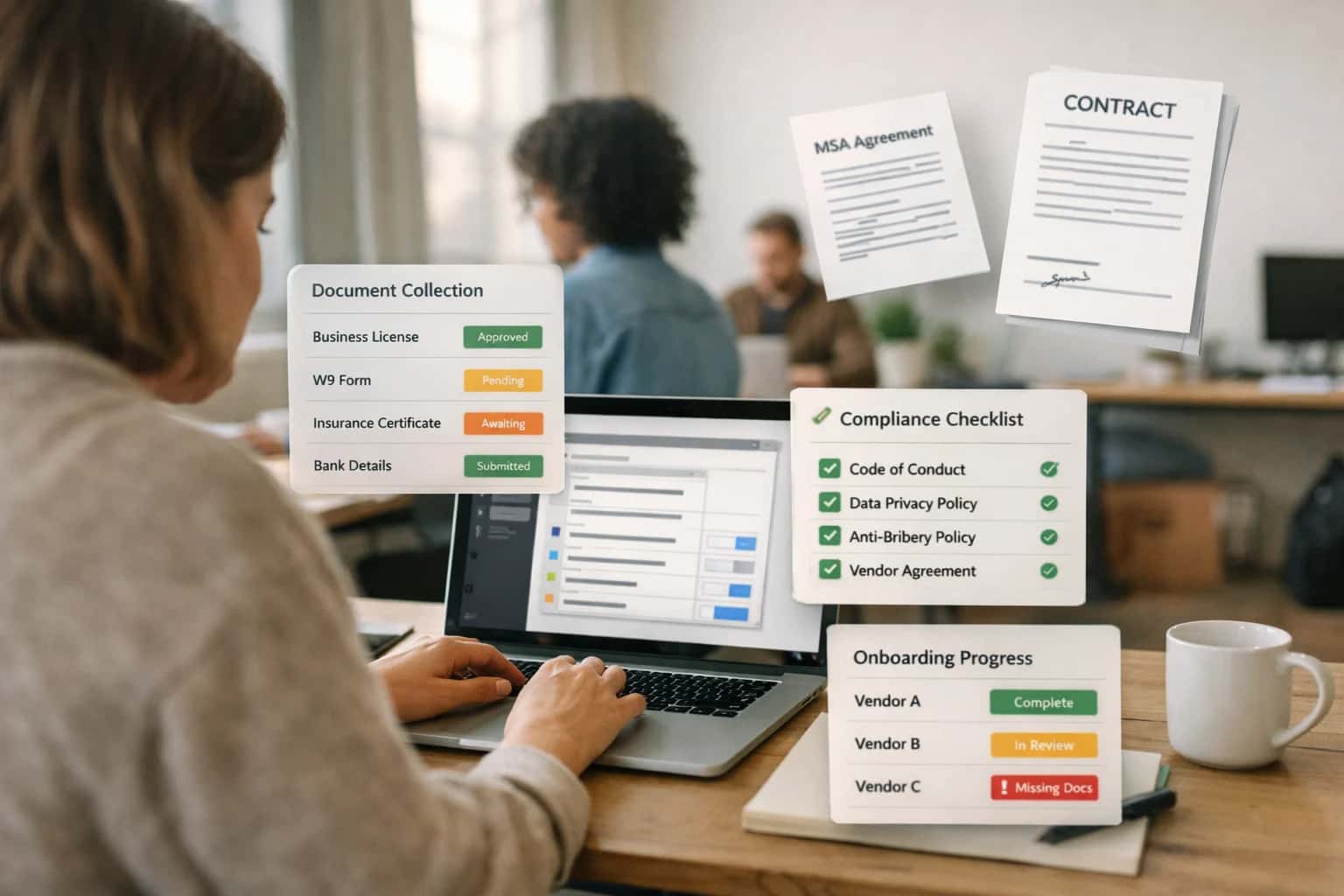
ARCHITECTURE FOR HIPAA-COMPLIANT CONTRACT INTELLIGENCE
Where AI Fits in Healthcare Contract Management
Integrating AI into healthcare CLM requires a secure, auditable architecture that protects PHI while automating high-friction workflows.
A production implementation uses a zero-data-retention pipeline where contract documents are temporarily staged in a secure, encrypted environment for AI processing. Models are fine-tuned or prompted to redact PHI identifiers before analysis or use a Retrieval-Augmented Generation (RAG) architecture grounded solely in de-identified clause libraries and playbooks. Outputs—such as risk scores, missing term flags, and obligation summaries—are injected back into the CLM as audit-logged activities, often triggering automated approval workflows or routing exceptions to a designated Privacy Officer or Legal review queue. This reduces manual triage from hours to minutes for standard agreements.
Governance is critical. The AI system must operate under the CLM platform's existing role-based access controls (RBAC) and maintain a full audit trail linking each AI-suggested action to the user who approved it. A human-in-the-loop review step is mandated for any contract amendment or deviation from a pre-approved playbook. Implementation typically follows a pilot on low-risk BAAs, measuring accuracy against a gold-standard manual review before scaling to more complex provider or payer contracts. This controlled rollout ensures the AI augments—rather than replaces—the compliance and legal oversight required in a regulated healthcare environment.
SECURE INTEGRATION PATTERNS
CLM Platform Touchpoints for HIPAA-Aware AI
Securing the AI Pipeline
The first critical touchpoint is the ingestion pipeline into the CLM. For HIPAA compliance, PHI must be identified and handled before AI processing. This involves a pre-processing layer that sits between the document upload (via API, email, or webform) and the AI extraction engine.
Key Integration Points:
- CLM Webhook/Event Listeners: Trigger a redaction service upon document upload to Ironclad, Icertis, or Agiloft.
- Secure File Transfer: Use encrypted channels (TLS 1.3+) to move documents to a processing environment.
- Programmatic Redaction: Apply Named Entity Recognition (NER) models specifically trained on HIPAA identifiers (names, dates, MRNs, etc.) to mask or tokenize PHI.
Example Workflow: A Business Associate Agreement (BAA) is uploaded to DocuSign CLM. A webhook fires, sending the document to a secure container. A PHI redaction model runs, replacing identifiers with secure tokens (e.g., [PATIENT_NAME_1]). The redacted version is passed to the clause extraction AI, while the original is stored in a separate, access-controlled vault. Audit logs track the entire chain of custody.
SECURE CONTRACT INTELLIGENCE
High-Value, HIPAA-Specific AI Use Cases
Integrating AI into Contract Lifecycle Management (CLM) platforms for healthcare requires a security-first architecture. These patterns focus on automating high-touch workflows involving Business Associate Agreements (BAAs), provider contracts, and other PHI-containing documents while enforcing HIPAA compliance by design.
01
Automated BAA Risk & Compliance Review
AI agents pre-screen incoming Business Associate Agreements against a healthcare-specific playbook within your CLM (e.g., Ironclad, Icertis). The system flags missing or non-standard HIPAA security rule clauses, required breach notification language, and permissible uses of PHI, routing only exceptions for legal review. This ensures BAAs move from legal to procurement in hours instead of weeks.
Weeks -> Hours
Review cycle
02
PHI-Aware Clause Extraction & Redaction
Deploy a secure extraction pipeline that identifies and extracts key commercial terms (term, liability caps, insurance) from provider or patient-facing contracts while automatically detecting and redacting Protected Health Information (PHI) before sending data to the LLM. This enables safe population of CLM metadata fields without exposing sensitive data, maintaining a clean audit trail.
Batch -> Real-time
PHI handling
03
Provider Contract Obligation Tracking
AI parses executed provider network agreements and service contracts to identify critical obligations (credentialing timelines, quality reporting, fee schedule updates). It then creates tracked tasks within the CLM or integrated project tool (e.g., ServiceNow), with automated reminders sent to contract owners. This prevents missed deadlines that can impact revenue cycle operations and compliance.
Manual → Automated
Obligation management
04
Clinical Trial Agreement Acceleration
For health systems and pharma, AI accelerates the review of complex Clinical Trial Agreements (CTAs) and site budgets. A RAG system grounded in approved protocol libraries and prior negotiated terms suggests edits, identifies non-standard indemnification or IP clauses, and generates a redlined summary for the study startup team, cutting negotiation cycles significantly.
1-2 Sprints
Time to activation
05
Secure, Grounded Contract Q&A
Implement a Retrieval-Augmented Generation (RAG) chatbot with strict access controls, allowing authorized business users (e.g., procurement, revenue cycle) to ask natural language questions about active contracts. The system retrieves answers only from approved, executed documents in the CLM, providing instant insights on termination rights, renewal terms, or billing rules without exposing the full document set.
Minutes -> Seconds
Information retrieval
06
Audit-Ready AI Governance Workflow
Build a human-in-the-loop review and audit trail for all AI actions. Every AI-suggested clause, edit, or extraction is logged with the model version, prompt, and user who approved/rejected it. This creates a defensible record for HIPAA and internal compliance audits, proving controlled use of AI on sensitive contracts. Integrates with CLM's native version history.
Full Traceability
Compliance evidence
CONTRACT AI FOR HEALTHCARE
Example HIPAA-Compliant AI Workflows
These workflows illustrate how AI can be integrated into Contract Lifecycle Management (CLM) platforms to automate high-volume, high-compliance tasks in healthcare environments. Each pattern is designed to operate within a Business Associate Agreement (BAA) framework, ensuring PHI is handled securely and all actions are logged for auditability.
Trigger: A new Business Associate Agreement (BAA) or amendment is uploaded to the CLM (e.g., Ironclad, Icertis) via a vendor portal or email ingestion.
Context/Data Pulled: The AI system, operating within a secure VPC, extracts the document text. It does not send raw documents to external LLM APIs. Instead, it uses a local embedding model to create a vector representation and queries a RAG index built on pre-approved BAA playbooks and HIPAA requirement checklists.
Model/Agent Action: An AI agent classifies the document as a BAA and performs a risk assessment:
- Clause Identification: Extracts key clauses (e.g., Permitted Uses & Disclosures, Safeguards, Breach Notification, Termination).
- Compliance Gap Analysis: Compares extracted clauses against the organization's standard BAA language, flagging deviations (e.g., weaker breach notification timelines, insufficient audit rights).
- PHI Scope Check: Identifies the types of PHI involved and the services provided, ensuring the BAA's scope is appropriately defined.
System Update/Next Step: The CLM record is automatically populated with:
- A risk score (High/Medium/Low).
- Extracted metadata (Parties, Effective Date, Termination Terms).
- A summary of flagged deviations. The workflow is then routed: Low-risk, compliant BAAs are auto-approved for signature. Medium/High-risk BAAs are routed to the Privacy Officer's queue with the AI-generated analysis pre-attached.
Human Review Point: Mandatory for any agreement where the AI flags a material deviation from the standard playbook or cannot confidently classify a clause. All AI actions and confidence scores are logged in the CLM's audit trail.
HIPAA-COMPLIANT AI INTEGRATION
Secure Implementation Architecture for PHI
Architectural blueprint for deploying AI within Contract Lifecycle Management (CLM) platforms like Ironclad or Icertis while protecting Protected Health Information (PHI) in Business Associate Agreements and other healthcare contracts.
A HIPAA-compliant AI integration for CLM requires a zero-trust data pipeline where PHI is never exposed to general-purpose models. The architecture typically involves a dedicated, isolated processing environment where contracts are ingested. Before any AI analysis, a pre-processing service redacts or tokenizes all PHI—such as patient names, medical record numbers, and treatment details—using deterministic pattern matching. The sanitized document is then passed to the AI engine for clause extraction, obligation tracking, or risk analysis. All extracted metadata and insights are written back to the CLM platform's structured fields (e.g., custom objects for Business Associate, Data Use Purpose, Minimum Necessary flags) without re-injecting the raw PHI. This ensures the CLM system of record maintains a full, compliant audit trail while the AI operates on a de-identified copy.
Implementation hinges on enforcing BAA terms at the workflow level. For instance, an AI agent integrated into Ironclad's review workflow can be configured to automatically flag any contract lacking a valid BAA reference or containing non-standard data handling clauses. The agent uses a RAG (Retrieval-Augmented Generation) system grounded in the organization's approved BAA template library and HIPAA policy documents to suggest specific, compliant language. All AI-generated suggestions and redlines are logged as draft recommendations, requiring a human-in-the-loop approval from a designated privacy officer or legal reviewer within the CLM's approval chain before any contract version is finalized or shared externally.
Rollout and governance require a phased, audit-first approach. Start with a pilot on a closed subset of non-critical vendor agreements, using the CLM platform's native version history and audit log features to trace every AI interaction. Implement strict RBAC (Role-Based Access Control) so that only authorized roles (e.g., Compliance Manager, Privacy Officer) can configure the AI models or access the underlying processing logs. Partner with your CLM vendor to ensure the integration points—typically webhooks for document upload and the REST API for metadata updates—are covered under your existing BAA. Continuous monitoring should track metrics like PHI detection accuracy, false positive rates for clause identification, and manual override rates to ensure the AI augments—rather than compromises—compliance workflows.
HIPAA-COMPLIANT CONTRACT AI
Code & Payload Patterns for Secure Integration
Secure Data Onboarding
Before any AI processing, a dedicated redaction service must strip Protected Health Information (PHI) from contract documents. This service should be deployed within your HIPAA-compliant cloud environment (e.g., AWS, Azure, GCP with BAA) and process documents before they reach the CLM's primary ingestion API.
Key Pattern: Use a serverless function triggered by a document upload event in your secure storage bucket. The function calls a pre-trained NER model (like spaCy's en_core_web_trf) to identify and redact PHI (e.g., patient names, MRNs, dates of service) before forwarding the sanitized document to your CLM platform's API.
python# Example: AWS Lambda for PHI Redaction import boto3 import spacy # Load model in Lambda layer nlp = spacy.load('en_core_web_smf') def lambda_handler(event, context): s3 = boto3.client('s3') bucket = event['Records'][0]['s3']['bucket']['name'] key = event['Records'][0]['s3']['object']['key'] # Get document text obj = s3.get_object(Bucket=bucket, Key=key) text = obj['Body'].read().decode('utf-8') # Redact PHI doc = nlp(text) for ent in doc.ents: if ent.label_ in ['PERSON', 'DATE', 'ID_NUM']: text = text.replace(ent.text, '[REDACTED]') # Post redacted text to CLM API # ... secure API call to Ironclad/Icertis ...
AI INTEGRATION FOR CLM IN HEALTHCARE
Realistic Time Savings & Operational Impact
This table outlines the tangible efficiency gains and risk reduction achievable by integrating a secure, HIPAA-aligned AI layer into your Contract Lifecycle Management platform for healthcare contracts like Business Associate Agreements (BAAs) and provider agreements.
| Workflow / Task | Before AI Integration | After AI Integration | Key Notes & Governance |
|---|---|---|---|
Initial BAA Review & Risk Flagging | 2-4 hours manual review per agreement | 15-30 minutes with AI-assisted summary and risk highlights | AI pre-screens for missing HIPAA clauses; final approval remains with legal. |
PHI Data Clause Identification & Redaction | Manual search and redaction in contract attachments | Automated detection and suggested redaction of PHI references | Operates on a copy; human validates all redactions before execution. |
Obligation Extraction for Compliance Tracking | Manual entry into tracking spreadsheet or CLM fields | AI auto-extracts key dates, reporting duties, and breach notification terms | Extracted data populates CLM metadata; triggers calendar and task creation. |
Contract Repository Query for Audit Prep | Days spent manually searching and compiling evidence | Minutes using a RAG-powered Q&A assistant over the entire corpus | Assistant provides citations; legal team verifies all evidence for auditors. |
Renewal & Expiration Forecasting for Provider Contracts | Monthly manual report run and analysis | Weekly automated dashboard with AI-predicted renewal windows | Forecasts based on term dates and usage; account managers own outreach. |
Playbook Deviation Detection in New Drafts | Reliant on reviewer's memory of standard positions | AI compares draft against approved playbook, flags non-standard language | Flags are advisory; legal negotiator makes final call on deviations. |
Vendor Onboarding Document Consolidation | Manual collection and filing of BAAs, insurance certificates | AI-assisted workflow triggers requests and validates document completeness | Workflow ensures all required PHI-related docs are collected before activation. |
HIPAA-COMPLIANT AI INTEGRATION
Governance, Audit, and Phased Rollout
A controlled approach to deploying AI for contract management in healthcare, ensuring PHI security and regulatory adherence.
Integrating AI into a CLM like Ironclad or Icertis for healthcare contracts requires a governance-first architecture. This starts with a pre-processing layer that identifies and redacts Protected Health Information (PHI) from contract documents before any text is sent to an LLM for analysis. Fields like patient names, medical record numbers, and specific treatment details must be masked or tokenized. The AI system should be configured to process only the legal and commercial constructs of the agreement—such as indemnification clauses, liability caps, and Business Associate Agreement (BAA) obligations—while the redacted PHI remains within the secure CLM environment for authorized human review only.
A phased rollout is critical for managing risk and building trust. Phase 1 typically targets low-risk, high-volume agreements like standard BAAs or vendor NDAs, where AI performs initial clause extraction and flags missing HIPAA-mandated terms for legal review. Phase 2 expands to more complex provider or payer contracts, introducing AI-powered obligation tracking for compliance reporting. Each phase should include a human-in-the-loop (HITL) review gate, where legal or compliance teams validate AI outputs before any automated actions (like updating a Compliance Status field) are committed back to the CLM. This creates a controlled feedback loop for model improvement.
Maintaining a defensible audit trail is non-negotiable. Every AI interaction—document ingestion, PHI redaction, clause prediction, and user override—must be logged with a timestamp, user ID, and action context. These logs should be immutable and linked to the contract record within the CLM. This traceability is essential for demonstrating due diligence to auditors, proving that AI-assisted decisions are explainable and that PHI handling complies with HIPAA's Security and Privacy Rules. Governance also extends to the AI models themselves; using dedicated, HIPAA-compliant LLM instances (like Azure OpenAI with a BAA) and ensuring all data in transit and at rest is encrypted are foundational requirements.
Successful implementation hinges on cross-functional oversight. A steering committee with representatives from Legal, Compliance, IT Security, and Procurement should define the acceptable use policy for the AI, approve the phased use cases, and review performance metrics. Key metrics include reduction in manual review time, accuracy of obligation identification, and the rate of HITL overrides. By anchoring the integration in governance, auditability, and incremental rollout, healthcare organizations can harness AI for contract intelligence without compromising the stringent requirements of a HIPAA environment.
Enabling Efficiency, Speed & Accuracy
Intelligent Analysis, Decision & Execution
We build AI systems for teams that need search across company data, workflow automation across tools, or AI features inside products and internal software.
Talk to Us
Search across company data
Give teams answers from docs, tickets, runbooks, and product data with sources and permissions.
Useful when people spend too long searching or get different answers from different systems.
Enterprise searchRAGPermissions
Read more
Automate internal workflows
Use AI to route work, draft outputs, trigger actions, and keep approvals and logs in place.
Useful when repetitive work moves across multiple tools and teams.
AI agentsWorkflow automationGovernance
Read more
Add AI to products and internal tools
Build assistants, guided actions, or decision support into the software your team or customers already use.
Useful when AI needs to be part of the product, not a separate tool.
AI integrationDecision supportModel routing
Read moreAI INTEGRATION FOR CONTRACT AI IN HIPAA ENVIRONMENTS
FAQ: Technical & Compliance Questions
Technical and compliance considerations for integrating AI into Contract Lifecycle Management (CLM) platforms like Ironclad, Icertis, Agiloft, and DocuSign CLM when handling Business Associate Agreements (BAAs) and other contracts containing Protected Health Information (PHI).
A secure AI integration for HIPAA-compliant CLM requires a multi-layered data handling strategy.
Key Implementation Patterns:
- Pre-Processing Redaction: Before a contract is sent to an AI model for analysis (e.g., for clause extraction), a separate, deterministic process identifies and redacts PHI. This can use:
- Pattern matching for common PHI formats (e.g.,
XXX-XX-XXXXfor SSNs). - Named Entity Recognition (NER) models trained to detect PHI, deployed in a secure, isolated environment.
- The redacted version is passed to the primary AI model, while the original is stored separately with access logs.
- Pattern matching for common PHI formats (e.g.,
- Zero-Data Retention with LLM Providers: When using third-party LLMs (e.g., OpenAI, Anthropic), you must:
- Utilize their Business Associate Addendum (BAA)-covered endpoints.
- Explicitly configure API calls to disable logging and data retention for training.
- Verify that prompts and responses are ephemeral.
- On-Premises or VPC-Deployed Models: For maximum control, deploy open-source or custom fine-tuned models (e.g., Llama 2, Mixtral) within your own HIPAA-compliant cloud environment or virtual private cloud (VPC). This keeps all data, including PHI, within your controlled boundary.
The integration architecture must log all data flows between the CLM, redaction service, and AI model to demonstrate compliance for audits.

About the author
Prasad Kumkar
CEO & MD, Inference Systems
Prasad Kumkar is the CEO & MD of Inference Systems and writes about AI systems architecture, LLM infrastructure, model serving, evaluation, and production deployment. Over 5+ years, he has worked across computer vision models, L5 autonomous vehicle systems, and LLM research, with a focus on taking complex AI ideas into real-world engineering systems.
His work and writing cover AI systems, large language models, AI agents, multimodal systems, autonomous systems, inference optimization, RAG, evaluation, and production AI engineering.
LinkedIn
Limited slotsGet a Free AI Consultation
Partnered with leading AI, data, and software stack.





How We Work
Custom AI workflows for your Business
One-fit-all AI don't work for modern businesses. At Inferensys, we aim to understand your business & custom requirements; which we use to define most efficient agentic workflows, the data, and the tools for your business.
01
Review the use case
We understand the task, the users, and where AI can actually help.
Read more02
Pick the right approach
We define what needs search, automation, or product integration.
Read more03
Build the first useful version
We implement the part that proves the value first.
Read more04
Improve from there
We add the checks and visibility needed to keep it useful.
Read moreThe first call is a practical review of your use case and the right next step.
Talk to Us