Integrating AI into platforms like Ironclad, Icertis, Agiloft, or DocuSign CLM under GDPR requires a data architecture that treats contract documents as a collection of personal data records. This means your AI pipeline must be aware of data subjects (signatories, employee contacts, third-party individuals), lawful basis for processing (typically contractual necessity or legitimate interest), and retention schedules. The integration must map AI-extracted clauses and metadata—such as party names, contact details, and obligation owners—back to the CLM's data model to support rights requests, including access, rectification, and erasure.

Integration
AI Integration for Contract AI in GDPR Environments
Implement AI for contract lifecycle management while ensuring strict GDPR compliance. This guide covers lawful processing, data subject rights, AI transparency, and secure integration patterns for CLM platforms.
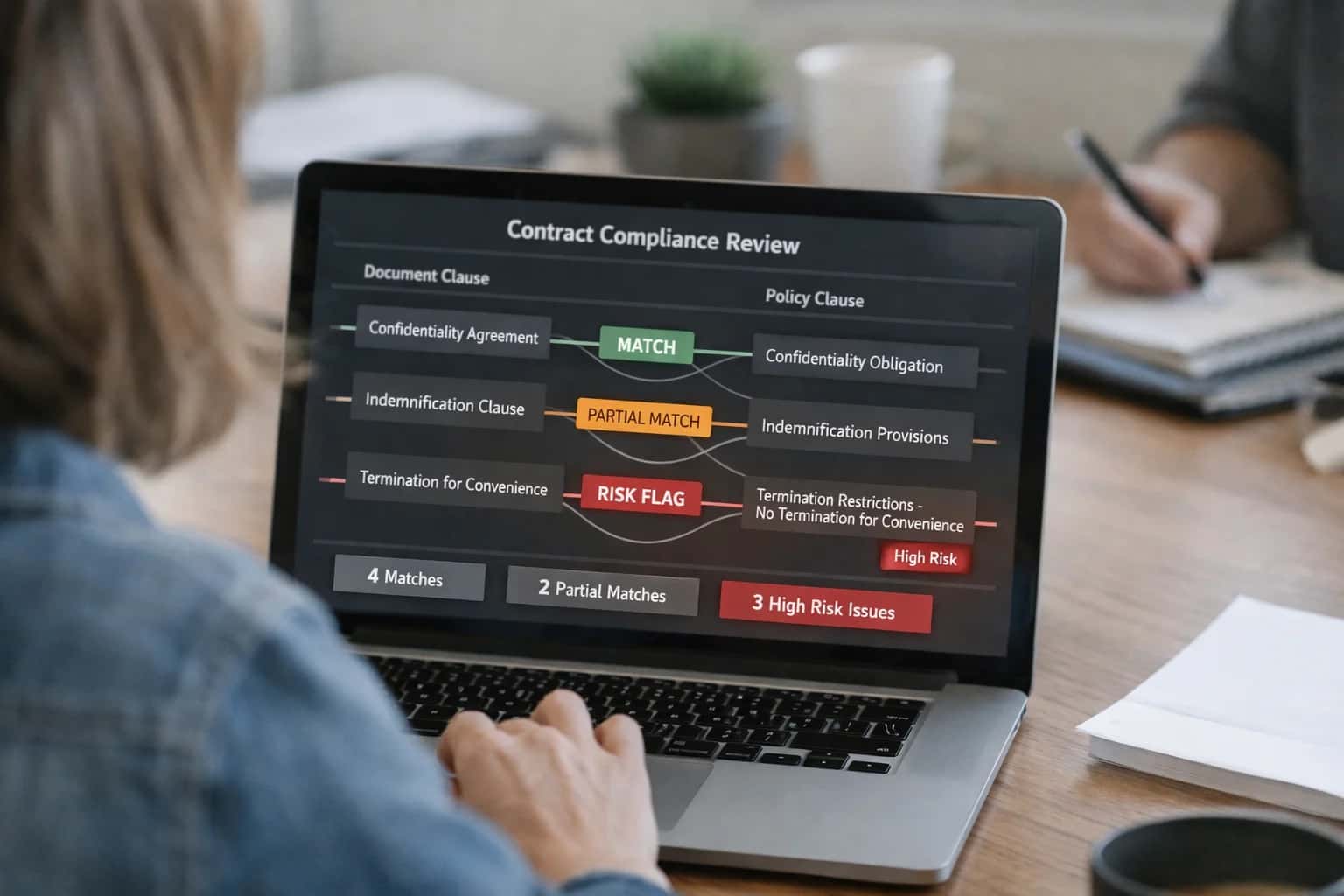
CONTRACT AI GOVERNANCE
AI for CLM Under GDPR: A Compliance-First Integration Blueprint
A technical guide to implementing AI for contract lifecycle management while ensuring strict adherence to GDPR's data subject rights, lawful processing, and transparency mandates.
Implementation centers on a governed RAG pipeline where the retrieval step is filtered by GDPR status. Before a contract chunk is sent to an LLM for summarization or Q&A, the system checks consent flags, retention policies, and role-based access controls (RBAC). For example, an AI agent providing a contract summary for a sales rep would automatically redact or mask personal data of EU-based individuals if the lawful basis or user permission doesn't support its disclosure. All AI actions—extractions, summaries, redline suggestions—must be logged in an immutable audit trail linked to the specific contract version and processing purpose to demonstrate accountability.
Rollout should begin with low-risk, high-volume use cases like automated NDA intake and triage, where the AI classifies documents and extracts basic metadata without deep analysis of sensitive clauses. This allows for the establishment of the human-in-the-loop review gate and fine-tuning of redaction models. A critical governance step is creating a Data Protection Impact Assessment (DPIA) for the AI-CLM integration, documenting the data flow, risks (e.g., hallucination revealing incorrect personal data), and mitigation controls like prompt engineering to avoid generating synthetic PII and regular model output audits against the source contracts.
IMPLEMENTATION BLUEPRINT
GDPR-Relevant Touchpoints for AI in CLM Platforms
Managing Data Subject Access Requests (DSARs) in CLM
AI integration must support GDPR's right to access and right to erasure. Within CLM platforms like Icertis or Ironclad, this means building AI agents that can:
- Identify Personal Data: Automatically scan contract repositories for PII (e.g., signatory names, contact details, employee data in SOWs) using NER models.
- Generate DSAR Reports: Create a workflow where an AI, triggered by a DSAR ticket from a system like ServiceNow, compiles a report of all contracts containing the data subject's information, including the specific clauses and metadata.
- Facilitate Redaction or Erasure: For right to erasure requests, AI can flag contracts for legal review, suggest redaction candidates, and log the action in a dedicated audit trail within the CLM.
Implementation requires linking the CLM's search API to a vector store for semantic retrieval of relevant contracts, ensuring all AI-processed data is logged for the Article 30 record of processing.
CONTRACT INTELLIGENCE WITH DATA PROTECTION BY DESIGN
High-Value, GDPR-Compliant AI Use Cases for CLM
Integrating AI into Contract Lifecycle Management platforms like Ironclad, Icertis, Agiloft, and DocuSign CLM requires a privacy-first architecture. These patterns show where AI can automate workflows while enforcing data subject rights, lawful processing, and model transparency mandated by GDPR.
01
Automated Data Subject Request Fulfillment
Implement an AI agent that monitors the CLM for contracts containing personal data (e.g., employee, customer, or vendor PII). Upon a GDPR Article 15 request, the agent automatically identifies, redacts non-relevant sections, and assembles a compliant data package for the legal team to review and dispatch. This integrates with the platform's audit trail to log the lawful basis for each data access.
Days -> Hours
Response time
02
Consent & Lawful Basis Tagging at Ingest
Deploy an AI classification layer at contract ingestion. It scans for clauses indicating the lawful basis for processing (e.g., performance of contract, legitimate interest, explicit consent) and tags the contract record accordingly in the CLM's metadata. This creates a searchable, audit-ready register of processing activities directly within the contract repository.
Manual -> Automated
Compliance mapping
03
PII Discovery & Risk-Aware Redaction
Use NLP models fine-tuned for European identifiers to proactively discover and classify PII within contract documents and metadata fields. The system can apply risk-based redaction for internal sharing or suggest anonymization for AI training datasets, ensuring processing aligns with data minimization principles. All actions are logged for Data Protection Impact Assessments (DPIAs).
Batch -> Real-time
Discovery scan
04
Right to Erasure ('Right to be Forgotten') Workflow
Build a governed automation that triggers when a right to erasure request is validated. An AI agent identifies all contract artifacts linked to the data subject across the CLM repository and connected systems, generates a deletion impact report for legal approval, and, upon sign-off, orchestrates the secure erasure or anonymization of records, preserving necessary archival copies where legally required.
Weeks -> 1 sprint
Process completion
05
Transparent AI Decision Logging for Article 22
For AI-driven actions like contract risk scoring or auto-routing, implement a sidecar logging system that captures the model version, input data snippets, and the rationale for each automated decision. This creates explainable audit trails, crucial for GDPR Article 22 provisions on automated decision-making, and allows for human review and challenge of significant AI-determined outcomes.
Full traceability
Model governance
06
Cross-Border Transfer Flagging & SCC Analysis
Integrate an AI module that parses governing law, jurisdiction, and data location clauses against a maintained rule set of adequacy decisions. It flags contracts with potential non-compliant international data transfers and can automatically check for and validate the presence of Standard Contractual Clauses (SCCs) or other transfer mechanisms, alerting legal ops for review.
Proactive alerts
Transfer risk
IMPLEMENTATION PATTERNS
GDPR-Aware AI Workflow Examples
Concrete examples of how AI can be integrated into CLM workflows while maintaining strict GDPR compliance. Each pattern details the trigger, data handling, AI action, and governance controls required for lawful processing.
Trigger: A new Non-Disclosure Agreement (NDA) is uploaded via a webform into Ironclad or Agiloft.
GDPR Context & Data Pull: Before AI processing, the system checks the lawful basis for processing (typically 'legitimate interests' for vendor/counterparty contracts). The workflow identifies if the document contains EU data subject information (e.g., employee names, contact details). If found, a pre-processing step redacts this PII using pattern matching, leaving placeholder tags.
AI Agent Action: An AI model, configured to ignore redacted sections, analyzes the remaining NDA text against a pre-approved playbook. It flags non-standard clauses (e.g., overly broad confidentiality, unusual data processing terms) and extracts key metadata (parties, effective date, term).
System Update & Human Review: The AI-generated risk summary and extracted metadata populate the contract record. The workflow is routed:
- Low-risk, standard NDAs: Auto-approved for signature with an audit log.
- Flagged NDAs: Sent to a legal reviewer with the AI summary. The redacted PII is never exposed to the model.
Governance Point: All AI interactions are logged with the contract ID, model version, and prompt used. The redaction logic and playbook rules are documented as part of the Data Protection Impact Assessment (DPIA).
SECURING PERSONAL DATA IN CONTRACT WORKFLOWS
Architecture for a GDPR-Compliant AI-CLM Integration
A technical blueprint for embedding AI into Contract Lifecycle Management platforms while enforcing GDPR's data protection principles for personal data within contracts.
Integrating AI with platforms like Ironclad, Icertis, or DocuSign CLM in the EU requires a data architecture that separates and protects data subject information from the core AI processing pipeline. This means implementing a pre-processing layer that identifies and redacts or pseudonymizes personal data (e.g., names, contact details, ID numbers) from contract text before it is sent to an LLM for analysis. The system must maintain a secure mapping to re-identify data only for authorized users and specific lawful processing purposes, such as fulfilling a contractual obligation to a counterparty. All AI actions—clause extraction, summarization, risk scoring—must be logged with a clear lawful basis (e.g., performance of contract, legitimate interest) tied to the specific contract record.
From an implementation perspective, this involves deploying a gateway service between your CLM's API and the AI model. This service handles data minimization, applying redaction models or pattern-matching rules to contract payloads. Processed, anonymized text is then routed to the AI service (e.g., for obligation extraction), while the original sensitive data remains within the CLM's governed environment. Results are re-associated within the CLM platform, and all data flows are recorded in an immutable audit trail that tracks the 'who, what, when, and why' of AI access to personal data, supporting Data Subject Access Requests (DSARs) and Article 30 record-keeping requirements. Use cases like automated NDA review or vendor contract analysis must be designed with purpose limitation, ensuring AI outputs are not repurposed beyond the original intent.
Rollout requires close collaboration between legal, data protection, and IT teams. Start with a pilot on a low-risk contract type, establishing a Data Protection Impact Assessment (DPIA) for the AI integration. Implement a human-in-the-loop review for initial outputs and for any AI decisions with high-risk implications for data subjects. Governance must include regular reviews of the AI's processing logic and the integrity of the redaction layer. For teams evaluating this, the key is to architect not just for intelligence, but for provable compliance, ensuring the AI acts as a controlled processor under the CLM platform's governance umbrella. Explore our related guide on AI Integration for Contract AI Governance for frameworks on model versioning and audit controls.
ARCHITECTURE FOR CLM AI WITH DATA SUBJECT RIGHTS
Code & Payload Patterns for GDPR-Compliant Processing
Enforcing Purpose Limitation in AI Pipelines
Before any contract document is sent to an AI model for analysis, a pre-processing layer must redact or mask personal data not strictly necessary for the defined processing purpose (e.g., clause extraction). This prevents unnecessary exposure of data subjects' details to the model.
Example Payload for Redaction Service Call:
json{ "document_id": "CON-2024-001", "raw_text": "...Agreement between John Doe (123 Main St)...", "redaction_rules": [ { "entity_type": "PERSON", "action": "MASK", "replacement": "[INDIVIDUAL_A]" }, { "entity_type": "ADDRESS", "action": "MASK", "replacement": "[ADDRESS_A]" }, { "entity_type": "EMAIL", "action": "REDACT", "replacement": "" } ], "processing_purpose": "clause_extraction_v1", "lawful_basis": "contractual_necessity" }
This payload logs the specific purpose and lawful basis, creating an audit trail for the Data Protection Impact Assessment (DPIA). The redacted text is then passed to the AI model, while the mapping of masked values is stored securely for potential restoration if required for a data subject access request.
CONTRACT AI FOR GDPR-CONSCIOUS ENTERPRISES
Realistic Impact: Efficiency Gains with GDPR Safeguards
This table illustrates the operational improvements and compliance controls achievable when integrating AI into a CLM platform with a GDPR-by-design architecture, focusing on data subject rights and lawful processing.
| Metric | Before AI | After AI | Notes |
|---|---|---|---|
Initial Contract Review & Triage | Manual screening by legal ops (2-4 hours per doc) | AI-powered classification & risk scoring (10-15 minutes) | AI flags contracts containing personal data for special handling; human review for high-risk flags. |
Data Subject Identification in Contracts | Manual search for PII/names in PDFs (1-2 hours) | Automated PII detection & entity redaction for processing (5 minutes) | AI redacts personal data from analysis streams; original document remains intact in the CLM for lawful basis. |
Clause Extraction for DSAR Response | Manual document review to locate relevant clauses (3-5 hours per request) | AI retrieves contract clauses linked to a data subject in minutes | Enables rapid response to Data Subject Access Requests (DSARs) with an audit trail of data processed. |
Consent & Lawful Basis Tracking | Spreadsheet or manual log of processing activities | AI tags contracts with processing purpose (e.g., 'Performance of Contract') | Automates record-keeping for Article 30 requirements; integrates with privacy management platforms. |
Contract Anonymization for AI Training | Not feasible; sensitive data blocks model training | Automated PII pseudonymization creates safe training datasets | Enables continuous model improvement on your contract corpus without violating data minimization principles. |
Obligation Discovery for Breach Notification | Manual cross-reference of contracts after an incident (Days) | AI maps data processor obligations & notification timelines (Hours) | Accelerates compliance with GDPR Article 33/34 breach notification duties tied to vendor contracts. |
Right to Erasure ('Right to be Forgotten') Workflow | Manual contract search and redaction process | AI identifies all contracts containing subject's data & flags for review | Supports compliant erasure workflows; final redaction/archiving requires human approval and logging. |
GDPR-COMPLIANT AI INTEGRATION
Governance, Rollout, and Maintaining Compliance
A practical framework for deploying AI in CLM platforms while adhering to GDPR's strict requirements for data processing, subject rights, and AI transparency.
A GDPR-compliant AI integration for CLM platforms like Ironclad, Icertis, or DocuSign CLM must be architected with data protection by design. This starts by establishing a lawful basis for processing—typically the performance of a contract or legitimate interest—and documenting it within the system's data processing records. The integration must ensure that all AI model interactions, from clause extraction to obligation tracking, are scoped to process only the minimum necessary personal data (e.g., names, contact details within contracts). This often requires implementing pre-processing logic to redact or pseudonymize sensitive fields before sending data to an AI model, and ensuring all data flows, including to vector databases for RAG, are confined to approved, auditable geographic regions.
Operational rollout requires a phased, role-based approach. Begin with a pilot in a controlled legal environment, such as processing NDAs or low-risk vendor agreements, where the data subjects are corporate entities. Implement a human-in-the-loop review for all AI-generated outputs (e.g., extracted clauses, summaries) before they are committed to the permanent contract record. This creates an audit trail and fulfills GDPR's right to human review of automated decisions. Configure the CLM platform's workflow engine to enforce these review steps and log all AI actions—including the prompt, model version, input data hash, and reviewer decision—to a secure, immutable audit log linked to the contract record.
Maintaining compliance is an ongoing process centered on data subject rights. The integration architecture must support workflows for Right to Erasure (Article 17) and Right to Access (Article 15). This means the system must be able to identify all AI-processed data associated with a data subject across the contract repository and related vector stores, and either delete it or compile it into a portable report. Furthermore, AI model transparency is critical. You must be able to explain, in simple terms, the logic involved in AI-driven decisions (e.g., why a clause was flagged as high-risk) to fulfill GDPR's provisions on automated decision-making. This is typically achieved by maintaining version-controlled prompt libraries and using model-agnostic logging that captures the key factors influencing each AI output.
Enabling Efficiency, Speed & Accuracy
Intelligent Analysis, Decision & Execution
We build AI systems for teams that need search across company data, workflow automation across tools, or AI features inside products and internal software.
Talk to Us
Search across company data
Give teams answers from docs, tickets, runbooks, and product data with sources and permissions.
Useful when people spend too long searching or get different answers from different systems.
Enterprise searchRAGPermissions
Read more
Automate internal workflows
Use AI to route work, draft outputs, trigger actions, and keep approvals and logs in place.
Useful when repetitive work moves across multiple tools and teams.
AI agentsWorkflow automationGovernance
Read more
Add AI to products and internal tools
Build assistants, guided actions, or decision support into the software your team or customers already use.
Useful when AI needs to be part of the product, not a separate tool.
AI integrationDecision supportModel routing
Read moreIMPLEMENTING CONTRACT AI WITH DATA PROTECTION
FAQ: AI, CLM, and GDPR
Practical questions for legal, procurement, and IT teams integrating AI into Contract Lifecycle Management (CLM) platforms while adhering to the EU's General Data Protection Regulation (GDPR).
Under GDPR, 'personal data' is any information relating to an identified or identifiable natural person. In contracts, this commonly includes:
- Signatory Information: Names, signatures, job titles, business contact details (if identifiable to a person).
- Counterparty Details: Individual freelancers, sole traders, or partnership contacts.
- Role-Based Data: Data concerning individuals referenced within clauses (e.g., "Key Personnel," "Dedicated Account Manager").
- Special Category Data: Rarely, but possible in certain HR or healthcare-related agreements.
AI Handling Requirements:
- Lawful Basis: Your AI processing must have a lawful basis, such as 'performance of a contract' or 'legitimate interests'. Document this basis in your Record of Processing Activities (ROPA).
- Data Minimization: Configure your AI extraction models to only pull necessary personal data fields required for contract management (e.g., signatory name for routing, but not for general analytics).
- Purpose Limitation: Use contract data solely for defined CLM purposes (e.g., obligation tracking, renewal management). Do not use the AI to create new profiles or repurpose data without a new lawful basis.
- Storage Limitation: Implement automated retention policies within your CLM to archive or anonymize contracts containing personal data after the retention period expires.

About the author
Prasad Kumkar
CEO & MD, Inference Systems
Prasad Kumkar is the CEO & MD of Inference Systems and writes about AI systems architecture, LLM infrastructure, model serving, evaluation, and production deployment. Over 5+ years, he has worked across computer vision models, L5 autonomous vehicle systems, and LLM research, with a focus on taking complex AI ideas into real-world engineering systems.
His work and writing cover AI systems, large language models, AI agents, multimodal systems, autonomous systems, inference optimization, RAG, evaluation, and production AI engineering.
LinkedIn
Limited slotsGet a Free AI Consultation
Partnered with leading AI, data, and software stack.





How We Work
Custom AI workflows for your Business
One-fit-all AI don't work for modern businesses. At Inferensys, we aim to understand your business & custom requirements; which we use to define most efficient agentic workflows, the data, and the tools for your business.
01
Review the use case
We understand the task, the users, and where AI can actually help.
Read more02
Pick the right approach
We define what needs search, automation, or product integration.
Read more03
Build the first useful version
We implement the part that proves the value first.
Read more04
Improve from there
We add the checks and visibility needed to keep it useful.
Read moreThe first call is a practical review of your use case and the right next step.
Talk to Us