Integrating AI into platforms like Ironclad, Icertis, Agiloft, or DocuSign CLM within a SOC2 environment requires a security-first architecture. This means mapping every AI interaction—clause extraction, redlining support, obligation tracking—against the five SOC2 trust service criteria. Your implementation must enforce strict access controls (RBAC) at the API layer, ensure all AI model calls and data processing are logged to immutable audit trails, and implement data encryption both in transit and at rest for sensitive contract text. The AI pipeline itself, whether for RAG-based Q&A or generative drafting, must be designed with processing integrity, guaranteeing accurate, complete, and authorized data handling from ingestion to output.

Integration
AI Integration for Contract AI in SOC2 Environments
Designing AI-powered contract lifecycle management integrations that meet SOC2 trust principles, with robust security, availability, processing integrity, confidentiality, and privacy controls for audit readiness.
SECURITY, AVAILABILITY, PROCESSING INTEGRITY, CONFIDENTIALITY, PRIVACY
Building SOC2-Compliant AI for Contract Lifecycle Management
Architecting AI-CLM integrations that meet SOC2 trust principles for audit-ready contract intelligence.
A compliant rollout starts with a human-in-the-loop (HITL) design for high-stakes workflows. For example, an AI agent can suggest redlines in Ironclad or extract obligations in Icertis, but final approval and any deviation from standard playbooks should require a credentialed user action, which is logged. Data residency is critical; ensure your vector database for semantic search and your LLM inference endpoints are configured within your approved cloud regions. Implement prompt security and output validation layers to prevent data leakage or hallucinated terms, and establish a model governance process to track versions, performance drift, and re-certification of any fine-tuned models against your contract corpus.
Maintaining SOC2 readiness means operationalizing continuous monitoring. This includes alerting on anomalous data access patterns, regularly testing the availability of your AI services that CLM workflows depend on, and conducting privacy impact assessments for any new data fields processed by AI (e.g., PII within contracts). Your integration should support detailed evidence generation for auditors, proving how AI-augmented processes for contract review, summarization, and analytics uphold confidentiality and privacy commitments. By embedding these controls into the integration fabric, you enable legal, procurement, and sales teams to leverage AI for faster cycle times and reduced risk, without compromising the trust principles that govern enterprise contract data.
ARCHITECTURE FOR AUDIT-READY CONTRACT AI
SOC2-Ready Integration Points Across CLM Platforms
Secure Document Intake & Triage
SOC2's Security and Processing Integrity principles require controlled, auditable data flows. AI integration begins at the ingestion API or webhook of your CLM (Ironclad, Icertis, Agiloft, DocuSign CLM).
Key Controls:
- Implement service-to-service authentication (OAuth 2.0, API keys) for all calls between CLM and AI services.
- Log all document submission events (timestamp, user/service ID, document hash) for a non-repudiable audit trail.
- Before processing, use AI to auto-classify document type (NDA, MSA, SOW) and sensitivity level, applying appropriate data handling rules.
Example Pseudocode for Secure Webhook:
python# CLM triggers webhook on contract upload @app.route('/clm/webhook', methods=['POST']) def handle_contract_upload(): # 1. Verify webhook signature (SOC2 Security) verify_signature(request.headers, request.data) # 2. Log the ingestion event (SOC2 Availability) audit_logger.log({ 'event': 'contract_ingested', 'clm_id': request.json['contract_id'], 'timestamp': datetime.utcnow().isoformat(), 'source': 'Ironclad' }) # 3. Call AI classification service doc_type = ai_classifier.classify(request.json['document_text']) # 4. Apply classification-based routing rules if doc_type == 'NDA' and sensitivity == 'Low': trigger_automated_approval_workflow() else: route_for_legal_review()
SECURITY, AVAILABILITY, PROCESSING INTEGRITY, CONFIDENTIALITY, PRIVACY
High-Value, SOC2-Aligned AI Use Cases for CLM
Integrating AI into Contract Lifecycle Management platforms requires a design that upholds SOC2's five trust principles. These use cases demonstrate how to embed intelligence while maintaining robust security, audit-ready processing integrity, and strict data governance for sensitive contract data.
01
Automated Clause Extraction with Audit Trail
Deploy an AI pipeline that ingests executed contracts from Ironclad or Icertis, extracts key clauses (e.g., liability caps, termination terms), and populates structured metadata fields. Every extraction is logged with the source text, model version, confidence score, and any human correction for full processing integrity and auditability.
Hours -> Minutes
Review time per contract
02
Policy-Aware Redlining & Deviation Alerts
Integrate an AI agent into the redlining interface of Agiloft or DocuSign CLM. The agent compares draft language against approved legal playbooks, suggests compliant edits, and flags deviations. Alerts are routed based on RBAC, and all suggestions are logged with the underlying policy rule to demonstrate security and confidentiality controls.
Batch -> Real-time
Compliance checking
03
Secure, Grounded Contract Q&A
Implement a RAG-based Q&A assistant over the CLM repository using a vector database like Pinecone. User queries are answered using only retrieved contract passages, preventing hallucinations. All queries and responses are logged with user ID and timestamp, and PII/PHI can be redacted pre-retrieval to uphold privacy and confidentiality principles.
1 sprint
Typical PoC timeline
04
Obligation Tracking with Automated Workflow Creation
Use AI to parse contracts within Icertis or Ironclad, identify obligations and milestones, and automatically create tracked tasks in integrated systems like Jira or ServiceNow. The workflow ensures availability through queued, idempotent API calls and maintains processing integrity by linking every task to the exact source contract clause and extraction evidence.
Same day
Obligation identification
05
AI-Powered Intake & Triage with Human-in-the-Loop
Build an AI classifier for the contract intake portal (e.g., in Ironclad) that routes NDAs, MSAs, and SOWs to the correct team and playbook. Low-risk, standard agreements can be auto-approved. The design incorporates a mandatory human review loop for high-risk or low-confidence classifications, with all decisions logged for audit, ensuring controlled security and integrity.
80% Auto-routed
Typical intake volume
06
Compliance Monitoring & Breach Detection
Establish a scheduled AI scan of active contracts in the CLM against a rules engine of regulatory (e.g., GDPR, CCPA) and internal policy requirements. Potential breaches (e.g., missing insurance certificates) trigger alerts within the CLM with a severity score. The entire monitoring pipeline—from data access to alert generation—is designed with security controls and detailed logs for compliance evidence.
Continuous
Monitoring cadence
TRUST PRINCIPLES IN ACTION
SOC2-Compliant AI Workflow Examples
These workflows demonstrate how AI can be integrated into Contract Lifecycle Management platforms while maintaining SOC2's core principles of security, availability, processing integrity, confidentiality, and privacy. Each example includes the technical controls and audit points required for compliance.
Trigger: A vendor submits a Non-Disclosure Agreement (NDA) via a webform connected to the CLM (e.g., Ironclad).
SOC2-Aligned Flow:
- Secure Ingestion: The document is uploaded via HTTPS to a secure, access-controlled staging area. All actions are logged with user ID, timestamp, and IP for audit.
- Context Pull: The system retrieves the submitting vendor's risk tier from a connected vendor management system (via API with mutual TLS).
- AI Action: A fine-tuned model, deployed in a private VPC, extracts key clauses (term, jurisdiction, liability caps). It scores the NDA against the company's standard playbook.
- System Update & Review:
- Low-Risk (Score > 85% match): The CLM workflow automatically routes the NDA for e-signature. The AI's score and rationale are stored in an immutable audit log.
- High-Risk (Score < 85% match): The contract is routed to a legal reviewer's queue. The AI highlights the deviant clauses and suggests fallback language from the playbook.
- Human Review Point: All high-risk flags require a human reviewer to approve or override the AI's recommendation. The reviewer's decision and notes are appended to the audit trail, satisfying processing integrity requirements.
SECURITY, AVAILABILITY, PROCESSING INTEGRITY, CONFIDENTIALITY, AND PRIVACY
SOC2-Compliant Implementation Architecture
A production-ready blueprint for integrating AI into Ironclad, Icertis, Agiloft, or DocuSign CLM while meeting SOC2 trust principles for audit readiness.
A SOC2-ready AI-CLM integration is built on a zero-trust data pipeline. Contract documents are ingested from the CLM platform's secure APIs (e.g., Ironclad's Workflow Engine API, Icertis's AI Studio) into a dedicated, isolated processing environment. Here, a governed extraction layer handles PII/PHI redaction, document classification, and secure chunking before any data touches an LLM. All AI operations—clause extraction, summarization, risk scoring—are executed via private API endpoints for models like GPT-4 or Claude, with strict input/output logging, rate limiting, and no persistent storage of raw contract text in third-party AI services.
Processing integrity is enforced through immutable audit trails. Every AI action—from a batch extraction job in Agiloft to a single redline suggestion in DocuSign CLM—generates a cryptographically signed log entry detailing the user, source contract ID, model version, prompt fingerprint, and output. These logs are written back to the CLM as a related record or to a SIEM platform. For human-in-the-loop workflows, the system mandates RBAC-gated approvals; for example, an AI-suggested edit to a high-value clause in Icertis cannot be auto-applied without review by a user with a 'Legal Approver' role, with the entire decision chain recorded.
Availability and confidentiality controls are designed into the integration's failover and data residency posture. The AI service layer is deployed in a VPC peered with the CLM platform's hosting environment (e.g., AWS for Ironclad, Azure for Icertis), with encrypted data-in-transit (TLS 1.3+) and data-at-rest using customer-managed keys. Processing jobs are queued with dead-letter handling to prevent data loss, and the system includes automated rollback procedures—if an AI extraction job for a batch of contracts in Agiloft fails validation checks, the system reverts all metadata changes and alerts an operator without exposing partial data. This architecture ensures the AI integration operates as a controlled, auditable extension of the CLM platform itself, not a black-box external service.
SECURITY, AVAILABILITY, PROCESSING INTEGRITY, CONFIDENTIALITY, PRIVACY
Code Patterns for SOC2 Controls in AI-CLM Integrations
Enforcing Least Privilege in AI Tool Calls
AI agents interacting with a CLM must operate under strict, role-based permissions. Implement a policy enforcement layer that validates the agent's intended action (e.g., read_contract, update_metadata) against the user's CLM permissions before execution. This prevents privilege escalation via AI.
python# Pseudocode for a policy check before AI action def enforce_soc2_access_control(user_context, ai_action, contract_id): """Validates AI action against user's RBAC permissions.""" user_permissions = clm_client.get_user_permissions(user_context.user_id) contract_scope = clm_client.get_contract_scope(contract_id) # Check if action is allowed for this user on this contract/type if not policy_engine.is_allowed(user_permissions, ai_action, contract_scope): raise PermissionError(f"AI action '{ai_action}' not permitted.") # Log the authorization check for audit trail audit_logger.log_access_attempt( user_id=user_context.user_id, ai_session_id=user_context.ai_session_id, action=ai_action, resource=contract_id, allowed=True ) return True
This pattern ensures AI workflows inherit and respect the CLM's native security model, a core SOC2 Security requirement.
CONTRACT LIFECYCLE MANAGEMENT
Realistic Impact & Time Savings with SOC2-Compliant AI
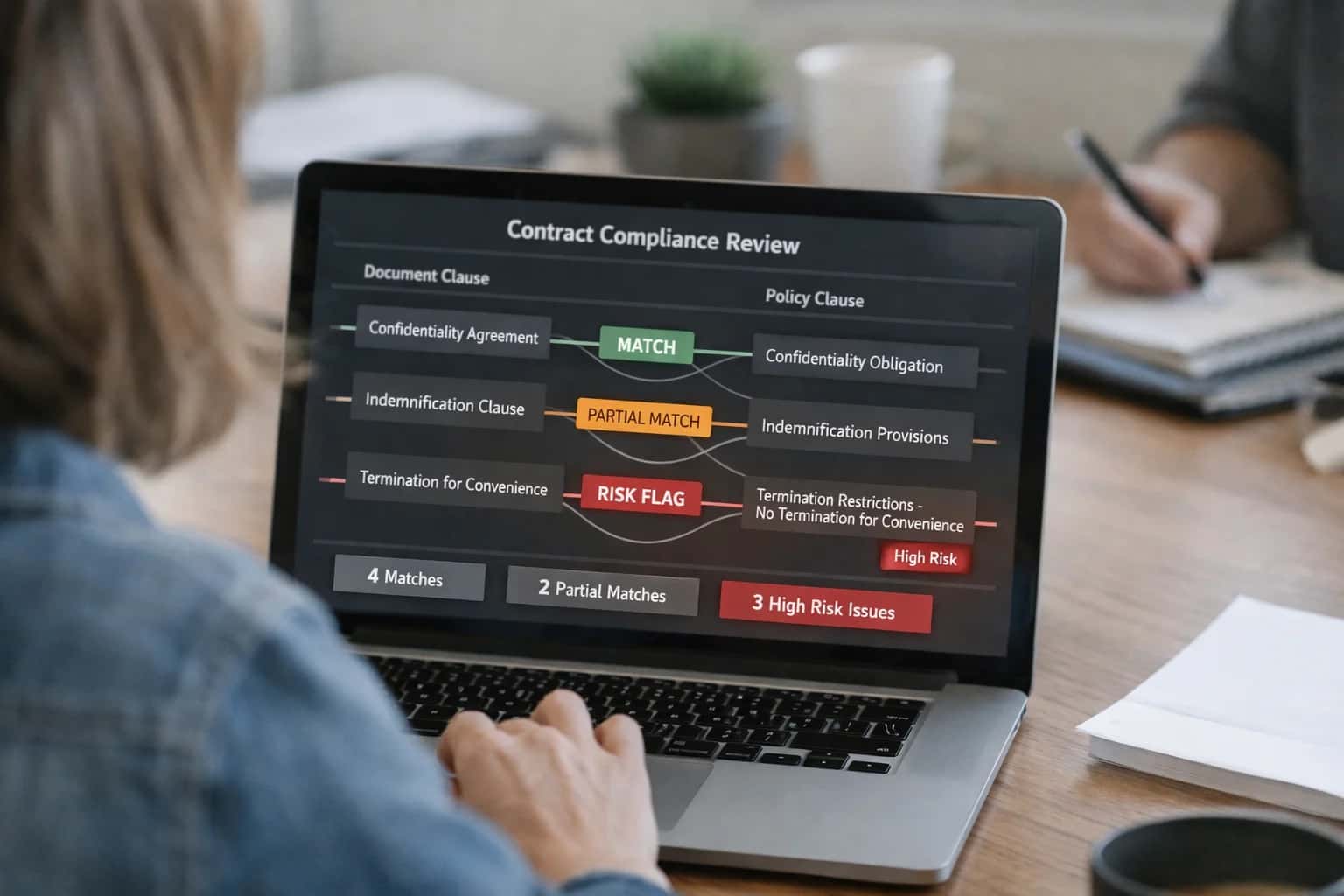
This table illustrates the practical, measurable improvements in security, efficiency, and audit readiness when integrating AI into a CLM platform within a SOC2-controlled environment. Impacts are based on typical enterprise implementations with governance guardrails.
| Workflow / Metric | Before AI (Manual/Semi-Automated) | After AI (Assisted/Automated) | SOC2 & Governance Notes |
|---|---|---|---|
Initial Contract Review & Triage | Legal team reviews 100% of inbound contracts; 2-5 business days for routing | AI pre-screens & routes 70-80% of standard agreements (e.g., NDAs); same-day assignment for exceptions | All AI actions logged with user, timestamp, and rationale. Human-in-the-loop required for final approval on exceptions. |
Key Clause Extraction & Metadata Population | Paralegal or analyst manually reads to extract parties, dates, terms; 30-60 minutes per contract | AI auto-extracts with 90%+ accuracy; metadata populated in <2 minutes; human validation spot-check | Extraction model outputs are versioned. PII/PHI redaction occurs before processing. Data lineage is tracked for audit. |
Obligation Identification & Tracking Setup | Manual reading and spreadsheet entry for milestones, reports, renewals; often missed or inconsistent | AI identifies obligations with high recall; creates tracked tasks in CLM or project tools automatically | Obligation mapping rules are documented as part of SOC2 control objectives. Audit trail shows creation source (AI/human). |
Risk Flagging Against Playbook | Attorney compares draft against lengthy playbook document; high cognitive load, potential for oversight | AI scores deviation from approved positions in real-time; highlights high-risk clauses for attorney review | Playbook rules codified and version-controlled. AI risk scores are explainable (e.g., cites specific clause conflict). |
Contract Summarization for Business Teams | Attorney or sales ops creates a custom summary email; inconsistent format, adds to cycle time | AI generates consistent executive summary & term sheet upon upload; available immediately in record | Summaries are tagged as 'AI-generated' and stored as system artifacts. Original document remains the source of truth. |
Renewal Forecasting & Alerting | Manual calendar reminders or spreadsheet tracking; often reactive, leading to missed opt-out windows | AI analyzes terms & usage data to predict renewal likelihood and triggers alerts 90-120 days in advance | Forecasting logic and data sources are documented. Alerts are delivered via approved, logged channels (e.g., CLM, email). |
Audit Evidence Compilation | Manual collection of contract documents, approval chains, and change histories for auditor requests; weeks of effort | AI-assisted querying of repository with natural language; auto-compiles evidence packets with full audit trail | AI query logs are part of the audit trail itself. Compilation process follows defined, repeatable SOC2 control procedures. |
ARCHITECTING FOR SOC2 COMPLIANCE
Governance, Audit Trail, and Phased Rollout
A production-ready AI integration for Contract Lifecycle Management (CLM) platforms must be built with SOC2's trust principles—security, availability, processing integrity, confidentiality, and privacy—as first-class requirements.
In a SOC2 environment, every AI action on a contract must be logged to an immutable audit trail. This includes logging the raw document hash, the specific prompt or query sent to the LLM, the model's raw output, any human reviewer's changes, and the final system action (e.g., updating a Clause record in Ironclad or creating an Obligation task in Icertis). This traceability is critical for demonstrating processing integrity during audits. Access to the AI system itself must be governed by the CLM platform's existing Role-Based Access Control (RBAC), ensuring that only authorized legal, procurement, or sales ops personnel can trigger AI reviews or view AI-generated summaries for sensitive agreements.
A phased rollout is essential for managing risk and building trust. Start with a pilot on a low-risk, high-volume contract type like NDAs. In this phase, the AI acts as a copilot, suggesting extractions and summaries but requiring mandatory human review and approval before any metadata is committed to the CLM database. This "human-in-the-loop" gate provides a control point and generates valuable feedback data. Subsequent phases can introduce conditional automation, where the system auto-populates fields for contracts that score above a high-confidence threshold, but still routes exceptions and low-confidence results for review. The final phase might enable fully automated processing for specific, well-defined workflows, but only after rigorous validation against historical data and with continuous monitoring for model drift.
Governance extends to the AI models and data. For confidentiality and privacy, a secure proxy layer should redact sensitive Personally Identifiable Information (PII) or Protected Health Information (PHI) from contract text before it is sent to an external LLM API. For maximum control, consider deploying a private, fine-tuned model. All AI-generated content should be visually watermarked within the CLM UI (e.g., "AI-Assisted Summary"), and a clear rollback procedure must exist to revert any AI-suggested changes. This structured approach—combining granular audit logs, RBAC integration, a phased go-live, and data privacy controls—ensures your AI-CLM integration delivers intelligent automation without compromising on the compliance requirements that SOC2 certifies.
Enabling Efficiency, Speed & Accuracy
Intelligent Analysis, Decision & Execution
We build AI systems for teams that need search across company data, workflow automation across tools, or AI features inside products and internal software.
Talk to Us
Search across company data
Give teams answers from docs, tickets, runbooks, and product data with sources and permissions.
Useful when people spend too long searching or get different answers from different systems.
Enterprise searchRAGPermissions
Read more
Automate internal workflows
Use AI to route work, draft outputs, trigger actions, and keep approvals and logs in place.
Useful when repetitive work moves across multiple tools and teams.
AI agentsWorkflow automationGovernance
Read more
Add AI to products and internal tools
Build assistants, guided actions, or decision support into the software your team or customers already use.
Useful when AI needs to be part of the product, not a separate tool.
AI integrationDecision supportModel routing
Read moreSECURITY, AVAILABILITY, PROCESSING INTEGRITY, CONFIDENTIALITY, PRIVACY
FAQ: SOC2 Compliance for AI-CLM Integrations
Integrating AI into Contract Lifecycle Management platforms like Ironclad, Icertis, Agiloft, and DocuSign CLM introduces new data flows and processing layers. For SOC2 compliance, these integrations must be designed with the five trust service criteria in mind. Below are key questions for architects and security teams.
Sending raw contract text to a vendor API like OpenAI or Anthropic is a major confidentiality risk. The standard pattern is a multi-layered approach:
- Pre-Processing & Redaction: Before any external API call, implement a local redaction service using pattern matching or a small, locally-run model to strip PII, PHI, financial terms, and other sensitive identifiers. This can be done using a service like Microsoft Presidio or a custom rules engine.
- Secure Proxy & Logging: Route all LLM calls through a secure API gateway (e.g., Kong, Apigee) that enforces:
- Data Residency: Ensures calls only go to endpoints in approved geographic regions.
- Token & Cost Controls: Prevents runaway usage.
- Audit Logging: Logs metadata (document ID, user, timestamp, model used) without logging the full prompt or response content.
- Vendor BAAs: Ensure your LLM provider (e.g., Azure OpenAI, Google Vertex AI) signs a Business Associate Agreement (for HIPAA) or provides SOC2 Type II reports and contractual data processing terms that align with your requirements.
Example Payload to External API (Post-Redaction):
json{ "model": "gpt-4-turbo", "messages": [ { "role": "user", "content": "Summarize the key obligations for the [REDACTED] party in the following redacted clause text: 'The Provider shall deliver quarterly reports on [REDACTED] metrics by the 15th day following the quarter's end.'" } ], "temperature": 0.1 }

About the author
Prasad Kumkar
CEO & MD, Inference Systems
Prasad Kumkar is the CEO & MD of Inference Systems and writes about AI systems architecture, LLM infrastructure, model serving, evaluation, and production deployment. Over 5+ years, he has worked across computer vision models, L5 autonomous vehicle systems, and LLM research, with a focus on taking complex AI ideas into real-world engineering systems.
His work and writing cover AI systems, large language models, AI agents, multimodal systems, autonomous systems, inference optimization, RAG, evaluation, and production AI engineering.
LinkedIn
Limited slotsGet a Free AI Consultation
Partnered with leading AI, data, and software stack.





How We Work
Custom AI workflows for your Business
One-fit-all AI don't work for modern businesses. At Inferensys, we aim to understand your business & custom requirements; which we use to define most efficient agentic workflows, the data, and the tools for your business.
01
Review the use case
We understand the task, the users, and where AI can actually help.
Read more02
Pick the right approach
We define what needs search, automation, or product integration.
Read more03
Build the first useful version
We implement the part that proves the value first.
Read more04
Improve from there
We add the checks and visibility needed to keep it useful.
Read moreThe first call is a practical review of your use case and the right next step.
Talk to Us