An AI-powered batch record review system automates the verification of electronic batch records (EBRs), a critical but time-consuming Good Manufacturing Practice (GMP) requirement. By deploying specialized AI agents, you can validate data against the master formula, check for missing signatures, and flag out-of-spec results in real-time. This system integrates directly with your Manufacturing Execution System (MES) to provide immediate release decisions, drastically reducing manual review from hours to seconds while improving accuracy and data integrity.

Guide
Launching an AI-Powered Batch Record Review System
A technical guide to implementing an autonomous AI agent that reviews electronic batch records against master formulas, flags discrepancies using computer vision and NLP, and integrates with MES for real-time release decisions.
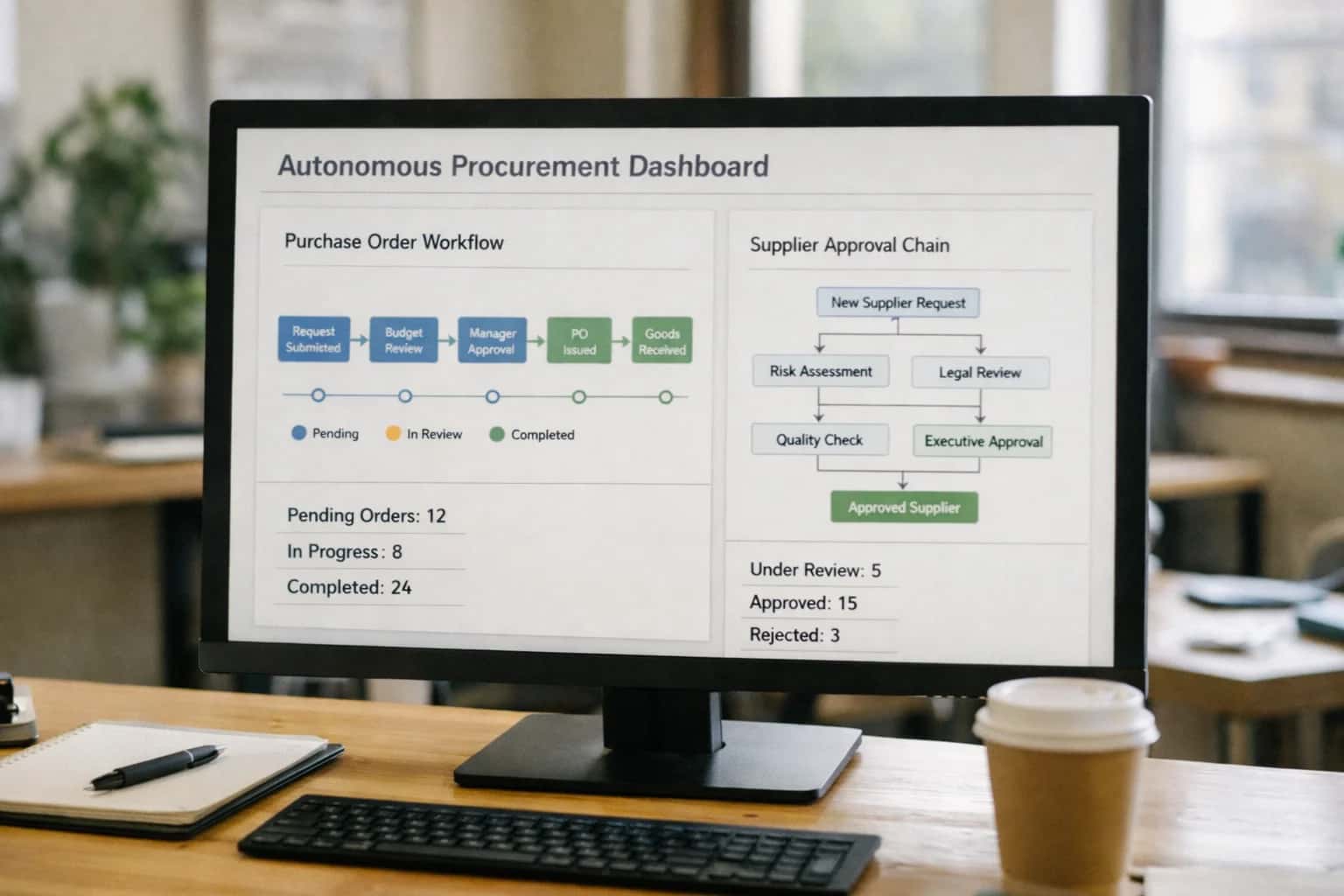
This guide details the implementation of an AI agent that automates the review of electronic batch records (EBRs) against master formulas and in-process controls.
Implementation requires a multi-agent architecture. A computer vision agent extracts and validates handwritten entries, while a natural language processing (NLP) agent parses text fields. A central orchestrator agent applies business rules, flags discrepancies for Human-in-the-Loop (HITL) review, and logs all decisions for audit trails compliant with FDA 21 CFR Part 11. This approach is a core component of a broader GMP compliance platform, enabling autonomous quality control and real-time release.
IMPLEMENTATION BLUEPRINT
Key Concepts: The Anatomy of an Automated Review
An AI-powered batch record review system automates the verification of electronic batch records (EBRs) against master formulas and quality controls. This guide breaks down its core technical components and integration points.
01
The Review Agent Core
This is the central AI agent that orchestrates the review. It executes a deterministic logic flow:
- Ingests the Electronic Batch Record (EBR) and Master Formula.
- Dispatches subtasks to specialized modules (e.g., for text, handwriting, calculations).
- Aggregates results and applies business rules to make a release decision.
- Flags discrepancies, missing data, or out-of-spec results for human review. Its design follows principles of Multi-Agent System (MAS) Orchestration, ensuring reliable, auditable task execution.
02
Computer Vision for Handwritten Entries
Handwritten data on paper logs is a major bottleneck. This module uses Computer Vision Sensing and Dynamic Interpretation to:
- Digitize handwritten text and checkmarks from scanned or photographed documents.
- Validate entries against acceptable ranges and expected formats.
- Extract signatures and verify their presence against a trained database. Integration with the MES allows for real-time capture via station cameras, turning analog data into structured, reviewable inputs.
03
NLP for Structured Text Fields
Structured text fields (like comments, material lot numbers) require semantic understanding. This module employs Natural Language Processing (NLP) and Entity Recognition:
- Parses free-text fields for key entities (e.g., equipment IDs
EQP-123, material codes). - Checks for deviations from standard operating procedure (SOP) language.
- Validates cross-references between fields (e.g., does the cleaning log referenced exist?). This moves validation beyond simple regex to context-aware checks, a form of Context Engineering.
04
Calculation & Trend Analysis Engine
Batch records contain calculations (yields, efficiencies) and time-series data (temperatures, pressures). This engine performs:
- Automated Arithmetic Verification: Recalculates yields and material usage from raw data.
- Statistical Process Control (SPC): Applies control charts to in-process measurements to detect out-of-trend (OOT) results before they become out-of-specification (OOS).
- Limit Checking: Flags any value exceeding pre-defined specification limits. This transforms raw data into actionable process intelligence.
05
MES & QMS Integration Layer
The system's value is unlocked by deep integration. This layer connects to:
- Manufacturing Execution System (MES): Pulls real-time EBR data and pushes review status and release decisions.
- Quality Management System (QMS): Automatically creates Deviation records for flagged issues, linking them directly to the batch record.
- Electronic Document Management System (EDMS): Retrieves the latest versions of master formulas and SOPs for comparison. This creates a closed-loop system, a key goal of Autonomous Workflow Design.
06
Human-in-the-Loop (HITL) Governance
Full autonomy is not the goal; controlled augmentation is. This subsystem defines Human-in-the-Loop (HITL) Governance Systems:
- Sets Confidence Thresholds: Only high-confidence passes/fails are auto-approved. Ambiguous cases are routed to a human reviewer.
- Provides Explainable Traces: For every flag or decision, the system provides a clear reasoning trail (e.g., 'Signature missing from page 3, per SOP-456').
- Maintains an Audit Log: Every action, automated or human, is logged with a timestamp and user/agent ID for 21 CFR Part 11 compliance. This ensures the AI acts as a force multiplier under human oversight.
FOUNDATIONAL BLUEPRINT
Step 1: Design the System Architecture
The first step in launching an AI-powered batch record review system is to design a robust, modular architecture that ensures reliability, scalability, and compliance with GMP regulations.
Your architecture must separate concerns into distinct layers: a data ingestion layer to connect with your Manufacturing Execution System (MES) and other sources like LIMS, a processing core with specialized AI agents for computer vision (handwritten entries) and NLP (text fields), and an orchestration layer to manage the workflow. This modular approach, similar to principles in our guide on Multi-Agent System (MAS) Orchestration, allows for independent scaling and maintenance of each component while ensuring data flows securely and audit trails are preserved.
Key design decisions include choosing between a microservices or serverless pattern for agent deployment, defining API contracts for system integration, and implementing a Human-in-the-Loop (HITL) governance interface for flagged discrepancies. This architecture directly supports the goal of real-time release decisions by creating a clear pipeline from raw batch record data to a validated, actionable output. For a deeper dive into compliance-specific platform design, see our guide on How to Architect an AI-Powered GMP Compliance Platform.
BATCH RECORD REVIEW IMPLEMENTATION
Tool Stack Comparison for Pharma AI
A comparison of core technology options for building an AI-powered batch record review system, focusing on compliance, integration, and performance.
| Feature / Metric | Custom Python + Open-Source | Enterprise MLOps Platform | Specialized Pharma AI Suite |
|---|---|---|---|
21 CFR Part 11 Compliance | |||
MES / LIMS Integration Effort | High (Custom APIs) | Medium (Connectors) | Low (Pre-built) |
Handwriting (CV) Accuracy |
| ~98% (Generic) |
|
NLP for Text Field Review | |||
Real-Time Release Decision Latency | < 2 seconds | < 5 seconds | < 1 second |
Audit Trail Granularity | Fully Customizable | Platform-Defined | Pre-configured for GMP |
Implementation Timeline | 6-9 months | 3-6 months | 1-3 months |
Annual Total Cost of Ownership | $150K - $300K | $500K - $1M+ | $250K - $600K |
Enabling Efficiency, Speed & Accuracy
Intelligent Analysis, Decision & Execution
We build AI systems for teams that need search across company data, workflow automation across tools, or AI features inside products and internal software.
Talk to Us
Search across company data
Give teams answers from docs, tickets, runbooks, and product data with sources and permissions.
Useful when people spend too long searching or get different answers from different systems.
Enterprise searchRAGPermissions
Read more
Automate internal workflows
Use AI to route work, draft outputs, trigger actions, and keep approvals and logs in place.
Useful when repetitive work moves across multiple tools and teams.
AI agentsWorkflow automationGovernance
Read more
Add AI to products and internal tools
Build assistants, guided actions, or decision support into the software your team or customers already use.
Useful when AI needs to be part of the product, not a separate tool.
AI integrationDecision supportModel routing
Read moreTROUBLESHOOTING
Common Mistakes
Launching an AI-powered batch record review system is a high-stakes technical project. These are the most frequent architectural and implementation pitfalls that cause delays, compliance failures, or system rejection.
This failure stems from treating Computer Vision (CV) as a simple OCR problem. Handwritten entries in batch records have extreme variability in ink, pressure, and form factor.
The fix is a multi-model CV pipeline:
- Pre-processing: Use image correction (deskew, contrast enhancement) specific to scanned paper or tablet screens.
- Specialized Models: Deploy separate, fine-tuned models for printed text, handwritten digits, and cursive signatures. A model trained on typed forms will fail on handwriting.
- Contextual Verification: Cross-reference the recognized value against the expected data type from the Master Formula. If the field requires a numeric temperature, reject an alphabetic string.
Without this pipeline, your system will have critical blind spots, leading to unreviewed discrepancies.

About the author
Prasad Kumkar
CEO & MD, Inference Systems
Prasad Kumkar is the CEO & MD of Inference Systems and writes about AI systems architecture, LLM infrastructure, model serving, evaluation, and production deployment. Over 5+ years, he has worked across computer vision models, L5 autonomous vehicle systems, and LLM research, with a focus on taking complex AI ideas into real-world engineering systems.
His work and writing cover AI systems, large language models, AI agents, multimodal systems, autonomous systems, inference optimization, RAG, evaluation, and production AI engineering.
LinkedIn
Limited slotsGet a Free AI Consultation
Partnered with leading AI, data, and software stack.





How We Work
Custom AI workflows for your Business
One-fit-all AI don't work for modern businesses. At Inferensys, we aim to understand your business & custom requirements; which we use to define most efficient agentic workflows, the data, and the tools for your business.
01
Review the use case
We understand the task, the users, and where AI can actually help.
Read more02
Pick the right approach
We define what needs search, automation, or product integration.
Read more03
Build the first useful version
We implement the part that proves the value first.
Read more04
Improve from there
We add the checks and visibility needed to keep it useful.
Read moreThe first call is a practical review of your use case and the right next step.
Talk to Us