A self-auditing Quality Management System (QMS) is an autonomous AI platform that continuously monitors documentation, training records, and process data to identify non-conformances and control gaps. It moves beyond static checklists to implement agentic workflows where specialized AI agents—like a scanner, an analyzer, and a scheduler—collaborate to perform audits, schedule follow-up actions, and track closure. This creates a closed-loop system for quality assurance, directly linking to our guide on How to Architect an AI-Powered GMP Compliance Platform.

Guide
How to Architect a Self-Auditing Quality Management System (QMS)
A technical guide to designing and implementing an autonomous QMS that performs continuous internal audits using AI agents. You will build agents to scan documentation, identify non-conformances, schedule actions, and generate audit reports, creating a closed-loop system for GMP compliance.
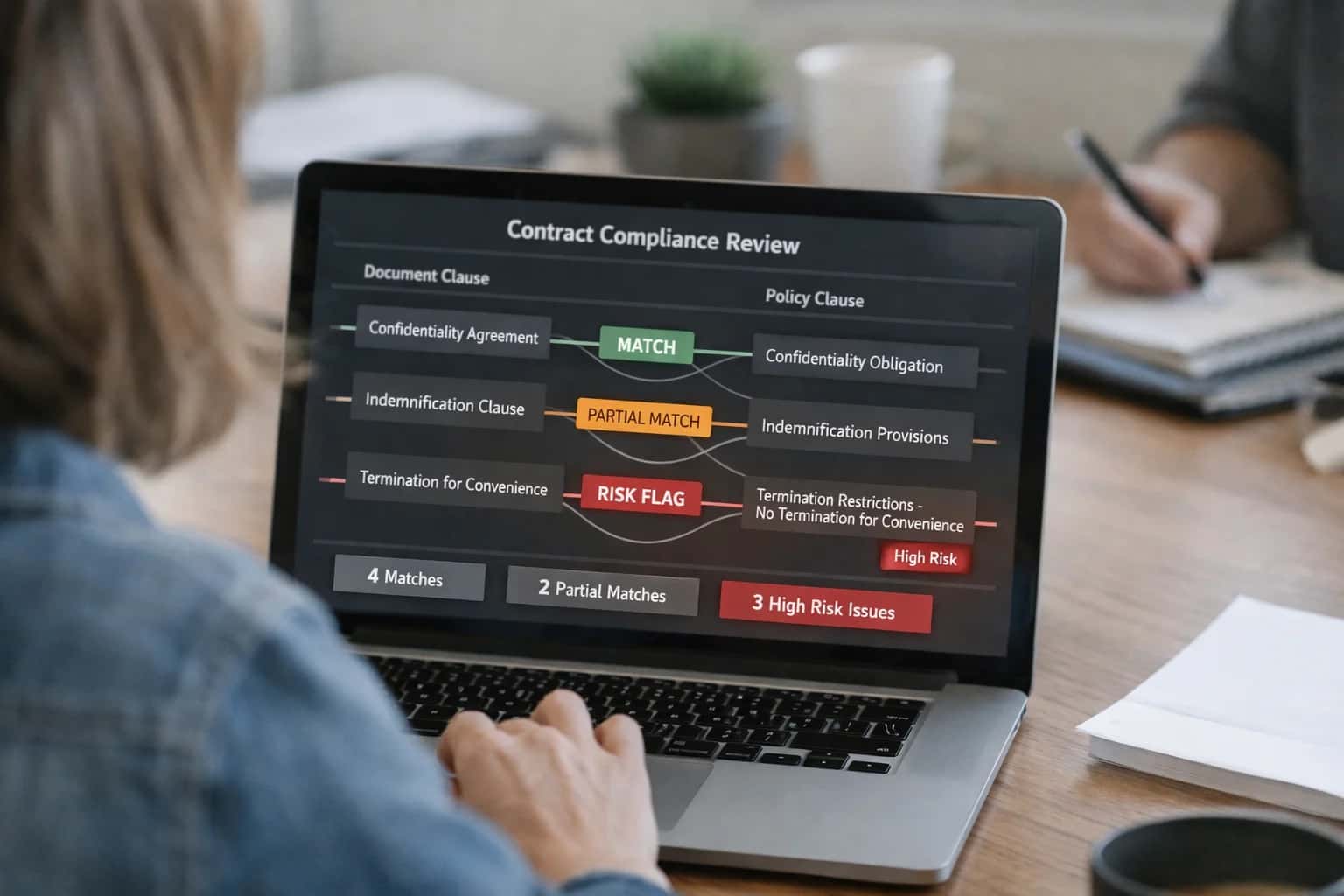
This guide explains the core principles for designing an autonomous QMS that performs continuous internal audits against GMP regulations.
The architecture requires integrating with data sources like LIMS and MES, implementing real-time monitoring agents, and designing auditable logic flows. You will build agents that scan for deviations, auto-generate findings, and route corrective actions, ensuring perpetual inspection readiness. This foundational approach to autonomous workflow design is critical for reducing manual overhead and is a key component of broader Regulatory Intelligence and Pharma Compliance Automation.
ARCHITECTURAL FOUNDATIONS
Key Concepts for a Self-Auditing QMS
A self-auditing QMS is an autonomous system of AI agents that continuously monitors processes, documents, and data against GMP rules. These are the core technical concepts required to build one.
01
Agentic Workflow Orchestration
This is the nervous system that coordinates specialized AI agents (auditors, investigators, reporters) to perform complex, multi-step audits without human intervention. You implement a central orchestrator that:
- Defines audit triggers (e.g., new batch, SOP update).
- Routes tasks between agents based on context and outcome.
- Manages state and handoffs to ensure a closed-loop audit cycle. Without this orchestration, you have isolated scripts, not a cohesive autonomous system. This relates directly to principles of Multi-Agent System (MAS) Orchestration.
02
Regulatory Knowledge Graph
A self-auditing system needs a machine-readable map of regulations (e.g., 21 CFR Part 211), internal SOPs, and their relationships. This semantic layer enables agents to reason about compliance.
- Entities: Regulations, clauses, documents, equipment, personnel.
- Relationships:
SOP-123references> CFR-211.22,Batch-456produced_by> Reactor-A. - Agents query this graph to understand which rules apply to a given process or document change. Building this is a core exercise in Context Engineering and Semantic Alignment.
03
Autonomous Evidence Gathering
Audit agents must autonomously collect and verify evidence from disparate systems. This requires agentic RAG and API integrations.
- Multi-Hop Retrieval: An agent queries the Document Management System for a procedure, then the Training Records system to verify personnel certification.
- Source Verification: Agents cross-reference data points (e.g., a batch record entry against LIMS results) to flag inconsistencies.
- This moves beyond simple search to autonomous, fact-checking investigation, a key capability of Agentic Retrieval-Augmented Generation (RAG).
04
Dynamic Risk-Based Scheduling
Instead of a fixed annual audit schedule, the system uses a predictive engine to dynamically prioritize what to audit and when.
- Inputs: Historical deviation rates, process complexity, supplier performance, recent changes.
- Output: A continuously updated audit calendar that allocates agent resources to the highest-risk areas.
- This transforms compliance from a calendar-driven activity to a real-time, data-driven function, aligning with the proactive approach of a Predictive Compliance Risk Engine.
05
Closed-Loop Corrective Action (CLCA)
Finding a non-conformance is only half the audit. The system must automatically initiate and track remediation.
- Upon a finding, the orchestrator triggers a CAPA workflow agent.
- The agent generates investigation tasks, assigns owners, and monitors deadlines.
- It verifies closure evidence and re-audits the area to confirm effectiveness.
- This creates a true self-healing quality system, a practical application of Autonomous Workflow Design and Logic Routing.
06
Explainable Audit Trail Generation
For regulatory acceptance, every autonomous audit decision must be traceable and explainable. The system generates a human-readable audit trail that includes:
- Reasoning Path: Which rules were evaluated, what evidence was found, and the logic for the finding.
- Evidence Links: Direct pointers to source documents, data logs, and personnel records.
- This transparency is non-negotiable for high-stakes GMP environments and is a core requirement of Explainability and Traceability for High-Risk AI.
FOUNDATION
Step 1: Define Audit Scope and Data Model
The first step in architecting a self-auditing QMS is to precisely define what will be audited and how the data will be structured. This creates the single source of truth for all autonomous agents.
Begin by mapping the audit scope against GMP regulations like 21 CFR Part 211. Identify the critical quality elements your system must monitor: - Document control - Training records - Deviation reports - CAPA logs - Equipment calibration. This scope determines the data your agents will need to access and analyze. A clearly bounded scope prevents agent sprawl and ensures the system focuses on high-risk compliance areas, which is a core principle of autonomous workflow design.
Next, design a unified data model that normalizes information from disparate sources like your LIMS, MES, and document management system. Define entities (e.g., Document, TrainingEvent, Deviation) and their relationships. This model acts as the agent's world view, enabling consistent reasoning. For example, a Deviation entity should link to related CAPA and Investigation records. A robust model is the backbone for agentic RAG systems that will later retrieve and cross-reference this data to identify non-conformances.
CORE ARCHITECTURAL COMPONENTS
Agent Responsibility Matrix
Defines the roles, triggers, and responsibilities of each autonomous agent within a self-auditing QMS, ensuring clear separation of duties and closed-loop control.
| Agent | Primary Trigger | Core Responsibility | Success Metric | Escalation Path |
|---|---|---|---|---|
Audit Scheduler | Calendar-based (e.g., quarterly) or risk-score threshold | Generates and dispatches audit plans based on regulatory schedule and process criticality |
| Quality System Owner |
Document Scanner | New/updated SOPs, batch records, or training documents in the Document Management System | Parses documents for regulatory keyword compliance, missing signatures, and version control errors | < 0.1% false negative rate on critical fields | Document Control Agent |
Anomaly Detector | Real-time data stream from MES, LIMS, or environmental monitors | Applies statistical process control (SPC) and ML models to flag out-of-trend or out-of-specification events | Mean time to detection < 1 hour | Deviation Management Agent |
Root Cause Analyst | Open deviation or non-conformance record | Performs causal inference using historical data and process maps to identify probable root cause | Root cause accuracy > 85% per audit validation | CAPA Management Agent |
CAPA Management Agent | Approved root cause analysis report | Auto-generates corrective/preventive action plans, assigns owners, and tracks closure evidence | CAPA closure rate within deadline > 95% | Quality Management Review |
Report Generator | Audit completion or CAPA closure | Compiles findings, evidence, and action timelines into audit-ready reports per FDA/EMA templates | Report generation time < 5 minutes | N/A (Final Output) |
Compliance Verifier | Prior to any system change or batch release | Executes pre-defined checks against current GMP rules to verify state of compliance | 100% verification of critical checks before release | System Lockout / HITL Gate |
Enabling Efficiency, Speed & Accuracy
Intelligent Analysis, Decision & Execution
We build AI systems for teams that need search across company data, workflow automation across tools, or AI features inside products and internal software.
Talk to Us
Search across company data
Give teams answers from docs, tickets, runbooks, and product data with sources and permissions.
Useful when people spend too long searching or get different answers from different systems.
Enterprise searchRAGPermissions
Read more
Automate internal workflows
Use AI to route work, draft outputs, trigger actions, and keep approvals and logs in place.
Useful when repetitive work moves across multiple tools and teams.
AI agentsWorkflow automationGovernance
Read more
Add AI to products and internal tools
Build assistants, guided actions, or decision support into the software your team or customers already use.
Useful when AI needs to be part of the product, not a separate tool.
AI integrationDecision supportModel routing
Read moreARCHITECTURE PITFALLS
Common Mistakes
Building a self-auditing QMS is a complex integration of AI, data, and regulatory logic. These are the most frequent technical and design errors that undermine system autonomy, reliability, and compliance.
False positives erode trust and create alert fatigue. This typically stems from poorly engineered context and a lack of feedback loops.
Root Causes:
- Brittle Rule Matching: Using simple keyword searches (e.g., flagging any document with "deviation") instead of semantic understanding.
- Missing Domain Grounding: The agent lacks access to a structured knowledge graph of your SOPs, GMP regulations, and historical audit findings to interpret data correctly.
- No Human-in-the-Loop (HITL) Calibration: The system doesn't learn from user corrections. You must implement a feedback mechanism where QA personnel confirm or reject findings, using this data to fine-tune the agent's classification model.
Fix: Move from rules to a neuro-symbolic AI approach. Use a small language model (SLM) fine-tuned on your quality documents to understand intent, and pair it with symbolic logic that encodes explicit GMP rules (e.g., "training must be current before task execution"). Integrate this with our guide on Context Engineering and Semantic Alignment to build robust agentic context.

About the author
Prasad Kumkar
CEO & MD, Inference Systems
Prasad Kumkar is the CEO & MD of Inference Systems and writes about AI systems architecture, LLM infrastructure, model serving, evaluation, and production deployment. Over 5+ years, he has worked across computer vision models, L5 autonomous vehicle systems, and LLM research, with a focus on taking complex AI ideas into real-world engineering systems.
His work and writing cover AI systems, large language models, AI agents, multimodal systems, autonomous systems, inference optimization, RAG, evaluation, and production AI engineering.
LinkedIn
Limited slotsGet a Free AI Consultation
Partnered with leading AI, data, and software stack.





How We Work
Custom AI workflows for your Business
One-fit-all AI don't work for modern businesses. At Inferensys, we aim to understand your business & custom requirements; which we use to define most efficient agentic workflows, the data, and the tools for your business.
01
Review the use case
We understand the task, the users, and where AI can actually help.
Read more02
Pick the right approach
We define what needs search, automation, or product integration.
Read more03
Build the first useful version
We implement the part that proves the value first.
Read more04
Improve from there
We add the checks and visibility needed to keep it useful.
Read moreThe first call is a practical review of your use case and the right next step.
Talk to Us